
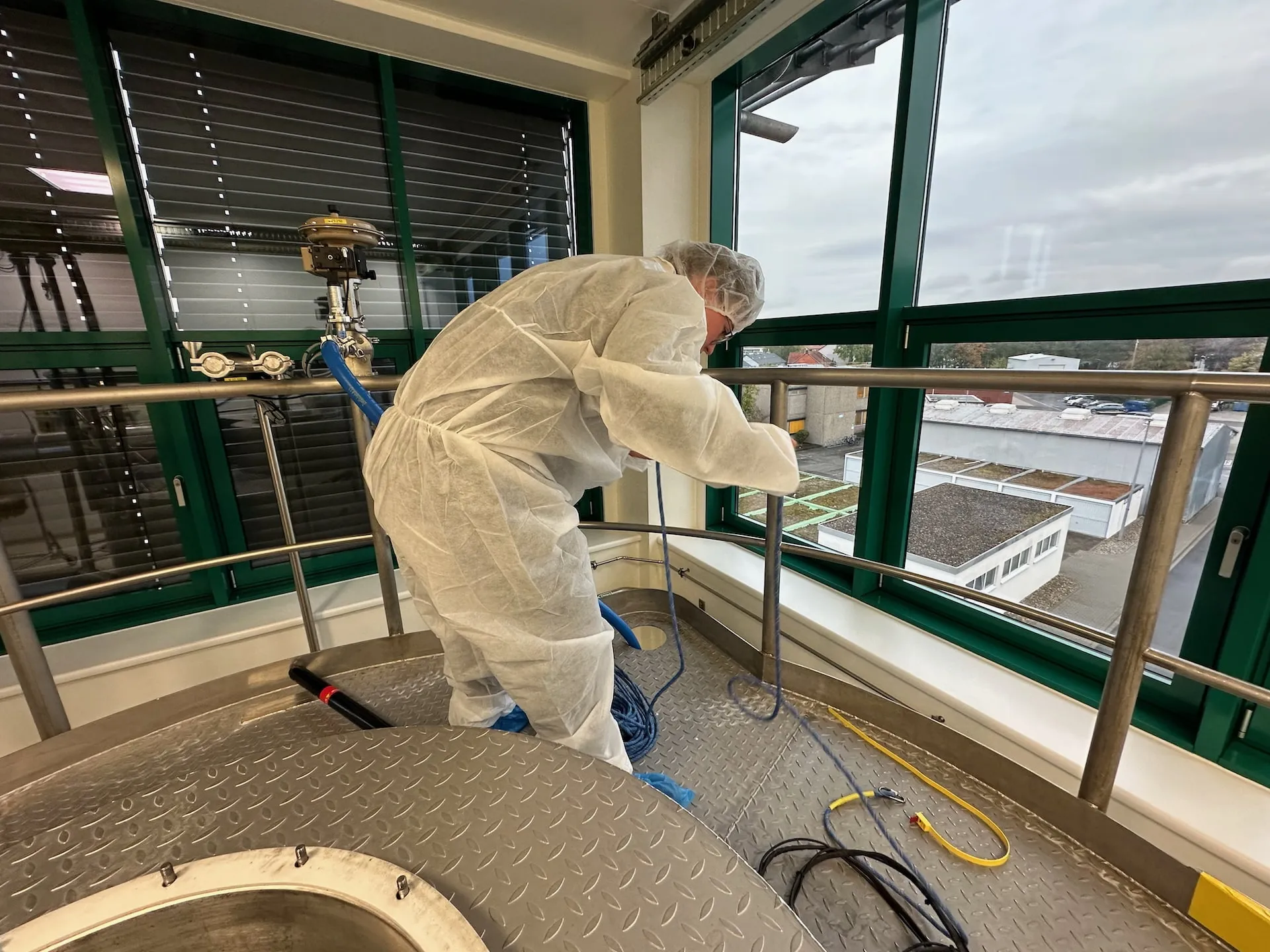
Drone Inspection: Pharmaceutical Industry – Contamination-Free, GMP-Compatible
Cleanrooms, reactors, mixing vessels, WFI tanks and HVAC systems – inspected without personnel entry, with drastically reduced contamination risk, using 4K video, thermography and LiDAR. The Flyability ELIOS 3 enables inspection under strict GMP conditions – without cleanroom suits, airlock procedures or requalification.
Request inspection
What we inspect in the pharmaceutical industry
Pharmaceutical production facilities are subject to the most stringent hygiene regulations. We inspect all critical assets – contamination-free, without personnel entry, without compromising cleanroom quality:
Cleanrooms & GMP Zones
Cleanrooms classes A–D, sterile production environments, isolators – document ceilings, walls, ventilation outlets and HEPA filters. No contamination risk from personnel.
Reactors & Mixing Vessels
Pharmaceutical reactors, stirred vessels, mixing tanks – check enamel coatings, linings, agitators. Without entry, without contamination risk for the next batch.
WFI Tanks & Storage Tanks
Water-for-Injection tanks (WFI), API storage vessels, buffer tanks – document internal surfaces, weld seams, surface finish. Without personnel entry, without contamination.
HVAC & Ventilation Ducts
Ventilation ducts, air handling units, supply/exhaust air ducts in cleanroom environments – document deposits, damage, filter conditions. Without dismantling.
Technical Floors & Plenum Spaces
Mezzanine floors above cleanrooms, filter ceilings from above, cable trays and media routing – no GMP risk, extremely difficult to access, complete inspection without aerial work platforms.
HVAC Ducts (technical areas)
Large ventilation ducts in technical areas outside active cleanroom zones – no GMP restrictions, no ATEX zones. Systematically record deposits, damage and insulation defects.
Technical Rooms & Utilities
Supply rooms for pure steam (Reinstdampf), WFI systems, cooling water and technical media. Early detection of corrosion, leaks and damage to pipework and valves.
Exhaust Systems after Process
Exhaust air runs after filter stages, outside safety-critical zones. Document deposits, corrosion and structural damage in often-underestimated exhaust ducts.
Pharmaceutical industry: contamination-free inspection under GMP conditions
The pharmaceutical industry operates cleanrooms, reactors, mixing vessels, WFI tanks and HVAC systems that must be regularly inspected for damage, corrosion and contamination. At the same time, GMP (Good Manufacturing Practice), FDA and EU-GMP Annex 1 impose the most stringent hygiene requirements of any industry – every inspection must not jeopardize cleanroom quality.
Classical inspections in sterile production environments require elaborate airlock procedures, cleanroom garments, decontamination and often multi-day shutdowns for cleaning and requalification. Every personnel entry into a cleanroom or vessel is a potential contamination risk for the production process.
The Flyability ELIOS 3 inspects cleanrooms, reactors, tanks and ventilation ducts – without personnel entry, with significantly lower contamination risk than conventional entry-based inspection. 4K video documents surface defects and condition, LiDAR captures geometry and spatial profiles. The drone is pre-decontaminated according to a protocol agreed with your QA team – the requalification effort after the inspection can thereby be substantially reduced.
What the ELIOS 3 documents in pharma
We inspect with the ELIOS 3 and systematically document all quality-relevant areas in pharmaceutical production facilities. Specialist assessment and GMP documentation are handled by your QA teams – we deliver the data:
| Area | What we document | Why it matters |
|---|---|---|
| Vessel walls, enamel coatings & surfaces | 4K footage of corrosion, enamel damage, cracks, surface roughness, deposits and coating defects in reactors and mixing vessels | Flawless internal surfaces are critical for product purity. Micro-cracks or coating damage can be contamination sources. Early detection prevents batch failures. |
| Cleanroom ceilings, walls & HEPA filters | Condition of ceiling panels, wall cladding, seals, HEPA filter frames, ventilation outlets, luminaires and media penetrations | Any defect in the cleanroom envelope can compromise the particle class. Drone inspection documents hard-to-reach ceiling areas without scaffolding and without additional personnel in the cleanroom. |
| WFI tanks & API vessels | Internal surfaces, weld seams, surface finish (Ra values visually), dead zones, valves and connections | WFI tanks and API vessels must have highest surface quality. Biofilm formation, corrosion or weld seam defects jeopardize water quality and product safety. |
| Ventilation ducts & HVAC systems | Duct internal surfaces, deposits, damage, insulation, dampers, seals and filter conditions | HVAC systems are the backbone of cleanroom qualification. Deposits or damage in ventilation ducts can be particle sources and jeopardize qualification. |
Challenges in the pharmaceutical industry
Cleanrooms, reactors, WFI tanks – sterile environments with the highest quality requirements. Every personnel entry = contamination risk + airlock procedures + requalification. ELIOS 3 inspects without personnel entry – with drastically reduced contamination risk, with 4K + thermography + LiDAR.
- Contamination risk from personnel entry: Every person in the cleanroom or vessel introduces particles. Airlock procedures, cleanroom garments, decontamination – enormous effort. ELIOS 3 flies in without personnel – prepared for cleanroom use, with significantly lower contamination risk.
- Requalification after inspection = days of downtime: After every intervention in cleanrooms or vessels: cleaning, particle counting, requalification. Every hour = production loss and documentation effort. Drone minimizes downtime to hours.
- Complete documentation for GMP audits: 4K footage, thermography and LiDAR 3D models provide objective, reproducible inspection data – as a basis for your GMP documentation and FDA audits.
- Particle control & cleanroom classes (ISO 5–8): Even the smallest particle input can endanger batches. Drone inspection reduces personnel presence and thereby particle introduction significantly.
- Validation and release processes (GMP): Every entry requires approvals, documentation and validation steps. Drones reduce interventions and can simplify release processes.
- Hard-to-reach areas in isolated systems: Isolators, closed systems and complex internals are barely accessible. ELIOS 3 enables visual access without opening large areas.
- Product adhesions & residues: Residues on walls or internals can impair processes and increase contamination risks. Drones identify critical areas quickly and specifically.
- Surface condition critical for CIP/SIP: Damaged surfaces promote adhesion and biofilm formation. 4K inspections make defects visible early.
- Documentation pressure at audits: FDA, EMA and internal audits demand traceable and reproducible data. Structured image and 3D data create reliable evidence.
- Downtime costs for high-value products: Production stoppages mean high economic losses per hour. Drone inspection minimizes interventions and accelerates inspections.
- Cross-contamination between batches: Insufficiently cleaned areas can lead to batch losses. Drones support visual verification of critical areas.
Typical inspections in the pharmaceutical industry
With the Flyability ELIOS 3 we inspect pharmaceutical production facilities contamination-free – without personnel entry, without particle load, with minimal downtime:
Cleanrooms & sterile production areas
Visual inspection of ceilings, walls, HEPA filters, ventilation outlets and media penetrations – without additional personnel in the cleanroom.
Sensors: Visual, LiDAR, Thermography
Typical findings: Damage to ceiling panels, defective seals, contaminated HEPA filters, cracks in wall cladding, leaks at penetrations
Pharmaceutical reactors & mixing vessels
Inspection of enamel coatings, linings, agitators and heating coils. Document surface defects that could be contamination sources.
Sensors: Visual, LiDAR, Thermography
Typical findings: Enamel damage, corrosion at weld seams, coating delamination, mechanical damage to agitators, product adhesions
WFI tanks & API storage vessels
Inspection of internal surfaces, weld seams and surface quality. Documentation of dead zones that could promote biofilm formation.
Sensors: Visual, LiDAR
Typical findings: Corrosion, roughness at weld seams, dead zones, biofilm adhesions, surface defects
HVAC ducts & ventilation systems
Inspection of supply and exhaust air ducts, dampers, insulation and filter areas without dismantling duct sections.
Sensors: Visual, LiDAR
Typical findings: Deposits, corrosion, damaged insulation, defective dampers, leaks
Storage tanks for pharma raw materials
Inspection of walls, floors and roofs in raw material storage tanks. Thermography detects leaks and insulation defects.
Sensors: Visual, LiDAR, Thermography
Typical findings: Corrosion, sediment deposits, leaks, coating damage, structural deformation
Technical floors & plenum spaces
Inspection of mezzanine floors above cleanrooms, filter ceilings from above and cable trays – no GMP risk, extremely difficult to access without aerial work platforms.
Sensors: Visual, LiDAR, Thermography
Typical findings: Corrosion at media routing, cable damage, soiling, damage to filter ceilings, moisture ingress
Your advantages as a pharmaceutical company
Drastically reduced contamination risk
No personnel in the cleanroom, no airlock procedures, no cleanroom garment effort. Contamination risk through inspection is significantly lower than conventional entry – provided the drone is prepared in a cleanroom-compatible manner.
Minimal downtime
Inspection in hours instead of days. No complex requalification after personnel entry – faster resumption of production.
Precise damage detection
Thermography shows leaks and insulation defects. LiDAR captures geometry. 4K video documents surfaces with the highest level of detail.
Cost savings up to 80%
Compared to conventional inspection with personnel entry, airlock procedures, cleaning and requalification – savings of up to 80% of costs.
GMP-compatible documentation
Objective, reproducible inspection data with 4K, LiDAR and thermography – as a basis for your GMP documentation and audits.
Reproducible inspections
Stored flight paths enable comparative inspections over years. Condition changes become measurable and fully documentable.
Minimally invasive
Opening systems means risk to sterility and validation. ELIOS 3 can be deployed via existing access points – minimally invasive and with reduced intervention in validated systems.
Repeatability & trend analysis
Conditions must be comparable over time (e.g. for qualification). Standardized drone flights enable genuine trend analyses across inspection cycles.
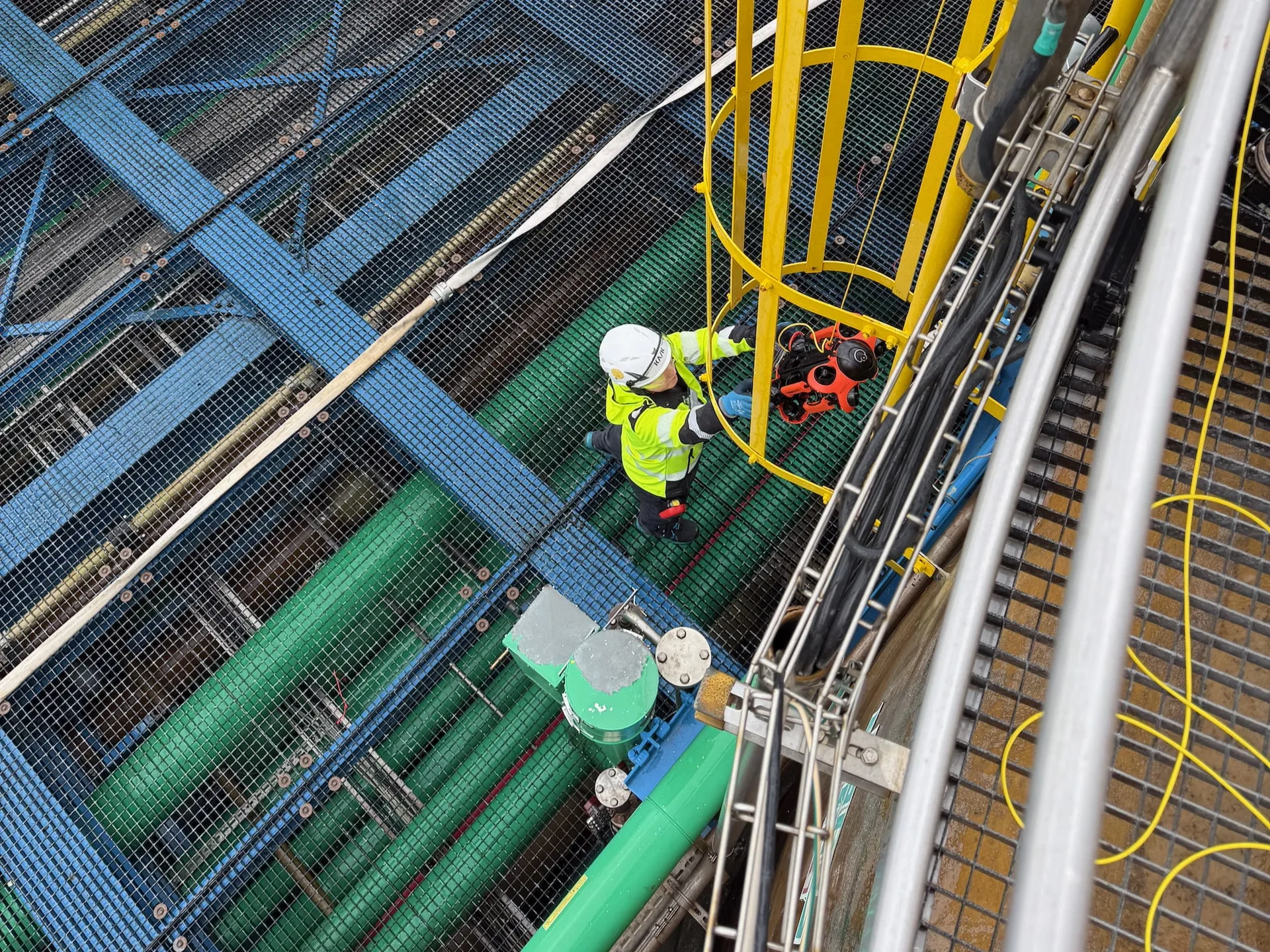
How the inspection works
-
Initial consultation
We analyze your requirements, GMP requirements and access conditions – and advise you free of charge on all technical and organizational questions. -
Scheduling & quotation
You receive a transparent quotation. Together we plan timing, access, cleanroom protocols and safety concept. -
On-site inspection
We carry out the inspection with state-of-the-art drone technology – contamination-free, usually within a few hours. -
Evaluation & inspection report
You receive a detailed report with 4K footage, 3D models, thermography analyses and systematic finding overview – as a basis for your GMP documentation.
Our team
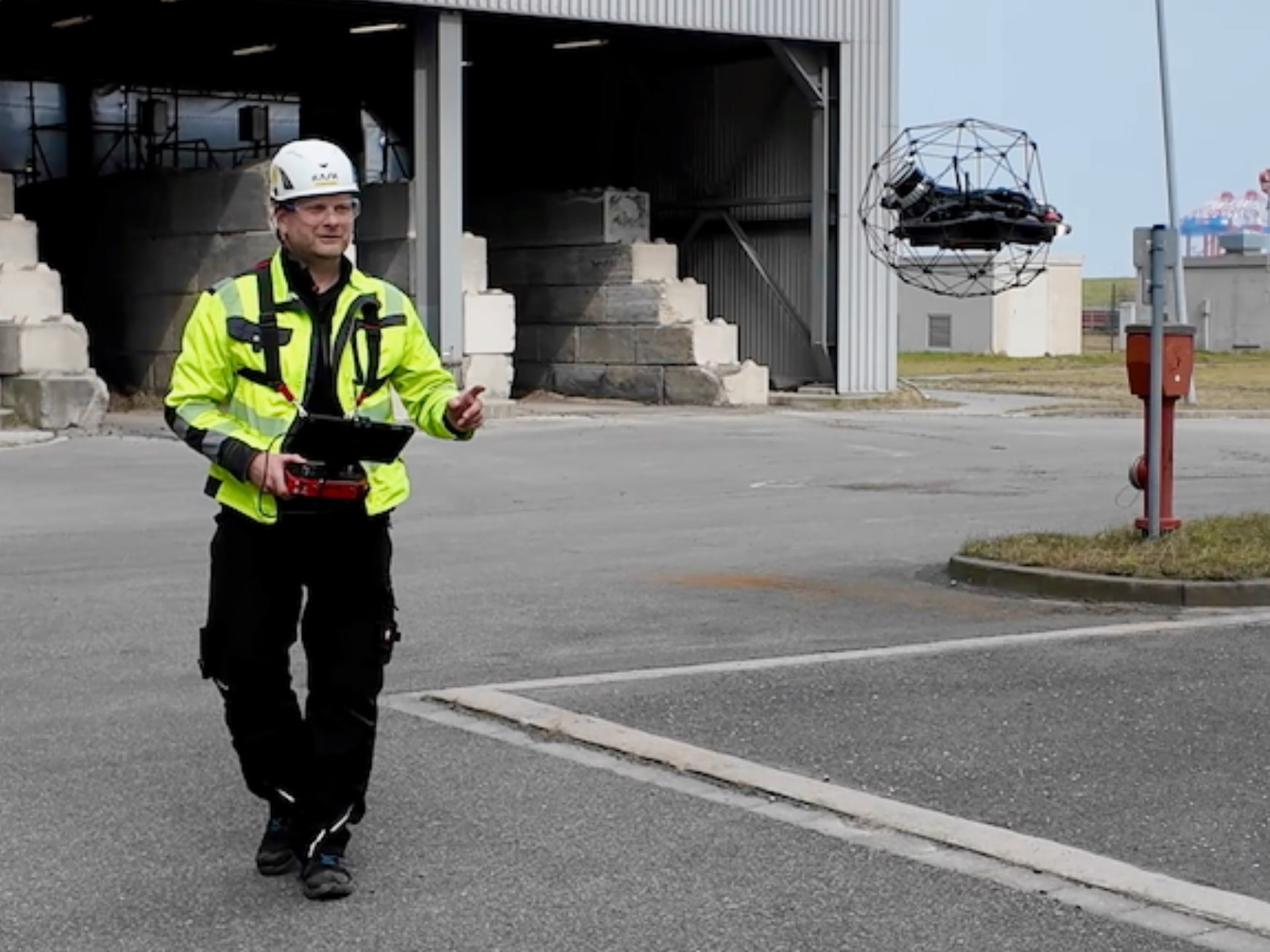
In operation since 2017 – experience from numerous inspections in complex industrial environments. We understand the special requirements of the pharmaceutical industry: highest hygiene standards, GMP-compatible documentation, minimal downtime.
Frequently asked questions – drone inspection in the pharmaceutical industry
Is drone inspection in the pharmaceutical industry GMP-compliant – and do authorities such as the FDA or EMA accept the results?
The drone is a data acquisition tool, not a regulated testing instrument. It provides 4K footage, thermography and LiDAR data as an objective documentation basis. Specialist assessment and GMP-compliant classification are handled by your QA teams within your existing documentation processes. In practice, drone-based inspection data is increasingly accepted by FDA and EU-GMP inspectors as valid visual documentation – provided that recordings are clearly localized, dated and reproducible.
Does the drone itself contribute to contamination – through particle abrasion, material abrasion or air turbulence?
The risk is real and must be carefully managed. Propeller abrasion, material particles from the cage and air turbulence from the rotor wind can be relevant in sensitive cleanroom areas. In practice this means: the drone is thoroughly cleaned before each deployment, decontaminated if necessary, and the flight takes place in coordinated corridors with defined speeds. In actively classified zones, particle counts before and after deployment are recommended. The overall risk is significantly lower than conventional personnel entry – but it is not zero, and this must be taken into account in the QA process.
What decontamination or sterilization protocol is applied to the Elios 3 before use in cleanrooms?
The protocol is individually agreed with your QA team, as requirements vary depending on cleanroom class and production conditions. Typical steps include cleaning with pharmaceutically suitable cleaning agents, isopropanol wipe disinfection of all accessible external surfaces and if necessary UV treatment. For Grade C/D areas a documented surface disinfection is generally sufficient. For more sensitive areas an extended protocol can be agreed. The drone is delivered in closed transport packaging and only brought into the cleanroom after completed decontamination.
What materials are the ELIOS 3 cage and propellers made of – and are they suitable for cleanroom use?
The ELIOS 3 cage is made of CFRP composite material (Carbon Fiber Reinforced Polymer), the propellers of glass fiber reinforced plastic. These materials are mechanically stable, can be cleaned with isopropanol and pharmaceutically suitable disinfectants and show no relevant material abrasion under normal use. Formal cleanroom certification to ISO 14644 is not available for the ELIOS 3 – for use in GMP environments, a risk assessment and approval by your QA team is required.
From which cleanroom class can drone inspection be used – and is Grade A possible?
Use in Grade C and D is well established in practice and achievable with documented cleaning protocol. Grade B is possible but requires a more elaborate preparation and monitoring protocol and coordination with the responsible QA manager. Grade A – i.e. critical aseptic processing zones with ISO 5 particle class – is fundamentally the most challenging case: here particle counting during flight and very close coordination with QA are absolutely required. Many operators choose a compromise approach for Grade A areas: inspection with production interrupted, followed by particle counting and requalification before resumption.
How well does the drone detect damage to HEPA filter frames and seals – is the resolution sufficient for fine cracks?
The ELIOS 3 delivers very good results with its 4K camera and 16,000 lumen LED lighting from close-up shots for visible damage: cracks in filter frames, loose or deformed seals, visible dirt or corrosion on mounts. Fine hairline cracks in sealing materials under 0.5 mm are difficult to detect visually – here a good approach angle and sufficient proximity (typically 30–60 cm) are crucial. The drone is not a replacement for a formal integrity test procedure (e.g. DOP test), but it provides a very efficient visual inspection and can document obvious defects and their location before a replacement is planned.
Can thermography in cleanrooms and HVAC systems detect leaks and temperature anomalies?
Yes, and this is one of the particularly useful applications. The thermal camera detects temperature differences at ventilation ducts (leaks, missing insulation), at heating coils in reactors (uneven temperature distribution), at cooling or heating circuits as well as at electrical components. Prerequisite: sufficient temperature difference between the medium and the environment. In HVAC systems this can for example be used to check whether ducts are evenly flowed through or whether leaks are present. Thermal documentation can be incorporated into the GMP report as a supplement to visual inspection.
What data does LiDAR provide – and how can it be used for a digital twin or requalification?
LiDAR captures a three-dimensional point cloud of the inspection object – for example the internal geometry of a reactor or cleanroom. This allows dimensional accuracy to be checked, deformations to be detected (e.g. deformation of vessel walls) and digital reference models to be created. For requalification a LiDAR scan can serve as a geometric reference. For the digital twin it provides the exact room dimensions relevant for process simulations and CFD models. Point clouds are delivered as .las/.laz or .ply files and can be further processed in CAD or BIM systems.
What does the 4K camera detect for enamel damage, micro-cracks and biofilm – where are the limits?
4K video with close-up shots and good illumination is very well suited to detect enamel damage from about 1–2 mm in size, document visible micro-cracks in coatings, identify discolorations or adhesions indicating biofilm and record corrosion trails, deposits and surface changes. Limits lie with very fine hairline cracks under 0.5 mm, defects in poorly accessible shadow zones (behind agitator internals, in narrow dead zones), and distinguishing biofilm from other adhesions, where microbiological sampling would be needed. The camera provides indications – specialist assessment remains with technical personnel.
How well can weld seams, Ra values and dead zones in WFI tanks and reactors be visually assessed?
Weld seams can be very well documented visually: corrosion, heat tint, cracks, inclusions and mechanical damage are detectable with good illumination and sufficient proximity. Ra values (surface roughness) can only be roughly assessed visually – a drone recording can indicate abnormalities but does not replace metrological roughness measurement with profilometers. Dead zones – i.e. poorly flowed areas with increased contamination risk – can be geometrically located and documented. Whether a dead zone is actually problematic depends on process and medium and requires assessment by your process engineers.
How long does a pharma drone inspection take including preparation and cleaning – what downtime must I plan for?
This depends strongly on facility, access conditions and protocol requirements. As indicative values: preparation (drone cleaning, decontamination, checking, safety briefing, coordination with QA) 1–2 hours; the flight itself for a medium-sized reactor or cleanroom area 30–90 minutes; final cleaning and handover 30–60 minutes. For a complex multi-part deployment (multiple vessels, cleanroom ceiling plus HVAC) one to two days is realistic. Compared to conventional entry with personnel entry, airlocks, cleaning and requalification this is a considerable time saving.
Must the cleanroom be requalified after drone inspection?
This depends on your SOPs, the cleanroom class and the specific procedure – blanket statements are not reliable here. In Grade C/D areas after documented cleanroom-compatible execution, requalification can often be omitted or reduced to a simplified particle count. In Grade A/B areas, a final particle count and release by QA is generally required. We agree the procedure with your QA team in advance and adapt protocol and execution so that the requalification effort is kept as low as possible.
In what format do you deliver inspection results – and how are findings localized?
Standard delivery includes: 4K video and individual images from the flight, thermography recordings with false-color display (if used), LiDAR point clouds (if used), a structured inspection report with marked findings and brief descriptions, and a finding overview with localization by facility, zone and position. Since GPS does not function indoors, localization is via facility designations, zone designations, compass directions, height specifications or coordinate systems in the CAD plan. On request we agree the report format in advance on your internal documentation structure.
Is the data audit-ready – can I present it at FDA or EU-GMP inspections?
Drone inspection data is well suited as objective, dated visual documentation – with structured finding overview, timestamp, recording location and technology used. They meet typical requirements for traceable inspection documentation. For formal audit-readiness in the sense of GMP qualification documents (e.g. as IQ/OQ/PQ component) integration into your documentation structure and approval by your QA managers is required. We deliver the raw data and reports – classification into your QM system is handled by you.
Can flight paths be stored and repeated for follow-up inspections – for trend monitoring over years?
Yes, this is one of the key advantages of the ELIOS 3 over conventional visual inspections. Flight paths, camera settings and inspection points are documented and can be reproduced at follow-up inspections. This enables direct visual comparisons: how has an enamel defect developed since the last inspection? Which areas show corrosion progression? For WFI tanks, reactors and HVAC systems with regular inspection intervals, this creates seamless, comparable condition documentation over the entire service life.
What happens if the drone touches a wall in the cleanroom or reactor – particle release and collision damage?
The ELIOS 3 cage is designed to tolerate light contacts – this is part of the safety concept and also applies outdoors. Light wall contacts rarely cause damage to the test object in practice. Particle release through contact is possible and depends on surface characteristics and impact energy. To minimize risk, flight speed is reduced in sensitive areas, adequate safety distances are maintained and the flight path is carefully planned in advance. In the event of unwanted contact the location is documented and reported to the QA team.
How much shorter is downtime with drone inspection compared to conventional personnel entry?
The difference is considerable. Conventional entry in a GMP environment typically comprises: coordination with QA and occupational safety, procurement and provision of cleanroom garments, airlock procedures, actual inspection, cleaning after exit, particle counting and requalification – frequently one to three days total effort. Drone inspection reduces this effort to typically a few hours. Concrete figures depend on facility, protocol requirements and cleanroom class – but savings of 60–80% of downtime are realistic in practice.
Do your pilots have GMP training or experience in pharmaceutical production environments?
Our pilots are specially prepared for deployments in pharma environments: they know the basic GMP requirements, cleanroom behavior, airlock protocols and documentation obligations. Formal GMP certification to a recognized training standard is not per se required, but is expected by some operators. We recommend clarifying this point early in the preparation meeting so that we can determine the appropriate preparation protocol for your site.
Are there references or case studies from the pharmaceutical industry – what facilities have already been inspected?
We have experience with inspections in pharmaceutical production facilities and can provide references or describe specific deployment examples on request. Due to the strict confidentiality requirements in the pharmaceutical industry, we mention customer names and locations only with explicit approval from the respective operator. What we can openly describe: reactor and vessel inspections in GMP-regulated environments, HVAC inspections in cleanroom buildings and visual inspections of WFI tanks and cleanroom ceilings. Contact us – we are happy to describe concrete cases in a confidential consultation.
How frequently do you recommend drone inspections for reactors, WFI tanks and HVAC in the pharmaceutical industry?
A blanket recommendation is difficult, as inspection intervals depend on facility age, production conditions, medium, GMP category, insurer requirements and internal inspection plans. As guidance: for WFI tanks and reactors, annual or biennial visual inspections are common in practice, often as part of planned shutdowns. HVAC systems in active cleanrooms are frequently inspected every one to two years. The drone is particularly well suited as a regular visual check between elaborate full maintenance cycles and as an incident-driven tool when damage is suspected or before GMP audits.