
Flyability Elios 1 vs. 2 vs. 3: 10 Years of Hands-On Experience
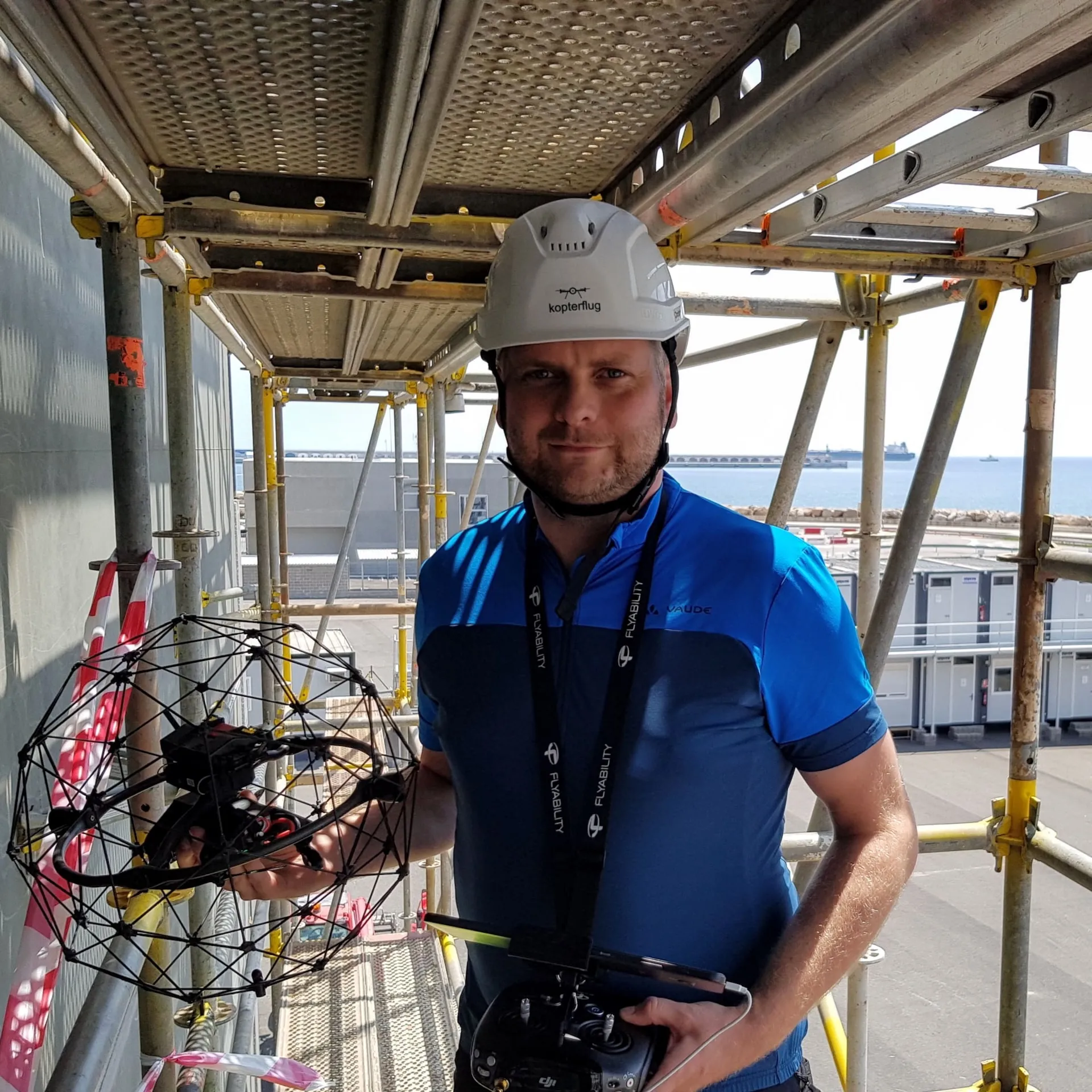
We have worked with all three Elios generations – from the pioneering Elios 1 since 2016, through the Elios 2 which we borrowed and intensively tested, to the Elios 3 as our daily workhorse. This is our honest field report from hundreds of real-world deployments.
- Elios 1 – our entry point since 2016, the foundation of our expertise
- Elios 2 – borrowed and tested for several weeks, not purchased
- Elios 3 – our daily workhorse since market launch – Vision + LiDAR fusion changed everything
We Were There: All Three Generations from First-Hand Experience
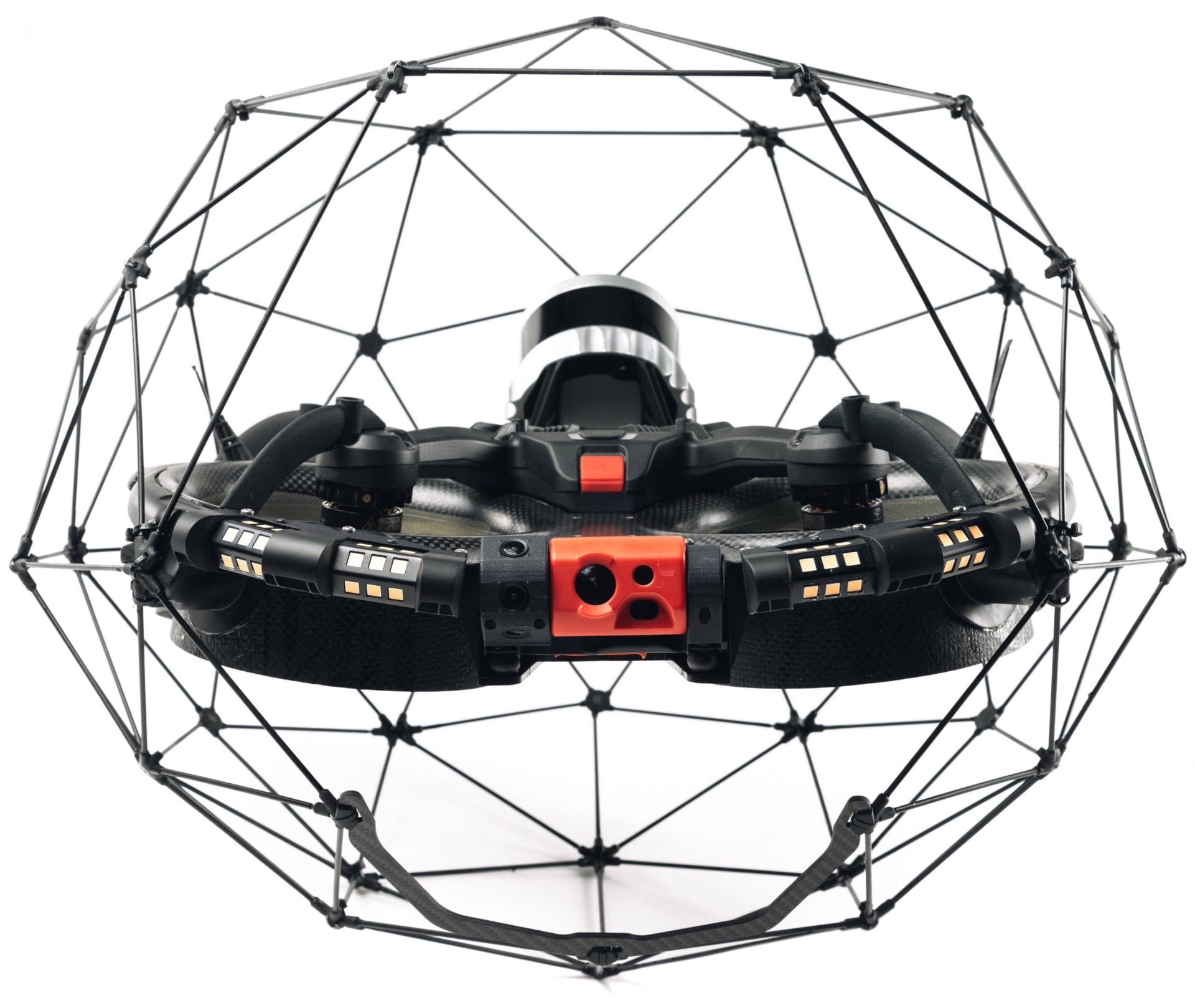
We have been flying Flyability Elios drones since 2016 – nearly 10 years of real-world deployment experience in confined spaces. Power plants, silos, sewers, tanks, shafts, reactor chambers – we have taken these drones everywhere that humans can no longer safely go.
We have witnessed the entire development first-hand: The Elios 1 as our door-opener, with which we started and built enormous expertise – one unit still stands in our office today. The Elios 2 we did not purchase but borrowed and intensively tested for several weeks. The Elios 3 is our current workhorse, deployed daily since market launch.
In the German-speaking market, there is hardly anyone who has worked as long and as intensively with all three generations. This is not a dry technical comparison – it is an honest field report: What truly advanced our work? And why is the Elios 3 the clear winner for us?

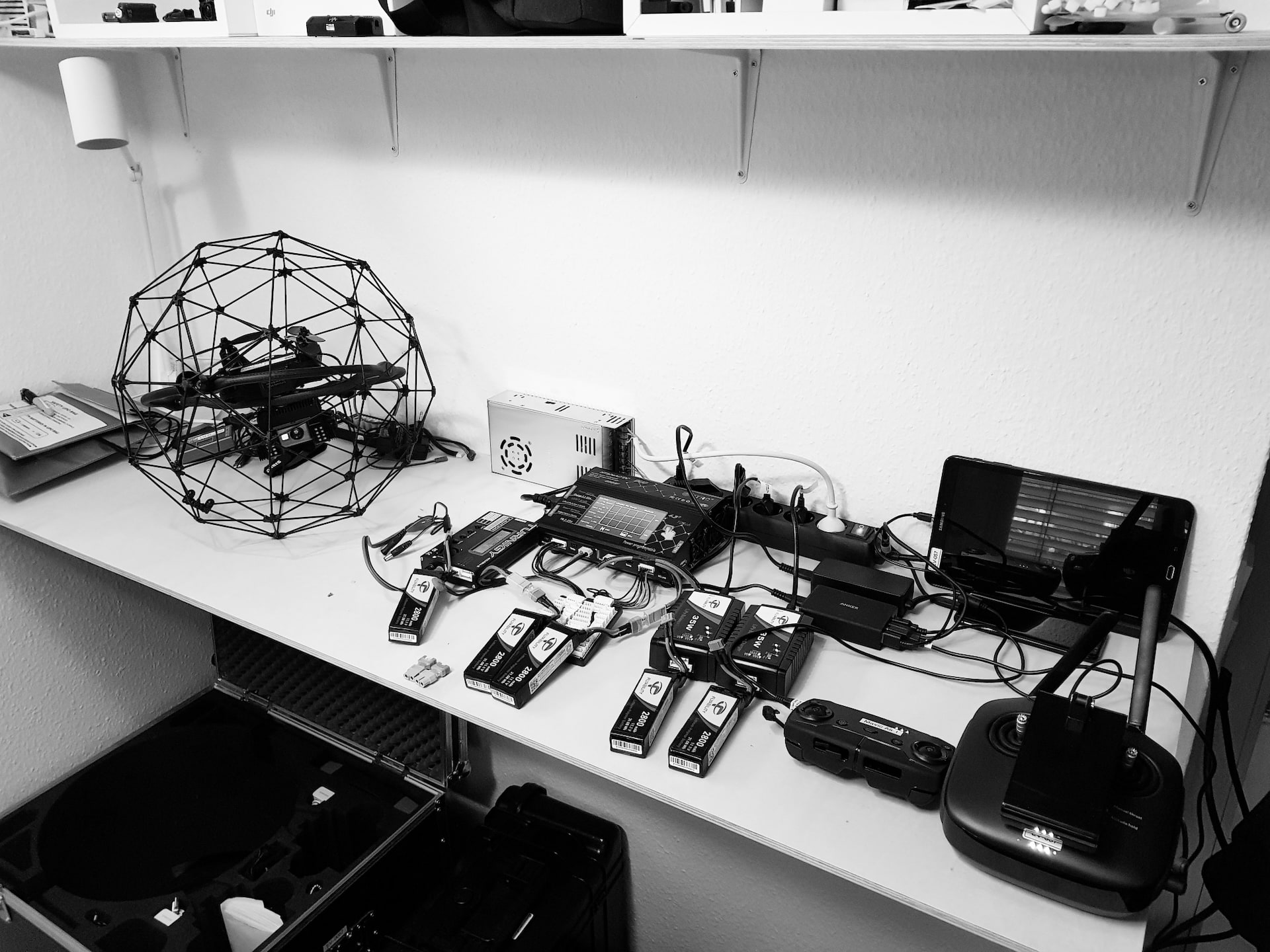
Flyability Elios 1 – our first confined spaces drone, charging before a deployment.
Elios 1 (2016): The Pioneer That Made Everything Possible
When the Elios 1 came to market, it was a genuine wow moment for us. Suddenly there was a drone that could deliberately fly in confined, dark and dangerous spaces – thanks to its patented, freely rotating carbon cage. The drone bounces off walls, rotates, and simply keeps flying. No GPS, no sophisticated electronics – just mechanical protection and a stabilised camera.
What we experienced in practice: Full HD camera, powerful LED illumination (up to 28 W), optional small thermal camera. Flight time approximately 10 minutes. No real electronic stabilisation – purely mechanical via the cage and basic sensors (IMU, barometer, magnetometer). You needed considerable feel, especially in turbulence or dusty conditions.
For us, the Elios 1 was the door-opener. We could suddenly inspect boilers, tanks and shafts without scaffolding and without rope access – keeping people out of high-risk zones. We built immense expertise with this drone, flew it in hundreds of missions and know every one of its quirks. One unit, incidentally, still stands in our office today – as a reminder of the beginning and a testament to how much has changed.


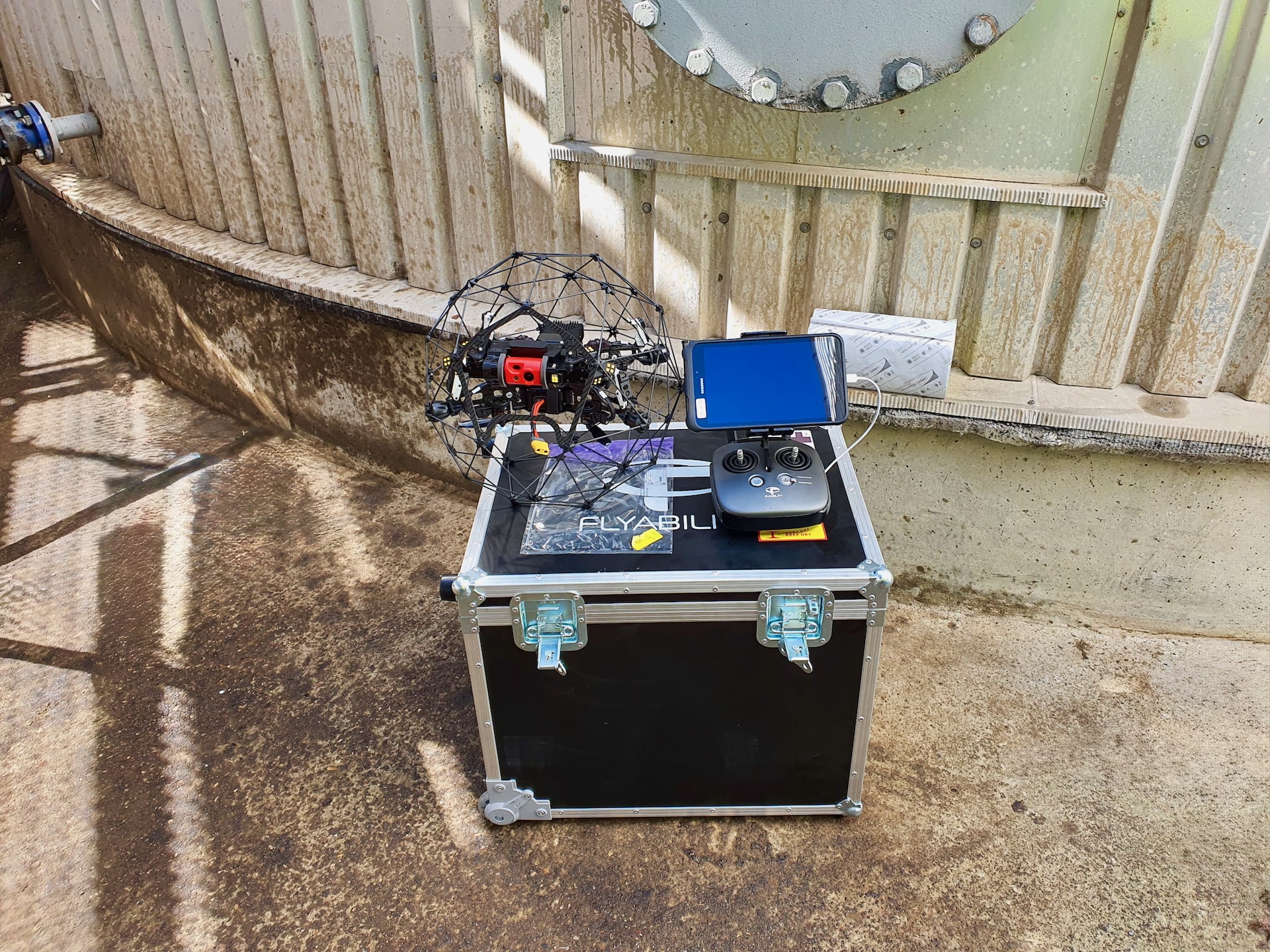
Flyability Elios 2 – tested by Kopterflug before a tank inspection deployment.
Elios 2 (2019): The Intermediate Step – Tested But Not Convincing
Three years later came the Elios 2. On paper, everything sounded better: 4K camera, smarter illumination with oblique mode, distance lock, and above all the vision stabilisation through multiple vision sensors.
We did not purchase the Elios 2 but only borrowed it and tested it intensively for several weeks. Honestly, it did not blow us away. The vision stabilisation made flying smoother and the drone could hold position better – especially in dark rooms. Image quality was noticeably improved. Still, it felt to us like a refinement of the existing, not the big leap forward.
Our concrete conclusion after testing: The vision system was relatively unreliable in practice – and the drone could not be manually controlled with true precision. Admittedly: in certain closely defined areas with clear structures, it flew remarkably well. But as soon as conditions became more challenging, we lacked the necessary confidence.
The core problem: The drone was still primarily a high-resolution flying camera. No real 3D mapping, no real spatial awareness in GPS-denied environments. The vision stabilisation worked well in well-lit or structured environments – in total darkness, dust or on homogeneous surfaces (smooth tanks), it could quickly lose orientation. In certain situations, we found the stabilisation compared to the mechanical reliability of the Elios 1 even less predictable.


Elios 3 (2022): Vision + LiDAR Fusion – The Real Quantum Leap
Then came the Elios 3 – and for us, this was the moment when a good inspection drone became a true professional data platform.
The decisive innovation: Fusion of Vision and LiDAR. Three VIO cameras (Visual Inertial Odometry) combined with the integrated Ouster LiDAR and the FlyAware™ SLAM engine. The result is a stabilisation unlike anything we had experienced before. The drone hovers almost rock-solid even in dust, darkness or light turbulence – even in completely smooth, featureless stainless steel tanks where the Elios 2 reached its limits.
Additionally: the modular payload bay with two ports (LiDAR, ultrasonic wall thickness measurement, radiation sensor and more), real-time 3D mapping with live position display, and the ability to create true digital twins.
What changed for us in daily practice: Previously, we flew and captured videos and photos. Today, we deliver precise 3D models with position data and measurements – reproducible, scalable and with significantly less pilot stress. The spatial awareness (“Where am I right now in the space?”) is an enormous difference. Even in unfamiliar facilities, we now work much more systematically and safely.



The Three Generations in Direct Comparison
Our honest practical comparison – not the marketing sheet, but what we actually experienced:
| Feature | Elios 1 | Elios 2 | Elios 3 |
|---|---|---|---|
| Stabilisation & Navigation | Purely mechanical (cage + IMU). Much pilot feel required, but predictable. | Vision stabilisation – good in bright, structured rooms; limited in darkness and smooth tanks. | LiDAR + Vision Fusion – consistently stable regardless of light and surface. |
| Image Quality | Full HD, sufficient for visual inspections. | 4K, noticeably better. | 4K with 16,000 lumen – complete illumination and position-anchored findings in 3D space. |
| 3D Mapping & Data | No mapping, only video/photos. | No mapping, only video/photos. | Real-time LiDAR point clouds, digital twin, reproducible comparison inspections – entirely different product category. |
| Flight Time | ~10 minutes | ~10 minutes | Up to 15 minutes with smart batteries and improved energy management. |
| Payload System | Fixed configuration, small optional thermal camera. | Limited extensions. | Modular payload bay with two ports – UT wall thickness, radiation sensor, additional sensors retrofittable. |
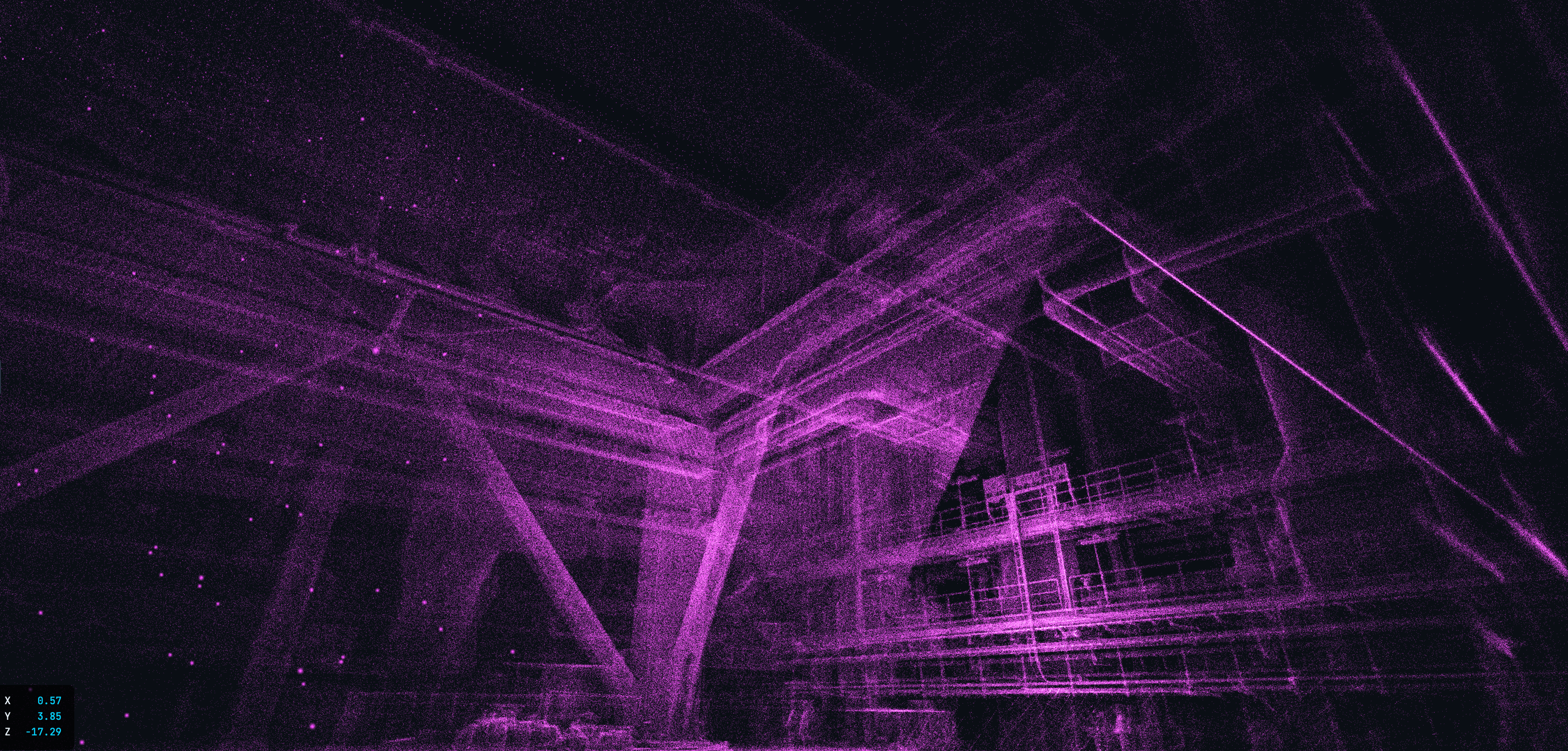
Real-time LiDAR 3D scan with the Flyability ELIOS 3 – boiler house inspection.
Conclusion: Why We Chose the Elios 3 – and What the Elios 1 Will Always Mean
After nearly 10 years with the Flyability Elios series, we can say one thing with full conviction: The Elios series has fundamentally changed how we work in confined spaces.
From “somehow getting through safely” to “precise, data-rich and reproducible.” The Elios 1 was the decisive first step – and we owe it an incredible amount. The fact that one still stands in our office is no coincidence.
The Elios 2 was a solid intermediate step but did not lead us to a purchase decision. The vision stabilisation was progress but insufficient for our demanding deployments. In hindsight, that was the right call: because then came the Elios 3.
The Elios 3 is not an upgrade for us – it is a different product category. Flyability has since declared the Elios 1 and Elios 2 end-of-life. For us, that is only logical: the focus is clearly on the Elios 3 as the future-proof system. Anyone still working with older models or entering the market fresh – the Elios 3 is the clear next step.

Your Contacts

Related Information
- Flyability ELIOS 3 – All details on our current workhorse – specs, payloads and deployment areas.
- LiDAR & 3D Scanning – How LiDAR-SLAM has changed industrial inspection.
- Confined Spaces Inspection – Our core area – inspections without dangerous human entry.
- 10 Things That Set the Elios 3 Apart – The ten decisive unique selling points of the Elios 3.
- Elios 3 Technical Specifications – Complete data sheet with practical assessment from hundreds of missions.
Frequently Asked Questions
Why did you not purchase the Elios 2?
Honestly: The Elios 2’s vision stabilisation was an improvement, but not reliable enough in the scenarios most important to us – smooth tanks, darkness, dust. We tested it for several weeks and decided to wait. That decision was correct: the Elios 3 with LiDAR fusion delivered what we had been looking for.
Do you still fly with the Elios 1?
No, not in commercial deployments. Flyability has declared the Elios 1 end-of-life and no longer manufactures spare parts. We still have one unit in our office – as a reminder and a tangible testament to how much has changed in 10 years. For current missions, we deploy exclusively the Elios 3.
What is the most important difference between the Elios 2 and Elios 3?
The decisive difference is the integrated LiDAR sensor and the SLAM engine. The Elios 2 stabilises only via cameras – which fails in darkness or on featureless surfaces. The Elios 3 combines LiDAR and Vision: more stable in all environments, plus real-time 3D mapping. This is not merely an upgrade – it is a different product category.
Can you still work productively with an Elios 1 or Elios 2 today?
For simple visual inspections in accessible, well-lit assets, technically possible – but we would not recommend it. Flyability has declared both models end-of-life; spare parts and support are becoming scarce. The Elios 3 is cheaper to operate, delivers significantly better data and is more stable. The switch pays for itself quickly.
How long does it take to learn the Elios 3?
Anyone who has flown the Elios 1 or 2 will learn the Elios 3 significantly faster – the basic operation is similar. The new features (LiDAR mapping, Inspector 5, payload configuration) require additional training. Flyability offers training courses. We also share our 10 years of experience in advisory discussions.
Are the Elios 3’s LiDAR data genuinely practical?
Yes – and we say this based on hundreds of deployments. The 3D point clouds are precise enough for asset management, finding localisation and comparison inspections over years. Combined with Inspector 5, complete digital twins are created. This was simply not possible with the Elios 1 and 2.
Get in Touch
Questions about which Elios generation suits your deployment? Or ready to benefit from our 10 years of Flyability experience? Fill out the form below – we’ll get back to you within 24 hours.