
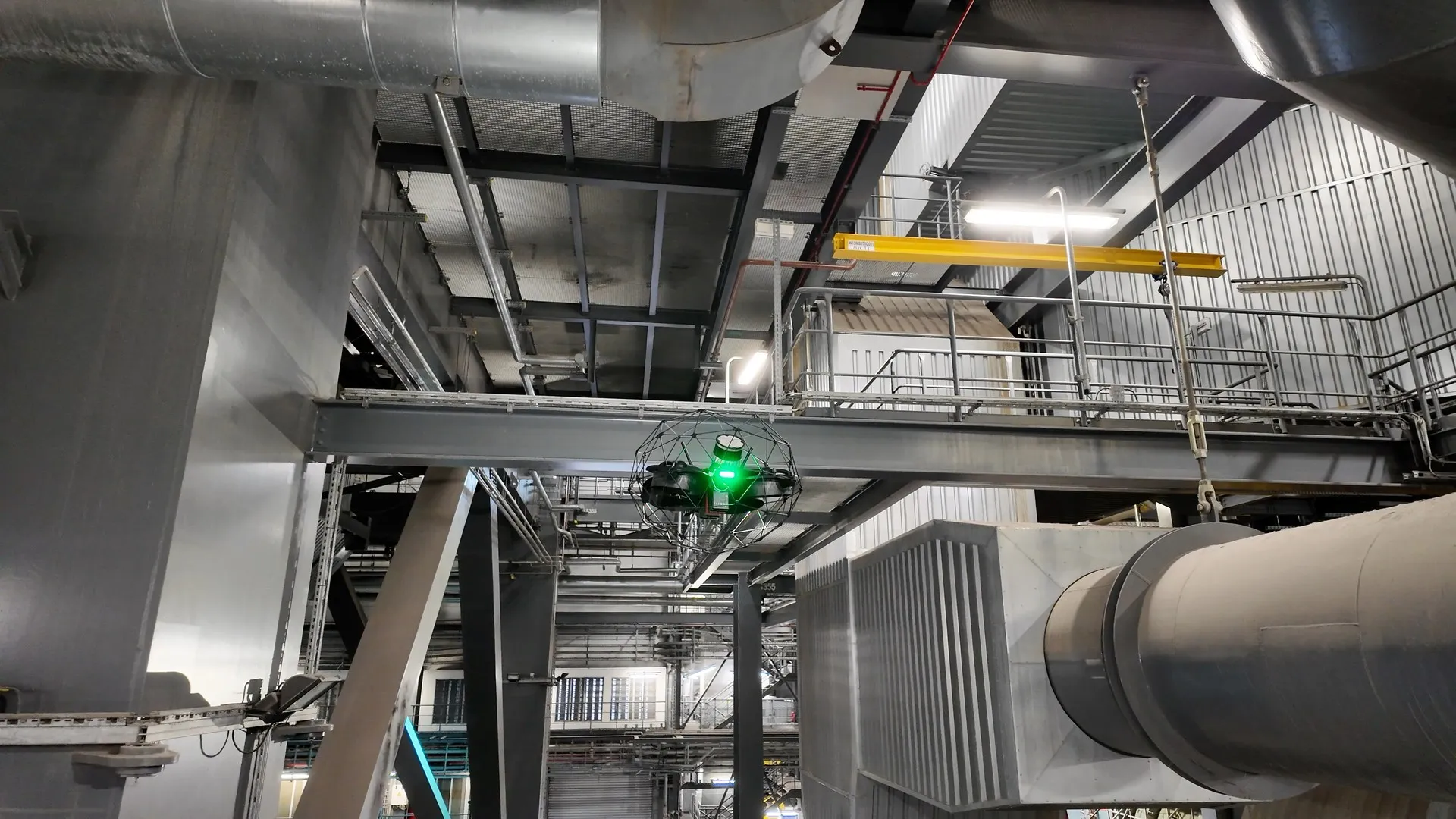
NDT Inspection with Flyability Elios 3 – Non-Destructive Testing in Confined Spaces
The Flyability Elios 3 is a flying NDT platform: visual testing (VT), LiDAR 3D surveying and thermography (IRT) in a single flight – without scaffolding, without human entry into confined spaces. UT payload for wall thickness measurement is in development.
- Visual Testing (VT) – 4K camera with 16,000 lumen LED illumination
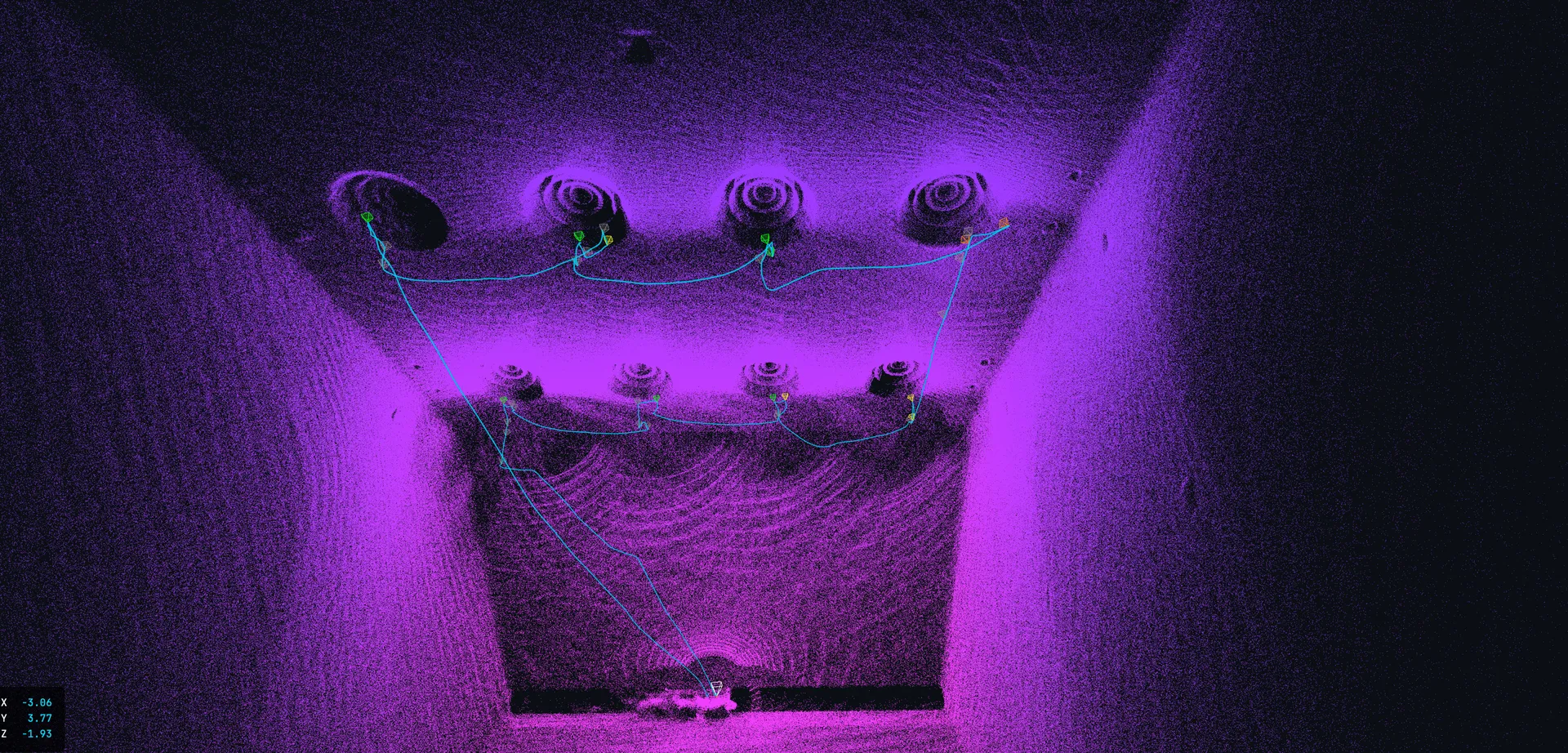
- LiDAR 3D surveying – Ouster OS0-128, deformation analysis and measurement
- Thermography (IRT) – optional thermal camera for hotspots, CUI, insulation damage
- UT payload in development – contact-based ultrasound wall thickness measurement
What Is NDT / NDE?
Non-Destructive Testing (NDT) – also referred to as Non-Destructive Evaluation (NDE) or in German as Zerstörungsfreie Prüfung (ZfP) – examines the condition of components and plants without damaging them. In confined spaces this was previously only possible with laborious scaffolding and human entry. The Flyability Elios 3 brings NDT methods directly into the confined space – without risk to people.
| NDT Method | Description | ELIOS 3 | Status |
|---|---|---|---|
| Visual Testing (VT) | Visual surface inspection | ✓ | Available (4K + 16,000 lumen) |
| Ultrasound (UT) | Wall thickness, internal flaws | ⚠ | In development (UT payload) |
| Radiography (RT) | X-ray testing | ✗ | Not possible (radiation source) |
| Magnetic Particle (MT) | Near-surface cracks | ✗ | Contact method |
| Penetrant Testing (PT) | Surface-breaking cracks | ✗ | Contact method |
| Thermography (IRT) | Thermal imaging, CUI, hotspots | ✓ | Available (optional payload) |
| LiDAR (3D) | Geometry, deformation | ✓ | Available (Ouster OS0-128) |




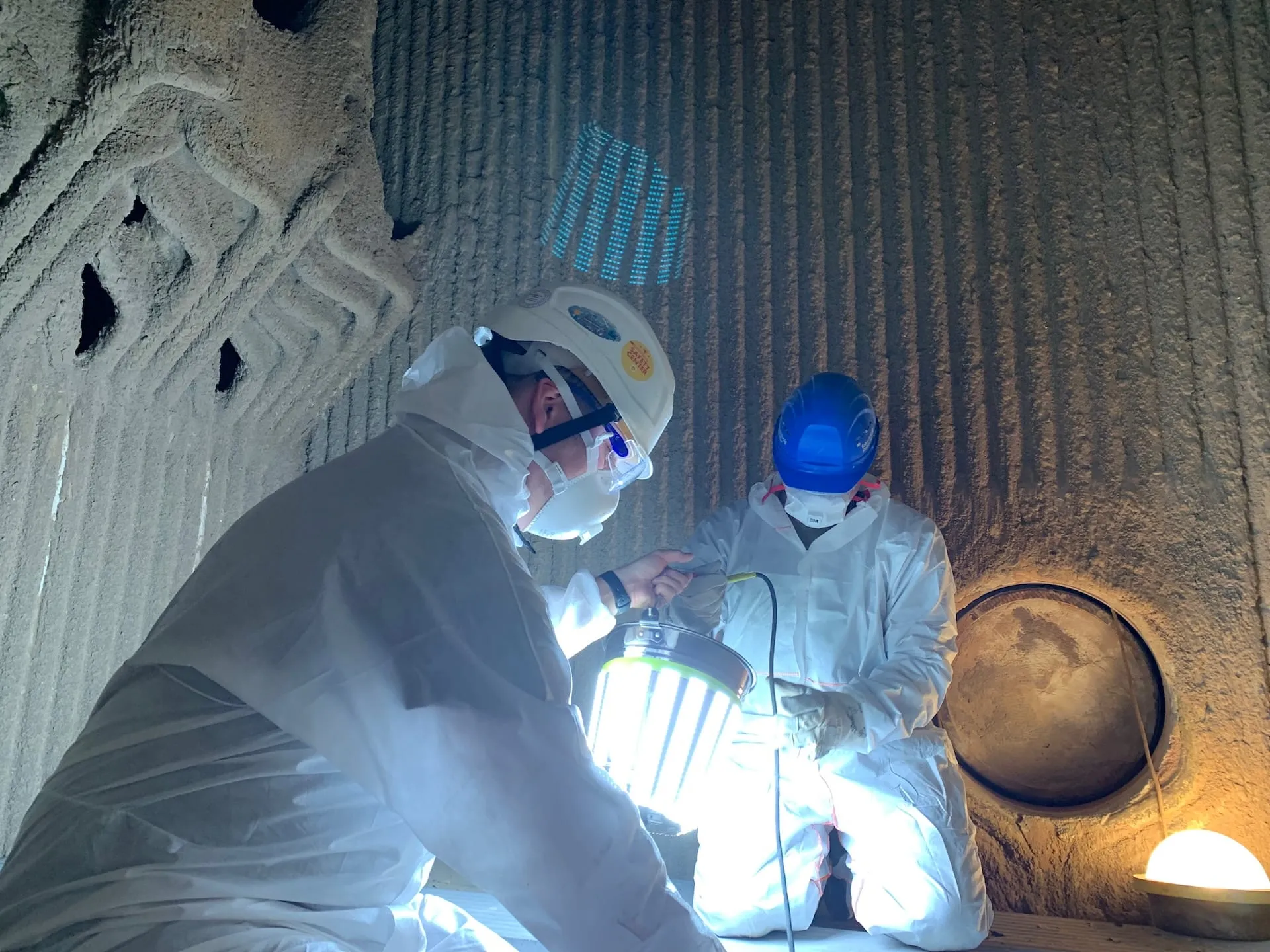
Elios 3: NDT Platform for Confined Spaces
The Flyability Elios 3 is not just an inspection drone – it is a flying NDT platform that combines multiple testing methods.
The combination of VT + LiDAR + thermography in a single flight makes the ELIOS 3 the most comprehensive NDT platform for confined spaces.


Benefits of Drone NDT Inspection



UT Payload: The Future of Wall Thickness Measurement
Ultrasonic wall thickness measurement by drone
Flyability is working on a UT payload (Ultrasonic Testing) for the Elios 3. Goal: wall thickness measurement directly by drone in confined spaces – without scaffolding, without personnel. Until then we combine the drone pre-assessment (VT + thermography + LiDAR) with targeted conventional UT testing at identified locations.




The combination of VT + UT + LiDAR makes the Elios 3 the most comprehensive NDT platform for confined spaces.
Typical NDT Applications with Elios 3

Your Contact
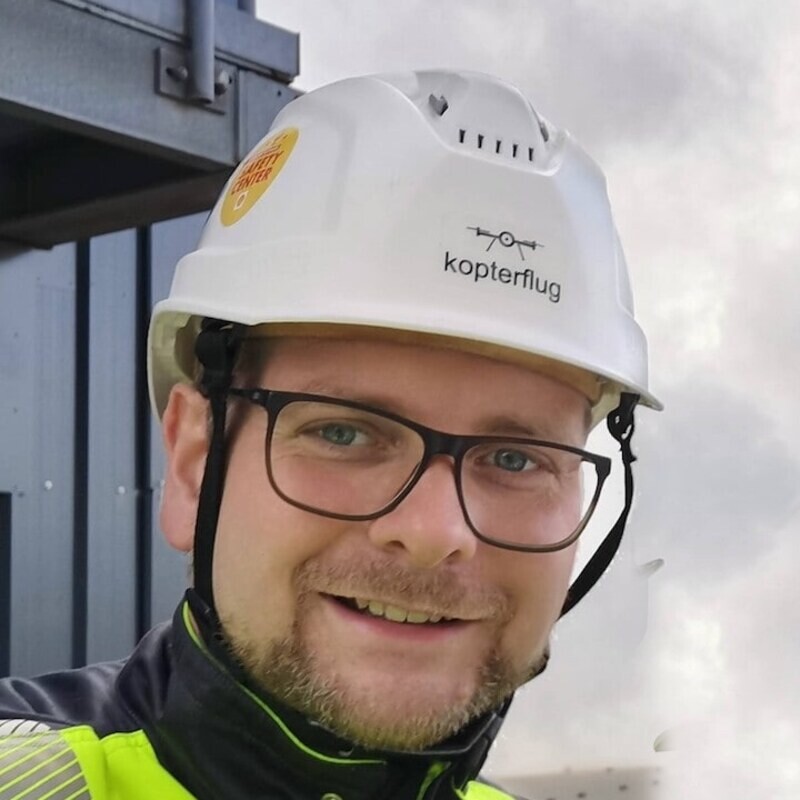
Founder & Drone Pilot / Confined Spaces since 2017
“NDT and drone – a perfect match. VT, thermography and LiDAR deliver more data in a single flight than a conventional visual inspection with scaffolding. And when the UT payload arrives, the Elios 3 will become the most complete NDT platform for confined spaces.”
Related Services
- Flyability ELIOS 3 – The collision-safe NDT platform with 4K, LiDAR, thermography and UT payload
- Industrial Inspection – Non-destructive testing in industrial plants with state-of-the-art drone technology
- Confined Spaces Inspection – NDT testing in confined spaces without human entry
- Tank Inspection – Tanks tested non-destructively by VT, thermography and LiDAR
- Boiler Inspection – Boilers and steam generators inspected by drone using NDT methods
- Chimney Inspection – Chimneys tested non-destructively from inside – VT, thermography and LiDAR
Frequently Asked Questions: NDT Drone Inspection
- Which NDT methods can the Elios 3 currently perform?
- Currently available: Visual Testing (VT) with 4K camera and 16,000 lumen LED, LiDAR 3D surveying (Ouster OS0-128) for deformation analysis and measurement, optional thermography (IRT) for hotspots, CUI detection and insulation damage. In development: UT payload for wall thickness measurement. Not possible: contact methods such as MT, PT and RT.
- Does the drone replace conventional NDT methods such as UT or MT?
- No – the drone does not replace all NDT methods but supplements them. Contact methods (UT, MT, PT) still require physical access. The advantage: the drone delivers a fast pre-assessment via VT and thermography. Only at suspect locations is conventional testing carried out – this is the hybrid approach.
- Are the results standards-compliant?
- Visual testing (VT) with the Elios 3 is aligned with the requirements of DIN EN ISO 17637. LiDAR surveys are reproducible and CAD/BIM-compatible. Inspection reports are aligned with BetrSichV and DGUV requirements. Recognition by TÜV/DEKRA is decided on a case-by-case basis – our experience shows increasing acceptance.
- Which plants are suitable for NDT by drone?
- All confined spaces with openings from 50×50 cm: power plant boilers (firebox, superheater, economiser), tanks and pressure vessels, chemical reactors and columns, chimneys and flue gas passes, pipework (from approx. 50 cm diameter), silos and shafts. For exterior inspections the DJI M30T with zoom and thermography complements the ELIOS 3.
Contact – NDT Inspection Enquiry
Contact us for a free consultation. We show you which NDT methods are suitable for your plant.