
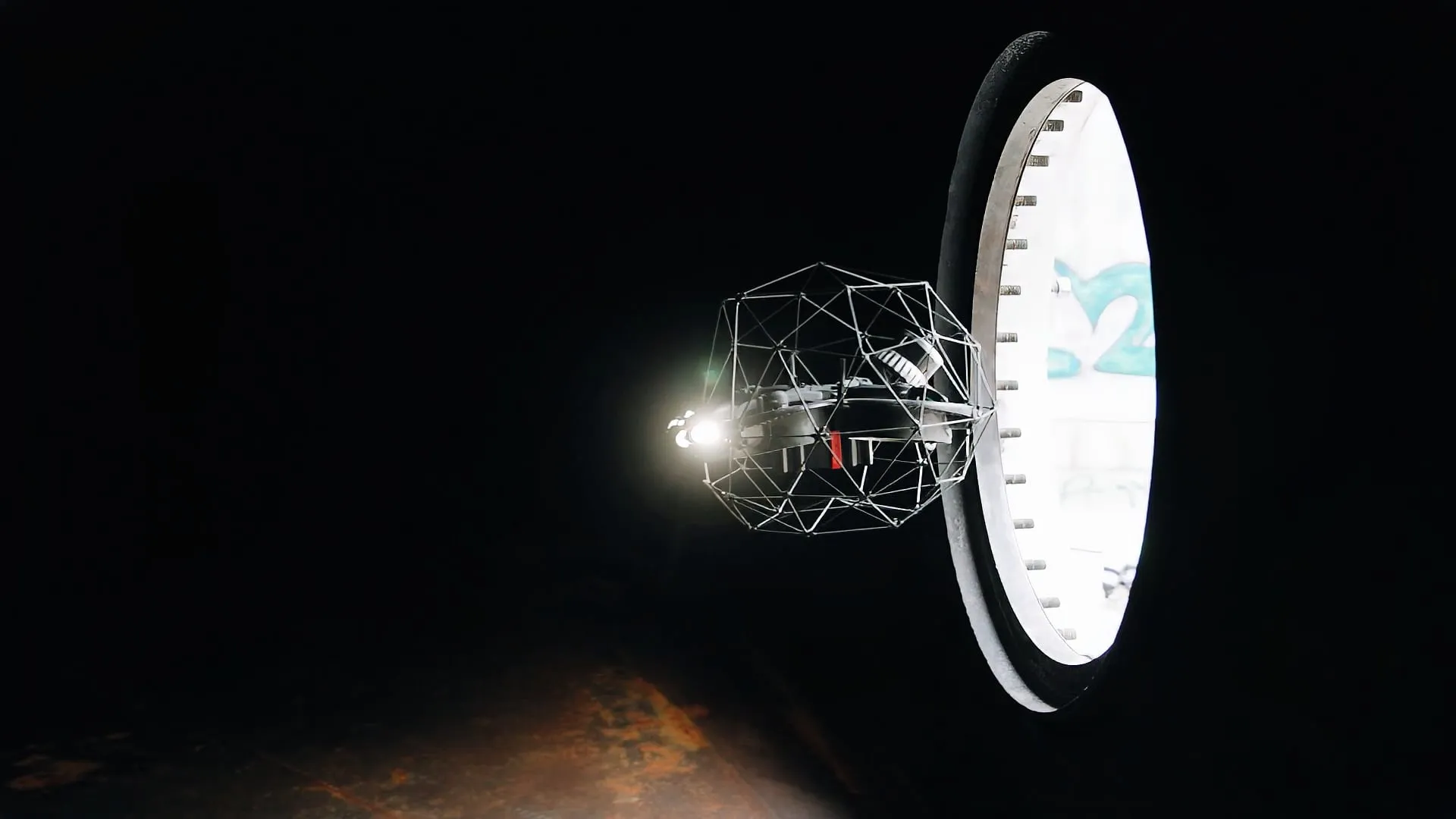
Flyability ELIOS 3 – Collision-Safe Indoor Drone for Industrial Inspection
Kopterflug deploys the ELIOS 3 as its primary system for interior inspections – in tanks, boilers, silos, chimneys and confined spaces. No scaffolding, no rope access, no human entry: the drone flies in, your team stays outside.
- Inspection without human entry
- DN 600 as practical minimum opening (access-dependent)
- 4K + Thermography + LiDAR in a single flight
GPS-Free Indoor Drone for Industry
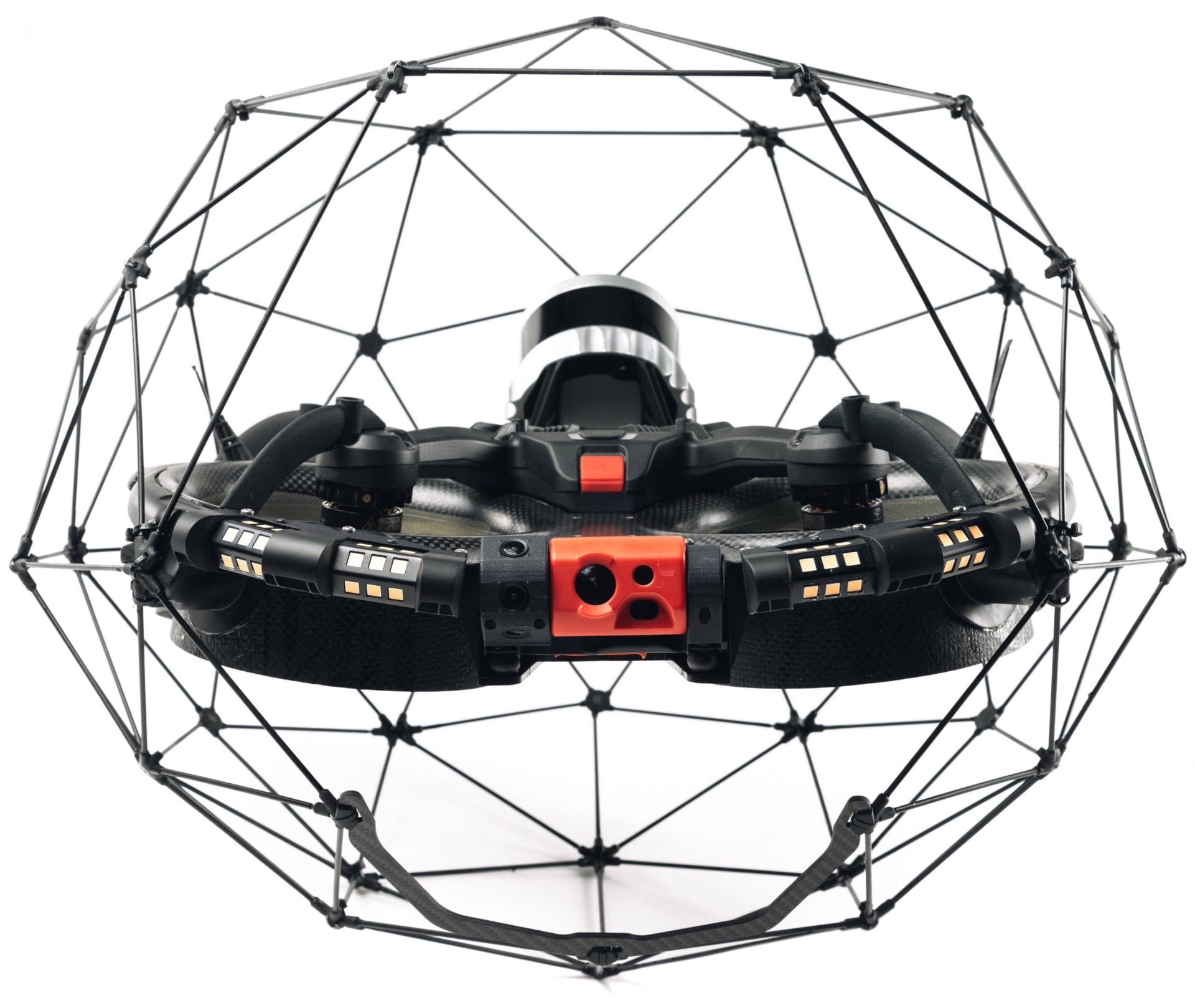
The ELIOS 3 with its collision-safe carbon cage – designed for confined industrial environments.
GPS-independent, collision-safe, LiDAR-supported. The ELIOS 3 inspects confined interior spaces where no human can work safely – delivering 4K video, thermography and 3D point clouds in one flight.
- GPS-free SLAM navigation: Stable flights in tanks, boilers, silos and shafts – even without light or GPS signal.
- Collision-safe protective cage: Contact with walls and internals is tolerable – the drone remains stable. Entry from approx. DN 600.
- LiDAR 3D mapping: Precise point clouds for geometry, documentation and repeatable inspections.
- Thermography in confined spaces: Detection of hotspots, leaks and thermal anomalies – even in complete darkness.
- 4K documentation with high-power lighting: Clear footage even in dusty, dark and contaminated environments (16,000 lumens).
- Zero human entry: No confined space entry, no rescue chain, no risk to your personnel.
ELIOS 3 in Action
The ELIOS 3 is Kopterflug's primary system for all interior and confined space inspections. The advantages are clear: safety through zero human entry, data quality through 4K + thermography + LiDAR, and efficiency through eliminating scaffolding and access equipment.
Practical check – will it fit? The ELIOS 3 measures approx. 50 × 45 cm and fits through a standard DN 600 manhole in many installations – depending on entry angle and clearance.
What matters for data: 4K video for visual findings, thermography for thermal indications, and LiDAR for 3D positional reference – so findings are locatable and repeatable.
Mission Planning: What We Clarify Together
Before every deployment, we coordinate three areas with you:
1. Access & Geometry
We check opening dimensions and entry feasibility (DN 600 as guideline), potential bottlenecks, airflow, dust and moisture conditions. We also clarify start/landing zones and communication between pilot and plant operator.
2. Data & Deliverables
You decide what data you need: 4K video and photos for visual findings, thermography for thermal anomalies, LiDAR/3D for surveying and volume calculation. The result is a structured findings list with positional reference – not raw, uncontextualized video.
3. Safety & Clearances
Zero human entry is our target – whether this is fully achievable depends on the scope. We work according to your operator standards for gas-free measurements and work permits, and clarify roles and responsibilities (pilot, spotter, plant supervisors) in advance.
Typical Applications





1. Tanks & Process Vessels
Storage and process tanks in chemical, petrochemical and water supply industries. Wall corrosion, deposits, coating damage – inspectable without human entry.
- Sensors: Visual, thermography, LiDAR
- Typical findings: Pitting, corrosion, weld defects, deposits, coating damage
2. Boilers & Pressure Vessels
Steam boilers, water-tube boilers, pressure vessels per BetrSichV (German Industrial Safety Regulation). Findings list for certified inspectors – without confined space entry per DGUV (German statutory accident insurance regulations).
- Sensors: Visual, thermography
- Typical findings: Weld seam corrosion, scale deposits, wall damage, valve wear
3. Silos & Bulk Storage
Cement, chemical and agricultural silos. LiDAR volume measurement, buildup detection, outlet inspection – without entry.
- Sensors: Visual, LiDAR
- Typical findings: Bridging, material buildup, liner damage, corrosion, deformation
4. Chimneys & Flue Gas Ducts
Tall vertical interior structures such as industrial chimneys, flue gas ducts and liner pipes. Interior inspection without climbing teams.
- Sensors: Visual, LiDAR, thermography
- Typical findings: Masonry damage, liner cracks, corrosion, sooting, thermal anomalies
5. Pipes & Tunnels (from DN 600)
Sewers, large-diameter pipes, galleries – anywhere humans cannot safely access.
- Sensors: Visual, LiDAR
- Typical findings: Cracks, infiltrations, deposits, deformations, joint defects
6. Blast Furnaces & Industrial Furnaces
Refractory linings, furnace interiors, combustion chambers in cooled-down state. Thermography for residual hotspots and early damage detection.
- Sensors: Visual, thermography, LiDAR
- Typical findings: Refractory wear, cracks in firebrick, thermal anomalies, material fatigue
Why the ELIOS 3 Delivers in Practice
- Zero entry as a safety lever: Send technology into hazardous areas – human entry and exposure can be reduced or eliminated depending on scope.
- 4K + Thermal + LiDAR: More than just video – visual findings, thermal indications and measurable 3D data for planning and repeatability.
- Less access equipment: In many scenarios, less organizational effort than scaffolding, rope access or lifting platforms.
- Reproducible findings: Position-referenced findings lists instead of uncontextualized video. Results are repeatable, comparable and traceable over years.
- Shorter preparation: Eliminating scaffolding and access equipment often saves more time and cost than the actual inspection.
- Report quality for certified inspectors: Structured reports with 4K screenshots, thermal imaging evaluation and 3D models. Suitable as basis for certified inspectors and BetrSichV documentation.
ELIOS 3 vs. Conventional Access Methods
| Aspect | Conventional (scaffolding / climbers / entry) | Flyability ELIOS 3 |
|---|---|---|
| Human entry | Required – respiratory protection, rescue chain, DGUV confined space entry | No entry – drone flies in, team stays outside |
| Navigation | Technician navigates manually – limited by body size and safety overhead | GPS-free SLAM navigation – stable in tanks, boilers, shafts |
| Collision protection | None – damage from tools or falls possible | Collision-safe carbon cage – wall contact without crash |
| Sensors | Handheld camera, flashlight – spot checks only | 4K + thermography + LiDAR 3D in one flight |
| Preparation | Scaffolding, safety posts, permits – days | Gas-free measurement, access point – deployment in hours |
| Result | Subjective technician report, not reproducible | Structured findings report, position-referenced, repeatable |
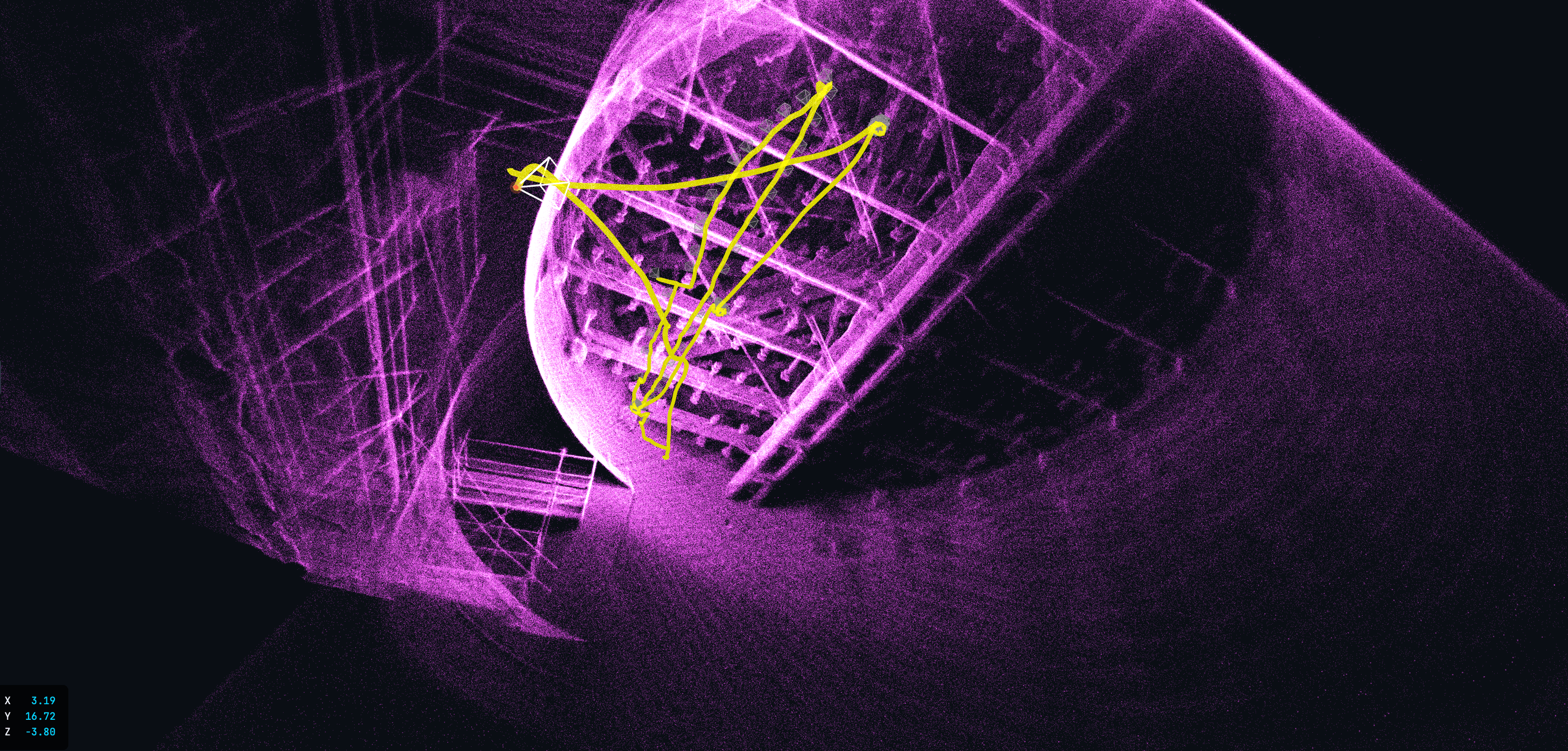
LiDAR 3D point cloud generated by the ELIOS 3 – centimeter-accurate geometry data for documentation and digital twins.
Limitations – When the ELIOS 3 Is and Isn't the Right Choice
The ELIOS 3 is not an all-purpose system. It is specialized for confined, dark, GPS-denied interior spaces. For exterior inspections of facades, bridges or chimney outer walls, other platforms are more suitable.
Own vs. service: With fewer than 10 deployments per year, owning the drone rarely pays off. We advise honestly – even if the recommendation is: commission rather than purchase.
How a Consultation Works
Step 1: Needs Assessment (free)
Which assets, what frequency, what data? We help you assess whether owning or commissioning the service makes more sense for your situation.
Step 2: Define Requirements
DN dimensions, access routes, sensor requirements (4K / thermal / LiDAR), safety concept – we create a practical technology profile for your installations.
Step 3: Demo Deployment / Proof of Concept
On request, we fly a reference installation as proof of concept. This way you see data quality and workflows before any procurement decision.
Step 4: Procurement or Deployment Planning
Depending on the outcome: referral to supply sources, or direct commissioning as inspection service – straightforward, no detours.
Your Contacts for ELIOS 3 Questions
Christian Engelke – your direct contact for ELIOS 3 projects.
Christian Engelke is your direct contact for technical questions about the ELIOS 3 – deployment, configuration, safety concepts. Since 2017, we have been operating the drone in industrial installations: blast furnaces, tanks, silos, chimneys.
We advise without sales pressure – even if the recommendation is: commission the service rather than purchasing.
Related Services
- Confined Spaces Inspection – The primary ELIOS 3 use case: tanks, boilers, silos and shafts without human entry.
- Tank Inspection – Corrosion, coating damage and wall thickness in storage and process tanks.
- Boiler Inspection – Steam boilers and pressure vessels – findings for certified inspectors without DGUV confined space entry.
- Silo Inspection – Liner damage, buildup and LiDAR volume measurement in silos.
- Industrial LiDAR Survey – 3D point clouds with the ELIOS 3 Surveying Payload (Ouster OS0-128).
- Industrial Drone Inspection – Overview of all inspection services with ELIOS 3 and complementary systems.
Frequently Asked Questions
Does Kopterflug sell the ELIOS 3 directly?
Kopterflug is primarily an inspection service provider. For procurement, we advise on the right configuration and can refer you to suitable supply sources and partners.
What does an ELIOS 3 cost?
As a rough guide: the ELIOS 3 typically ranges between €80,000 and €120,000 depending on configuration, payloads and software packages. Add training costs, maintenance and ongoing operating costs (replacement batteries, service contracts, software licenses). We don't quote fixed prices – we're happy to clarify your scope and connect you with suitable suppliers.
Does the ELIOS 3 fit through a DN 600 manhole?
Practical check: The ELIOS 3 measures approx. 50 × 45 cm and fits through a DN 600 manhole in many installations – the key factors are entry angle, edges, internals and the specific clearances on site.
Which sensor combination makes sense?
For most integrity and maintenance processes, three sensors are the standard: 4K video (see the findings), thermography (hotspots and moisture), LiDAR/3D (volumetry and positional reference) – individually or combined depending on the asset.
What is the ELIOS 3 NOT suitable for?
The ELIOS 3 is not an all-purpose drone. Exterior inspections (facades, bridges, chimney outer walls) require different platforms. It is not ATEX-certified and may only be deployed in potentially explosive areas after gas-free measurement. Maximum ambient temperature is 50°C – installations must be fully cooled before inspection.
Own an ELIOS 3 or commission as a service?
With fewer than 10 deployments per year, varying assets or high internal training effort, commissioning the service is often more economical than owning. At higher deployment frequency with standardized assets, ownership can make sense. We advise openly on both options.
What makes the ELIOS 3 special compared to other drones?
The ELIOS 3 is one of the few drones purpose-built for confined spaces – not retrofitted. Key differentiators: collision-robust carbon cage, GPS-free SLAM+LiDAR navigation, and the combination of 4K, thermography and 3D data in a single deployment. Standard FPV or industrial drones cannot reliably operate in tight interior spaces and have no collision tolerance.
Can the ELIOS 3 completely eliminate human entry?
In many cases: yes. Concretely: no respiratory protection, no rescue chain, no work in hazardous spaces. The drone flies in – your team stays outside. Whether zero entry is fully achievable depends on the installation type, clearance situation and specific findings requirements. We clarify this with you in advance.
How accurate is the ELIOS 3 LiDAR data?
Accuracy is in the centimeter range – typically ±2–5 cm depending on distance, flight speed and surface properties. Sufficient for geometry capture, deformation analysis and digital twins – not sufficient for precision surveying under 1 cm. For higher requirements, we recommend terrestrial reference points as supplements.
What does point cloud colorization do?
The ELIOS 3 can automatically overlay point clouds with 4K color information – you see not just geometry but also surfaces, corrosion spots, coating damage and deposits directly in the 3D view. This makes findings significantly easier to interpret – especially for engineers and assessors who weren't present during the flight.
How long does the ELIOS 3 fly per battery?
Typically 10–12 minutes per battery depending on payload, flight style and ambient temperature. Multiple flights with battery changes are planned for a complete installation. We work with a battery pool to minimize downtime. Large tanks or chimneys are fully documented in 2–4 flights. Total time on site: usually 1–4 hours.
What training does an ELIOS 3 pilot need?
Three things are relevant for professional operation: a suitable drone qualification (the exact category depends on deployment location and context), Flyability-specific training for ELIOS control and firmware, and – often underestimated – practical confined space experience: safety concepts, gas-free measurement, communication with plant operators.
How safe is the ELIOS 3 during collisions?
The carbon protective cage is engineered to tolerate light collisions – the drone bounces off and remains stable. With light contacts, relevant damage to typical industrial surfaces is not expected – the drone's mass and energy are too low for significant impact on steel walls or concrete surfaces.
Can the ELIOS 3 fly in gas-hazardous areas?
With restrictions: The ELIOS 3 is not ATEX-certified. Deployment in Ex zones is only possible when the area has been gas-free measured and a corresponding operating permit (hot work permit or similar) is in place. With the optional gas sensor, the ELIOS 3 can monitor gas levels during flight and withdraw if thresholds are exceeded.
How long does a typical ELIOS 3 inspection take?
Typically 1–4 hours on site depending on installation size, complexity and sensor setup. Multiple assets per day are possible for compact installations. Post-processing (data processing, findings list and report) is typically delivered within a few working days.
What does an ELIOS 3 inspection report look like?
A structured findings report typically contains: 4K images and video excerpts with localized findings, thermography evaluation with anomalies, 3D LiDAR data with positional reference, and a commented findings list (severity, action recommendation, comparison to previous inspection). No uncontextualized video – every finding is traceably located.
Can the ELIOS 3 measure wall thickness?
Yes – with the optional UT payload (ultrasonic wall thickness measurement). This is additional sensor equipment mounted on the drone that makes contact with the inner wall to measure wall thickness. LiDAR only measures geometry – wall thickness is a separate measurement process. Combining LiDAR scan and UT measurement in one deployment is possible.
Can ELIOS 3 inspections be repeated and compared?
Yes – this is one of the most practically valuable aspects. Flight paths and finding positions are documented so that follow-up inspections can take place at exactly the same locations. Corrosion progress, material fatigue and damage development become traceable over months and years – as a basis for maintenance planning and RBI decisions.
How quickly can an ELIOS 3 deployment be scheduled?
Significantly faster than conventional access equipment. No scaffolding, no long lead times for safety measures. If your installation is accessible and gas-free measured, we are typically on site within a few working days. For planned revisions, we recommend early scheduling to optimally use the revision window.
What is the difference between ELIOS 2 and ELIOS 3?
Key improvements: LiDAR payload for 3D point clouds and precise positional reference (ELIOS 2 had no true LiDAR), significantly better 4K camera quality and lighting (16,000 vs. ~10,000 lumens), improved SLAM navigation for more stable flights in tight and feature-poor spaces, and a new cockpit interface with real-time 3D live map. The protective cage is lighter and more robust.
What do we need to prepare as a company?
The effort on your side is typically minimal: access to the installation (manhole, inspection opening – at least DN 600 as guideline), information about atmospheric conditions (we perform gas-free measurement ourselves), brief safety briefing by your on-site safety officer, and – for vessel inspections – a depressurized, cooled-down installation. No scaffolding, no separate confined space entry preparation.
Get in Touch
Have questions about the ELIOS 3 or need a quote for your project? Fill out the form below and we'll get back to you within 24 hours.