
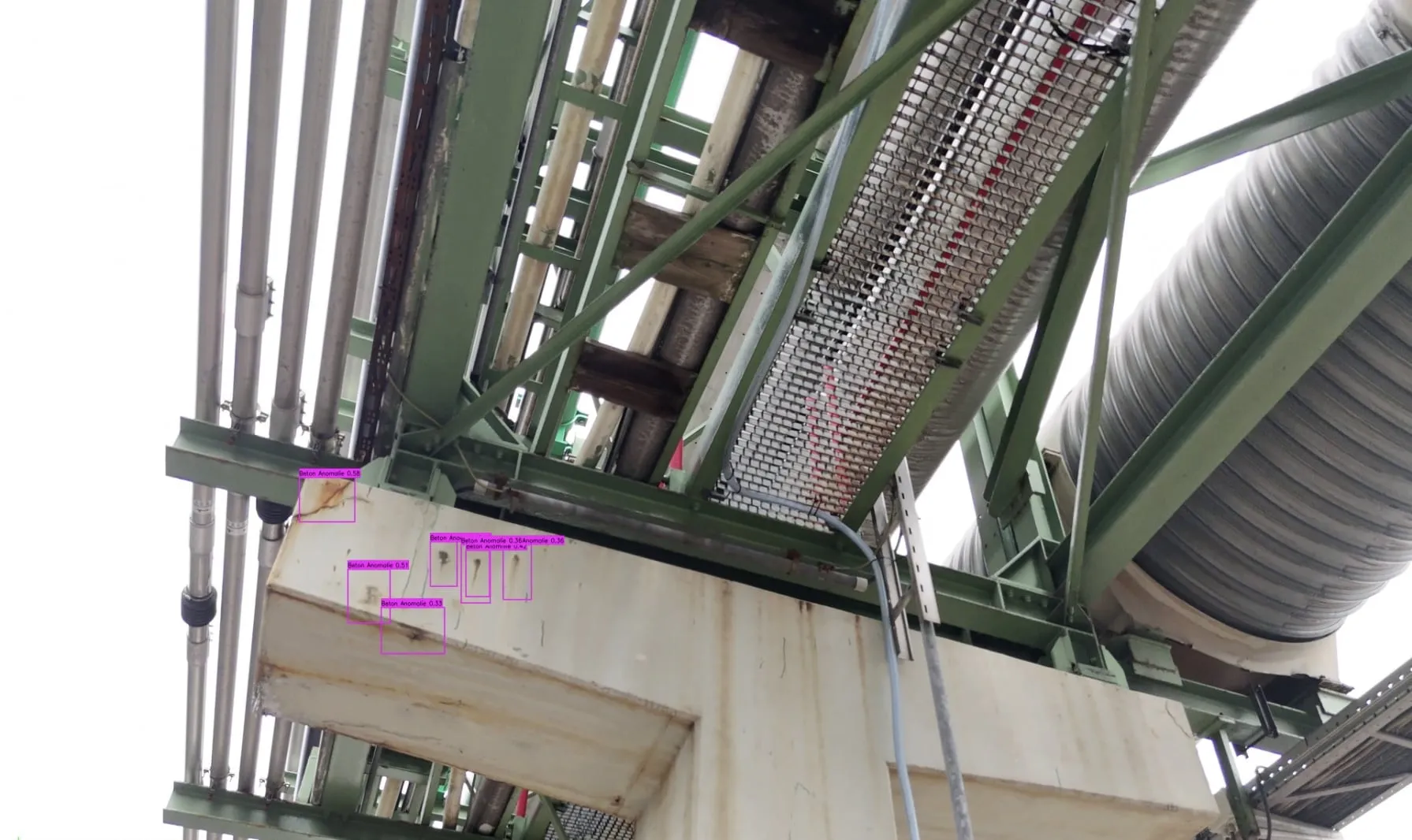
The 7 Most Common Concrete Damage Types – and How to Detect Them Early
From cracking to carbonation (Karbonatisierung) – modern inspection methods for safe structures. Drone inspections detect all 7 damage types early and without scaffolding. Since 2017, Kopterflug has been inspecting concrete structures throughout Germany.
- 7 damage types detectable with 4K, thermography and LiDAR
- 60–80% cost savings vs. scaffolding methods
- Cracks from 0.2 mm detectable via 4K camera
Introduction: Why Concrete Inspection in Industrial Plants Is Essential
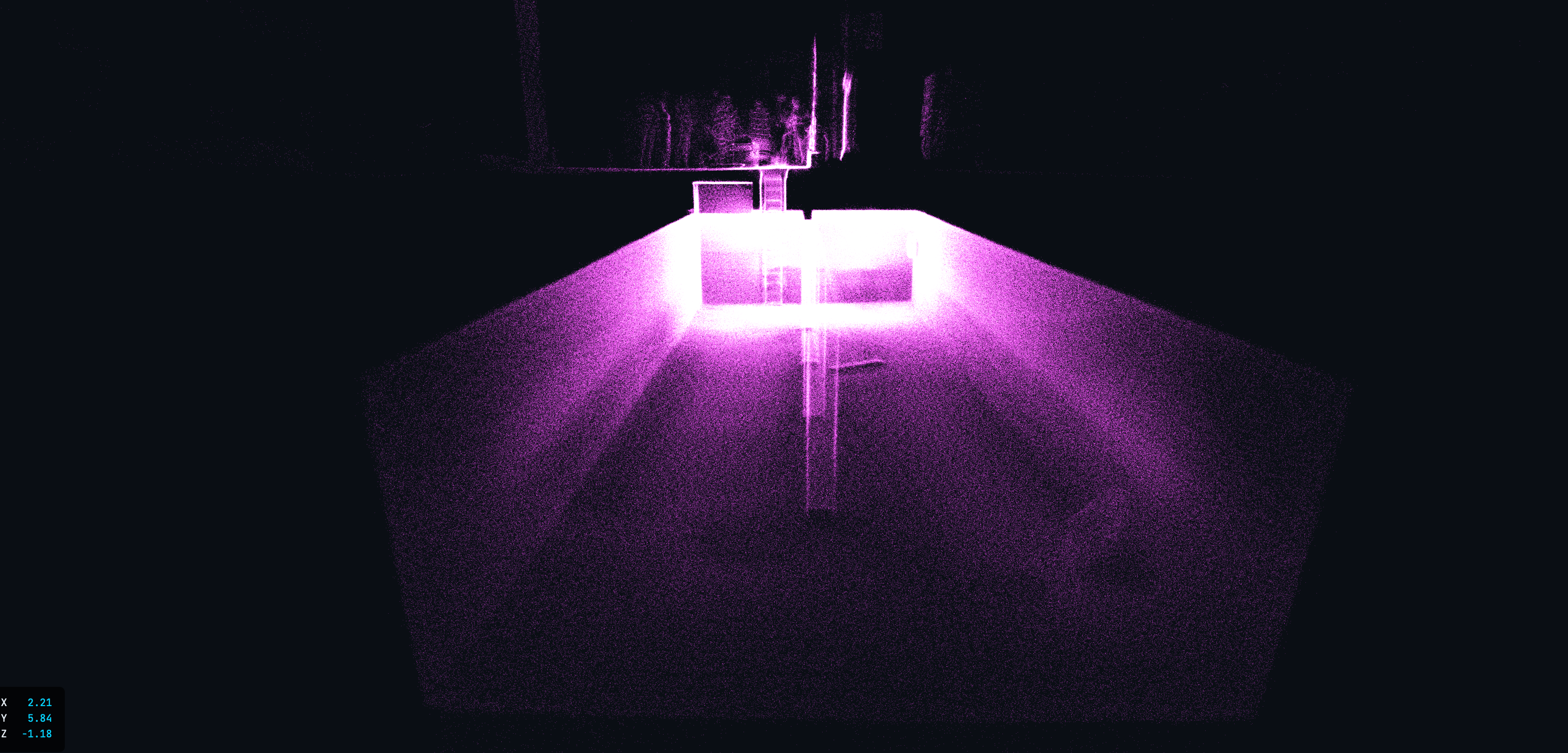
LiDAR 3D scan of a retention basin (Regenrückhaltebecken) – concrete condition documented with centimetre accuracy.
Concrete forms the foundation of many industrial structures – from support pillars and foundations to chimneys and silos. In heavy industry and power generation in particular, concrete structures are exposed to high loads.
The challenge: Many damage types remain invisible for a long time and impair load-bearing capacity and service life. Modern drones with 4K cameras, thermography and LiDAR detect this damage early – without scaffolding and with up to 80% cost savings.
Our expertise since 2017: With modern drone technology, we inspect concrete structures throughout Germany.




7 Concrete Damage Types at a Glance
| Damage Type | Detection Method | Key Indicator |
|---|---|---|
| Cracking | ELIOS 3 / DJI M30T (4K Zoom) | Cracks from 0.2 mm detectable; large-area capture |
| Spalling | ELIOS 3 / DJI M30T (4K + Thermography) | Exposed rebar immediately visible; thermography shows moisture |
| Carbonation | ELIOS 3 / DJI M30T (Thermography) | Thermography detects moisture as indicator; phenolphthalein test as supplement |
| Chloride Attack | 4K Camera + Thermography | Corrosion products and staining visible; thermography for moisture accumulation |
| Frost & Thaw Damage | 4K Camera + Thermography | Scaling, spalling; thermography for moisture accumulation |
| Sulfate Attack | 4K Camera (4K + Zoom) | Surface degradation, discolouration, crystal formation |
| Biological Growth | 4K Camera (Visual) | Algae, moss, lichens visible; root penetration damage |
1. Cracking from Mechanical Loading
Bending, shear and torsion cracks arise when strength limits are exceeded. Concrete has only approximately 10% of its compressive strength as tensile strength. Cracks allow moisture and pollutants to penetrate and promote rebar corrosion (Bewehrungskorrosion).
- Bending cracks: Vertical cracks at field midspan of slabs/beams
- Shear cracks: 45° diagonal cracks near supports
- Torsion cracks: Helically circumferential cracks
- Maximum crack widths (German standards): Interior max. 0.3 mm, exterior max. 0.2 mm, hydraulic structures max. 0.1 mm
- Detection: 4K detects cracks from 0.2 mm; large-area capture; repeatable documentation
2. Spalling at Edges and Surfaces
Surface damage from frost-thaw cycles, mechanical impact or rebar corrosion. Exposed rebar dramatically accelerates corrosion. Distinction between shallow (<5 mm), medium (5–20 mm) and deep (>20 mm) spalling.
- Edge spalling at exposed corners
- Surface delamination with exposed rebar
- Honeycombing and aggregate exposure
- Corrosion-induced bursting (rust pressure from rebar expansion)
- Detection: Exposed rebar immediately visible; thermography shows moisture; damage depth documentable
3. Carbonation (Karbonatisierung) – Loss of Corrosion Protection
CO₂ reacts with concrete and lowers the pH value from approximately 13 to below 9 – the passive layer of the rebar is destroyed. The carbonation front advances with √t (time). The process is visually invisible, but thermography detects increased moisture as an indicator.
- Carbonation front: Depth increases with √t (square root of time)
- Depassivation of rebar at pH < 9
- Consequences: Surface, pitting and crevice corrosion of the rebar
- Detection supplement: Phenolphthalein test (turns pink at pH >9) for field verification
4. Chloride Attack
Chlorides from de-icing salt, seawater or industrial processes penetrate the concrete and destroy the rebar passive layer locally – leading to pitting corrosion (Lochfraß). Particularly critical for reinforced concrete in coastal areas, bridge structures and parking garages.
- Visual indicators: Brown-orange rust stains on the concrete surface, crack formation parallel to the rebar
- Drone detection: 4K camera for rust stains and crack patterns; thermography for moisture accumulation areas
5. Frost & Thaw Damage
Water in the concrete pores expands upon freezing and creates internal pressure that leads to cracking and spalling. Repeated frost-thaw cycles produce cumulative damage. Particularly critical: concrete with high water-cement ratio and inadequate air void content.
- Scaling: Fine material washes off the surface
- Internal cracking: Invisible until spalling occurs
- Detection: Thermography detects moisture accumulation in frost-susceptible zones; 4K documents scaling and spalling progression
6. Sulfate Attack
Sulfates from soil, groundwater or industrial wastewater react with concrete components. Ettringite formation (Ettringitbildung) causes expansion and concrete disintegration. Visible indicators: surface degradation, whitish deposits, crystal formation.
- Affected areas: Foundations in sulfate-rich soils, wastewater structures, industrial floors
- Detection: 4K for surface degradation and crystal deposits; LiDAR for deformation measurement
7. Biological Growth & Fouling
Algae, moss, lichens and roots on concrete surfaces are not merely aesthetic problems. Root penetration forces cracks open further; biological metabolic products (organic acids) attack the cement matrix. Particularly common on shaded, humid concrete structures.
- Detection: 4K visual inspection clearly shows coverage extent and root penetration damage
- Risk assessment: Heavy growth on cracked surfaces indicates long-term moisture penetration
Drone Inspection: The Practical Solution for Concrete Structures
Which concrete structures are particularly suitable? Especially structures with hard-to-reach areas: bridges (piers, superstructures, bearings), chimneys (exterior), cooling towers (interior and exterior), silos (exterior), industrial buildings (facades, roofs), retention basins and sewage treatment plants.
What drone inspections deliver for concrete structures:
- 4K-6K cameras with up to 200x zoom (DJI M30T): detect cracks from approximately 0.2–0.5 mm
- Radiometric thermography: detects moisture and delamination invisible to the naked eye
- LiDAR-3D: measurable geometry capture; deformation analysis over years
- 60–80% cost savings vs. scaffolding; no scaffolding (often €20,000–100,000 saved)
- More frequent inspections enable early detection – annual instead of every 5 years
Your Contacts


Related Services
- Industrial Drone Inspection – Professional drone inspections for all industrial plants and sectors.
- Energy & Power Plants – Inspection of power plant components including concrete structures.
- Cooling Tower Inspection – Interior and exterior inspection of cooling towers.
- Chimney Inspection – Interior and exterior inspection of industrial chimneys.
- Industrial LiDAR Survey – 3D point clouds for geometry, deformation analysis and digital twins.
- Flyability ELIOS 3 – The indoor inspection drone for confined concrete structures.
Frequently Asked Questions
Why is drone inspection for concrete structures more efficient than conventional methods?
Drones enable rapid capture of hard-to-reach concrete surfaces such as elevated bridge areas or concrete facades: no scaffolding required (60–80% cost savings), 60–80% faster than scaffolding methods, no height work with personnel risk, and regular inspections become economically viable for early damage detection.
How does drone inspection contribute to safety of inspectors at concrete structures?
Drones eliminate personnel risks during concrete inspection: no height work risk (bridges, chimneys often 20–50m height), no scaffolding with fall hazard, no dangerous access to structures, no exposure to environmental influences (cold, heat, wind). The inspection team stays on the ground.
Are drone inspections precise enough for detecting concrete damage?
Yes – modern drones often surpass the human eye: 4K–6K cameras with up to 200x zoom (DJI M30T) detect cracks from approximately 0.2–0.5 mm, radiometric thermography detects moisture and delamination, LiDAR creates precise 3D models for deformation measurement. For safety-relevant decisions, drone findings serve as the basis for targeted follow-up NDT testing.
Which concrete structures are particularly suitable for drone inspections?
Especially suitable: bridges (piers, superstructures, bearings), chimneys (exterior), cooling towers (interior and exterior), silos (exterior), industrial buildings (facades, roofs, fire protection), retention basins and sewage treatment plants, tunnels with GPS-independent navigation.
How do drones help with early detection of concrete damage?
Drones enable more frequent inspections (more cost-effective): regular inspections (annually instead of every 5 years) enable early detection, thermography detects moisture before visible damage appears, 4K cameras document crack progression for trend analysis, and LiDAR enables measurable deformation monitoring over years.
Can a drone inspection identify structural weaknesses in concrete structures?
Yes, indirectly through visual indicators: crack patterns (bending, shear, torsion cracks) provide indications of load type, spalling indicates rebar corrosion, thermography shows moisture infiltration paths. Note: drone inspection is visual pre-detection; structural engineering assessment and NDT testing are required for safety-relevant statements.
How do drones support inspection for damage documentation and follow-up?
Comprehensive digital documentation: 4K videos of the entire inspection archived, high-resolution photos with GPS coordinates, thermography images show development over years, 3D models enable precise deformation measurement, and all findings are traceable for comparison inspections.
Are drones suitable for inspection of large concrete surfaces like tunnels or parking garages?
Yes, with some conditions: tunnels require GPS-independent navigation (ELIOS 3 with LiDAR-SLAM), good illumination (16,000 lumen LED), and systematic flight planning. Parking garages: ideal for ceiling inspections (rebar corrosion), column condition assessment, and crack monitoring. Generally: indoor structures require ELIOS 3; outdoor structures use DJI M30T.
Can drone inspections help detect frost-thaw damage or surface damage to concrete early?
Yes, through visual and thermographic capture: visual inspection detects scaling, spalling, surface cracks, exposed aggregate. Thermography detects moisture (precursor to frost damage), delaminations and zones of increased water saturation. Regular thermography inspections after winter are particularly valuable for bridges and exposed concrete structures.
Are drone inspections a cost-efficient choice for operators of concrete structures?
Yes – significant cost savings: 60–80% cheaper than conventional methods with scaffolding, no scaffolding (often €20,000–100,000 saved), minimal downtime, low personnel requirements (2 inspectors vs. 8–15 persons), and early damage detection prevents expensive emergency repairs.
Get in Touch
Need drone inspection of your concrete structures? Fill out the form – we'll get back to you within 24 hours.