
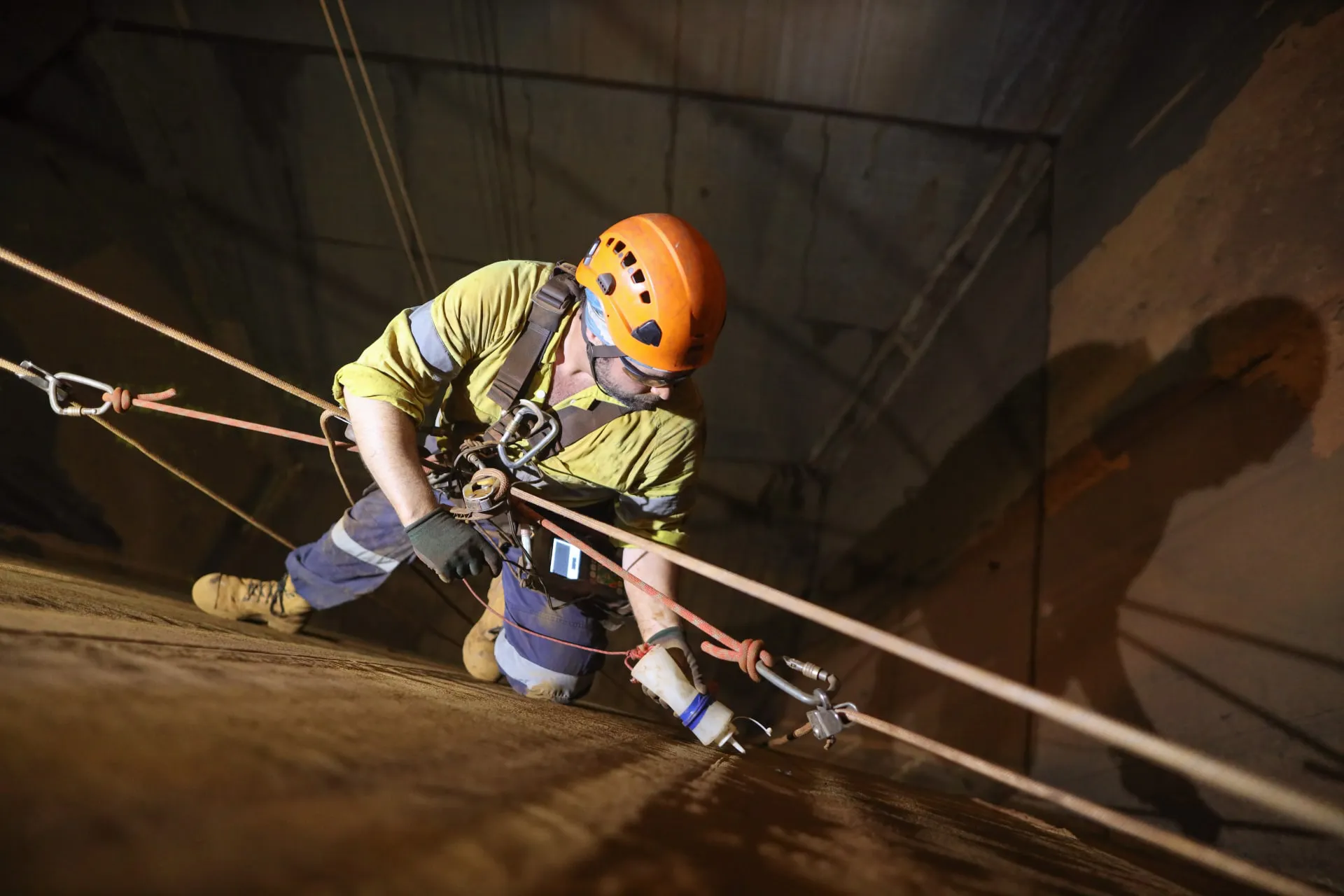
Drone vs. Industrial Climber – Direct Pro/Contra Comparison
Safety, costs, documentation quality and deployment scope – when the drone wins and when rope access (Seilzugang) remains the better choice. Operating since 2017.
- No personnel at height – zero fall risk
- 4K video, LiDAR 3D model, thermography – vs. manual notes
- Hybrid strategy: drone first, climber only where needed
Rope Access (Seilzugangstechnik) in Industrial Inspection: Strengths and Limits
The industrial climber with rope access technology (Seilzugangstechnik, SZT) is the established method of choice in many sectors for inspecting hard-to-reach structures: chimneys, silos, bridges, cooling towers, tall buildings. Qualified rope access specialists certified to IRATA Level 1–3 or the German FISAT standard can reach virtually any height and geometry while simultaneously examining, measuring and carrying out minor repairs.
However, rope access has structural limits that are increasingly problematic in industrial use:
- Safety risk: Working at height is – despite all protective measures – one of the most accident-prone activities in industry. Under DGUV Vorschrift 38 (the German accident-prevention regulation for work at height), extensive protective measures are mandatory. Every deployment team increases risk to workers.
- Time requirements: Climbers move on ropes – their speed is physically limited. A full inspection of an 80-metre chimney takes one to two days. A drone needs 30–60 minutes for the same chimney.
- Weather dependency: At wind speeds of approximately 8–10 m/s (Beaufort 5) rope access deployments must be abandoned for safety reasons. Drones (especially outdoor systems like the DJI Matrice 30T) are stable up to 15 m/s.
- Documentation quality: A climber can take photographs – but not a georeferenced 3D model, not complete surface coverage, not thermography with radiometric data.
Strengths of the Industrial Climber
An honest assessment must consider both sides. Industrial climbers have clear advantages in scenarios requiring physical contact:
- Tactile testing: Hammer sounding, magnetic particle testing (MT), dye penetrant testing (PT), ultrasonic wall-thickness measurement (UT) – all these methods require direct surface contact that a drone cannot provide.
- Immediate repair: After inspection, climbers can carry out simple repairs on the spot (sealing, grouting, minor works).
- High-resolution close-up shots: At a few centimetres from the surface, climbers see cracks that are not visible even with a 4K camera at 30 cm distance.
Where the Drone Outperforms the Industrial Climber
The drone – depending on application either the ELIOS 3 for indoor use or the DJI Matrice 30T for outdoor structures – has clear advantages over rope access in several central dimensions:
Safety
The most fundamental advantage of drone inspection: no personnel are put at risk. During a drone deployment the entire team remains on the ground. This eliminates fall risk entirely – and relieves the operator of duty-of-care obligations towards height workers. With the ELIOS 3 for indoor use, personnel entry into confined spaces (Confined Spaces) is also avoided, which under DGUV Vorschrift 1 requires considerable safety overhead.
Speed and Efficiency
- DJI Matrice 30T – exterior inspection: A 100 m chimney is fully documented inside (ELIOS 3) and outside (Matrice 30T) in 45–60 minutes. For a climber, ascent and descent alone take 2–4 hours depending on the chimney.
- ELIOS 3 – interior inspection: A 2,000 m³ tank is fully documented internally in 60–90 minutes. For scaffolding in the same tank, operators plan 2–3 days for erection alone.
- Multiple units in one day: In a single deployment day a drone team typically inspects 3–6 equipment units. A climber team manages 1–2 structures.
Documentation Quality
4K video footage, LiDAR 3D model and thermography combined deliver a documentation depth that no climber deployment achieves. All findings are three-dimensionally located, measurable and comparable over time. The 3D model can be imported into BIM/CAD systems.
Costs
For purely visual inspections the drone is generally cheaper. The comparison: a climber team (2–4 people) costs €1,500–3,000/day plus equipment hire, travel, safety gear. A drone team (1–2 people) is similarly priced – but more productive in the same time.
Direct Pro/Contra Comparison: Eight Criteria
The following comparison shows for eight evaluation criteria which method leads. Rating: ++ (clear advantage), + (advantage), = (equal), − (disadvantage), −− (clear disadvantage).
| Criterion | Drone | Industrial Climber |
|---|---|---|
| Occupational safety (height / confined space) | ++ | − |
| Inspection speed | ++ | − |
| Documentation quality (video, 3D) | ++ | − |
| Visual resolution at close range | + | ++ |
| Tactile NDT testing (UT, MT, PT) | −− | ++ |
| Feasibility in poor weather | + | − |
| Cost per inspection object | ++ | − |
| Immediate repair after finding | −− | ++ |
The result is clear: for visual inspection and documentation the drone is superior in almost every dimension. For tactile testing methods and repairs the industrial climber remains indispensable.
The Optimal Combination: Hybrid Strategy
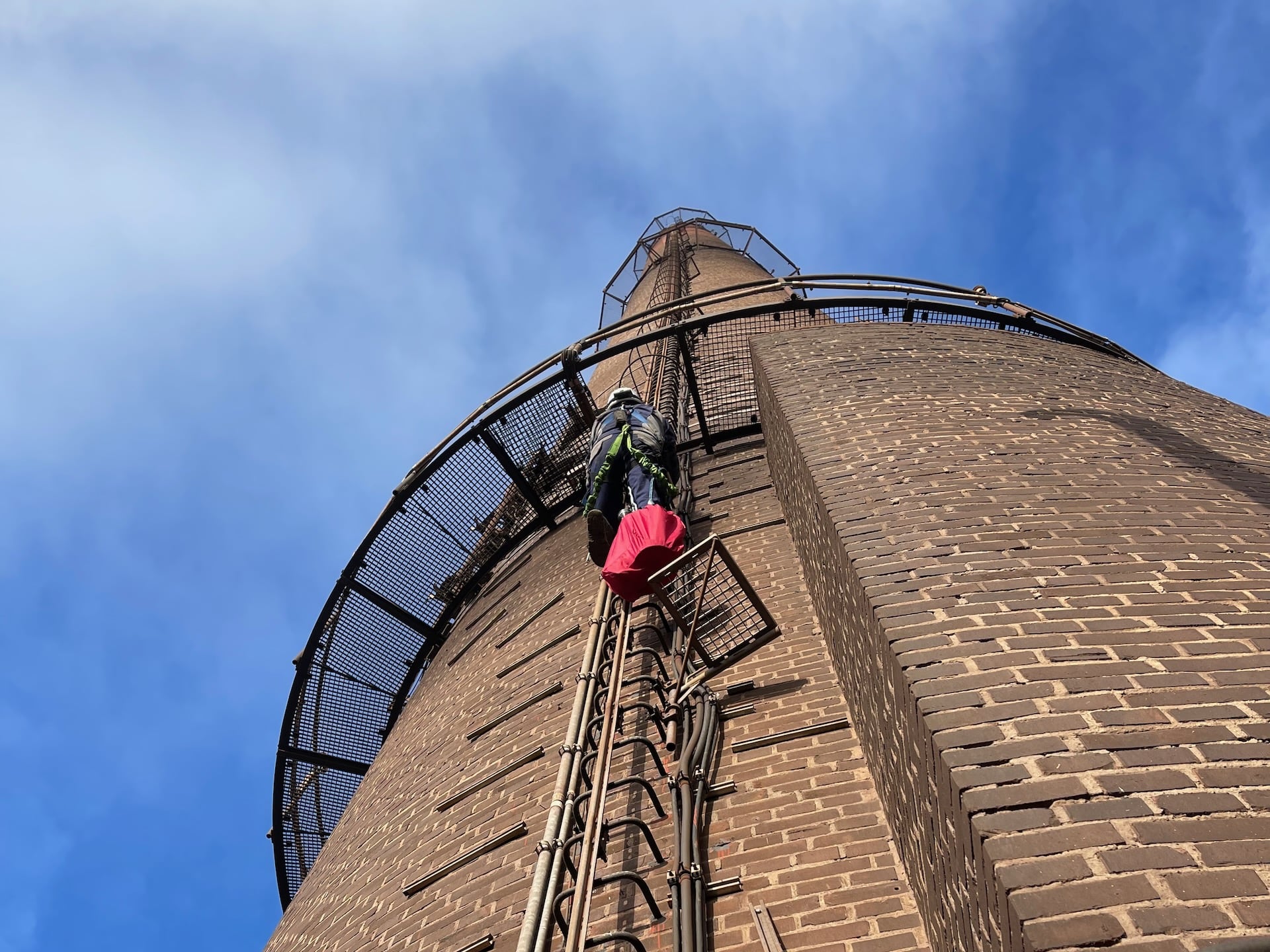
Rope access remains indispensable for tactile NDT testing – but the drone defines the scope in advance.
The most practical answer to “drone or climber?” is usually: both – in the right order. Hybrid inspection combines the strengths of both methods:
Recommended Hybrid Approach
- Drone first flight: The drone documents the entire structure in 4K and optionally with LiDAR. All visible findings are identified, located and classified. This typically takes a fraction of the time of a climber deployment.
- Targeted climber deployment: Only at locations where the drone has identified findings with suspected further damage – or where tactile NDT methods (UT, MT) are required – are climbers deployed. The scope is clearly defined: no blind walk-over of the entire structure.
This approach reduces the climber deployment to a minimum, saving time, cost and safety risk – without sacrificing the quality of tactile testing methods.
When the Climber Adds No Value
For purely visual condition documentation – the majority of all industrial inspection tasks – a climber is not necessary. Typical applications where the drone alone is sufficient:
- Annual inspections of chimneys and flues (Schornsteine und Kamine)
- Condition documentation of tanks before and after maintenance
- Pre-TAR (Turnaround) inspections for scope definition
- Insurance and regulatory documentation obligations
- Damage progression monitoring over multiple inspection cycles
Speak to us: we advise you free of charge on which combination makes sense for your specific equipment – and where we would recommend the climber.
Talk Directly to Our Team
We give you an honest assessment – including when rope access or a hybrid approach makes more sense.
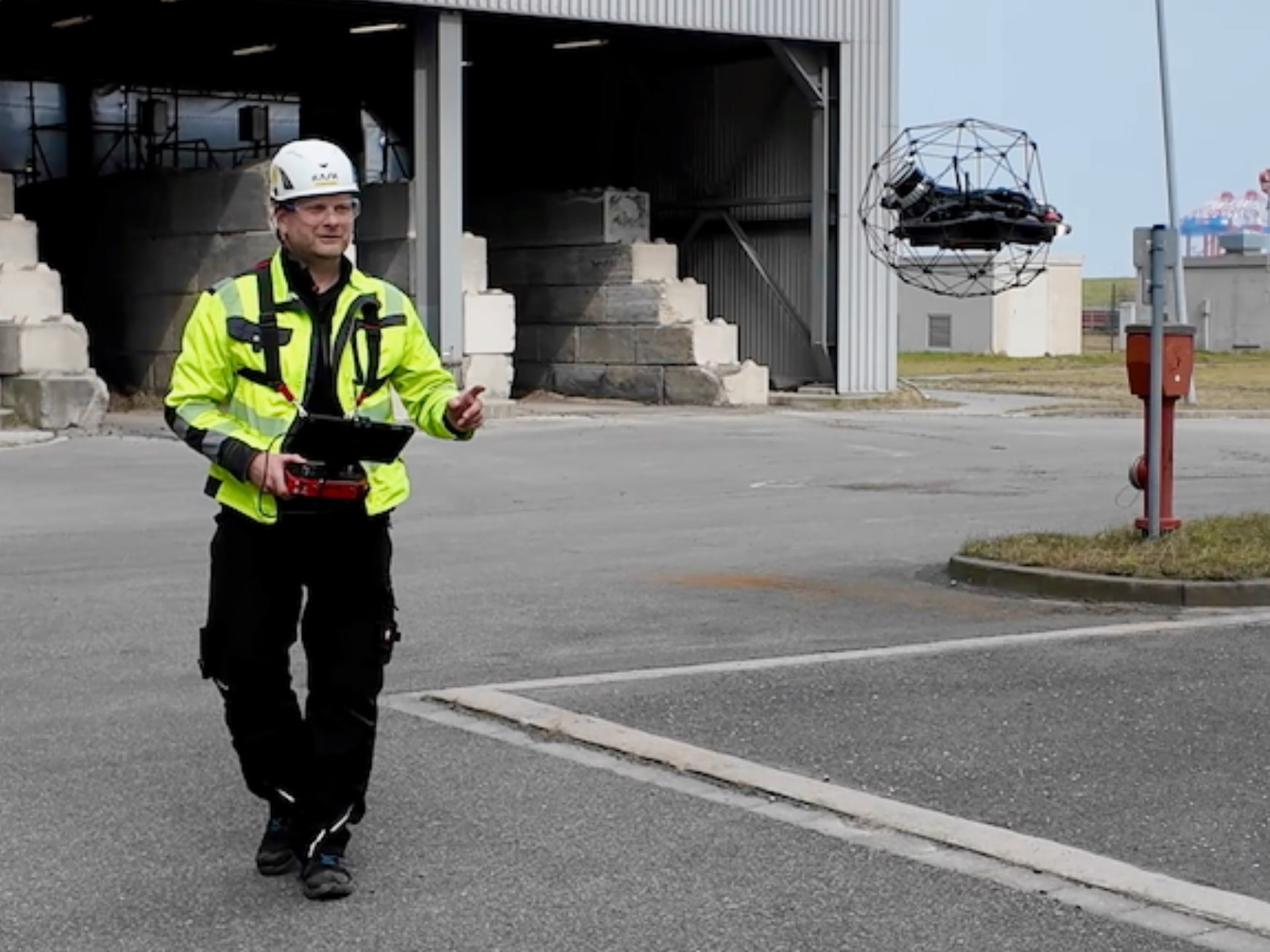 Christian Engelke
Managing Director & Chief Pilot
Christian Engelke
Managing Director & Chief Pilot
 Karsten Lehrke
Dipl.-Ing., Senior Inspector
Karsten Lehrke
Dipl.-Ing., Senior Inspector
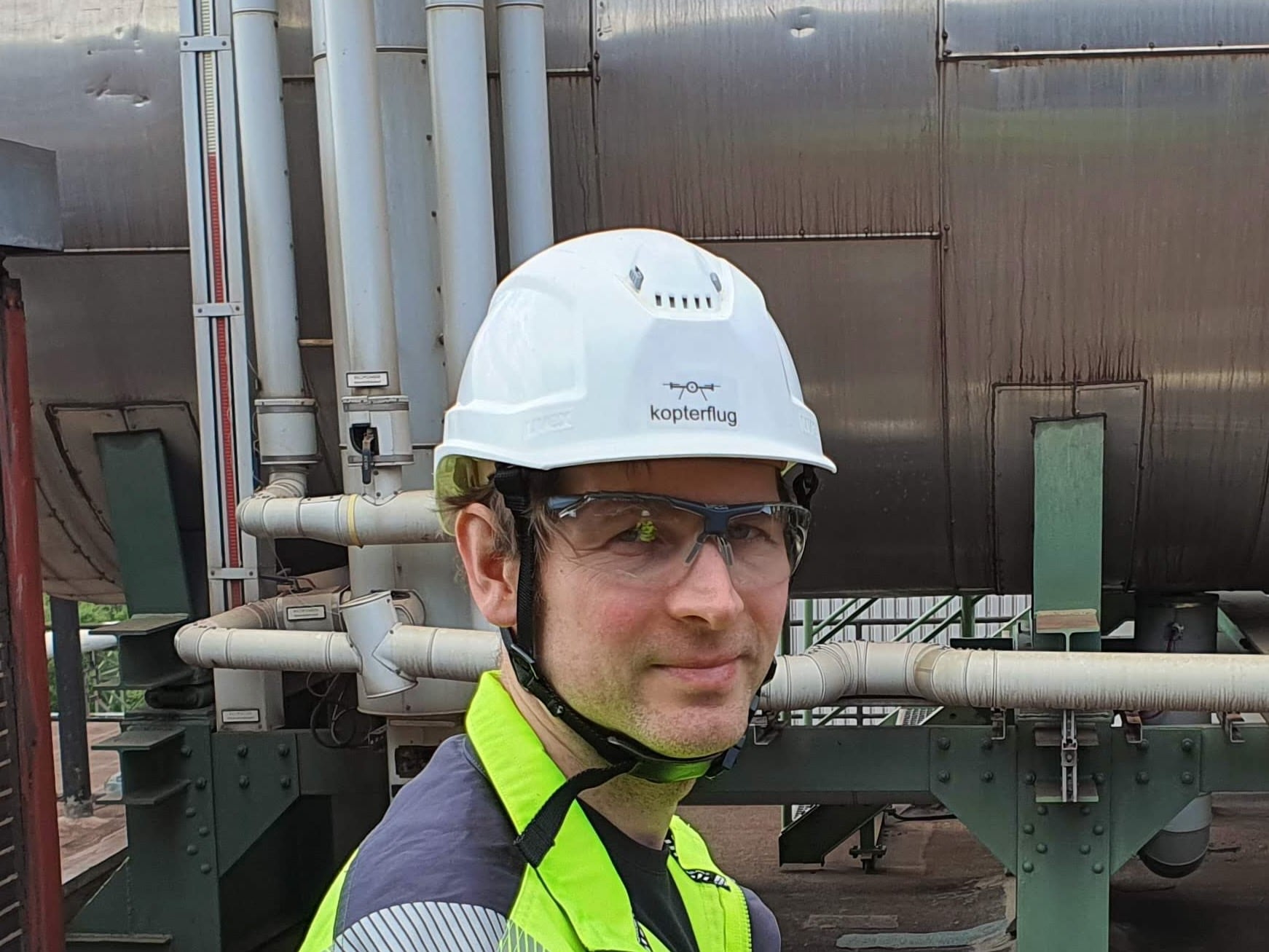 Philipp
Drone Pilot & Inspector
Philipp
Drone Pilot & Inspector
 Juliana
Project Coordination
Juliana
Project Coordination
 Stephan
Drone Pilot & Inspector
Stephan
Drone Pilot & Inspector
Related Services
- Drone vs. Scaffolding & Rope Access (Gerüst & Seilzugang) – Cost comparison between drone, scaffolding and rope access.
- Chimney Inspection (Schornsteininspektion) – Interior and exterior chimney inspection – also without full shutdown.
- Hybrid Inspection Practical Guide – Drone first, human only where necessary.
- Confined Spaces Inspection – Safe inspection of tight spaces without personnel entry.
- Pipe Bridge Inspection (Rohrbrücken-Inspektion) – Drone inspection of pipeline bridges inside and out.
- Heavy Industry Inspection – Drone inspection for blast furnaces, steel mills and heavy industry.
Frequently Asked Questions: Drone vs. Industrial Climber
Can a drone completely replace the industrial climber?
For purely visual inspection and documentation the drone is in most cases the superior method. However, wherever tactile NDT testing (UT, MT, PT) is required, or where repairs must be carried out immediately after inspection, the climber remains indispensable. Our recommendation for complex assets: hybrid inspection – drone first, climber only in targeted, finding-based areas.
Is the drone cheaper than rope access?
For visual inspection: yes, typically. A drone team (1–2 people) has similar daily rates to a climber team (2–4 people), but is 3–5 times more productive in the same time. The drone inspects 3–6 units per day; a climber team 1–2 structures. The cost advantage grows with the number of units and inspection height.
Can the drone work in poor weather?
The ELIOS 3 for indoor use is completely weather-independent – it flies in tanks, boilers and confined spaces regardless of outdoor conditions. The DJI Matrice 30T for outdoor use is rated IP55 and is stable up to 15 m/s – considerably more weather-resistant than rope access teams, who must stop work at around 8–10 m/s (Beaufort 5).
What certification does a professional inspection drone service require?
For outdoor operations: EU drone licence A2/A3 (EU Drone Regulation 2019/945). For indoor inspections with the ELIOS 3: no drone licence required (EU regulation only covers outdoor airspace). Additionally: liability insurance (≥€5 million), and for VT reporting: VT Level 2 certification of the evaluating personnel according to DIN EN ISO 9712. We fulfil all requirements – operating since 2017.
Can the drone also inspect inside chimneys?
Yes. The ELIOS 3 inspects chimney interiors from DN 600 upwards. LiDAR navigation works GPS-free inside the chimney. The lining condition, mortar condition, condensate zones and anchor bolts are documented in 4K. The DJI Matrice 30T covers the chimney exterior with 200x zoom from ground level – without scaffolding, without rope access.
Which NDT methods can the drone perform?
The drone performs visual testing (VT) in 4K, thermography (TT) for heat anomalies and CUI detection, and 3D geometry measurement via LiDAR. It cannot perform contact-based methods such as UT (ultrasonic thickness measurement), MT (magnetic particle) or PT (dye penetrant). For these methods we recommend a hybrid approach: drone first for location, then NDT specialist for targeted measurement.
How do I decide which method to use for my asset?
The key question: do I need purely visual documentation, or are tactile NDT measurements required? If purely visual: the drone is the better choice in almost all cases. If NDT measurements are needed: we recommend hybrid inspection – drone first to identify and prioritise, then NDT specialist only where needed. We advise you free of charge – simply describe your equipment.
What does the documentation look like after a drone inspection?
You receive: 4K video of all inspected surfaces, a findings report (PDF) with photos, finding location, assessment and recommended action, optionally a LiDAR 3D model (.PLY/.OBJ) for BIM/CAD and thermography evaluation with radiometric data. This documentation depth is not achievable with rope access methods.
Method Comparison for Your Asset: Drone vs. Industrial Climber
We help you decide which method is more efficient for your specific case – and combine both when it makes sense. Free initial assessment, no obligation.