

Risk Assessment before Drone Inspection – Safety Concept, ATEX & DGUV
Professional drone inspection in industrial plants requires a systematic, documented risk assessment before every deployment. DGUV Regel 103-003, BetrSichV, ATEX directive – what must be checked, and why a thorough safety concept is legally mandatory.
Why a Systematic Risk Assessment Is Indispensable
A drone inspection in industrial plants is not a standard flight. Industrial environments confront any deployment with a wide range of specific hazard sources that must be systematically assessed and documented before operations begin. This is not merely a question of internal quality management – it is a clear requirement under occupational safety law and applicable standards:
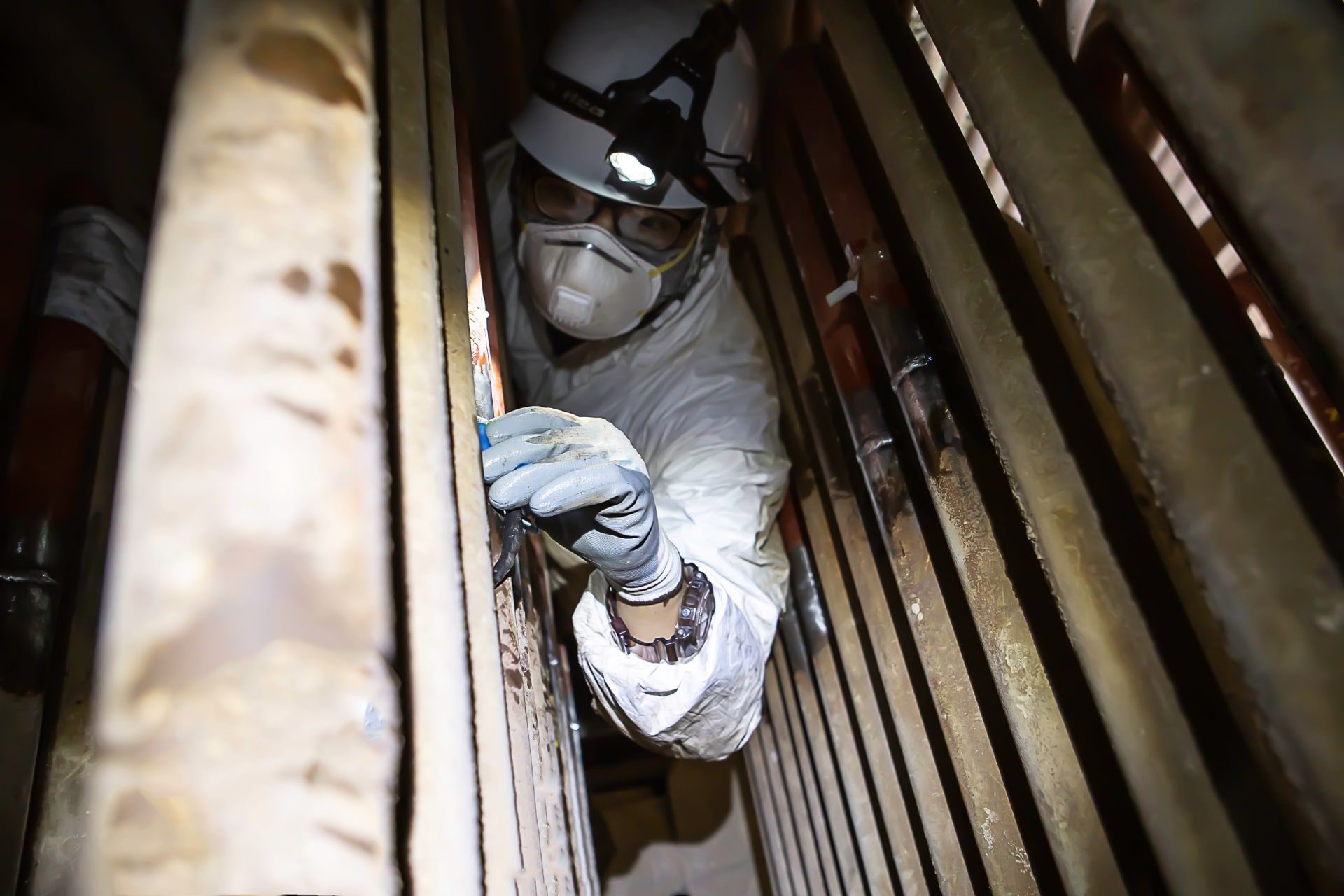
DGUV Regel 103-003 (Arbeiten in engen Räumen – Working in Confined Spaces) requires a written risk assessment (Gefährdungsbeurteilung) prior to entry or entry-like activities in confined spaces, and – where relevant hazards exist – a written permit (Erlaubnisschein). Even though the drone does not require personnel to enter, persons at the entry point (manhole, inspection nozzle) and in the immediate vicinity must be secured.
BetrSichV (German Industrial Safety Regulation) and GefStoffV (Hazardous Substances Regulation) require a risk assessment for all work activities – including inspection activities – in hazardous areas. A professional risk assessment prior to drone deployment is therefore not optional, but legally mandatory.



A professional drone inspection company delivers not just images – it delivers a traceable safety concept that stands up to scrutiny by the plant operator, client and authorities.
Key Hazard Sources in Industrial Drone Deployments
The following hazard sources are systematically assessed prior to every drone deployment in industrial plants:




ATEX & Explosion Zones: What Is Permitted?
The most frequent question in process industry drone deployments concerns ATEX: Is a drone permitted to fly in potentially explosive atmospheres?
The clear answer is: it depends on the zone – and on the drone.
The ELIOS 3 by Flyability is not ATEX-certified and may therefore not be deployed in active Ex Zones 0, 1, 20 or 21 where an explosive atmosphere is present. For Ex Zone 2 and 22 (occasionally explosive atmosphere) a risk assessment with the plant operator is required.
This changes, however, when the plant has been properly purged, inertised or ventilated and a gas measurement confirms that the lower explosive limit (LEL) is below <10%. In this case, the ELIOS 3 can be deployed in formerly classified zones – the zone classification applies only during normal operation with flammable media, not in the cleaned shutdown state.
Practical procedure:
- Preliminary clarification with the plant operator: which Ex zones exist in the plant?
- Purge and measurement protocol: gas measurement with calibrated instrument, result documented
- Permit-to-work system: written release by the plant safety officer
- Continuous gas monitoring at the entry point throughout the flight
ATEX classification does not automatically mean drone deployment is impossible. What matters is the atmospheric condition at the time of deployment – not the zone classification under normal operating conditions.
The Safety Plan: Components and Structure
For every drone deployment in safety-relevant environments, Kopterflug prepares a written safety plan comprising the following elements:

Related Services
- Confined Space Inspection – Inspect confined spaces safely without human entry.
- Chemical Industry – Drone inspection in chemical plants – safe, ATEX-aware and without production shutdown.
- Industrial Inspection Overview – All drone inspection applications in industry.
- Oil & Gas Inspection – Drone inspection in ATEX-classified oil and gas environments.
- ATEX & Explosion Protection – Requirements for ATEX-compliant drones in explosive atmospheres.
Your Contacts
Christian Engelke – your direct contact for risk assessment and drone inspection.
Since 2017, Kopterflug has been carrying out drone inspections in demanding industrial plants – including plants with ATEX zones, confined spaces and high-hazard atmospheres. We prepare a written safety concept for every deployment and coordinate with your plant safety officer in advance.
 Christian
Founder & Drone Pilot
Christian
Founder & Drone Pilot
 Philipp
Founder, Operations & Logistics
Philipp
Founder, Operations & Logistics
 Juliana
Drone Pilot
Juliana
Drone Pilot
 Stephan
Operations & Logistics
Stephan
Operations & Logistics
Frequently Asked Questions: Risk Assessment & Safety
Is a risk assessment legally required before a drone inspection?
Yes. Under BetrSichV (German Industrial Safety Regulation) and DGUV Regel 103-003, a written risk assessment is required for all inspection activities in potentially hazardous areas – including drone deployments near confined spaces. The plant operator bears primary responsibility; a professional inspection company prepares its own safety concept for the deployment.
Can the ELIOS 3 fly in ATEX-classified zones?
The ELIOS 3 is not ATEX-certified. It must not be deployed in active Ex Zones 0, 1, 20 or 21. Deployment is permissible once the plant has been properly purged, inertised or ventilated and a calibrated gas measurement confirms the atmosphere is below 10% of the lower explosive limit (LEL). The zone classification under normal operation does not automatically apply in the cleaned shutdown state.
Who is responsible for the safety concept?
Both parties share responsibility: Kopterflug prepares the deployment-specific safety concept and documents all safety measures. The plant operator provides information on existing ATEX zones, process media and plant condition, and issues the permit-to-work. Gas measurement at the entry point is carried out by Kopterflug or the plant operator in agreement.
What gas measurements are required before drone deployment?
At minimum: oxygen content (target: 19.5–23.5%), explosive gas concentration (target: <10% LEL), carbon monoxide (CO) and – depending on the medium – hydrogen sulphide (H⊂S), ammonia (NH⊂) and toxic process gases. Measurement with calibrated, ISO-certified detection instruments. The result is documented in writing.
What temperature is required for drone deployment in boilers and reactors?
The ELIOS 3 is rated for an operating temperature of 0°C to +50°C. For deployment in boilers, furnaces and reactors, the internal temperature must be below approx. 50°C. Temperature measurement at the entry point prior to deployment is part of the standard safety check.
What happens if an alarm triggers during the drone flight?
The emergency plan defines clear procedures: in the event of a gas alarm, the drone is immediately retrieved or the entry point is closed. If retrieval is not possible, the drone remains in the vessel until safe access is ensured. All procedures are defined in writing prior to deployment and coordinated with the plant's on-site safety officer.
Request Safety Concept
Tell us your plant, operating status and ATEX classification – we will assess feasibility and prepare a tailored safety concept. Free and without obligation.