
Drone Inspection in Steelworks – Blast Furnaces, Converters & Chimneys
Refractory lining assessment, structural damage and corrosion safely documented – with the ELIOS 3 without scaffolding. Since 2017. Blast furnaces, LD converters, EAF vessels and flue gas systems.
Steelworks as Extreme Environments for Inspections
Steelworks are among the most demanding industrial environments. Blast furnaces, converters (LD converters/BOF), electric arc furnaces, foundries and their associated flue gas and chimney systems operate under extreme temperatures, aggressive atmospheres and heavy dust loading. Inspections here are not only difficult – they are particularly safety-critical due to the enormous hazard potential.
Conventional methods – scaffolding, entry devices, industrial rope access teams – quickly reach their limits in steelworks. Refractory linings must be assessed after every campaign cycle before a decision can be made whether they are fit for another operating cycle or need repair. Any misjudged wear can lead to a breakout – with catastrophic consequences for the plant and workforce.
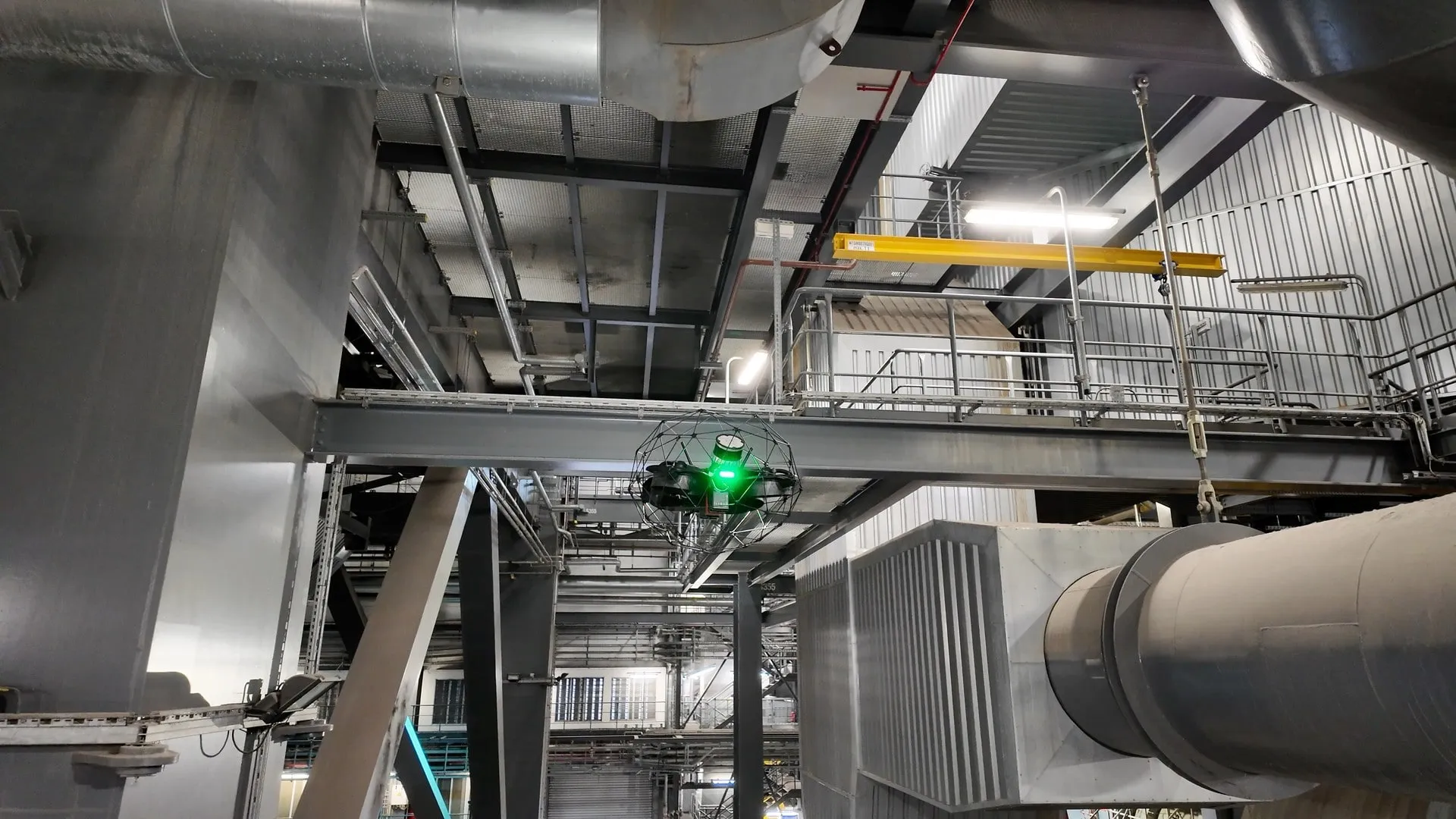
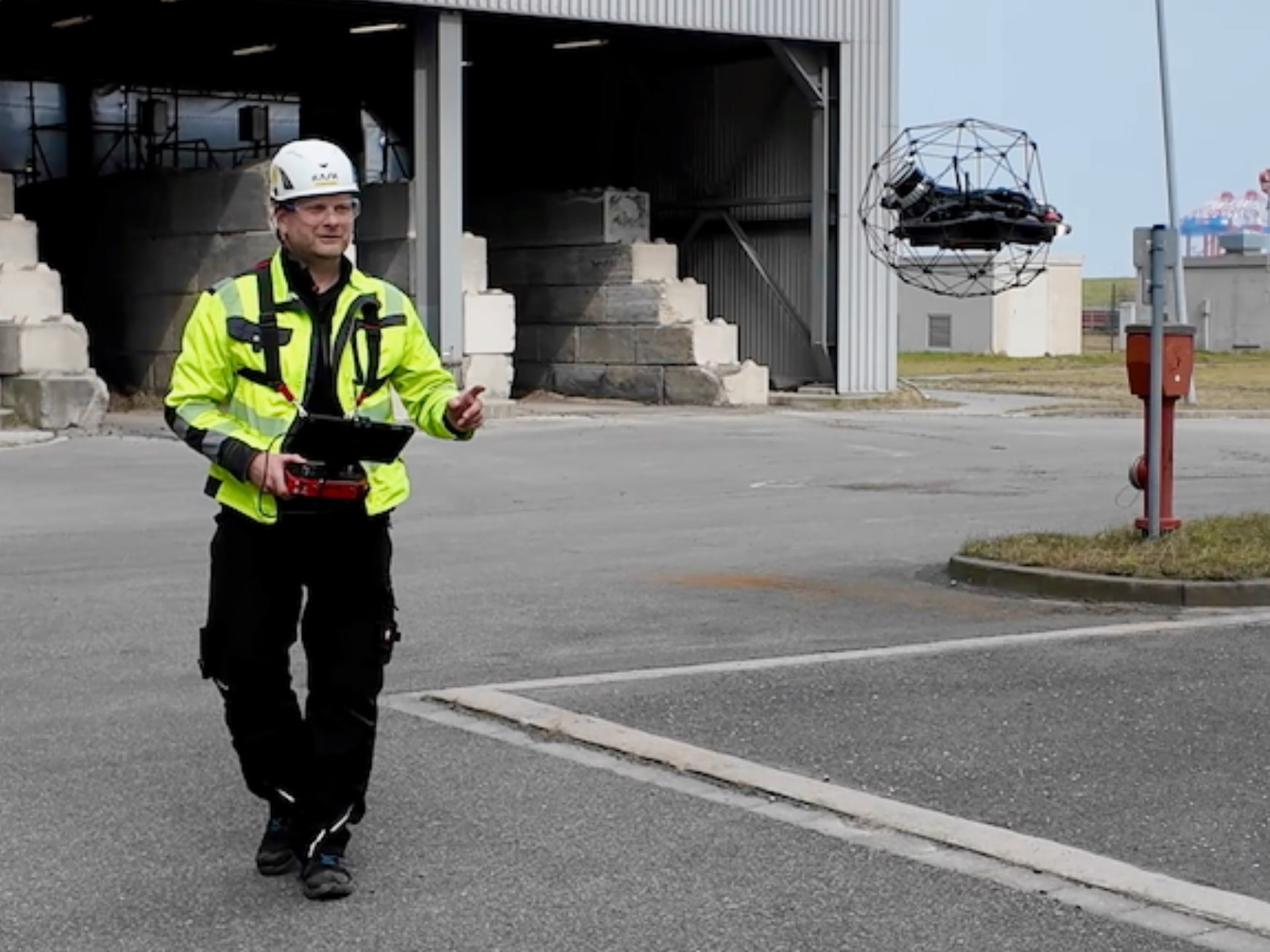
The Flyability ELIOS 3 is the first indoor drone to address these requirements systematically. Equipped with a collision-resistant cage, 4K-60fps camera, optional thermography camera and an integrated LiDAR system, it navigates GPS-free in complete darkness through enclosed spaces – without human entry, without scaffolding.
Typical Inspection Objects in Steelworks
- Blast furnaces: shaft lining (Schachtausmauerung), bosh, hearth, cooling stave zones, top gas cleaning
- LD converters (BOF): refractory lining, mouth ring (Mundring), bottom tuyeres (OBM/Q-BOP), trunnion zone
- Electric arc furnaces (EAF): vessel, roof, electrode system, taphole runner
- Dedusting chimneys and filter plants: internal corrosion, condensate nests, lining condition
- Casting hall roof structures: girder corrosion, weld fatigue, crane rail tracks
- Ladles and slag pots: lining condition, iron build-up, cracking
The blast furnace sets the highest requirements: in shutdown state the interior is hazardous due to blast furnace gas, residual slag and furnace atmosphere. The ELIOS 3 can be introduced through specialist entry points into the furnace interior and delivers a complete 4K video record of the entire lining within minutes.
Refractory Lining Assessment by Drone
The refractory lining is the core of every metallurgical vessel. In blast furnaces it is called the Zustellung, in converters the Ausmauerung – in both cases the condition of this lining determines the remaining service life until the next rebuild.
Conventionally, wear is assessed by manual walkthrough with measuring rod and visual inspection – a time-consuming, dangerous method that also delivers no complete documentation. The ELIOS 3 with integrated LiDAR scanner transforms this process:
- 3D laser scanning of the internal contour: The LiDAR system generates a centimetre-accurate point cloud of the entire lining geometry. Wall thickness reductions are visualised as a colour gradient.
- Comparison with as-built geometry: The current scan is overlaid with the baseline state after the last rebuild. Wear exceeding 50 mm in critical zones is immediately identified.
- Thermography overlay: Hot spots on the outer wall correlate with lining damage inside. With the optional thermography camera of the ELIOS 3 or a DJI Matrice 30T for external inspection, a complete picture emerges.
- Crack detection: Deep cracks, joint openings and spalling of refractory material are documented in 4K and localised in the 3D model.
The result is a sound decision basis: is the remaining lining cross-section sufficient for another operating cycle? Which areas must be repaired in the next shutdown? These questions traditionally cost days of manual measurement – the drone answers them in hours.
Normative Framework
Visual inspection to DIN EN ISO 17637 and condition assessment under BetrSichV §15 (recurring inspections) provide the normative basis. Drone inspection does not replace the licensed expert, but delivers the information base for their assessment. For blast furnaces, the relevant technical rules of BG RCI and TRGS requirements for hot operations also apply.
Chimney and Structural Inspection in Steelworks
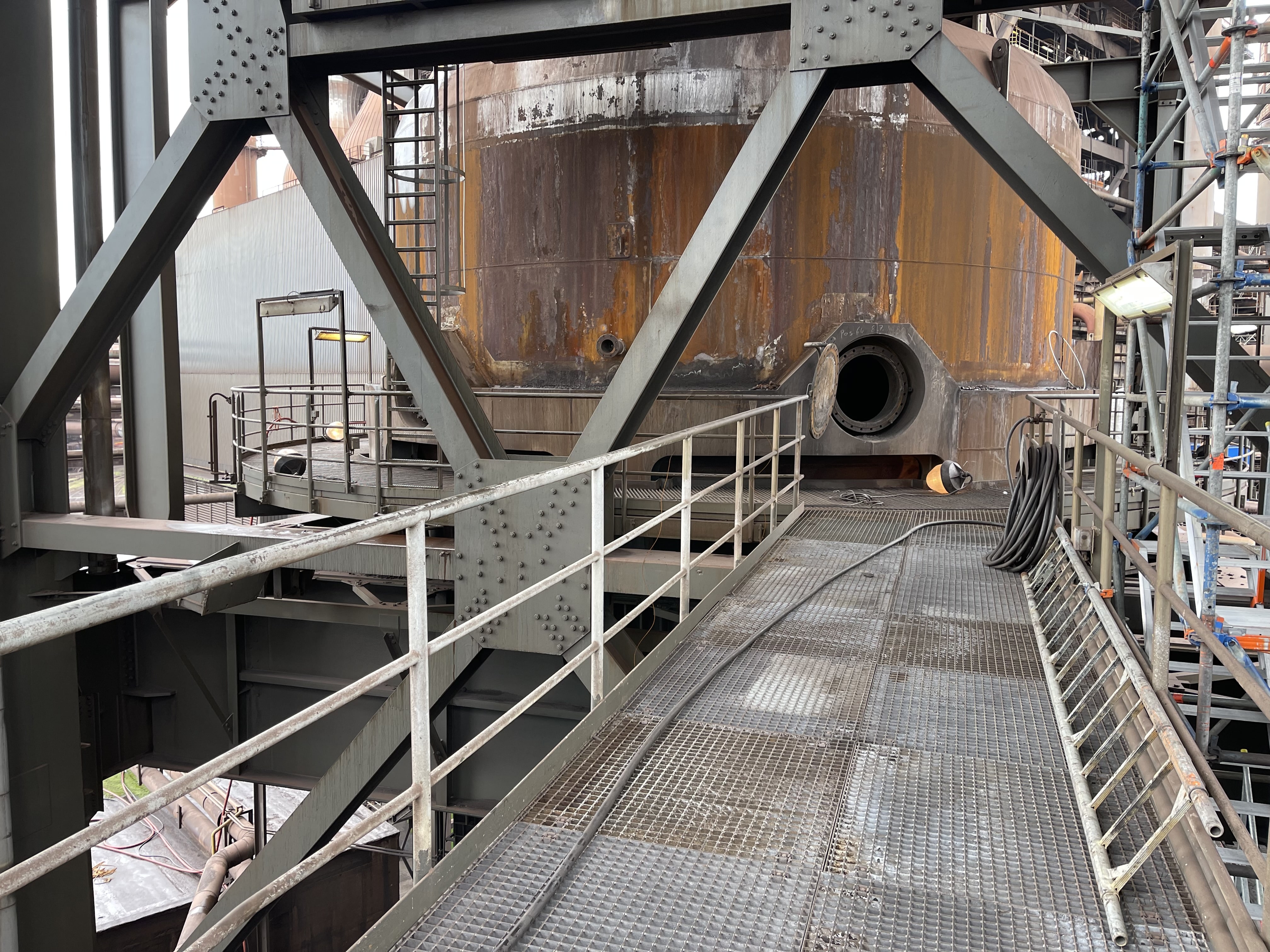
Steelworks operate a network of flue gas ducts, chimneys and dedusting plants requiring continuous monitoring. Sulphur dioxide, nitrogen oxides and dusts from the smelting process aggressively attack steel and concrete structures.
Chimneys and Flue Gas Ducts
The ELIOS 3 is deployed for internal inspection of steelworks chimneys – without entry platform, without scaffolding. Typical findings:
- Internal corrosion and pitting in steel chimneys
- Condensate nests in the condensation zone (below acid dew point temperature)
- Cracks in concrete chimneys, rebar exposure
- Zugankerplatte (anchor plate) and ladder rung corrosion
- Corrosion at cleanout openings and condensate drains
For external inspection of tall steelworks chimneys, the DJI Matrice 30T is used – with 200x hybrid zoom and integrated thermography camera, it captures surface damage and metal connections that are invisible from ground level.
Steel Structures and Hall Frameworks
Casting halls, slag handling bays and converter halls are steel structures under extreme thermal and mechanical loading. Overhead cranes with 300–500-tonne capacity impose fatigue cycling on girders and connections. Typical damage:
- Weld fatigue cracks at crane rail connections
- Corrosion under insulation (CUI) at wall and roof sections
- Deformations and deflections in overheated girders (slag spatter heat exposure)
- Bearing corrosion and cracking at column bases
Integration into Maintenance Planning
For steelworks operators such as ArcelorMittal, thyssenkrupp Steel, Salzgitter AG or Hüttenwerke Krupp Mannesmann, integrating drone inspection into the existing maintenance and shutdown plan is the decisive success factor.
Recommended Inspection Strategy
- End-of-campaign inspection (pre-repair): Immediately after tapping and cool-down, the drone documents the lining condition. This data feeds directly into the repair scope for the next rebuild.
- Post-repair documentation: After lining rebuild, the new state is 3D scanned. This reference geometry serves as the baseline for all subsequent inspections.
- Damage progression monitoring: Scan-to-scan comparison documents lining wear across multiple campaigns. Predicted refractory life enables plannable budget management.
- Annual chimney inspection: Outside the main shutdown (with individual aggregates offline) the chimney inspection is carried out with the ELIOS 3.
Safety Requirements
Steelworks apply special safety regulations under BGR 109 (working in vessels and confined spaces) and BG RCI rules. Before every entry, the following are carried out:
- Explosive gas analysis (carbon monoxide, furnace gas) per TRGS 722
- Temperature measurement – ELIOS 3 deployment only below 60°C internal temperature
- Release by the plant safety officer
- Rescue standby per DGUV Information 213-050
Related Services
- Heavy Industry Inspection – Drone inspection for blast furnaces, steelworks and heavy industry.
- Chimney Inspection – Inside and outside chimney inspection – possible without full shutdown.
- Confined Space Inspection – Safe inspection of confined spaces without human entry.
- Boiler Inspection – Water tube boilers and steam generators safely inspected by drone.
- Chemical Industry – Inspection of reactors, columns and pipelines in chemical plants.
- Power Plant Inspection – Drone inspection for power plants, boilers and chimneys.
Your Contacts
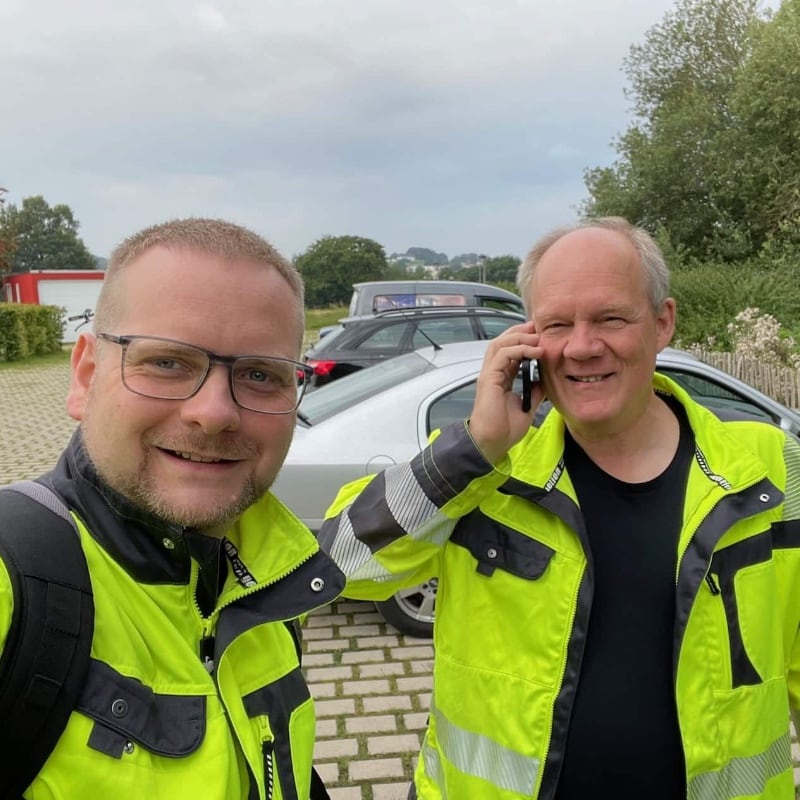
Christian Engelke and Dipl.-Ing. Karsten Lehrke – your direct contacts for steelworks inspection projects.
Our pilots are experienced in working in hot and gas-hazardous environments and align every deployment in detail with the plant operator in advance. Contact us for a feasibility assessment for your steelworks.
 Christian
Founder & Drone Pilot
Christian
Founder & Drone Pilot
 Karsten
Project Manager
Karsten
Project Manager
 Philipp
Founder, Operations & Logistics
Philipp
Founder, Operations & Logistics
 Juliana
Drone Pilot
Juliana
Drone Pilot
 Stephan
Operations & Logistics
Stephan
Operations & Logistics
Frequently Asked Questions
Can the ELIOS 3 fly inside a blast furnace?
Yes – the ELIOS 3 can be introduced through specialist entry points (inspection nozzles, tuyere openings) into the blast furnace interior. The prerequisite is that the furnace is in a cooled-down, gas-free shutdown state. The temperature must be below approximately 50–60°C and a gas-free measurement (CO, furnace gas) must confirm safe atmospheric conditions. We assess feasibility in advance in coordination with the plant's safety officer.
What does refractory lining wear assessment by drone look like in practice?
The ELIOS 3 generates a centimetre-accurate 3D point cloud of the entire lining interior surface. This is compared with the as-built geometry from the last rebuild. The deviation – visualised as a colour gradient – shows exactly where and how much wear has occurred. Zones with more than 50 mm wear in critical areas are immediately flagged. The result replaces days of manual measurement and delivers a significantly better data basis for the repair scope decision.
Can drone inspection replace the licensed inspector (ZÜS/TÜV)?
No. Drone inspection provides the data basis for the licensed inspector's assessment – it does not replace the inspector. Our 4K documentation and LiDAR point clouds serve as input for the inspector's evaluation. In many cases this reduces the inspector's on-site time and allows more focused inspection of the areas actually requiring attention.
How is a steelworks drone inspection integrated into the shutdown plan?
We recommend an end-of-campaign inspection immediately after tapping and cool-down, before repair work begins. Typical timing: drone inspection on day 1–2 of the shutdown, repair scope decision on day 2–3 based on the findings. This eliminates guesswork in the repair planning and avoids unnecessary rework in zones that are still serviceable.
Request Steelworks Drone Inspection
Whether blast furnace, converter, chimney or pipe bridge – we assess free of charge which of your plant components can be more efficiently inspected by drone.