
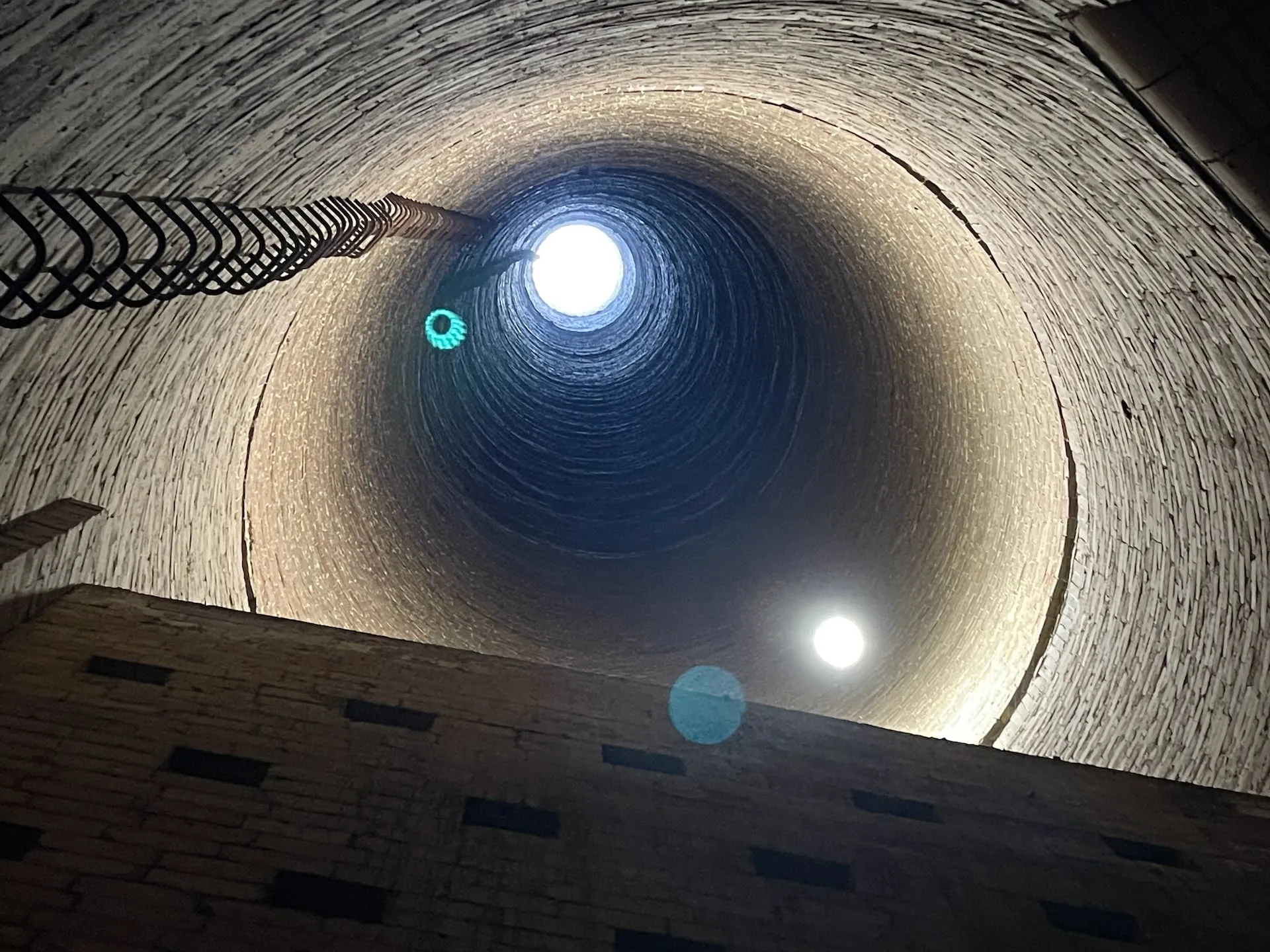
Chimney Inspection by Drone – No Scaffolding, No Climbers, Inside & Out
Kopterflug inspects industrial chimneys with the Flyability ELIOS 3 from the inside and the DJI M30T from the outside – without scaffolding, without rope access teams, without height workers. Your chimney experts assess the findings; we deliver the data.
- Interior inspection without human entry – drone ascends from ground level to the top
- Exterior inspection without scaffolding – DJI M30T with 200× zoom and thermography
- 4K + Thermography + LiDAR – documentation for expert assessors and certified inspectors
- Compliant with 1. BImSchV (Federal Emission Control Regulation) and KÜO – nationwide since 2017
Services at a Glance
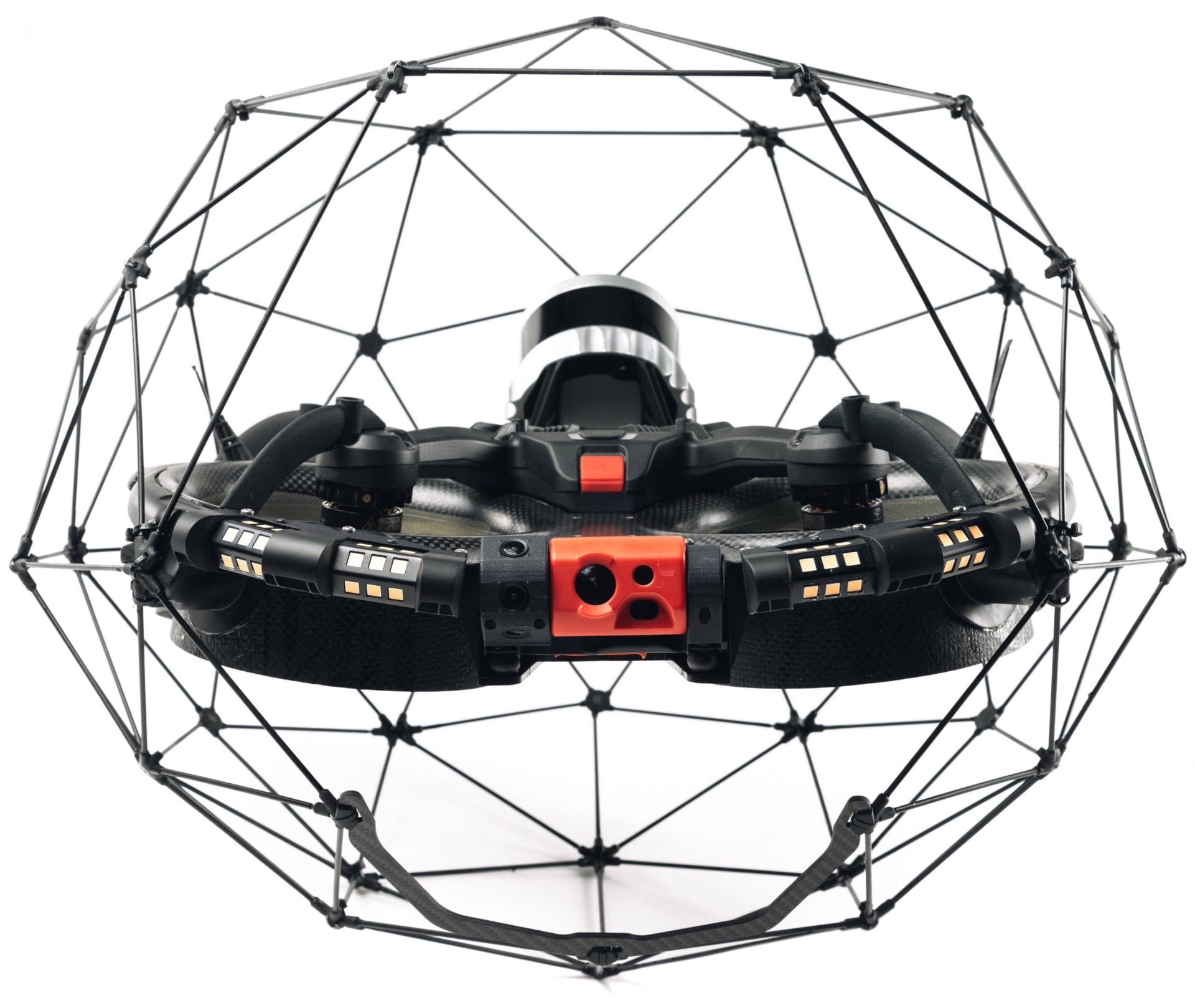
The ELIOS 3 ascends from ground level through the flue shaft – no scaffolding, no climbers, no human entry into the flue gas atmosphere.
Our services for chimneys – Schornsteine in German:
- Interior and exterior inspection: ELIOS 3 for the interior (through the shaft), outdoor drone for the exterior (thermography of the chimney head and outer shell)
- 4K + Thermography + LiDAR: High-resolution documentation of masonry and liner pipes, thermography for thermal anomalies, LiDAR for geometry
- No scaffolding, no climbers: Drastically reduced costs compared to external scaffolding or rope access
- Expert documentation: Detailed inspection reports per 1. BImSchV and KÜO for your chimney builders and certified assessors
We have been deploying the ELIOS 3 in industrial chimneys since 2017 – with experience from numerous inspections in power plants, refineries, cement works and waste-to-energy plants. We collaborate regularly with chimney builders (Schornsteinbauer), assessors (Sachverständige) and engineering offices such as Züblin, ZCR and I.S.T. – Ingenieurbüro für SchornsteinTechnik (Jörg Gajewski, qualified chimney inspector dgfs).
The key advantage: while conventional exterior scaffolding for chimneys from 100 m height means months of assembly time and often over €100,000 in costs, we inspect from the inside in a fraction of the time. No months of scaffolding erection, no climbers at 100 m height, no fall risk. Documentation aligned with 1. BImSchV and KÜO – coordinated with your chimney builders and district chimney sweeps (Bezirksschornsteinfeger).
The Challenges of Industrial Chimney Inspection
Industrial chimneys – Industrieschornsteine – are among the most demanding structures to inspect. Large heights, aggressive media, difficult access and strict safety requirements make conventional inspection methods laborious, expensive and risky – both externally and internally.


Scaffolding & Complex Access
External scaffolding (Außengerüst) for chimneys from 100 m height means months of erection time and often six-figure costs. Internally, cradle systems or specialized access equipment are used – each with considerable logistical overhead. The ELIOS 3 flies from the bottom up through the shaft – no external work, no scaffolding costs.
Safety Risks and Weather Dependency
Work inside or at height on the chimney is subject to strict regulations. Industrial climbers (Industriekletterer) cost €3,000–5,000 per day and are weather-dependent – wind, rain or ice can completely block exterior work. Drone inspections eliminate the height risk entirely.
Limited Visibility and Hidden Structural Damage
Masonry cracks, liner erosion, sooting (Versottung) and reinforcement corrosion are not visible from the outside. Internals, constrictions and large heights make complete visual inspection difficult. Thermal cycling and chemical attack cause structural damage that only becomes visible through an interior inspection.
High Temperatures and Residual Heat in the Shaft
Even after shutdown, the chimney often remains intensely heated for days. An interior inspection is only possible once temperatures have dropped to a safe level – this extends downtime and restricts the inspection window. Plan the cooling phase when scheduling.
Toxic and Corrosive Atmospheres
Sulfur, chlorine and other aggressive compounds as well as soot and fly ash create harmful atmospheres inside. Respiratory protection, ventilation and continuous gas monitoring are required for human entry. Drone inspections proceed without human entry into the flue gas atmosphere.
No Reproducibility
Manual inspections are frequently based on individual photographs and subjective assessments. Comparable condition assessment over multiple years is only possible to a limited extent. Drone footage delivers systematically documented, position-referenced findings – ideal for trend analyses and condition comparisons.
What the ELIOS 3 Documents in Chimney Inspections
We fly the ELIOS 3 from the bottom up through your chimney shaft and systematically document all safety-relevant areas. The technical assessment is carried out by your chimney experts and certified assessors – we deliver the data:
Inner Masonry & Brickwork (Innere Ausmauerung)
4K footage of cracks, erosion, spalling, mortar damage, joint failure. Masonry damage leads to heat escape and structural weakening. Your assessors can use our 4K imagery to determine whether remediation is required.
- How we do it: 4K camera documents every centimetre from bottom to top; LiDAR measures geometry deviations; thermography reveals thermal anomalies
Liner Pipes & Flue Gas Routing (Futterrohre & Abgasführung)
Close-up footage of corrosion, cracks, sooting and deposits on the liner pipe (Futterrohr). Stainless steel or ceramic liner pipes carry hot flue gases – corrosion and cracks lead to leaks and sooting of the surrounding masonry. Our 4K footage shows every defect – your chimney builders assess the risk.
- How we do it: 4K imagery at close range, thermography for leaks and thermal deviations, 360° documentation
Sooting & Moisture Damage (Versottung & Feuchteschäden)
Versottung – acidic condensate soaking into the masonry – destroys the brickwork from the inside and can lead to structural damage. We document the current condition; your assessors plan the remediation measures.
- How we do it: 4K camera shows discoloured and soaked zones; thermography identifies moisture pockets
Chimney Head & Internals (Schornsteinkopf & Einbauten)
Condition of the chimney cap (Schornsteinkopf), covers, fittings, ladders and connections. The chimney head is exposed to weathering – cracks and damage here lead to water ingress. For exterior inspections, we additionally document the chimney head from the outside with an outdoor drone.
- How we do it: 4K documentation from inside (ELIOS 3) and outside (outdoor drone with thermography), LiDAR for structural measurement
Weld Seams & Steel Shell (Schweißnähte & Stahlmantel, steel chimneys)
Weld defects (Schweißnahtdefekte), coating delamination, pitting corrosion (Lochkorrosion), condensation zones and structural deformation. Steel chimneys frequently fail through dew-point corrosion (Taupunktkorrosion) on the interior – particularly in the lower third where flue gases condense. Weld failure is difficult to predict and invisible from the outside. Our drone shows every centimetre of weld seam at close range.
- How we do it: 4K camera at close wall proximity, thermography for condensation zones and thermal bridges, LiDAR for deformation analysis and geometry comparison between inspection cycles
At the end we hand over a detailed inspection report with 4K imagery from ground to chimney head, thermography evaluation for thermal anomalies and optionally 3D models. Documentation oriented to 1. BImSchV, KÜO and prepared for expert assessments. Your chimney experts assess the findings and make the decisions.
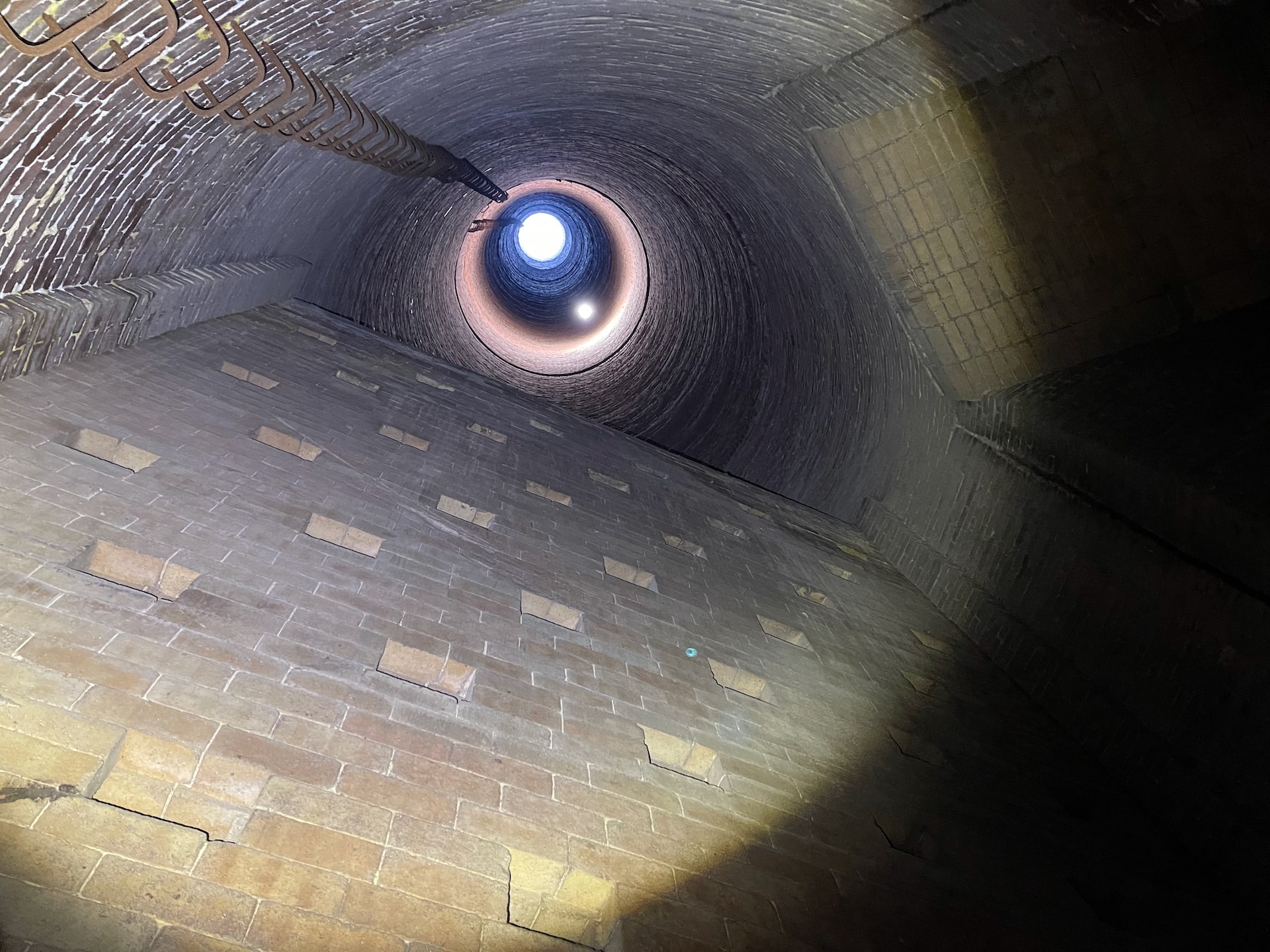
Interior view looking up through the chimney shaft – the ELIOS 3 documents every centimetre from ground level to the top.
Chimney Types We Inspect
With the Flyability ELIOS 3 we inspect industrial chimneys from the inside – safely, precisely and without human entry. For exterior inspections we deploy the DJI Matrice 30T – robust, efficient and suitable for large heights.
1. Power Plant Chimneys (Kraftwerks-Schornsteine)
Large industrial chimneys (typically 50–300 m) in coal, gas and biomass power plants. Interior lining, liner pipes and flue gas routing.
- Sensors: Visual, LiDAR, Thermography
- Typical findings: Masonry erosion, liner pipe cracks, steel shell corrosion, sooting, thermal damage
2. Industrial Chimneys / Flue Stacks (Industrie-Schornsteine / Abgaskamine)
Chimneys in chemical, refinery and cement plants for carrying away process gases. Interior lining and connection points.
- Sensors: Visual, Thermography
- Typical findings: Lining cracks, chemically induced damage, deposits, sooting
3. Concrete Chimneys – Reinforced Concrete / RCC (Beton-Schornsteine)
Tall reinforced concrete chimneys with internal liner pipe in industrial plants. Focus on load-bearing structure and interior lining.
- Sensors: Visual, LiDAR, Thermography
- Typical findings: Thermal cracking, reinforcement corrosion, delaminations, deformations, thermal anomalies
4. Steel Chimneys (Stahl-Schornsteine)
Self-supporting or guyed steel structures, common in the process industry. Interior coatings and weld seams.
- Sensors: Visual, Thermography, LiDAR
- Typical findings: Internal corrosion, weld seam cracks, coating defects, condensate formation
5. Multi-Flue Chimneys (Mehrzügige Schornsteine)
Chimneys with multiple internal flue channels within a common outer shell. Each channel is inspected separately.
- Sensors: Visual, LiDAR, Thermography
- Typical findings: Uneven deposits, corrosion at dividing structures, thermal differences between channels, leaks
6. Flare Stacks (Fackelschornsteine)
Chimneys in refineries and gas plants with an open flame at the tip. Focus on structure and thermal loading.
- Sensors: Visual, Thermography
- Typical findings: Corrosion, thermal damage in the upper section, material fatigue, deposits
7. Cement & Lime Works Chimneys (Schornsteine in Zement- und Kalkwerken)
Plants with highly abrasive and alkaline flue gases. Refractory linings (Feuerfeste Auskleidungen) and interior surfaces.
- Sensors: Visual, LiDAR, Thermography
- Typical findings: Lining erosion, high-temperature cracking, material abrasion, heavy dust deposits
8. Waste-to-Energy Chimneys (Müllverbrennungs-Schornsteine)
Chimneys with highly aggressive, acidic flue gases. Interior lining and critical transition zones.
- Sensors: Visual, Thermography, LiDAR
- Typical findings: Acid corrosion, lining defects, deposits, thermal stresses
9. Flue Gas Ducts & Smoke Channels (Abgaskanäle und Rauchgaszüge)
Horizontal and inclined flue gas routing as the connection between boiler and chimney.
- Sensors: Visual, LiDAR
- Typical findings: Deposits, cross-sectional constrictions, corrosion, structural deformations
Conventional Chimney Inspection vs. Drone
| Aspect | Conventional (scaffolding / climbers) | Drone (ELIOS 3 + M30T) |
|---|---|---|
| Access | External scaffolding (Außengerüst) or suspended cradle | From the inside through the shaft – drone ascends from ground level |
| Time required | 4–8 weeks (scaffolding erection + inspection) | 1–2 days on site |
| Weather dependency | Highly dependent – wind, rain and ice block exterior work | Interior inspection – no fall risk, no weather dependency |
| Human entry / height work | Yes – fall risk at over 60 m height, DGUV safety chain | No – team stays at ground level |
| Documentation | Photos + sketches, subjective, not reproducible | 4K + Thermography + LiDAR, position-referenced, repeatable |
| Cost | Scaffolding often >€100,000; climbers €3,000–5,000/day | Fraction of conventional costs – up to 80% savings |
Why the ELIOS 3 for Chimney Inspection
- No external scaffolding (Kein Außengerüst): Inspection from the inside through the shaft – no months of scaffolding around the chimney. Often savings of over €100,000.
- No climbers (Keine Kletterer): No fall risk, no height work, no human entry into the shaft. The drone flies from ground level upward – your team stays on the ground.
- Inspection in hours: Chimney inspection completed in far less time than scaffolding or rope access methods – fits into existing maintenance windows.
- Complete 4K documentation: 4K video from ground to chimney head. Thermography reveals thermal anomalies and insulation defects. LiDAR measures geometry.
- Up to 80% cost reduction: No scaffolding (often >€100,000), no climbers (€3,000–5,000/day). Inspection for a fraction of conventional method costs.
- Expert-compliant documentation (Sachverständigen-konform): Documentation per 1. BImSchV, KÜO and dgfs standards. Collaboration with your chimney builders (Schornsteinbauer) and district chimney sweeps (Bezirksschornsteinfeger).
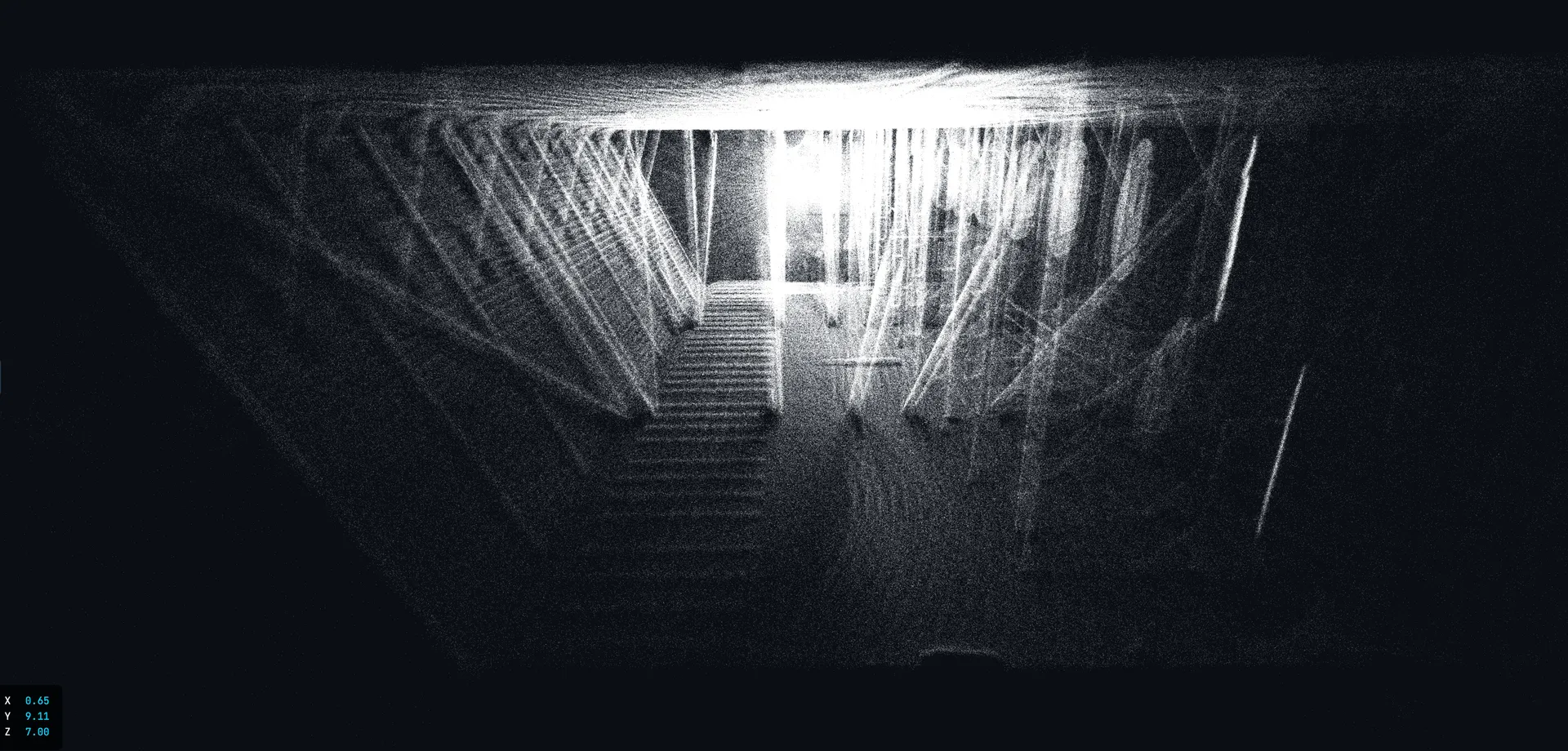
LiDAR 3D point cloud of a power plant flue gas duct (Rauchgaskanal) – geometry data for documentation, deformation analysis and planning.
How the Chimney Inspection Works
Step 1: Initial Consultation & Feasibility Analysis (free)
We analyse your chimney: height, diameter, cross-section, expected dust development. We assess feasibility and advise you at no cost.
Step 2: Scheduling & Quotation
You receive a transparent quote. We jointly plan timing, access and shutdown – coordinated with your chimney builders (Schornsteinbauer) and certified assessors (Sachverständige).
Step 3: On-Site Inspection
Our ELIOS 3 pilots fly from the bottom up through the chimney shaft – significantly faster than conventional methods. If required, assessors can be present on site.
Step 4: Analysis & Inspection Report
You receive a detailed report with 4K footage from ground to chimney head, thermography analyses, 3D models (optional) – per 1. BImSchV and KÜO. Ready for your chimney experts to evaluate.
Complementary Systems for Chimney Inspection
The ELIOS 3 inspects the interior lining. The outer shell and the chimney head area are additionally captured with the DJI Matrice 30T.
DJI Matrice 30T – Outer Shell, Cap & Crown Area
Exterior chimney inspection during or after operation – outer shell, covering cap, joints and masonry from 200× zoom range. Thermography for heat losses and cracks. No scaffolding; inspection possible while in operation.
Handheld LiDAR – Geometry & Deformation Analysis
3D capture of chimney cross-section, wall inclination (Wandneigung) and ovality measurement (Ovalitätsmessung) in accessible areas. No tripod required. Output in E57/LAZ format for structural calculations and stability assessments (Standsicherheitsnachweis).
Major Industrial Chimney Manufacturers
The industrial chimney market divides into two segments: steel and stainless steel chimneys (typically 20–150 m) for industry and energy, and large concrete and hybrid chimneys (100–300+ m) as individual structures in the power plant sector. Regardless of manufacturer, year of construction and design, we document the condition of your chimney – inside and out, with the Flyability ELIOS 3 and the DJI M30T.
- Jeremias International – One of Europe's leading chimney manufacturers (Germany); strong in industrial, energy and special solutions; very present in waste-to-energy, chemicals and power plants.
- Steegmüller Schornsteintechnik – Highly specialised German manufacturer of industrial chimneys; engineering focus for demanding applications.
- Raab Gruppe – Wide range of flue gas systems and chimney technology; relevant for larger industrial plants.
- Schiedel – Major European player (Austria/Germany) with broad product portfolio; industrially relevant but more broadly positioned than pure industrial specialists.
- Hamon – Historically one of the most important global players for large power plant chimneys – many major projects in coal-fired power plants and industrial plants worldwide.
- Lizmontagens – Strong in international plant construction (Portugal) – steel, concrete and refractory chimneys for industrial and power plant projects worldwide.
- Poujoulat – Strong European metal chimney manufacturer (France) – specialised in mid-range sizes for industry and commerce.
- MK Schornsteinsysteme – Rapidly growing Polish supplier with competitive pricing; increasingly present in European projects.
- Hoch³ / B. Poll / Rief – German specialists for refurbishment, conversion and special solutions for industrial chimneys – highly relevant for maintenance and modernisation of existing installations.
Your Contacts for Chimney Inspection
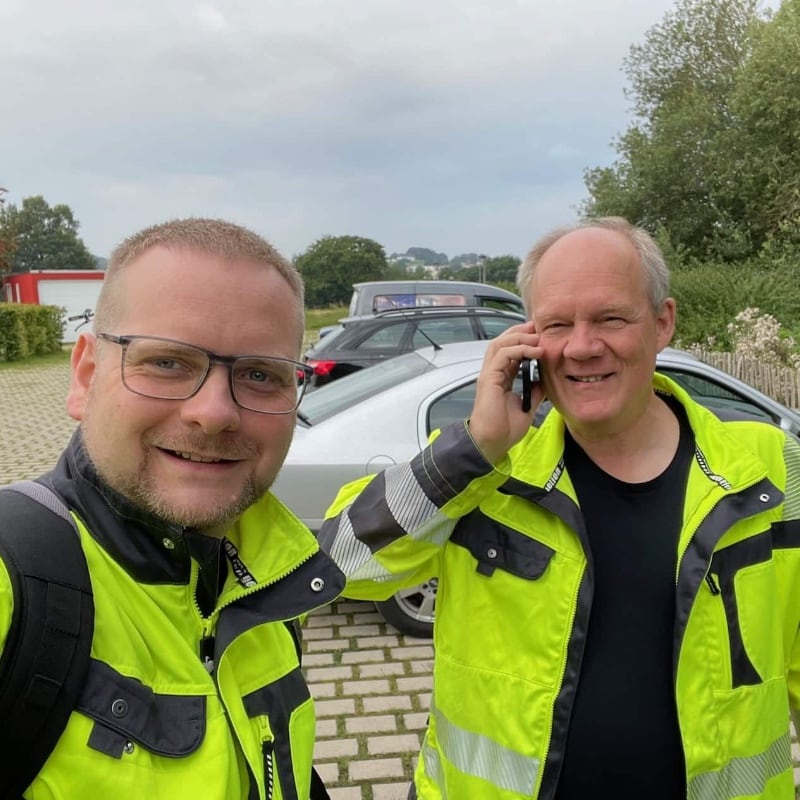
Christian Engelke and Dipl.-Ing. Karsten Lehrke – your direct contacts for chimney inspection projects.
Our pilots know the ELIOS 3 inside out – navigation in tight shafts, documentation of masonry cracks and sooting, thermography for expert assessments. We bring the ELIOS 3 technology; you bring the chimney expertise.
Christian Engelke and Dipl.-Ing. Karsten Lehrke are your direct contacts. Since 2017 we have been operating the ELIOS 3 in industrial chimneys: power plants, refineries, cement works and waste-to-energy plants. We advise without sales pressure – and honestly when a different method would be more appropriate.
Related Services
- Cooling Tower Inspection – Natural draught and cell coolers – M30T for the exterior, ELIOS 3 for internals.
- Power Plant Inspection – Complete power plant inspection: boilers, chimneys, cooling towers.
- Boiler Inspection – Steam boilers and fireboxes – 4K + LiDAR without scaffolding.
- Confined Spaces Inspection – Tight spaces without human entry – ELIOS 3 for all confined space assets.
- Flyability ELIOS 3 – The collision-safe indoor drone with 4K, LiDAR and thermography.
- Industrial Drone Inspection – Overview of all inspection services with ELIOS 3 and complementary systems.
Frequently Asked Questions
What is a chimney inspection by drone?
A scaffold-free inspection of industrial chimneys (Industrieschornsteine) – from the inside with the Flyability ELIOS 3 and from the outside with camera drones such as the DJI M30T. The result is high-resolution imagery, video and – on request – 3D data. The method is suitable both for regular chimney inspection per 1. BImSchV (Bundesimmissionsschutzverordnung – Federal Emission Control Regulation) and for event-driven condition assessments. The technical evaluation is carried out by your assessors or chimney builders.
Which chimney types can be inspected?
Power plant and industrial chimneys, concrete and steel structures, multi-flue installations (mehrzügige Anlagen), flare stacks (Fackelschornsteine), chimneys in cement and lime works, waste-to-energy plants, as well as flue gas ducts (Abgaskanäle) and smoke channels (Rauchgaszüge).
Does the chimney have to be taken out of service?
Yes, the chimney must be at standstill for the interior inspection – both for temperature reasons and because of the airflow in the shaft. The inspection is typically carried out during planned revisions or maintenance shutdowns (Revisionsstillstände). Since drone inspection takes hours rather than days, it fits well into existing revision windows. Plan in the cooling phase when scheduling.
Can the drone be deployed at high temperatures?
Only under suitable conditions. Interior deployments take place only after the shaft has cooled to a safe temperature level – the ELIOS 3 is designed for operation up to approximately 50°C. Allow for sufficient cooling time when planning the inspection date.
What is the minimum diameter required?
The ELIOS 3 can fly chimneys with an internal diameter from approximately 60 cm. For round cross-sections with a liner pipe (Futterrohr), the free cross-section between the liner pipe and the masonry, or the liner pipe's internal diameter, must be at least 50 cm. During the feasibility analysis we check in advance whether your chimney can be flown.
How high can the drone fly in the chimney?
This depends on the geometry, lighting conditions and conditions in the shaft. In practice we systematically inspect the relevant zones, working our way from the bottom upward. We can give a realistic estimate of achievable height after a brief discussion of your installation.
How does the drone fly vertically through a chimney shaft?
The ELIOS 3 ascends from the bottom upward through the chimney shaft, documenting the entire inner wall in a spiral pattern. The carbon protective cage allows wall contact without crashing – essential in tight cross-sections. SLAM navigation orients itself along the chimney wall and keeps the drone stable, even at heights over 100 m.
How long does a typical chimney inspection take?
Usually one to two days on site including data acquisition. The organisational effort is significantly less than for scaffolding or rope access deployments – no weeks of lead time, no complex access equipment. The post-processing (data processing, findings list and report) is typically delivered within a few working days.
Which sensors are used for chimney inspection?
Depending on the task, we combine: high-resolution 4K camera for visual documentation; thermography for detecting temperature differences, sooting zones and leaks; and LiDAR for spatial capture and geometry documentation including deformation analysis.
What does thermography add to chimney inspection?
Thermography makes temperature differences visible and helps detect moisture, leaks or damaged areas behind the surface – for example sooting zones (Versottungszonen), thermal bridges (Wärmebrücken) or leaking sections in the lining. This reveals defects that appear intact from the outside.
What is LiDAR used for in chimney inspection?
LiDAR creates 3D point clouds (3D-Punktwolken) and enables precise documentation of geometry, deformations and constrictions within the chimney shaft. The data can be used for structural stability assessments (Standsicherheitsbeurteilungen) or remediation planning.
What damage is typically found?
The most common findings are cracks and erosion in the masonry, corrosion on the steel shell and liner pipes, sooting (Versottung) from condensate formation, lining defects, deposits, and weld seam anomalies and condensation zones. Many of these defects are invisible from the outside.
Can the chimney head also be inspected?
Yes. Interior sections are captured with the ELIOS 3; the exterior and the chimney head (Schornsteinkopf) are inspected with the DJI M30T – thermography and 4K at sight distance, without rope access or aerial work platforms. A full combined inspection in one deployment is possible.
Can flue gas ducts and smoke channels also be inspected?
Yes. Particularly in horizontal or inclined sections that are conventionally only accessible with great effort, drone deployment is especially effective. We document deposits (Ablagerungen), cross-sectional constrictions, corrosion and structural deformations. See also: Confined Spaces Inspection.
What does the inspection report look like?
We deliver a structured report with 4K footage from ground to chimney head, high-resolution detail photographs of anomalies, thermography evaluations and optionally LiDAR 3D point clouds. Documentation is prepared for expert assessments per 1. BImSchV and KÜO (Kehr- und Überprüfungsordnung – chimney inspection regulations). Request a sample report via the contact form below.
Are inspections repeatable and comparable?
Yes. Through systematic and complete capture, conditions can be compared across multiple years – ideal for trend analyses and the planning of predictive maintenance. Finding positions are documented so that follow-up inspections can take place at exactly the same locations. Corrosion progress, material fatigue and damage development become traceable over months and years.
Which standards apply to chimney inspection?
Our documentation is oriented to the requirements of the 1. BImSchV (Bundesimmissionsschutzverordnung – Federal Emission Control Regulation), the Chimney Sweep Trades Act (Schornsteinfeger-Handwerksgesetz, SchfHwG) and TA Luft (Technical Instructions on Air Quality Control). The condition assessment of the chimney based on our data is carried out by your certified assessors. We work closely with chimney builders (Schornsteinbauer), qualified chimney inspectors (dgfs) and district chimney sweeps (Bezirksschornsteinfeger), delivering documentation to KÜO standards. Relevant technical standards include VDI 3781 and DIN EN 13084.
How safe is chimney inspection by drone?
Since no human entry is required, the majority of conventional risks are eliminated – no fall risk, no exposure to pollutants or working in confined spaces. No climbers, no scaffolding, no height risk for your team. The drone flies in; your team stays on the ground.
Who assesses the damage found?
We document the condition precisely. The technical assessment and action planning is carried out by operators, certified assessors (Sachverständige) or engineering offices. Critical findings are documented immediately and can be forwarded directly to your technical departments. We can coordinate closely with your chimney experts.
Do you work with certified assessors?
Yes. We work regularly with chimney builders (Schornsteinbauer), expert witnesses and engineering offices and deliver data in the quality required for expert assessments. Partners include Züblin, ZCR and I.S.T. – Ingenieurbüro für SchornsteinTechnik. We bring the drone technology and the data; your experts bring the domain knowledge and assessment.
How do costs compare to conventional methods?
Significantly lower – since scaffolding, rope access and extensive access equipment are eliminated. Scaffolding for chimneys over 100 m frequently costs more than €100,000; industrial climbers charge €3,000–5,000 per day. A concrete cost estimate is provided after a brief discussion about your installation and scope.
How do I initiate an inspection?
After a brief discussion on installation, access and objectives, we provide an assessment and plan the deployment. Fill out the contact form below, or call us directly: +49 421 408 937 90.
When is a drone in the chimney not the right choice?
With strong airflows in the shaft (e.g. residual operation of adjacent channels in multi-flue installations) the flight stability of the ELIOS 3 can be limited. Steam and high residual moisture after shutdown severely impair image quality. And for chimneys with an internal diameter below 50 cm, deployment is physically impossible. We check these factors in advance and will honestly say when a different method would be more appropriate.
Does the drone deliver actionable findings – or just footage?
That is the crucial question. Raw footage alone is not an inspection. We deliver structured findings reports with localized anomalies, severity classification and action recommendations – directly usable by your assessors, chimney builders or expert witnesses. The quality of a drone inspection is not measured by flight time, but by whether the data leads to an actionable conclusion for your maintenance decision.
Get in Touch
Questions about chimney inspection by drone, or need a quote for your installation? Fill out the form below and we will get back to you within 24 hours.