
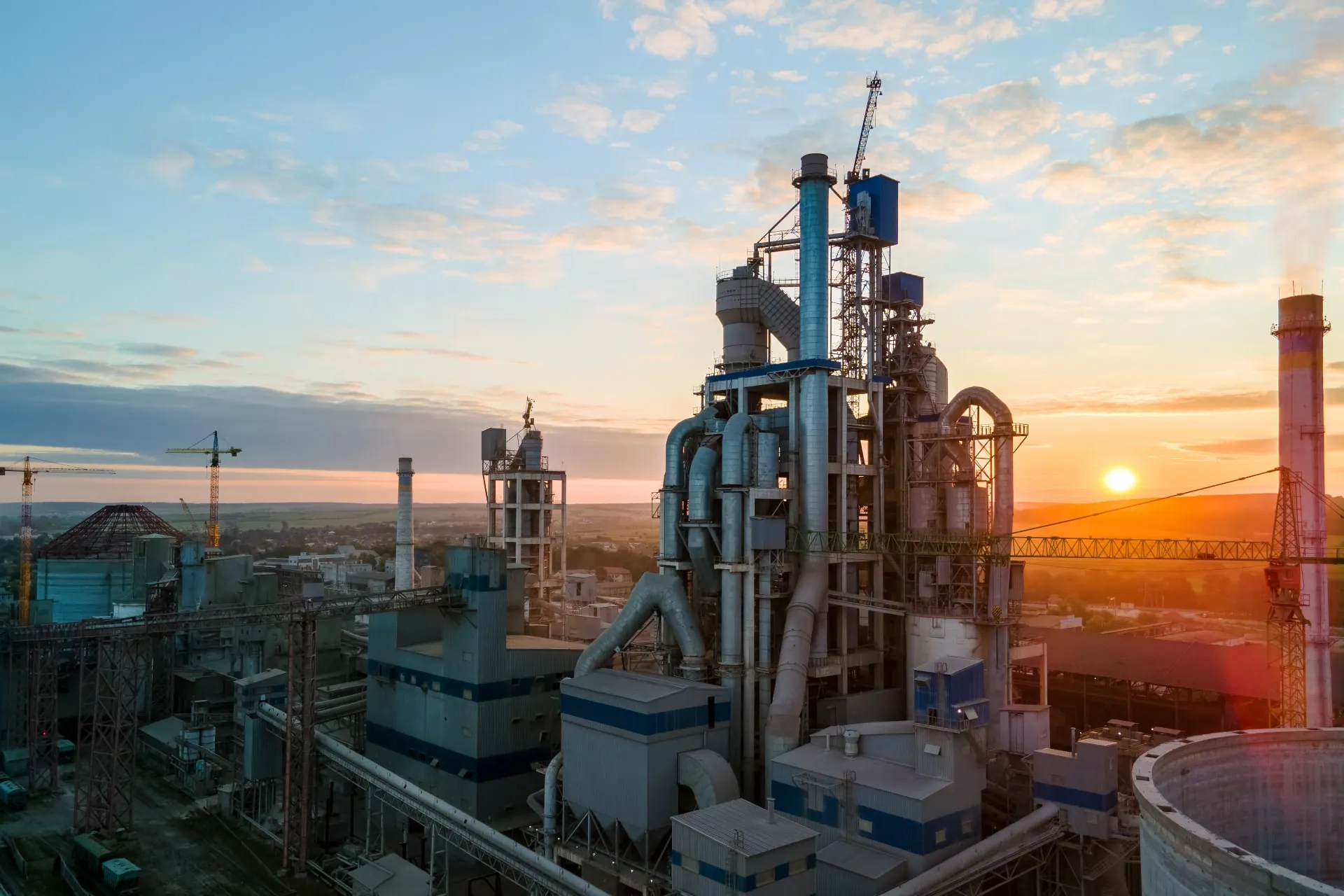
Drone Inspection Cement Plant – WITHOUT Scaffolding, WITHOUT Entry, Inside & Outside
Kopterflug inspects cement plants with the Flyability ELIOS 3 – Drehrohröfen, cement silos, chimneys, conveyor systems – LiDAR, thermography and 4K documentation. No human entry into hazardous areas. Germany-wide, since 2017.
- No human entry – drone flies in, your team stays outside
- 4K + Thermography + LiDAR + UT in a single deployment
- Minimum downtime – inspection directly after cooling, no weeks of preparation
What We Inspect in Cement Plants
Cement plants operate with extreme temperatures, abrasive materials and confined spaces. We inspect all safety-critical assets – without scaffolding, without human entry:




Flyability ELIOS 3 – Cement Plant Inspection Without Human Entry
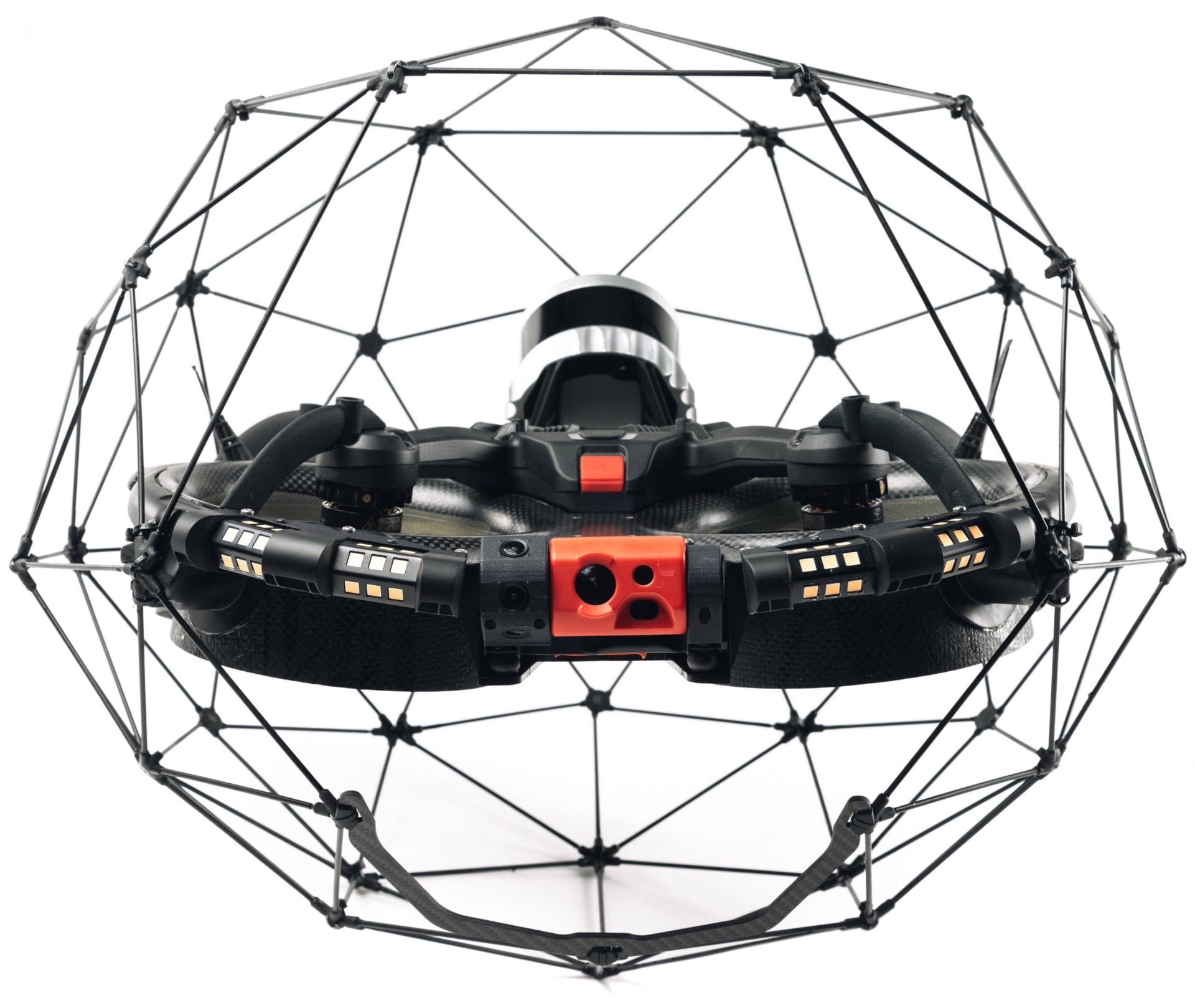
The Flyability ELIOS 3 – our primary system for all interior inspections in cement plants.
Our services:
- Confined Spaces Inspection – Rotary kilns, silos, chimneys, conveyor systems – anywhere human entry is dangerous or impossible
- 4K + Thermography + LiDAR + UT – Visual inspection, thermal camera for hotspots, 3D point clouds for digital twins, and ultrasonic wall thickness measurement on steel components
- No scaffolding, no climbers, no human entry – Drastically reduced downtime and costs – inspection directly after cooling, without weeks of preparation
- Professional documentation – Detailed inspection reports with 4K recordings, thermography analyses, 3D models and UT measurement data to industry standards
From cement plants in Hannover (HeidelbergCement), Duisburg, Nürnberg, Dortmund to Karlsruhe – we inspect cement plants throughout Germany.
Drone Inspection Cement Plant: Mastering Extreme Conditions Safely and Efficiently
Cement plants are among the most demanding industrial environments for inspections. Rotary kilns with refractory lining, cement silos with build-ups, chimneys with abrasion and conveyors under continuous load – wherever conventional inspection requires scaffolding, climbers or confined space entry, substantial costs and safety risks arise.
Production shutdowns in the cement industry are particularly costly. Every hour a rotary kiln stands still means production loss. At the same time, refractory linings wear at different rates – condition data is the basis for targeted maintenance planning instead of generic calendar intervals.
The Flyability ELIOS 3 enables inspections directly after cooling: 4K video, thermography and LiDAR-3D document rotary kilns, silos and chimneys – without scaffolding, without human entry. On steel components such as chimney steel shells, the UT payload additionally delivers geo-referenced wall thickness values – for refractory linings or concrete walls, other methods are used instead.
What We Document in Cement Industry Inspections
We fly the ELIOS 3 into silos, kilns, chimneys and conveyor shafts and systematically document wear, corrosion and structural damage. Technical evaluation is carried out by your maintenance engineers and inspectors – we deliver the data:
Silos, Bunkers & Material Containers
What we check: Wall corrosion, concrete shell breakouts, bridging, deposits and build-ups, condition of discharge equipment
Why it matters: Cement and clinker silos are subjected to extreme abrasive loads. Build-ups and concrete shell breakouts can lead to silo collapses – conventional inspection by entry is risky due to dust atmosphere and confinement.
How we do it: ELIOS 3 navigates through the manhole into the silo – 16,000-lumen lighting makes build-ups and wall damage visible even in dusty conditions; LiDAR documents wall geometry and breakouts metrically.
Rotary Kilns, Preheaters & Kiln Lines
What we check: Condition of refractory lining (brick displacement, cracks, spalling), corrosion on steel shell, damage to internals
Why it matters: The refractory lining of the rotary kiln is the decisive cost factor – an early-detected local damage costs a fraction of an unplanned full repair. Every hour of kiln downtime costs significantly.
How we do it: ELIOS 3 flies after kiln cooling (<50°C) through the inlet opening – thermography detects hotspots and areas with damaged lining; LiDAR documents geometry deviations and lining thicknesses.
Chimneys & Exhaust Ducts
What we check: Wall corrosion, cracks and material damage inside, sooting, condition of liner and compensators
Why it matters: Cement plant chimneys carry aggressive, dust-laden flue gases and are therefore above-averagely at risk of corrosion. Interior inspections by scaffolding or rope access are expensive and risky.
How we do it: ELIOS 3 with tether power unit for chimneys up to 300 m – LiDAR documents wall geometry and plumb deviations; colorization visualizes corrosion zones in colour.
Conveyor Shafts, Transfer Points & Conveyor Routes
What we check: Wear on conveyor chutes and shaft inner walls, deposits, damage to walkways and internals
Why it matters: Conveyor shafts and transfer points are weak points with abrasive materials such as clinker and raw meal. Wear is often only noticed at breakdowns – early documentation enables plannable shutdowns.
How we do it: ELIOS 3 flies conveyor shafts top to bottom – even tight and convoluted geometries are fully captured; 4K documentation shows wear patterns on shaft inner walls.
Coolers, Heat Exchangers & Process Internals
What we check: Deposits, clinker build-ups, corrosion on tube bundles and internals, condition of cooler beds and grate plates
Why it matters: Clinker build-ups in coolers and heat exchangers reduce heat transfer and increase energy consumption. Damage to grate plates and cooler beds is conventionally only detectable at full dismantling.
How we do it: Thermography identifies hotspots and areas with reduced cooling; ELIOS 3 documents internal geometry and build-ups from close range.
Steelwork, Platforms & Elevated Plant Components
What we check: Corrosion, cracks and deformations in steel structures, walkways, support frames and silo supporting structures
Why it matters: In dust-rich cement plant environments, steel components corrode significantly faster than in other industries. Elevated structural components are often only inspected during expensive rope access or aerial platform operations.
How we do it: DJI M30T (exterior areas) and ELIOS 3 (tight interior areas) – thermography for hotspots at bearings and joints; LiDAR for structural geometry and deformation analysis.
At the end, we hand over a detailed inspection report with 4K images, thermography evaluation and optionally LiDAR point clouds. Documentation according to BetrSichV and the relevant standards for pressure vessels and combustion systems. Technical evaluation and all maintenance decisions remain with your engineers and inspectors.
The Challenges in Cement Plants
Rotary kilns, cement silos, chimneys – extreme heat, abrasion, dust exposure. Human entry requires DGUV measures, scaffolding and extensive preparation. ELIOS 3 inspects in hours – without human entry, with 4K + Thermography + LiDAR + UT.
- Extreme heat and abrasive environment: Rotary kilns, clinker coolers, exhaust ducts – hot surfaces, dust exposure, tight areas. Human entry requires extensive safety measures. ELIOS 3 flies in, your team stays outside.
- Downtime = production loss: Scaffolding takes days. Every hour of kiln downtime costs. Drone inspects directly after cooling – significantly shorter inspection windows.
- Refractory wear is hard to assess: Refractory linings wear unevenly. Thermography shows hotspots, LiDAR documents geometry and wear profiles – objective data basis instead of estimation.
- Massive dust exposure reduces visibility & safety: Fine dust in silos, filters and ducts impairs visibility and breathing air. Conventional inspection becomes dangerous and often incomplete. ELIOS 3 brings its own lighting and stable image data – even in difficult conditions.
- Build-ups & material bridging in silos: Material deposits lead to blockages, uneven discharge and production problems. These often develop unnoticed in upper or hard-to-reach areas. The drone identifies critical zones early.
- Wear from abrasion on internals: Cement dust acts like an abrasive – internals, baffles and walls wear continuously. Damage develops gradually and is often detected too late. 4K + LiDAR make wear visible and traceable.
- Blockages in exhaust and process ducts: Dust, ash and material residues deposit in ducts and reduce efficiency. These areas are often hard to access. Drones enable rapid visual inspection without dismantling.
- Unclear conditions in large volumes: Silos and large containers are often not visible inside. Problems remain undetected for long periods. The drone creates complete transparency throughout the entire volume.
- Damage to steel structures & frameworks: Corrosion, cracks or deformations in steel structures are often detected late. Scaffolding is laborious and expensive. ELIOS 3 inspects elevated or hard-to-reach areas quickly and safely.
- Difficult inspection at residual temperature: Even after shutdown, many areas remain hot for a long time. This delays conventional inspections. Drones can be deployed earlier and shorten downtime.
Typical Inspections in Cement Plants
With the Flyability ELIOS 3, we inspect safety-critical assets in cement plants – precisely, safely and with minimal downtime. Up to approx. 80% cost savings compared to conventional methods:
Rotary Kiln – Refractory Inspection
Visually document the condition of the refractory lining: 4K video for cracks and spalling, thermography for thermal anomalies, LiDAR-3D for geometry capture and wear profiles. Abrasion rates become measurable over repeat flights.
- Sensors: Visual, LiDAR, Thermography
- Typical findings: Refractory lining wear, cracks, spalling, hotspots, ring formation, thermal damage
Cement Silos & Raw Meal Silos
Document bridging, build-ups and liner damage. LiDAR volume measurement for stock assessment and capacity planning. Without entry, without cleaning.
- Sensors: Visual, LiDAR
- Typical findings: Bridging, build-ups, liner damage, corrosion, structural deformations, material residues
Chimney Interior Profile (UT + Visual)
Interior inspection of industrial chimneys – without scaffolding, without climbers. UT wall thickness measurement on the steel shell, visual inspection of masonry and liner pipes.
- Sensors: Visual, LiDAR, UT (wall thickness)
- Typical findings: Masonry erosion, corrosion on steel shell, cracks in liner, sooting, abrasion from flue gases
Stockpile Volume Measurement (Scan-to-BIM)
LiDAR scan of bulk material stockpiles in storage halls – volume measurement for stock assessment, digital twins for plant planning. Centimetre-accurate, reproducible, without manual survey.
- Sensors: LiDAR
- Typical findings: Inaccurate stock data, missing digital plant models, laborious manual surveying
Cyclone Towers & Preheater
Inspection of cyclones, risers and connection ducts in the preheater – extremely hot, tight, classically barely accessible. Thermography shows hotspots, LiDAR captures constrictions and build-up volumes.
- Sensors: Visual, LiDAR, Thermography
- Typical findings: Build-ups, constrictions, lining wear, hotspots, flow problems
Calciner & Tertiary Air Ducts
Inspection of calciners and air ducts between kiln and preheater. Document lining wear, deposits and thermal anomalies without human entry.
- Sensors: Visual, LiDAR, Thermography
- Typical findings: Deposits, lining wear, thermal anomalies, deformations
Grate Cooler (Clinker Cooler)
Inspection of cooler channels, grate plates and air distribution zones. Thermography shows worn zones and thermal irregularities without scaffolding.
- Sensors: Visual, Thermography
- Typical findings: Worn grate plates, blockages, thermal anomalies, deposits, structural damage
Flue Gas Ducts & Connectors
Inspection of large-diameter connection ducts between kiln, filter and chimney. LiDAR captures deposit volumes, thermography shows leaks.
- Sensors: Visual, LiDAR, Thermography
- Typical findings: Deposits, corrosion, leaks, deformations, liner damage
ESP & Fabric Filters
Inspection of filter chambers, collection hoppers and housing structures – conventionally extremely laborious with scaffolding. Drone flies into the chamber and documents completely without extending downtime.
- Sensors: Visual, LiDAR
- Typical findings: Deposits, blockages, structural damage, corrosion, soiled electrodes
Raw Mills & Grinding Plants (Shutdown)
Inspection of mill housings and interiors after shutdown – document wear on impact surfaces, material build-ups and foreign objects without laborious dismantling.
- Sensors: Visual
- Typical findings: Wear, material build-ups, mechanical damage, foreign objects
Cooling Water Basins & Treatment Plants (ROV)
Inspect cooling water basins, sedimentation basins and wastewater ponds without emptying and without divers – ROV inspection with 4K camera. Completely document base, wall surfaces and internals.
- Sensors: ROV Visual
- Typical findings: Sediment deposits, corrosion, cracks, coating damage, leaks
Your Benefits as Cement Plant Operator
- No human entry: No DGUV confined space entry, no respiratory protection, no rescue chain. Your team stays outside – the drone takes over.
- No scaffolding: Scaffolding for kiln or chimney inspection is completely eliminated. Saving days of lead time and substantial costs.
- Minimum downtime: Inspection directly after cooling – no weeks of rigging. Maintenance window optimally used, kiln back in operation faster.
- Precise documentation: 3D models, thermal maps, UT measurement data (for steel components), 4K video – objective data basis for targeted maintenance instead of calendar schedule.
- Cost savings up to 80%: Compared to conventional methods (scaffolding, climbers, entry), total inspection costs can be significantly reduced.
- DGUV & BImSchV compliant: Complete inspection report with 4K findings, 3D model and UT data. Audit-proof archiving – as basis for recurring inspections.
Inspection Systems for Cement Plants – Inside & Outside
The ELIOS 3 inspects rotary kilns, mills and silo inner walls. The DJI Matrice 30T complements for chimneys, outer shells and silo exterior walls.
DJI Matrice 30T – Rotary Kiln Exterior, Chimneys and Silo Exterior Walls
Rotary kiln outer shell, chimneys, silo exterior walls – thermographically and visually from the air, without scaffolding and without operational shutdown.
Underwater Drone (ROV) – Cooling Water Basins & Treatment Plants
Inspect cooling water basins, sedimentation basins and wastewater ponds without emptying and without divers – ROV inspection with 4K camera.
How the Cement Plant Inspection Works
Step 1: Initial Consultation
We discuss the plant, access routes, cooling times and your inspection requirements. Free preliminary clarification.
Step 2: Scheduling & Quotation
You receive a transparent quotation including on-site time, sensors and report scope. Together we plan the deployment in the maintenance window.
Step 3: On-Site Inspection
We arrive with ELIOS 3 and inspect rotary kilns, silos, chimneys. Live feed for your maintenance planners. At least two people on site.
Step 4: Evaluation & Inspection Report
Detailed report with 4K recordings, 3D models, thermography analyses and UT measurement data. Audit-proof archiving.
Standards & Safety in the Cement Industry
Our inspections meet the highest safety and documentation standards:
- DGUV Rule 113-004: Work in containers, silos, rotary kilns – without human entry. Aligned with DGUV requirements.
- BImSchV compliant: Documentation for emission-protection-relevant plant components. Chimney inspections according to the requirements of the Federal Immission Control Act.
- Dust explosion protection observed: Cement dust can form explosive atmospheres. ELIOS 3 is not ATEX-certified – deployment only in emptied and cleaned condition without hazardous dust concentration.
- EU Drone Regulation: Insurance coverage EUR 5 million. Coordination with your HSE team before every deployment.
Our Team
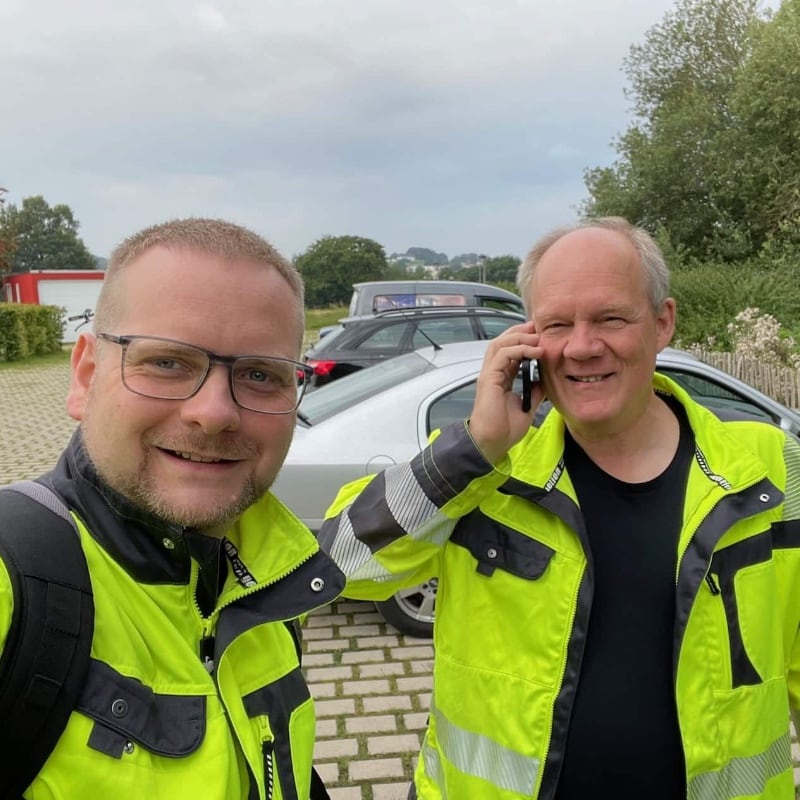
Christian Engelke and Dipl.-Ing. Karsten Lehrke – your direct contacts for cement plant inspection projects.
Active since 2017 – numerous inspections in heavy industry and the building materials sector. We know the requirements of cement plants: tight maintenance windows, extreme conditions, precise documentation for maintenance planning.
Related Inspection Services
- Silo Inspection – Raw material and cement silos – liner damage and deposits without entry.
- Boiler Inspection – Rotary kilns and preheaters – refractory lining and hot gas ducts without entry.
- Chimney Inspection – Chimneys and flue gas ducts in cement plants – interior inspection without scaffolding.
- Heavy Industry – Blast furnaces, industrial furnaces and bunkers in steel and heavy industry plants.
- Confined Spaces – All tight interior spaces without human entry – ELIOS 3 for every confined space.
- Condition Documentation – 4K video, findings list and PDF report – audit-proof documentation after every inspection.
Frequently Asked Questions About Cement Plant Inspections
Is drone inspection in cement plants (rotary kiln, silo, chimney) permitted?
Yes, deployment is generally possible when carried out within the framework of the operational hazard assessment and applicable regulations. Drones are used in particular to avoid hazardous confined space entries and human entry. An overview of typical applications in cement plants is described by Flyability at flyability.com/cement-plant-drone-inspections. More on our confined spaces deployments: Confined Spaces Inspection.
Is the drone suitable for rotary kilns and refractory linings?
Yes, especially after shutdown and sufficient cooling to below 50°C. Typical applications are visual detection of cracks and spalling, documentation of wear and optical assessment of lining conditions. Practical examples from cement plants (cyclones, calciner, clinker cooler) are shown by Flyability at casestudies/drone-digital-twin. More on our rotary kiln deployments: Confined Spaces Inspection.
Can thermography detect hotspots in the kiln or clinker cooler?
Thermography can make temperature anomalies and potential weak points visible, for example with breakthrough risks, insulation problems or thermally stressed areas. The benefit is highly dependent on local conditions – the degree of cooling and residual heat influence the significance. Applications are described at casestudies/drone-digital-twin. More on thermographic inspections: Confined Spaces Inspection.
Can the drone measure wall thickness (UT)?
Yes – but with an important restriction: the UT payload of the ELIOS 3 operates with probes in the 2–7.5 MHz range and is optimised for homogeneous and metallic materials. On steel components such as the steel shell of chimneys or steel flue ducts, UT delivers reliable geo-referenced wall thickness values. For refractory linings or concrete walls of silos, the method is not standardly suitable – impact echo or through-transmission is used here instead. Application examples from the cement industry are shown by Flyability at casestudies/ut-drone-inspection-cement. Details on the ELIOS 3: ELIOS 3 at Kopterflug.
How long does a drone inspection in a cement plant take (rotary kiln, silo)?
This depends strongly on the object – length, diameter, desired sensor technology and level of detail determine flight time. Practical examples show that drone inspections can in many cases be carried out significantly faster than conventional methods with scaffolding or climbing teams. Flyability describes the advantages at flyability.com/cement-plant-drone-inspections. More on inspection methodology: Confined Spaces Inspection.
Does the plant need to be taken out of service for drone inspection?
For interior inspection of rotary kilns, silos and chimneys with the ELIOS 3, yes – the object must be cooled to below 50°C and emptied. The rotary kiln outer shell thermography via DJI Matrice 30T, however, is also possible during ongoing operation: hotspots are detected without shutting down the kiln. Details on deployment conditions: Confined Spaces Inspection.
Does the drone completely replace scaffolding or human entry in cement plants?
In general yes – for visual inspection, LiDAR surveying and thermography in rotary kilns, silos and chimneys. Whether human entry is still required for supplementary measures (e.g. manual sampling) depends on the inspection objective. For pure condition assessment and damage diagnostics, the ELIOS 3 completely replaces entry. More at Confined Spaces Inspection.
What data do we receive after the drone inspection?
You receive a complete inspection report with 4K video documentation, thermography analyses with temperature data and anomaly map, LiDAR-3D point cloud (geometry, volume measurement, wear profiles) and UT wall thickness values on steel components. All data is geo-referenced and archived – as a basis for maintenance planning and compliance documentation. More on our service scope: Drone Inspection Kopterflug.
Do chimney inspections require scaffolding or climbers?
In many cases, no. The ELIOS 3 can fly chimneys from the inside – without scaffolding, without a climbing team. Whether this is possible in an individual case depends on the inspection objective, geometry and accessibility. A practical example from a cement plant is shown by Flyability at casestudies/chimney-tower-inspection. More on chimney inspections: Chimney Inspection.
Can the drone fully inspect very tall chimneys?
Practical examples exist even for tall installations. Important: feasibility always depends on geometry, signal connection and safety concept – blanket statements about maximum heights cannot be derived from this. Experience with chimney and stack inspections is shown by Flyability at casestudies/stack-inspection. All details: Chimney Inspection.
How does the drone detect damage in chimneys or flue gas ducts?
Typical findings are deposits, corrosion, cracks and spalling – both visually documented and (for steel components) quantified by UT wall thickness measurement. The steel shell of industrial chimneys is a typical application field for UT. Practical examples at casestudies/stack-inspection. More on chimney inspection: Chimney Inspection.
Can LiDAR detect bridging in silos?
Yes, LiDAR enables 3D capture of geometries and build-ups. This makes bridging, wall deformations and unusual deposits visible – without entry. An example is shown by Flyability at casestudies/lidar-stockpile-measurement. More on silo inspection: Silo Inspection.
Can fill levels and volumes in silos be captured with the drone?
Yes, through LiDAR-3D data, volumes and fill levels can be estimated. Accuracy depends on material, surface properties and ambient conditions. Examples from stock assessment are shown by Flyability at casestudies/lidar-stockpile-measurement. Details on silo inspection: Silo Inspection.
How much is production downtime reduced?
Practical examples show clear advantages over conventional methods – particularly through elimination of scaffolding, fewer personnel in hazardous areas and faster execution. The actual effect is always project-dependent. Flyability shows relevant applications at casestudies/drone-digital-twin. More on our industrial inspections: Confined Spaces Inspection.
What happens if the drone touches the plant?
The ELIOS 3 is designed for tight environments and tolerates light contact thanks to its carbon protective cage. Nevertheless, every deployment is planned to avoid contact with sharp-edged or critical structures as far as possible. Our page on the ELIOS 3: ELIOS 3 at Kopterflug. Details on the design at flyability.com/elios-3.
Can inspections be repeated and changes compared?
Yes, through 3D point clouds and systematically documented inspection areas, changes can be quantitatively compared across multiple campaigns. This is particularly relevant for refractory wear, deposit development and structural changes. Examples at casestudies/drone-digital-twin. More on our inspection services: Drone Inspection Kopterflug.
Is the data usable for maintenance and planning?
Yes – especially for condition assessment, maintenance planning and documentation. 4K recordings, LiDAR point clouds and thermography data provide the basis for targeted maintenance decisions instead of calendar-schedule maintenance. Examples for scan-to-BIM and plant modelling are shown by Flyability at casestudies/drone-scan-to-bim. Details on our services: Drone Inspection Kopterflug.
Is the drone suitable for conveyors and elevators?
Yes, especially for transfer points, hard-to-access areas and documentation of build-ups and wear patterns. Bucket elevators, belt conveyor transfers and elevator shafts are typical application fields. Typical applications in cement plants are described at flyability.com/cement-plant-drone-inspections. More on confined spaces deployments: Confined Spaces Inspection.
Are there limits regarding temperature or dust exposure?
Yes. The ELIOS 3 has a maximum operating temperature of 50°C – plants must cool down sufficiently before inspection. Dust exposure influences both flight stability and data quality, especially for the camera. In potentially explosive dust atmospheres (e.g. cement or coal dust), the drone must not be deployed, as the ELIOS 3 is not ATEX-certified. Details on the ELIOS 3: ELIOS 3 at Kopterflug.
Who may carry out drone inspections in cement plants?
Decisive factors are experience with indoor drones in industrial environments, understanding of processes and hazards in cement plants, and a coordinated safety concept. A specific drone class licence is not the central factor for interior deployments without manned airspace – the industrial experience profile is more important. More about Kopterflug: Drone Inspection Kopterflug.
Are there practical examples from the cement industry?
Yes, particularly from cement plants with cyclone inspections, digital twins of plants and chimney inspections. Flyability documents examples at casestudies/drone-digital-twin and a practical video at youtube.com (cement plant inspection). More on our deployments: Drone Inspection Kopterflug.
How economical is drone inspection compared to conventional methods?
The advantage lies in overall effort: less downtime through eliminated scaffolding, fewer personnel in hazardous areas and faster execution without weeks of preparation. Concrete savings are project-dependent. Practical examples can be found at casestudies/chimney-tower-inspection. More on our offering: Drone Inspection Kopterflug.
How often should cement plant assets be inspected?
This depends on plant, usage intensity and current condition. Typical are inspections before planned shutdowns for condition assessment, regular condition checks per BetrSichV and DGUV, and event-driven inspections after anomalies. A condition-based approach – instead of fixed calendar intervals – is often more economical for refractory-intensive plants. More on inspection intervals: Confined Spaces Inspection.
Can the M30T thermographically monitor the rotary kiln outer shell?
Yes – this is one of the most valuable deployments in cement plants. The DJI Matrice 30T scans the rotating steel shell of the rotary kiln with radiometric thermography during ongoing operation. Hotspots on the shell indicate refractory damage – detected early, before an emergency shutdown occurs. No downtime, no scaffolding, no production interruption. More on the DJI M30T: Drone Inspection Kopterflug.
Contact Us
Questions about drone inspection for your cement plant or need a quote? Fill out the form below and we will get back to you within 24 hours.