
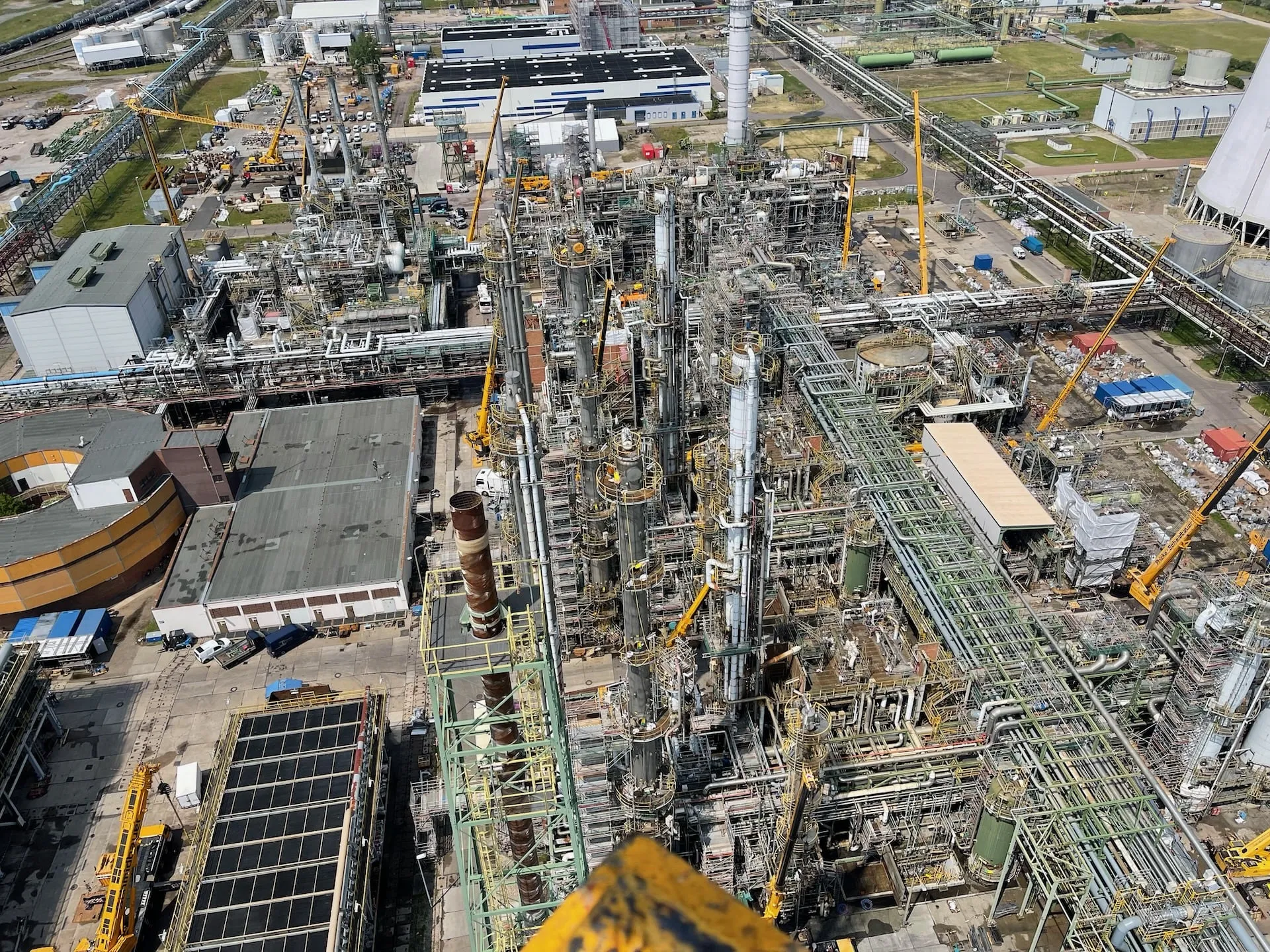
Drone Inspection in the Process Industry: 10 Concrete Use Cases
From tanks and reactors to pipe bridges – Kopterflug has been deploying the Flyability ELIOS 3 in process industry environments since 2017. Here are 10 specific use cases with realistic capabilities and honest limitations.
- 10 applications with clear strengths – and clear limits
- Indoor (ELIOS 3) + Outdoor (DJI M30T) – both systems combined
- Visual findings, 3D data, thermography in a single deployment
Drone Inspection in the Process Industry: Efficiency Meets Precision
Drone inspection in the process industry solves a fundamental problem: access-critical areas – tanks, chimneys, columns, pipe bridges – are either Confined Spaces with significant personnel risk, or can only be reached structurally via scaffolding and cranes. Drone inspections change this – but not equally for every application.
We have been deploying the Flyability ELIOS 3 in the process industry since 2017. What we have learned: the technology is powerful, but its strengths are specific. 4K video and LiDAR-3D deliver reliable results for visual findings. Wall thickness measurement, magnetic particle testing or ultrasonic testing cannot be replaced by the drone. Thermography only reliably detects CUI (Corrosion Under Insulation) under certain conditions.
In this article we present 10 concrete use cases – with typical findings from practice, realistic possibilities and clear limitations.

10 Use Cases at a Glance
| Asset | Drone System | Inspection Targets | Key Benefit |
|---|---|---|---|
| Tanks & Vessels | ELIOS 3 | Corrosion, welds, coating, deposits, CUI | Targeted NDT instead of full inspection; no DGUV entry |
| Chimneys | ELIOS 3 + DJI M30T | Liner cracks, steel shell corrosion, thermal anomalies | Interior and exterior in one appointment |
| Pipelines & Pipe Bridges | DJI M30T + ELIOS 3 | CUI via thermography, surface corrosion, clamps & supports | Hundreds of metres of pipe bridge in one day |
| Columns & Reactors | ELIOS 3 | Column trays, fouling, erosion, deformations | Findings localised per level; LiDAR for deformation comparison |
| Cooling Towers | ELIOS 3 + DJI M30T | Concrete cracks, fill packing, metal corrosion, scale | Interior and exterior without height work; IP44 |
| Heat Exchangers | ELIOS 3 + DJI M30T | Tube sheets, fouling, leaks, baffles | Tube sheet and baffles visually assessable before opening |
| Storage & Production Halls | ELIOS 3 + DJI M30T | Steel corrosion, welds, roofing, fire protection coating | Entire hall captured quickly; operational during inspection |
| Crane Runways | ELIOS 3 + DJI M30T | Rail wear, weld fatigue cracks, current rail corrosion | Entire runway documented in hours; no aerial work platform |
| Thermal Anomalies | DJI M30T + ELIOS 3 | CUI detection, leak detection, overheated components | Hotspots at electrical and pressure plants reliably detectable |
| Refractory Linings | ELIOS 3 | Cracks, spalling, erosion, anchor systems | Cracks and spalling area-wide localised; priorities for repair |
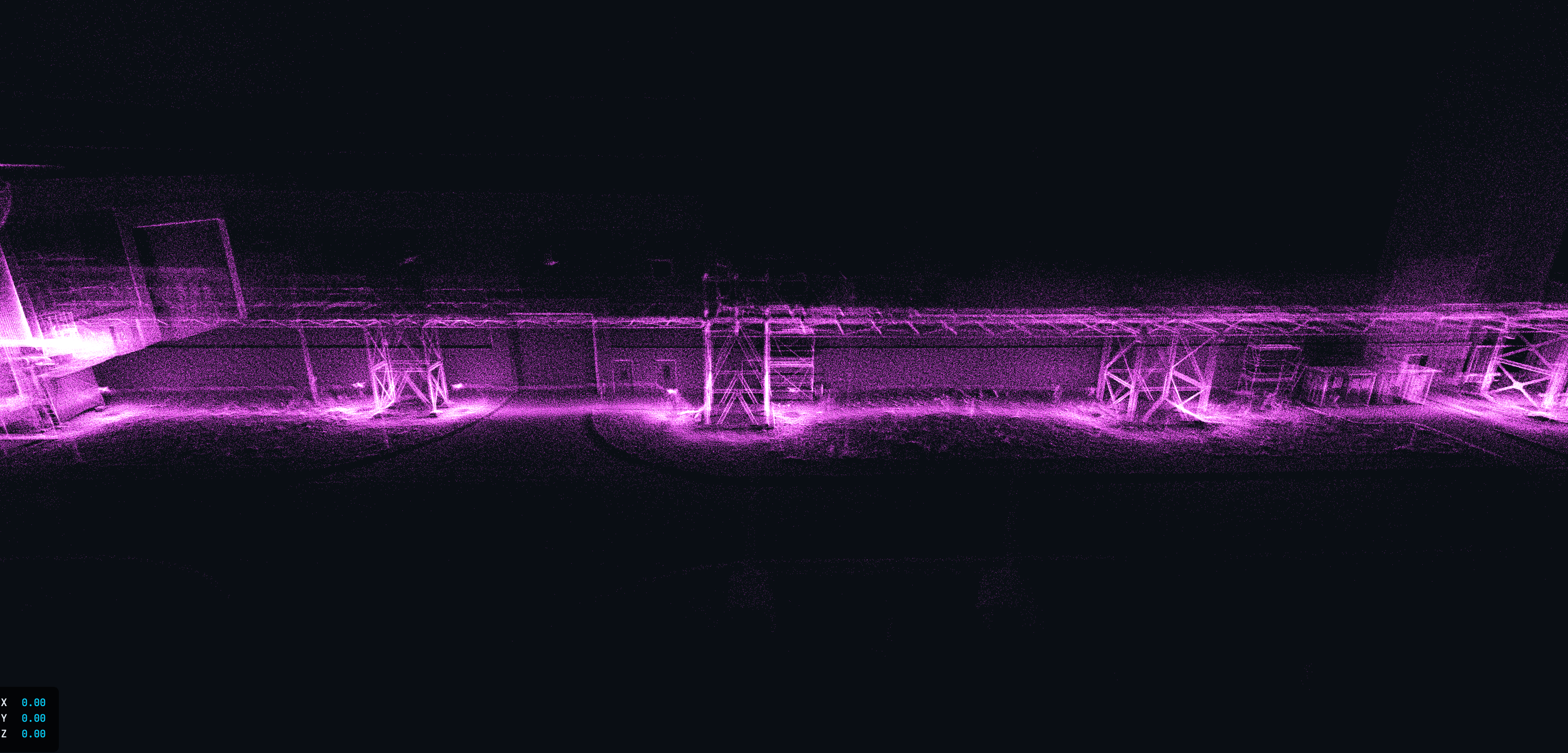
LiDAR 3D scan of a pipe bridge – geometry data for documentation and maintenance planning.
1. Tanks & Process Vessels
Storage and process tanks in chemical, petrochemical and water supply industries. The ELIOS 3 flies through manholes from DN 450 mm upwards. In practice, the most common findings are floor corrosion at water pockets, coating damage in wall corners, and structural indentations that are barely visible to the eye. LiDAR-3D makes deformations measurable – even without dismantling.
- Drone: Flyability ELIOS 3
- Inspection targets: Corrosion, welds, coating, deposits, CUI
- Benefits: Targeted NDT instead of full survey; no DGUV 113-004 confined space entry; LiDAR deformation measurement included
2. Chimneys
Interior with ELIOS 3, exterior with DJI M30T – without scaffolding or climbers. Typical findings: longitudinal cracks in the lining at console areas and ring anchors, hairline cracks in the steel shell near shaft openings. Both can be well localised with the drone before larger damage develops.
- Drone: ELIOS 3 + DJI M30T
- Inspection targets: Cracks in lining, steel shell corrosion, expansion joints, thermal anomalies
- Benefits: Interior and exterior in one appointment; crack localisation without scaffolding; thermography shows hidden insulation defects on the shell
3. Pipelines, Process Lines & Pipe Bridges
The DJI M30T captures pipe bridges with zoom and thermography from the air, the ELIOS 3 flies accessible pipelines from the inside. CUI thermography only works reliably with a temperature differential ≥5 K and not too thick, dry insulation – this must be assessed during deployment.
- Drone: DJI M30T + ELIOS 3
- Inspection targets: CUI via thermography, surface corrosion, clamps & supports, insulation damage
- Benefits: Several hundred metres of pipe bridge in one day; clamps and supports visually checkable; CUI screening – only works under defined conditions
4. Columns & Reactors
The ELIOS 3 navigates through tight internals and documents every level. Typical findings: fouling on column trays, erosion at inlet areas, corrosion in the liquid phase zone. The drone shows where NDT measures are sensible – it cannot replace them.
- Drone: Flyability ELIOS 3
- Inspection targets: Column trays & packings, corrosion & erosion, deformations, deposits
- Benefits: Findings localised and documented per level; LiDAR-3D makes deformations comparable across revisions; drone as basis – NDT as confirmation
5. Cooling Towers
The DJI M30T checks the concrete shell, the ELIOS 3 flies into the interior. In practice: concrete cracks at the transition area inlet/channel, mechanically damaged or biofilm-covered fill packing, corrosion on steel internals. Interior and exterior in one appointment, despite humid environment (IP44).
- Drone: ELIOS 3 + DJI M30T
- Inspection targets: Concrete cracks, fill packing, metal corrosion, scale deposits
- Benefits: Interior and exterior without height work; IP44 protection for humid environments; fill packing checkable for completeness and damage
6. Heat Exchangers & Condensers
The ELIOS 3 flies through accessible heat exchanger housings. Typical: pitting corrosion on tube sheets (especially water-side), fouling patterns at tube bundle inlets, corrosion on baffles. Important: tube bundle inner surfaces are only inspectable via endoscopy or dismantling.
- Drone: ELIOS 3 + DJI M30T
- Inspection targets: Tube sheets & bundles, fouling & deposits, leaks, baffles
- Benefits: Tube sheet and baffles visually assessable; preliminary assessment without opening; tube bundle inner surfaces still require endoscopy
7. Storage & Production Halls
The DJI M30T for overview, ELIOS 3 for detail areas. Common findings: corrosion on ridge purlins and roof connections, rust streaks at nodal points, damaged fire protection coating after welding work. Large halls fully captured in half a day.
- Drone: ELIOS 3 + DJI M30T
- Inspection targets: Steel corrosion, welds, roofing, fire protection coating
- Benefits: Entire hall quickly and completely captured; operational during inspection without production interruption; welds at heights above 10 m directly visible
8. Conveyor Systems & Crane Runways
The drone covers the entire crane runway without aerial work platforms. Typical findings: rail wear and flange wheel wear, fatigue cracks at weld seams of upper chords, corrosion at current rail brackets. Suspected locations are specifically marked for NDT follow-up inspection.
- Drone: ELIOS 3 + DJI M30T
- Inspection targets: Crane rails & wheels, structural welds, current rails, deformations
- Benefits: Entire crane runway documented in hours; findings localised for NDT follow-up; no aerial work platform, no production stop
9. Detection of Thermal Anomalies
Radiometric thermography of the DJI M30T detects hidden problems: defective insulation, leaks, CUI, overheated components. Hotspots at electrical and pressure plants reliably detectable. CUI screening on hot pipes (temperature differential ≥5 K) effective. Limited informative value for cold lines or thick insulation.
- Drone: DJI M30T + ELIOS 3
- Typical applications: CUI detection, leak detection, overheated components in electrical systems, defective insulation
10. Inspection of Refractory Linings
4K with 16,000 lumens shows even fine cracks and spalling. Typical findings: cracks at wall transitions and embedded components, spalling from thermal shock, anchor damage from chemical attack. Visual only – mechanical strength or anchor testing (NDT) remains necessary.
- Drone: Flyability ELIOS 3
- Inspection targets: Cracks & spalling, erosion, chemical attack, anchor systems
- Benefits: Cracks and spalling localised area-wide; repair priorities set precisely; visual inspection only – no substitute for mechanical NDT
Conclusion: Drone Inspections as Standard in the Process Industry
Drones have established themselves in the process industry as a reliable tool – not a cure-all, but genuine added value in the right deployment. The 10 use cases show: visual findings, 3D data and thermography screening can today be captured faster and more safely with drones than with classical methods.
What drones cannot do: wall thickness measurement, weld seam testing to standard, magnetic particle or phased-array ultrasound – that remains the domain of NDT specialists. Drones provide the visual basis; what is classified and assessed as a finding is decided by the responsible expert. Drone for initial survey, NDT for confirmation – for many plants this is the most efficient combination.
Your Contacts

Related Services
- Chemical Industry Inspection – Drone inspection in chemical plants and refinery operations.
- Tank Inspection – Safe inspection of storage tanks and pressure vessels without human entry.
- Boiler Inspection – Drone-assisted inspection of boilers and heat exchangers.
- Chimney Inspection – Interior and exterior inspection of industrial chimneys without scaffolding.
- Confined Spaces Inspection – Inspections in confined spaces without hazardous human entry.
- Flyability ELIOS 3 – The indoor inspection drone for all confined space applications.
Frequently Asked Questions
Which types of industrial plants can be inspected with drones?
Drone inspections are suitable for almost all plants in the process industry: tanks and pressure vessels, chimneys (interior and exterior), pipelines and pipe bridges, columns and reactors, cooling towers, heat exchangers, storage and production halls, conveyor systems and crane runways. Wherever regular inspections are required and classical methods with scaffolding or confined space entry involve high costs and risks.
How do indoor and outdoor drone inspections differ?
Indoor (ELIOS 3): GPS-independent LiDAR-SLAM navigation, collision-protected, 4K camera with 16,000 lumen LED, for confined spaces from 50 cm opening. Outdoor (DJI M30T): GPS-supported navigation, zoom camera (up to 200x), radiometric thermography, for exterior inspections of pipe bridges, chimneys and facades. Both systems complement each other for comprehensive process industry inspection.
How much does a drone inspection in the process industry cost?
Costs depend on plant size and complexity. In most cases up to 80% cheaper than classical methods with scaffolding or confined space entry: no scaffolding costs, minimal downtime, fewer personnel required. Contact us for a project-specific quote.
How quickly can a drone inspection be carried out?
The drone is ready for deployment within minutes. Inspection duration on site depends on plant size and complexity, but is significantly shorter than classical methods. Typical: tank (2–4 hours), chimney interior and exterior (half a day), pipe bridge (per 100 metres 1–2 hours).
What data is captured during a drone inspection?
Standard: 4K video, high-resolution photos, LiDAR-3D point clouds (with ELIOS 3). Optional: radiometric thermography (CUI detection, hotspots), gas sensors. All data is compiled in a detailed inspection report with findings list, positional reference and condition documentation.
Do plants need to be shut down for drone inspection?
For exterior inspections (pipe bridges, exterior chimneys, facades): Generally no shutdown required. For interior inspections (tanks, boilers, reactors): Plant must be out of service, but no scaffolding, no confined space entry preparation. This significantly reduces revision windows.
How is inspection data evaluated?
After inspection, all data is systematically evaluated: findings are classified and prioritised, damage locations are referenced in 3D models, follow-up inspections compare with previous findings. You receive a structured report suitable as a basis for certified inspectors and maintenance planning.
Is drone inspection recognised by certification bodies?
Acceptance is growing steadily. We regularly work with TÜV, DEKRA and other surveyors. Drone data serves as a high-quality basis for assessment by the surveyor. We provide structured reports with 4K screenshots, thermography evaluation and 3D models – suitable for BetrSichV (German Industrial Safety Regulation) documentation.
In which industries are drone inspections used?
Chemical and petrochemical, oil and gas, power generation (power plants), food industry, pharmaceutical industry, mining, water and wastewater, metal industry. Wherever plants are regularly inspected and classical methods involve high costs and risks.
What distinguishes Kopterflug from other drone service providers?
Specialisation in industrial inspections since 2017, combined indoor/outdoor solution (ELIOS 3 + DJI M30T), experienced inspectors with technical background, standards-compliant documentation for certification bodies, honest advice including limitations of drone technology.
Get in Touch
Have questions about drone inspection in the process industry? Fill out the form below and we'll get back to you within 24 hours.