
Digital Inspection in Industry 4.0 – Drone, AI and Digital Twin
AI-assisted damage detection, digital twin from LiDAR data, CMMS integration and predictive maintenance – the next level of industrial inspection. The drone is the sensor; AI, digital twin and CMMS integration are the platform that turns inspection data into real operational value.
- Drone as data generator – 4K, LiDAR and thermography instead of subjective impressions
- AI-assisted evaluation – up to 70% reduction in evaluation effort
- Digital twin – 3D model with georeferenced findings
From Visual Inspection to Data-Driven Plant Monitoring
The conventional industrial inspection rests on a model that has barely changed in decades: inspector enters plant, inspects visually, documents on paper or in a spreadsheet, creates report. This process is proven – but it does not scale well, is resource-intensive and delivers snapshots rather than a continuous data basis.
Industry 4.0 is fundamentally changing this model. Drones deliver high-resolution image and sensor data; AI algorithms evaluate this data automatically; digital twins integrate inspection findings into a three-dimensional plant model; CMMS and EAM systems link finding data with maintenance history and maintenance planning. The result is continuous, data-driven plant monitoring instead of periodic individual inspections.
For operators of large industrial plants – chemical works, refineries, power stations, port infrastructure – this delivers measurable advantages: early damage detection, reduced unplanned shutdowns, optimised maintenance intervals and complete compliance documentation.


AI-Assisted Damage Detection: State of the Art
Artificial intelligence in industrial inspection means concretely: deep learning algorithms (convolutional neural networks, CNNs), trained on thousands of inspection images with annotated damage patterns, automatically recognise these patterns in new recordings.
For drone inspection this means: the pilot systematically covers the object, the 4K video recording is analysed after the flight by the AI system. The system automatically marks suspect areas for:
- Corrosion (rust areas, pitting, layer corrosion) – detectable by colour, texture and form
- Cracks in concrete and steel – detectable by line geometry and contrast
- Coating damage (spalling, blistering, delamination)
- Deposits and foreign bodies
The AI provides a pre-selection that is validated by the expert – no AI system replaces professional assessment, but it significantly reduces evaluation effort. What a human inspector previously had to review manually in hours is pre-sorted in minutes.
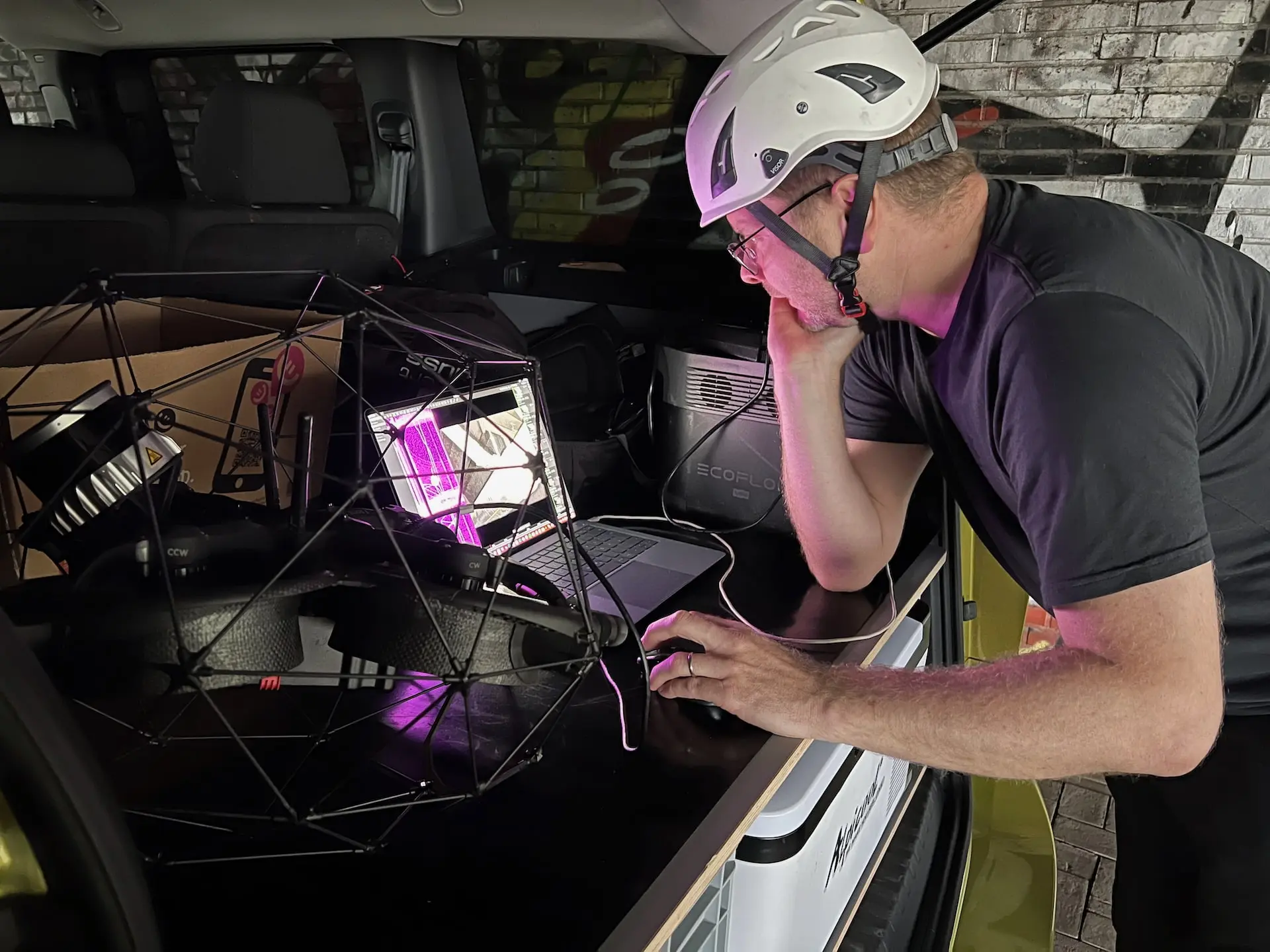
Important for practice: AI systems require high-quality input data. This means: systematic flight path, adequate lighting, defined distance to the surface. The ELIOS 3 with its 16,000-lumen lighting system and LiDAR-assisted position maintenance delivers these prerequisites consistently.
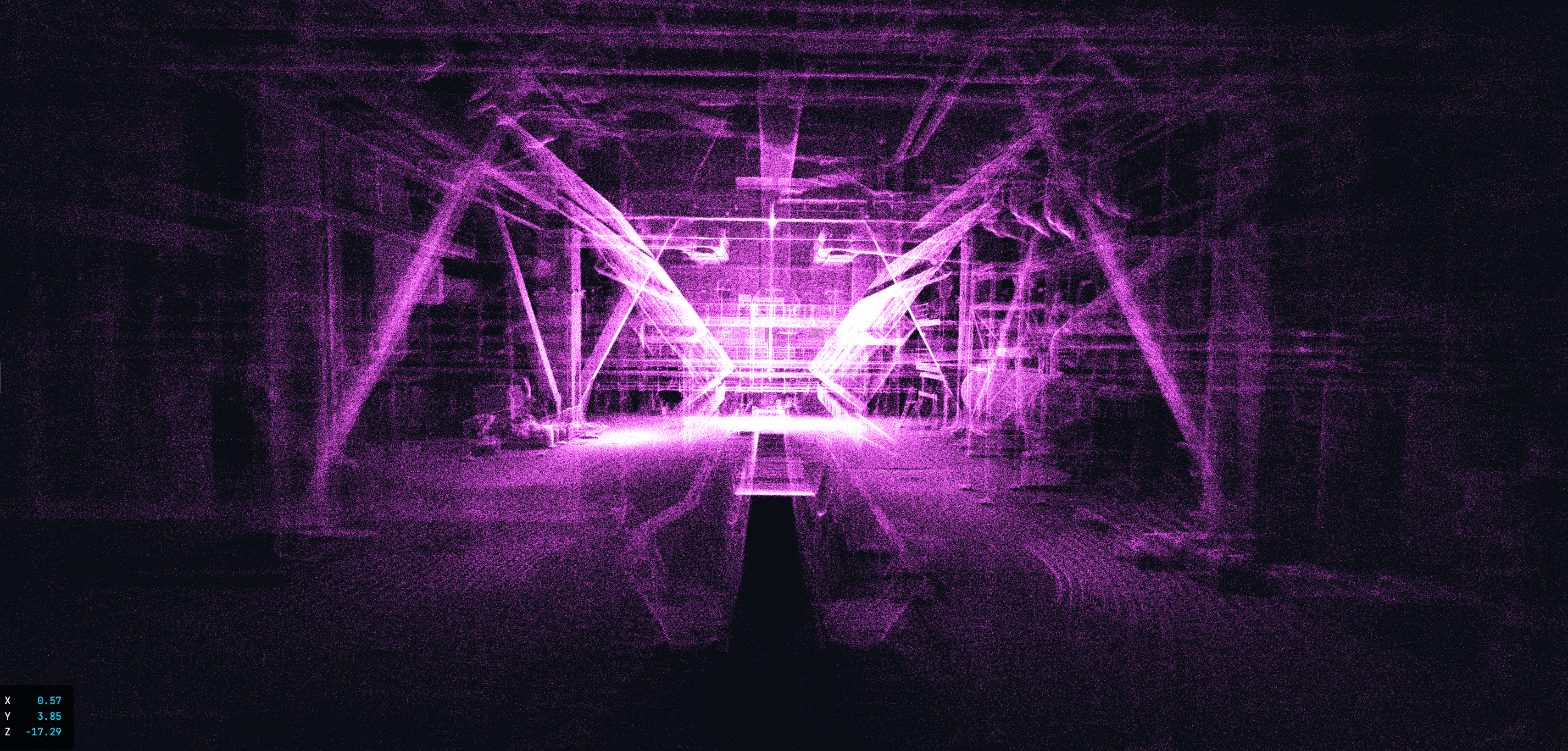
LiDAR 3D scan of a power station boiler house – the geometric basis for digital inspection and digital twin.
Digital Twin from LiDAR Data
The digital twin is the three-dimensional virtual image of a physical plant – enriched with condition data, operating parameters and inspection findings. It enables plants to be traversed virtually, damage patterns to be contextualised spatially and maintenance measures to be planned without entering the physical plant.
The basis for a digital twin is formed by LiDAR 3D scans that capture the geometry of the plant with dimensional accuracy. The ELIOS 3 is equipped with an integrated LiDAR sensor (SLAM-based) and delivers 3D point clouds directly from the interior of confined spaces – exactly where terrestrial laser scanners and photogrammetric exterior shots do not work.
Applications of the digital twin in inspection:
- 3D damage localisation: Findings are not just described, but localised three-dimensionally in the model – exactly referenceable for follow-up inspection and repair planning.
- Damage progression: Comparison of 3D models from different inspection periods makes wall thickness loss, corrosion spread and geometric changes measurable.
- Decommissioning planning: In nuclear decommissioning or plant conversions, the digital twin provides the planning basis for cutting plans and assembly sequences.
- Virtual inspection: Experts, planners and operators can inspect the plant virtually – without travel, without protective equipment, from any location.
Integration into CMMS/EAM & Predictive Maintenance
The most valuable use of inspection data arises when it does not disappear into a folder but flows into the operational maintenance organisation. Modern CMMS systems (Computerized Maintenance Management System) such as SAP PM, IBM Maximo, Ultimo or IFS allow linking finding data with maintenance orders, spare parts management and maintenance budgets.

Your Contacts
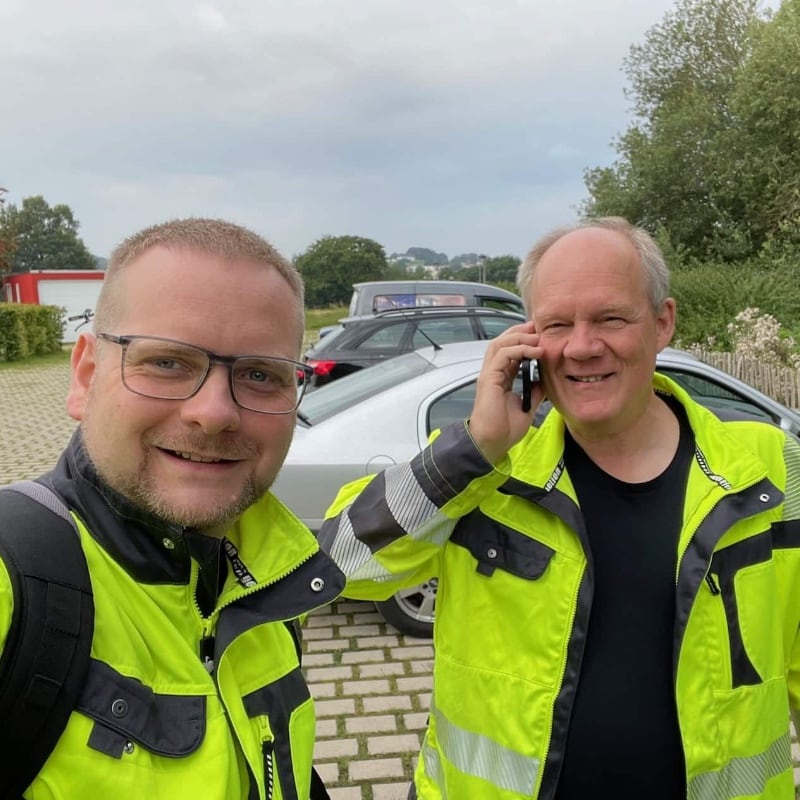
Dipl.-Ing. Karsten Lehrke and Christian Engelke – your direct contacts for digital inspection strategy.
We show you how to integrate drone data, LiDAR and digital twins into your maintenance organisation. Speak with us.
Related Services
- Industrial Inspection Overview – All application areas of drone inspection in industry.
- LiDAR & 3D Scanning – LiDAR-based 3D surveying and digitisation of industrial plants.
- Tank Inspection – Tanks and storage vessels checked without entry and without operational interruption.
- Confined Spaces Inspection – Confined spaces safely inspected without human entry.
- Digital Twin from Drone Data – How precise digital twins of industrial plants are created from drone recordings.
- Condition Documentation – Complete condition documentation as the basis for maintenance decisions.
Frequently Asked Questions: Digital Inspection & Industry 4.0
What does “digital inspection” mean concretely?
Digital inspection means the systematic collection, analysis and utilisation of inspection data in digital form. For drones: 4K video and photos as primary documentation, LiDAR point clouds as 3D geometry reference, thermography as thermal data layer. All data is machine-readable, georeferenced and comparable over time – unlike conventional paper documentation or subjective individual observations.
How does AI damage detection work with drone data?
Deep learning algorithms (CNNs) are trained on thousands of annotated inspection images. After the drone flight, the AI analyses the 4K footage and automatically marks suspect areas for corrosion, cracks and coating damage. The human expert validates the AI pre-selection and creates the finding documentation. Evaluation effort is reduced by up to 70%.
What is a digital twin and what does it deliver for inspection?
A digital twin is a 3D model of a physical plant – created from LiDAR scan data. For inspection: findings are georeferenced directly in the 3D model, damage progression is measurable by comparing models from different time points, follow-up inspections can approach exactly the same positions. The expert can inspect the plant virtually without travel or protective equipment.
Which CMMS systems can be integrated?
Drone inspection data can be integrated into any CMMS/EAM system that accepts structured data imports: SAP PM, IBM Maximo, Ultimo, IFS, Infor EAM and others. The integration typically runs via standard formats (CSV, XML, API) or direct interfaces. We deliver structured finding data that is transferable into maintenance orders with minimal manual effort.
What is RBI (Risk-Based Inspection)?
RBI (Risk-Based Inspection) is a methodology per API 580/581 and ASME PCC-3 for prioritising inspection effort based on damage probability and consequence of failure. High-risk assets are inspected more frequently and more thoroughly; low-risk assets less intensively. Drone inspection data – especially trend data from multiple inspection periods – provides the empirical finding basis for RBI decisions.
What is predictive maintenance and how does drone data contribute?
Predictive maintenance means: maintenance is conducted when the data indicates it is necessary – not according to a fixed calendar. Drone inspection data from multiple time points reveals damage rates (corrosion rate, crack growth). AI models project when a component will reach the critical threshold. The result: fewer unnecessary maintenance interventions, fewer unexpected failures.
How do I start building a digital inspection strategy?
A pragmatic starting point: first inspection with drone data collection (4K + LiDAR + thermography), creation of a digital twin as a baseline, definition of critical findings and relevant damage parameters, second inspection after a defined interval for trend comparison, integration of finding data into the existing CMMS. We support this process from the first inspection to CMMS integration.
What data security aspects are relevant?
Drone inspection data about industrial plants is sensitive. We work according to defined data protection standards: data transfer via encrypted connections, storage on European servers or on your own infrastructure on request, clear data deletion protocols and access management. For safety-critical facilities (KRITIS, classified areas) we clarify the relevant security requirements in advance.
Get in Touch
Interested in developing a digital inspection strategy? Fill out the form below and we’ll get back to you within 24 hours.