
Checklist: Preparing a Drone Inspection – 12 Steps
What operators need to clarify before a drone deployment – from safety clearance (Sicherheitsfreigabe) to coordination with operations. Operating since 2017.
- Gas analysis, ATEX clearance, Permit to Work – who is responsible?
- DGUV requirements for confined space inspections
- 12 preparation steps from objective definition to report format
Why Preparation Determines Success or Failure
A drone inspection in an industrial plant is not a spontaneous event. Between receiving the commission and the first flight lies a preparation process that must be systematically worked through on both the operator side and the inspection side. If this process is abbreviated, the best case is delays on the day – in the worst case, accidents or legal consequences.
This checklist is addressed to plant operators, maintenance managers and HSE (Health, Safety, Environment) managers who are planning a drone deployment for their equipment. It covers 12 central preparation steps – from technical feasibility assessment to coordination with live operations.
Step 1: Define Inspection Objective and Scope
Before any other preparation, clearly define what is to be inspected and what result is expected. Typical inspection objectives are:
- Visual testing (VT) per DIN EN ISO 17637 for finding identification before a maintenance decision
- 3D geometry capture with LiDAR for as-built documentation or wear assessment
- Thermography for detection of hot spots, insulation damage or active leaks
- Condition documentation as a reference baseline for future comparative surveys
The more precisely the inspection objective is formulated, the more efficiently the deployment can be prepared. Record: which equipment units? Which areas (inside/outside/both)? Will an expert be present? Are findings reports required for the authority?
Step 2: Clarify Access Points and Geometry
For interior inspection with the ELIOS 3, at least one access point of DN 600 or larger must be available. Clarify:
- Location and size of all manways, inspection nozzles, cleaning openings
- Internal fittings that could obstruct the flight path (agitators, agitator shafts, heating coils, floor fittings)
- Height/depth of the vessel – affects battery capacity requirement and number of flights
- Availability of isometric drawings, P&IDs or previous inspection drawings
Steps 3–7: Safety & Clearance
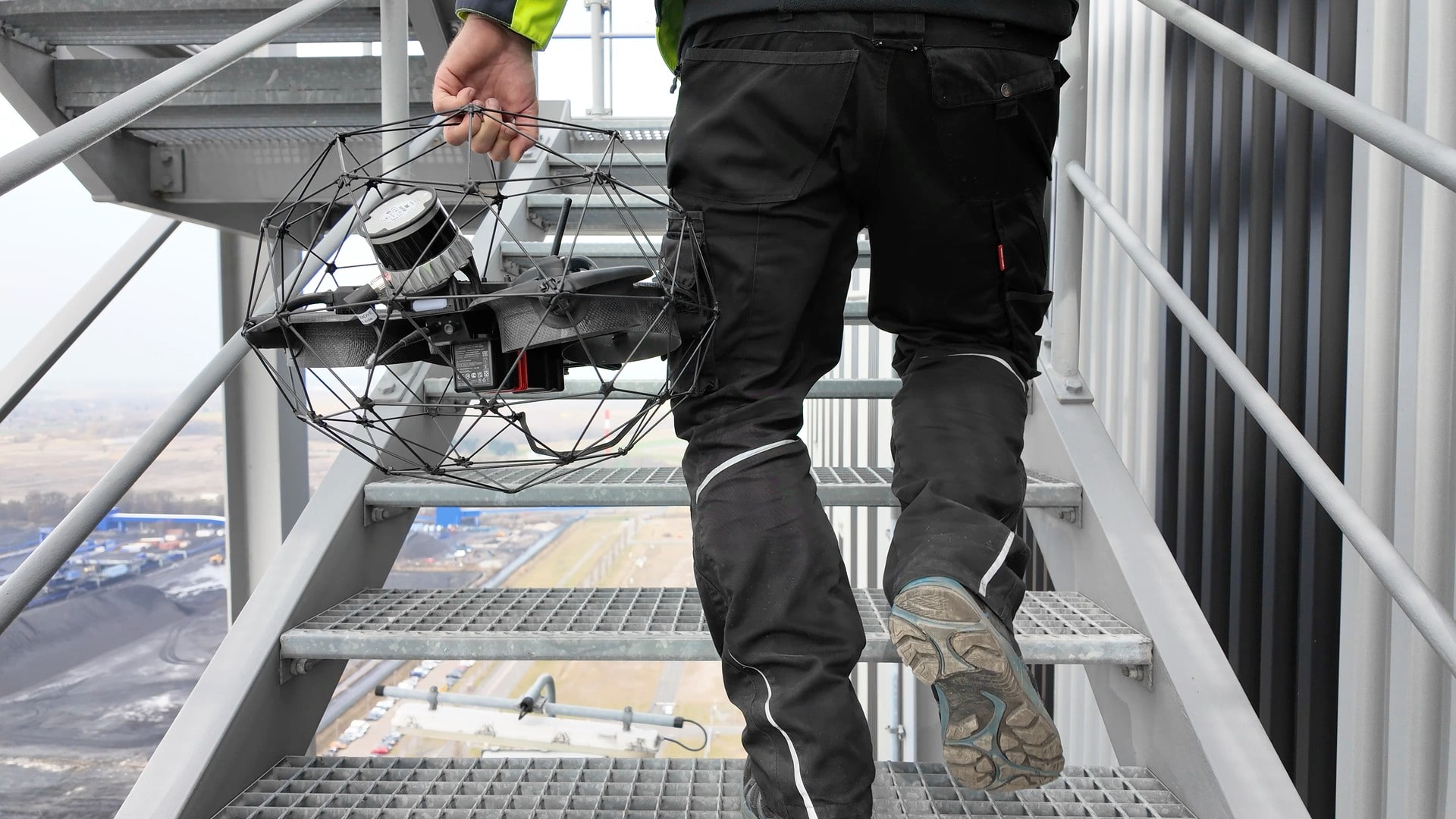
Preparation before deployment: gas measurement, Permit to Work, safety briefing – everything must be done before the first flight.
Step 3: Atmosphere Analysis and Explosion Protection
The ELIOS 3 is not ATEX-certified. Before every indoor deployment the atmosphere in the vessel must be analysed and declared non-explosive. The operator is responsible for this under TRGS 722 (avoidance of ignition hazards) and BetrSichV Annex 2 Section 3.
- Explosive gas analysis for flammable gases (LEL measurement): result must be below 10% LEL
- Oxygen content: 19.5–23 vol% for safe working conditions
- Toxic gases: H&sub2;S below 1 ppm, CO below 30 ppm, NH&sub3; below 20 ppm (guideline values – observe plant-specific limits)
- Measurement by trained personnel with calibrated equipment immediately before deployment starts
Step 4: Operational Clearance (Permit to Work)
In most industrial plants, a formal Permit to Work (PtW) procedure is required. A drone deployment is not “normal” work – but it still requires a clear assignment of responsibilities.
- Issue of the permit by the plant responsible person
- Definition of the work area (corridor, safety zones around the entry point)
- Coordination with parallel work (hot work, crane operations, deliveries)
Step 5: DGUV Requirements for Confined Spaces
As soon as the drone enters a vessel classified as a confined space (enger Raum) under DGUV Vorschrift 1 and DGUV Information 213-050, the full code of practice for vessel entry applies – even if no person is entering.
- Safety watchman at the manway required (may be waived if explicitly documented that no personnel hazard exists)
- Communication means between pilot and safety watchman
- Rescue readiness: minimum requirements for first-aid equipment at the deployment site
Step 6: Residual Gas Analysis and Inerting
For tanks and vessels that previously contained hazardous substances, a residual gas analysis after emptying and cleaning is mandatory. For the drone inspection: only after a successful residual gas analysis is the deployment released. If inerting with nitrogen was planned, the N&sub2; must be completely replaced by fresh air before deployment.
Step 7: Temperature Check
The ELIOS 3 is specified for ambient temperatures of −10°C to +45°C. For hot vessels (after turnaround, after steam purging) sufficient cooling time must be planned. A temperature measurement at the manway entry before deployment starts is mandatory.
Steps 8–10: Logistics & Coordination
Step 8: Lighting and Electrical Supply
The ELIOS 3 provides 16,000 lumen of its own lighting – sufficient for most interior inspections. For very large volumes (tanks over 15 m diameter, silos over 20 m height) additional portable lighting may be useful. Clarify:
- Availability of a 230V socket for the battery charging station near the deployment site
- If applicable: portable light sources for particularly large spaces
- Cable length for possible tethering (not required for the ELIOS 3, but as backup communication)
Step 9: Communication with the Control Room
The deployment must be coordinated with the control room or shift supervisor. Key coordination points:
- Time window for the drone deployment (exclude or coordinate parallel work)
- Cordoning of the immediate area around the entry point (radius approx. 5–10 m)
- Notification to adjacent work areas if the drone also overflies external areas
- Emergency communication: who is the responsible contact for unexpected incidents?
Step 10: Prepare Documents and Documentation
For a standards-compliant inspection and legally defensible documentation, the following documents should be available on the deployment day:
- Isometric drawings or plant plans of the equipment to be inspected
- Previous inspection reports as a comparison basis
- Operator-completed release/safety form (Permit to Work)
- Contact details of the responsible safety officer
- For plant subject to mandatory inspection under BetrSichV: commissioning letter to the authorised inspection body (ZÜS) or approved inspection authority (ZP)
Steps 11–12: Day of Deployment & After the Inspection
Step 11: Induction and Briefing on Deployment Day
Immediately before deployment starts, we conduct a joint Toolbox Talk with all involved parties:
- Brief introduction to the planned deployment sequence and inspection objectives
- Re-confirmation of the atmosphere analysis (measurement max. 30 minutes before deployment)
- Clarification of emergency procedures: what happens if the drone gets stuck in the vessel?
- Role assignment: pilot, safety watchman, plant responsible person, inspector/expert
A lost drone in the vessel is a rare but possible scenario. The ELIOS 3 has a failsafe mode that holds it at its last position on signal loss. A simple plastic recovery hook is sufficient in most cases to retrieve the drone. Clarify in advance where the recovery tool is located and who operates it.
Step 12: Agree Results and Report Format
Define before the deployment in which format the results are to be delivered:
- 4K video raw data: For internal evaluation or as an expert basis
- Findings report (PDF): With photos, finding location, assessment category and recommended action
- LiDAR 3D model: As .PLY or .OBJ for further processing in CAD/BIM systems
- Thermography report: Radiometric TIFF files with temperature maps and anomaly markings
Also clarify the operator’s data protection and data security requirements: on which server is the data stored? Who has access? How long are the raw data retained? For sensitive industrial plants (critical infrastructure, defence suppliers) special requirements apply that should be agreed in writing in advance.
Talk Directly to Our Team
We go through the checklist together with you – free of charge, tailored to your plant. Submit a plant description and we will get back to you.
 Christian Engelke
Managing Director & Chief Pilot
Christian Engelke
Managing Director & Chief Pilot
 Karsten Lehrke
Dipl.-Ing., Senior Inspector
Karsten Lehrke
Dipl.-Ing., Senior Inspector
 Philipp
Drone Pilot & Inspector
Philipp
Drone Pilot & Inspector
 Juliana
Project Coordination
Juliana
Project Coordination
 Stephan
Drone Pilot & Inspector
Stephan
Drone Pilot & Inspector
Related Services
- Confined Spaces Inspection – Safe inspection of tight spaces without personnel entry.
- Tank Inspection (Tankinspektion) – Professional tank inspection by drone – inside and outside without scaffolding.
- Boiler Inspection (Kesselinspektion) – Water-tube boilers and steam generators safely inspected by drone.
- Chemical Industry Inspection – Drone inspection for chemical plants, columns and reactors.
- Pipe Bridge Inspection (Rohrbrücken-Inspektion) – Drone inspection of pipeline bridges.
- Power Plant Inspection (Kraftwerk-Inspektion) – Drone inspection for power plants, boilers and chimneys.
Frequently Asked Questions: Preparation Checklist
Who is responsible for the gas measurement before drone deployment?
The plant operator is responsible for the atmosphere analysis under TRGS 722 and BetrSichV Annex 2 Section 3. The measurement must be carried out immediately before deployment starts (max. 30 minutes before) by trained personnel with a calibrated measuring device. The drone deployment is only released after confirmed gas-free clearance (LEL <10%, O&sub2; 19.5–23%).
What minimum access size does the ELIOS 3 require?
The ELIOS 3 requires a minimum access opening of 50 × 50 cm (DN 600 equivalent). Round manways from DN 600 are generally sufficient. Rectangular cleaning openings or inspection nozzles can also be used if the minimum dimensions are met. Access position (top/side) affects the flight approach – please specify when requesting a quote.
Is a Permit to Work always required for drone inspections?
This depends on the plant's internal permit-to-work system. In most industrial plants a formal PtW process is prescribed for any work on or near equipment. Even for drone deployments – where no person enters the vessel – responsibility must be clearly assigned: who issues the permit, who is the plant responsible person, how are parallel works coordinated. We adapt to your plant's PtW requirements.
Do DGUV confined-space requirements also apply when no person enters the vessel?
Yes – in part. DGUV Vorschrift 1 and DGUV Information 213-050 fundamentally apply to vessel entry operations. Even without personal entry, the operator must document that no hazard to persons exists. In practice: safety watchman at the manway, communication to the pilot and rescue readiness are generally maintained. The exact scope depends on the plant's safety management system.
What temperature limits apply for drone inspection?
The ELIOS 3 is specified for ambient temperatures of −10°C to +45°C. For boilers and furnaces after shutdown, sufficient cooling time must be planned. A temperature measurement at the manway entry is required. From approximately 45°C interior temperature the deployment must be postponed – we inform you transparently about the delay if temperatures exceed limits.
What if the drone gets stuck in the vessel?
The ELIOS 3 has a failsafe mode that holds it at its last position on signal loss. In practice, retrieval is possible in most cases with a simple recovery tool (plastic hook on a rod). We clarify retrieval scenarios in the pre-deployment briefing. Loss of the drone in a vessel is rare, but it should be planned for. We coordinate recovery options transparently with you in advance.
How far in advance must a drone deployment be planned?
For standard deployments: 1–2 weeks lead time is sufficient for preparation, permit processing and scheduling. For deployments during planned shutdowns (turnarounds): we recommend planning 4–8 weeks in advance to align with the shutdown schedule. For urgent deployments (unplanned shutdown, damage event): short-notice availability is often possible – contact us directly.
Which documents should be available on the deployment day?
At minimum: Permit to Work (signed), gas measurement protocol (max. 30 min before deployment), plant plans / isometric drawings, previous inspection reports for comparison, and the contact details of the safety officer. For mandatory inspection plants under BetrSichV additionally: commissioning letter to the ZÜS. We provide a standard document checklist on request.
Request Consultation on Drone Inspection Preparation
We go through the checklist together with you – free of charge, tailored to your plant. Submit a plant description and we will get back to you.