
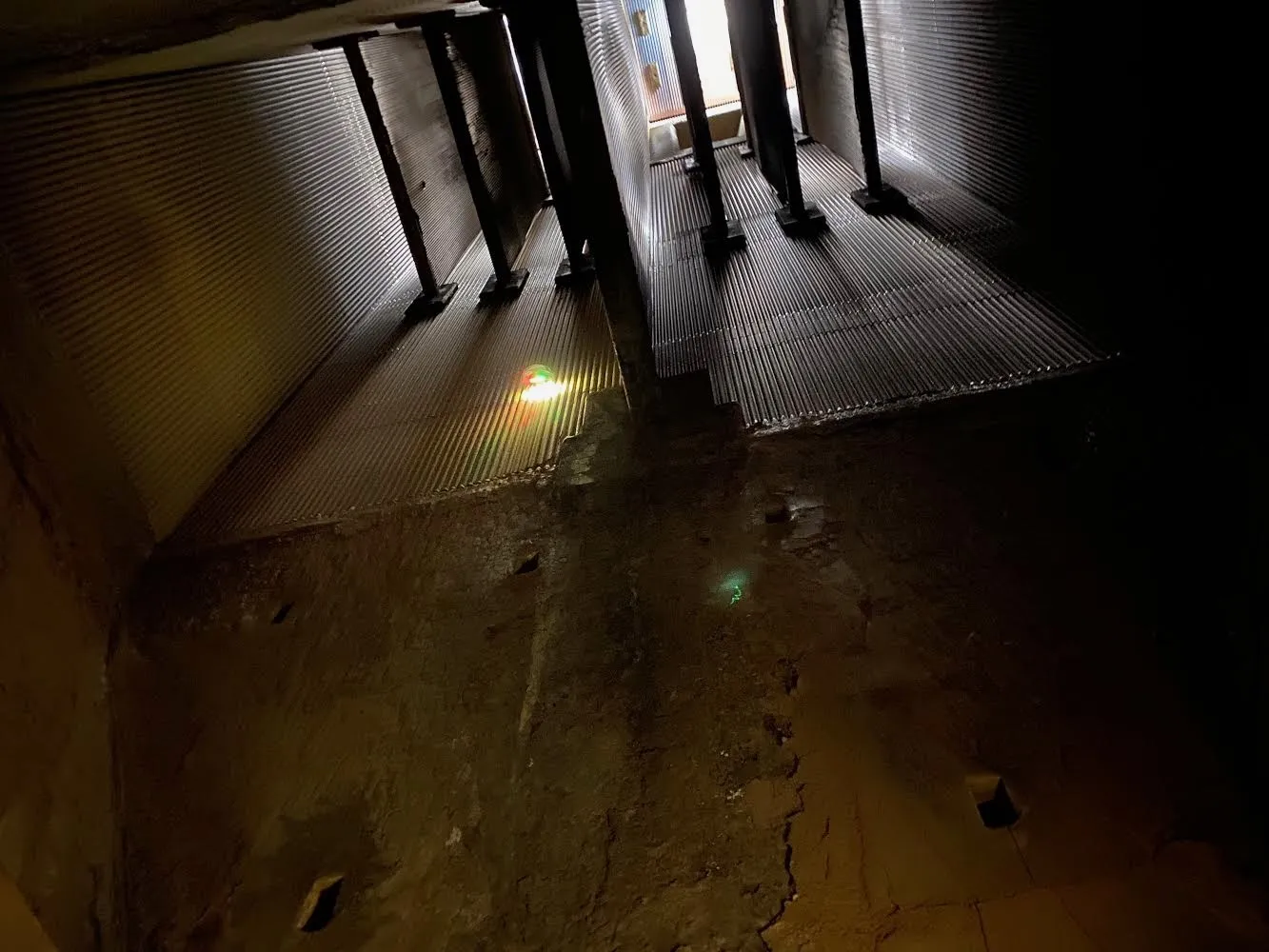
Power Plant & Nuclear Decommissioning Inspection – Boilers, Cooling Towers & Containments
Boiler interiors, cooling towers and containments – dose reduction and safety gains through the ELIOS 3. ALARA principle in practice. Operating since 2017.
- Boiler inspection without scaffolding – hours instead of weeks
- Nuclear decommissioning: ALARA principle – drone flies while team stays in safe area
- Cooling tower inspection: exterior (Matrice 30T) + interior (ELIOS 3)
Power Plant Inspection: Highest Demands on Efficiency and Safety
Power plants – whether coal, gas or biomass-fired – depend in their core technology on regular, thorough inspections. In particular, boiler interiors, steam generators, cooling towers and flue gas ducting represent extreme inspection objects: vast volumes, extreme heat residue shortly after shutdown, dust loading from fly ash and the sheer size of the structures make conventional inspection methods expensive and time-consuming.
A single scaffold in the boiler house of a 500 MW block costs weeks and considerable resources. The ELIOS 3 performs the initial inspection in hours and delivers 4K video documentation plus LiDAR 3D geometry – before the first scaffold pole is erected. This saves not only time, but enables targeted maintenance planning: scaffolding only where there is actually a need for action.
For cooling towers (natural draught and forced cooling) the drone is already established: exterior inspection of cooling tower shells with the DJI Matrice 30T and interior inspection (internals, water distributors, drift eliminators, concrete shell) with the ELIOS 3 are complementary methods that together deliver a complete picture.
A conventional power plant boiler can only be entered after cooling times of days. The drone flies earlier – and thus shortens the inspection bottleneck in the turnaround.

Nuclear Decommissioning: The ALARA Principle and the Drone
The decommissioning of nuclear power plants is one of the most demanding inspection tasks of all. The ALARA principle (As Low As Reasonably Achievable) requires that the radiation exposure of persons be reduced to the technically reasonably achievable minimum. Every minute that a person spends in contaminated or radiation-affected areas increases the cumulative dose.
The ELIOS 3 offers a fundamental advantage here: the drone flies into areas that would only be accessible to the human inspection team with protective equipment and time-limited exposure. For the following decommissioning tasks, drone deployment is particularly relevant:
Containment structure: The reinforced concrete containments of pressurised water reactors and boiling water reactors must be fully geometrically captured and checked for structural damage before decommissioning. LiDAR scans from the ELIOS 3 deliver dimensionally accurate 3D point clouds for decommissioning planning – without personnel exposure.
Ventilation systems and exhaust ducts: The ventilation and exhaust ducts in a nuclear plant are often contaminated and poorly accessible. The drone can navigate through cross-sections that are not walkable for humans, and document deposits and coating damage.
Spent fuel pool surroundings: The structures around spent fuel pools (walls, ceiling structures, pipe penetrations) can be inspected by drone for cracks, coating damage and corrosion – with minimal personnel exposure.
In nuclear decommissioning, every minute of personnel exposure in radiation fields must be minimised. The ELIOS 3 flies while the team remains in the controlled area – this is lived ALARA.



Cooling Tower Inspection in Detail
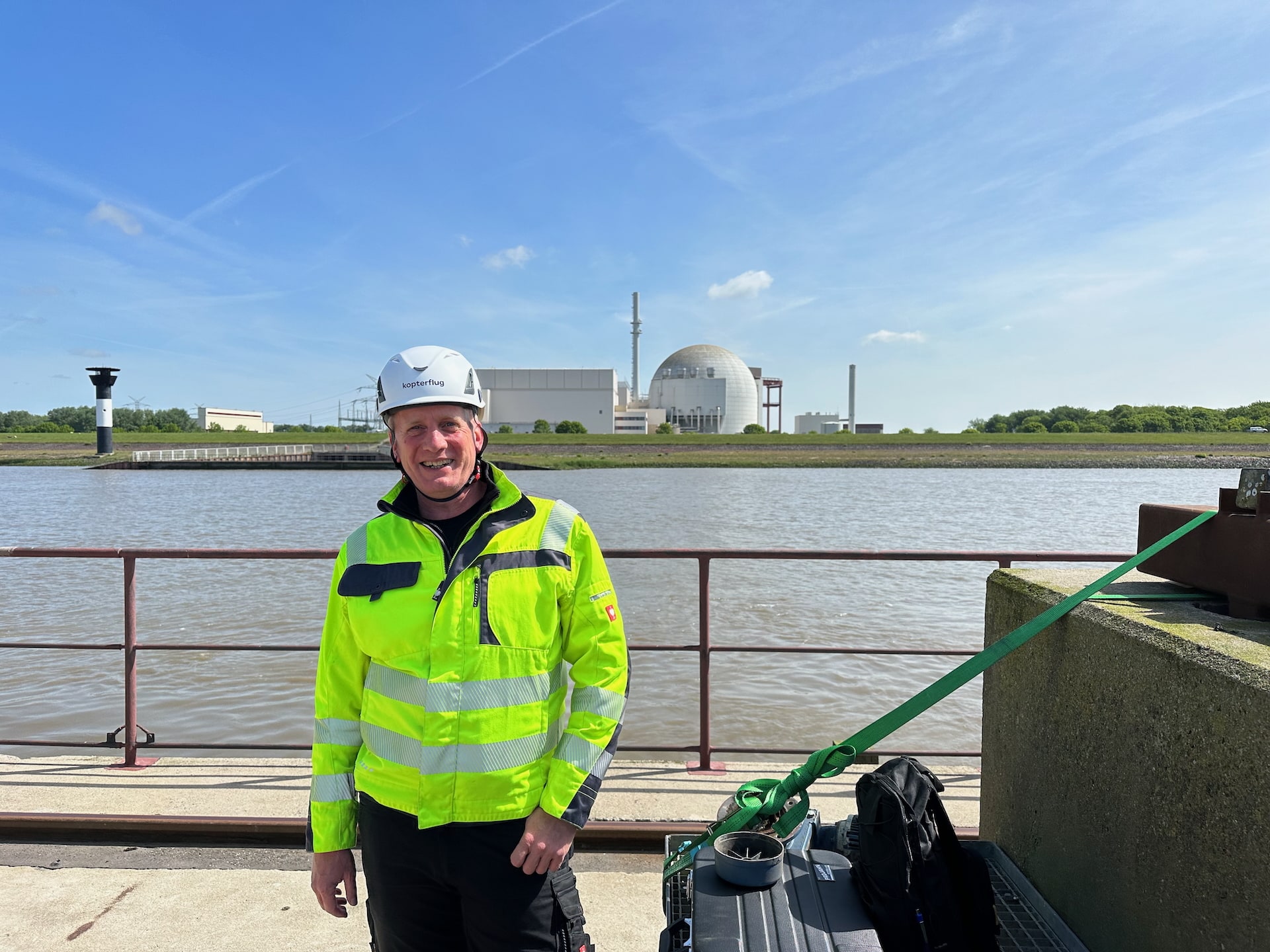
Cooling towers – up to 200 m high and with complex interior structures. ELIOS 3 and Matrice 30T cover both sides.
Cooling towers are particularly demanding inspection objects due to their size (natural-draught cooling towers reach 150–200 m height) and their operating environment. Kopterflug deploys both systems depending on the task:
Exterior inspection with the DJI Matrice 30T: The outer shell of a natural-draught cooling tower in reinforced concrete typically shows spalling, cracks, reinforcement corrosion (carbonation, chloride ingress) and drainage damage. The Matrice 30T with 41x optical zoom and 640×512-pixel thermal camera documents these damages from a safe distance – no scaffolding, no rope access.
Interior inspection with the ELIOS 3: The interior of a cooling tower is a damp, hard-to-access confined space: water distribution levels, drift eliminators, internals (packing/fill media) and the concrete shell from inside. Salt deposits, biological growth (Legionella prevention!), internal corrosion and concrete damage are captured via 4K camera and thermography.
The Legionella problem makes frequent inspections of the water distribution systems necessary: TRBA 466 requires regular checks. The drone can document water distribution equipment, distribution nozzles and drift eliminator integrity without personnel needing to enter the damp interior.
Cooling towers combine the challenges of a tall building (exterior inspection) with those of a confined space (interior inspection). With Matrice 30T and ELIOS 3, Kopterflug covers both aspects.
Typical Findings in Power Plant and Nuclear Inspections
The ELIOS 3 and the DJI Matrice 30T capture a broad spectrum of power-plant-specific damage patterns:


Talk Directly to Our Team
We have experience with power plant boilers, cooling towers and nuclear decommissioning projects. We assess feasibility honestly and plan dose-minimised deployment concepts.
 Christian Engelke
Managing Director & Chief Pilot
Christian Engelke
Managing Director & Chief Pilot
 Karsten Lehrke
Dipl.-Ing., Senior Inspector
Karsten Lehrke
Dipl.-Ing., Senior Inspector
 Philipp
Drone Pilot & Inspector
Philipp
Drone Pilot & Inspector
 Juliana
Project Coordination
Juliana
Project Coordination
 Stephan
Drone Pilot & Inspector
Stephan
Drone Pilot & Inspector
Related Services
- Power Plant Drone Inspection (Kraftwerk-Inspektion) – Power plants and energy installations inspected efficiently and safely by drone.
- Boiler Inspection (Kesselinspektion) – Boiler interior walls, superheaters and furnace rooms without scaffolding or entry.
- Industrial Inspection Overview – All drone inspection deployment areas in industry.
- Nuclear Power Inspection (Kernkraftinspektion) – Specialised drone inspection for nuclear plants and decommissioning projects.
- Chimney Inspection (Schornsteininspektion) – Chimneys and flues inside and outside without scaffolding.
- Cooling Tower Inspection (Kühlturminspektion) – Cooling towers fully and safely documented by drone – without climbing scaffold.
Frequently Asked Questions: Power Plant & Nuclear Decommissioning
How soon after a boiler shutdown can the drone inspect?
The ELIOS 3 is specified for ambient temperatures up to +45°C. For a conventional power plant boiler after shutdown, an interior temperature measurement at the manway is required before deployment. In practice, the drone can begin inspection considerably earlier than a conventional inspection team – no scaffolding erection is required, and personnel entry with respiratory protection is not necessary. This shortens the inspection bottleneck in the turnaround (Turnaround-Bottleneck) measurably.
What specific value does the drone offer in nuclear decommissioning?
The core benefit is ALARA compliance (As Low As Reasonably Achievable): drone deployment reduces the cumulative personnel dose in contaminated areas documentably. The ELIOS 3 flies in areas with elevated radiation levels while the team stays in the controlled area. For LiDAR geometry capture of containments, documentation of ventilation ducts and inspection of spent fuel pool surroundings, this is a directly quantifiable safety gain – relevant for radiation protection records and licensing procedures.
Can the drone inspect cooling towers fully – inside and outside?
Yes – with two complementary systems. Exterior: DJI Matrice 30T with 41x optical zoom and radiometric thermography documents the reinforced concrete shell from ground level – cracks, spalling, reinforcement corrosion, drainage damage, geometric deviations. Interior: ELIOS 3 documents water distribution systems, drift eliminators, packing, the concrete shell from inside and salt deposits – relevant for Legionella prevention per TRBA 466.
Can refractory damage be detected by drone?
Yes. Refractory lining damage (Refractory-Schäden) in boiler furnace rooms is detectable both visually (spalling, cracks, surface erosion in 4K) and thermographically (heat loss through damaged lining areas). The combination of 4K camera and thermography in the ELIOS 3 makes it possible to identify and prioritise areas of action before scaffolding is erected – targeted instead of full-surface investigation.
What documentation is produced after a cooling tower inspection?
You receive: 4K video of all exterior and interior surfaces, a findings report (PDF) with photos, finding location, damage classification and recommended actions, optionally a LiDAR 3D model of the cooling tower geometry (useful for deformation analysis and planning of renovation measures), and thermography evaluation with radiometric data for the concrete shell exterior. The documentation is suitable for use by your structural engineer and as the basis for maintenance planning.
Are special permits required for drone deployment in nuclear plants?
Indoor inspections with the ELIOS 3 (inside buildings, containments, shafts) do not require an EU drone licence – EU drone regulation only covers outdoor airspace. Specific nuclear site access requirements (authorisation, radiation protection briefing, PPE requirements) must be clarified with the plant operator and/or the nuclear supervisory authority. We coordinate all requirements with you in advance and adapt our deployment procedures accordingly.
Can fly-ash dust affect the drone during boiler inspection?
Fly ash is relevant for two reasons: visual (reduced image quality through dust clouds) and mechanical (contamination of the drone). We take both into account in deployment planning: sufficient time after the last furnace operation for dust to settle, and cleaning of the ELIOS 3 after the deployment in the boiler. For extremely dusty environments, additional filtration of the camera aperture can be used. We discuss these boundary conditions with you before the deployment.
Can Legionella-relevant water distribution systems be inspected by drone?
Yes. The ELIOS 3 documents cooling tower water distribution systems, distribution nozzles and drift eliminator integrity in 4K – without personnel needing to enter the damp interior. This is directly relevant for compliance with TRBA 466 (technical rules for biological working agents for cooling towers). The drone inspection can serve as documentation for the mandatory inspection intervals and for identifying deficiencies in the water distribution system.
Request Power Plant or Decommissioning Inspection
We assess which areas of your power plant or decommissioning object can be efficiently inspected with ELIOS 3 and Matrice 30T. Dose reduction, time savings, complete documentation.