
Hybrid Inspection: Drone First – Human Only Where Necessary
The most efficient inspection approach for confined spaces: remote initial assessment followed by targeted manual follow-up. Kopterflug has applied hybrid inspection in practice since 2017.
What is Hybrid Inspection?
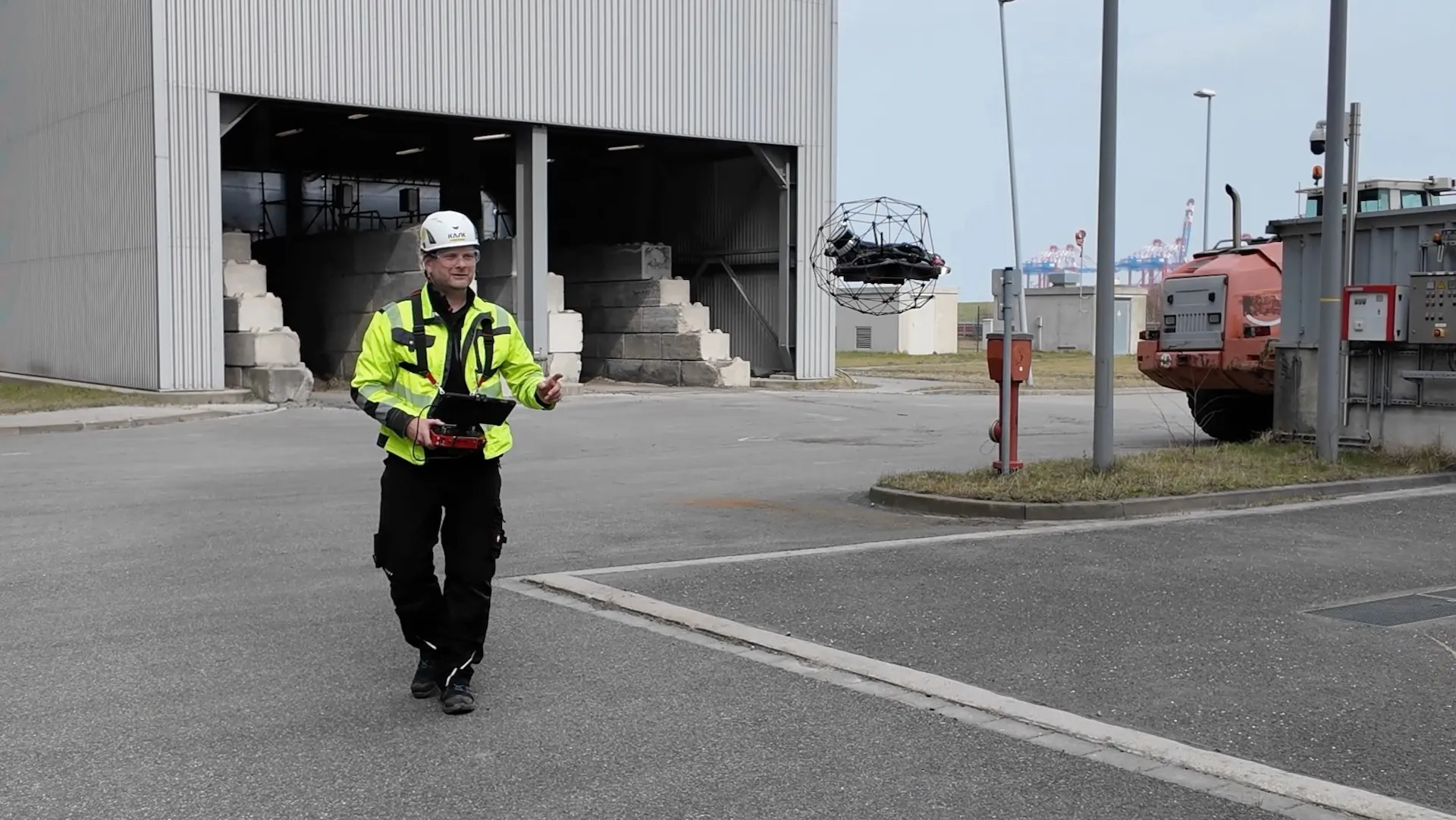
Hybrid inspection means: the drone carries out the initial inspection – and a person is only deployed where it is genuinely necessary.
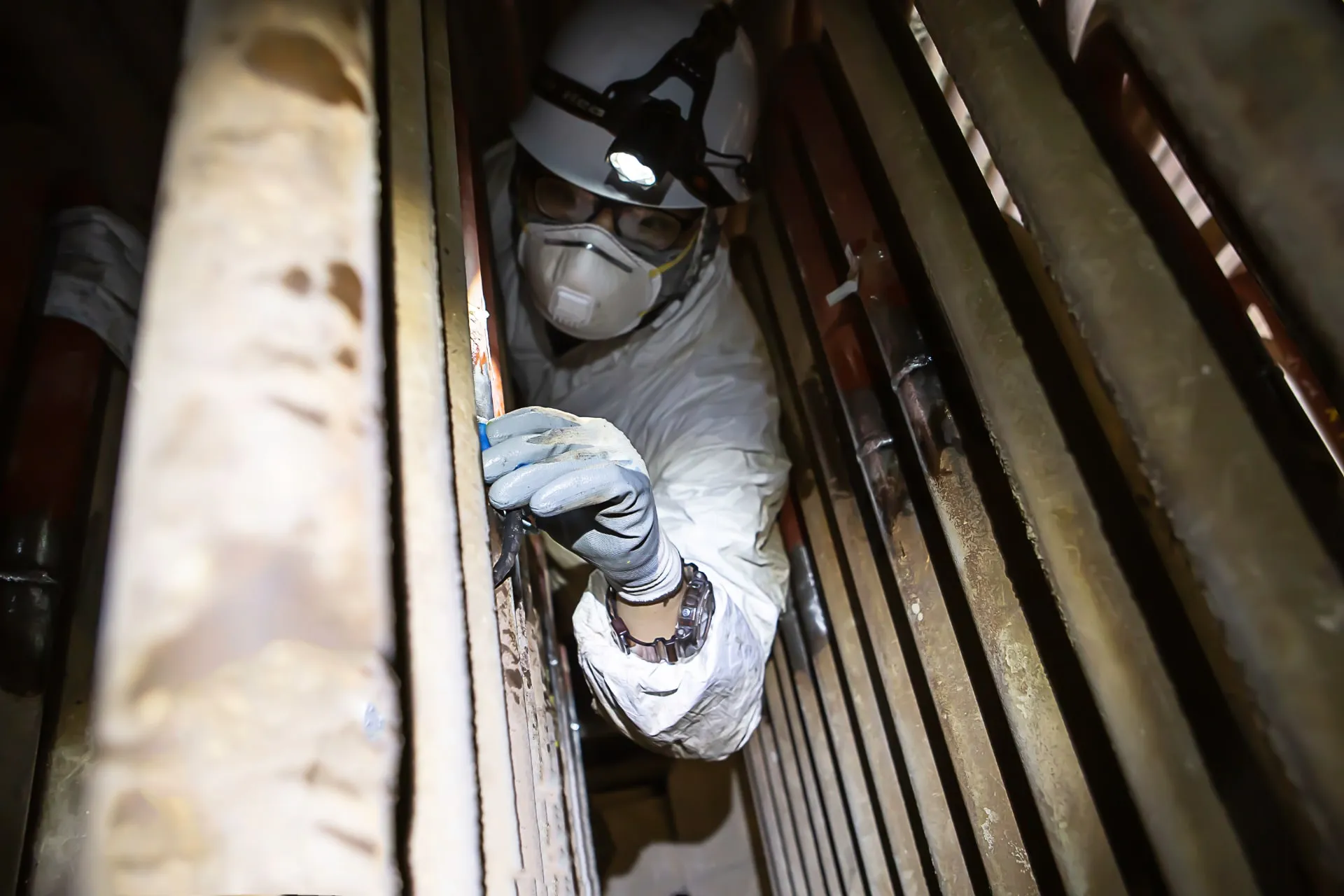
This sounds simple, but it represents a fundamental paradigm shift. Until now, inspecting a confined space (tank, boiler, silo, chimney) was an all-or-nothing operation: erect scaffolding, send personnel in, search everything, dismantle scaffolding – regardless of whether 2 or 200 defects were found at the end.
Hybrid inspection reverses this: the drone does the screening, the person only carries out targeted follow-up checks.
The Three Phases
Why Not Do Everything with the Drone?
Transparency is important to us: the drone cannot do everything. There are NDT procedures that require physical contact:
- Ultrasonic Testing (UT): Wall thickness measurement requires a probe with couplant on the surface
- Magnetic Particle Testing (MT): Requires direct contact and magnetisation
- Penetrant Testing (PT): Requires application of test agents
- Sampling: Material, swab or coating samples
- Repair: Welding, coating, mechanical restoration
The drone flies – it has no mechanical contact with the surface. That is why hybrid inspection is not a compromise but the optimal combination: the drone does what it does best (comprehensive visual coverage and measurement), and the person does what only they can (targeted physical contact and intervention).
Drone vs. Human – Capability Overview
| Task | Drone (ELIOS 3) | Human (manual) |
|---|---|---|
| Visual Testing (VT) | ✅ 4K full coverage | ✅ But slower |
| Thermography (IRT) | ✅ Radiometric | ⚠️ Hand-held camera |
| LiDAR 3D Survey | ✅ Automatic | ❌ |
| Ultrasonic (UT) | ✅ UT payload available | ✅ Standard method |
| Magnetic Particle (MT) | ❌ | ✅ |
| Penetrant Testing (PT) | ❌ | ✅ |
| Sampling | ❌ | ✅ |
| Repair / Welding | ❌ | ✅ |
| Documentation | ✅ Automatically georeferenced | ⚠️ Manual, subjective |
Hybrid Workflow Step by Step
The systematic procedure of a hybrid inspection – from project clarification through to the final report:
- Project Clarification – What needs to be inspected? What inspection depth is required (purely visual or also contact testing)? Which standards apply? Are there known pre-existing defects?
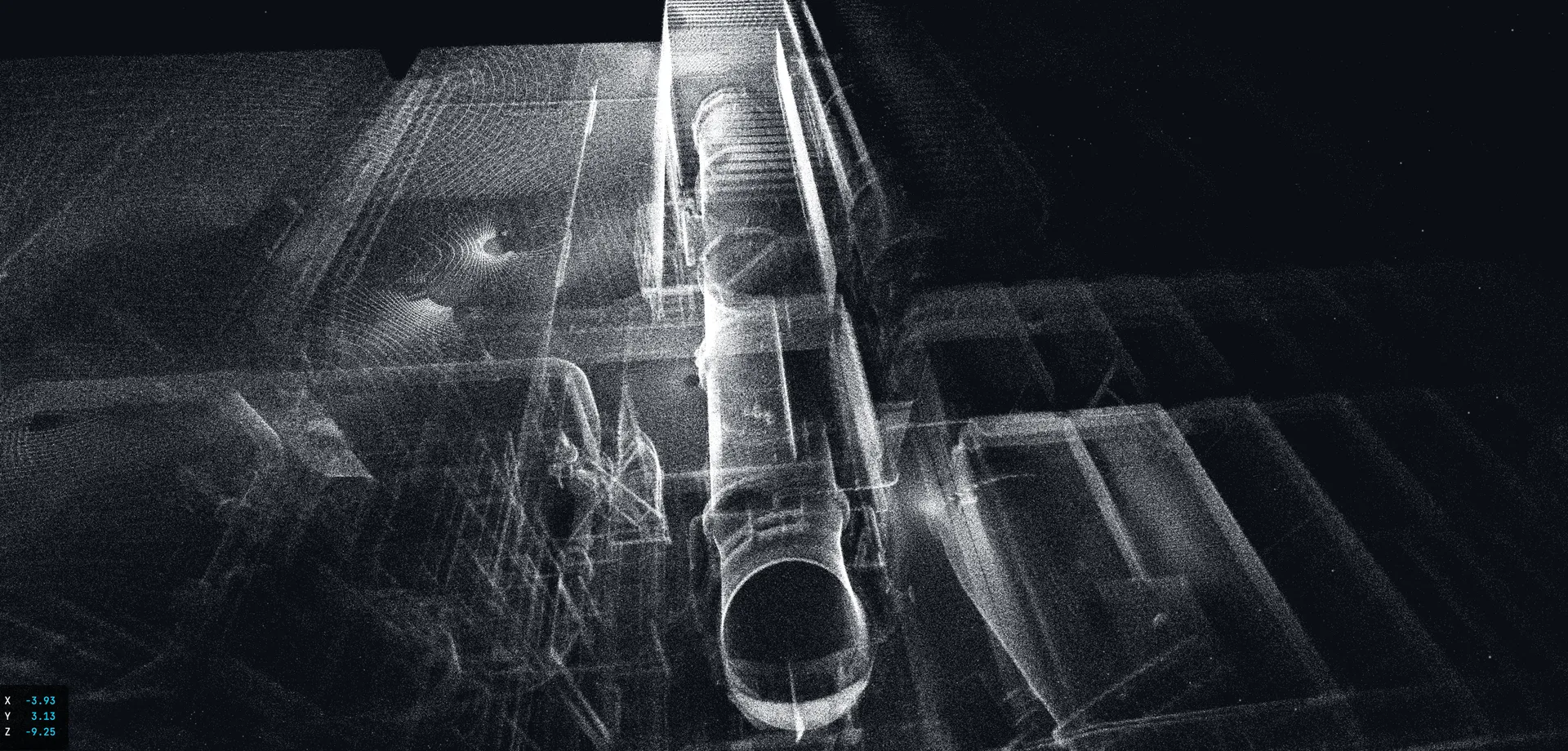
- Drone Initial Inspection (Remote VT + IRT + LiDAR) – The ELIOS 3 systematically flies through the confined space: 4K video (16,000 lm), radiometric thermography and LiDAR 3D scan.
- Data Evaluation and Defect Map – In Flyability Inspector 5: all findings marked in the 3D model. Each finding has an exact position (x, y, z). Result: a prioritised defect map.
- Scope Decision – The inspector or operator decides based on the defect map which locations require manual follow-up and which are non-critical.
- Targeted Manual Testing – Only at defined locations: UT measurement, sampling, detailed inspection. The inspector knows exactly where to go beforehand – thanks to 3D positioning.
- Final Report – Combined report: drone data + manual findings in one document. 3D model as reference.
Where Hybrid Inspection Saves Money




Case Study: Hybrid Tank Inspection
Starting point: A cylindrical storage tank (diameter 15 m, height 12 m) with fixed roof, scheduled for routine inspection. Last inspection: 5 years ago. Medium: heating oil.
Conventional approach: Drain tank → clean → gas-free measurement → erect scaffolding (inner wall + roof) → full walkthrough by inspector → dismantle scaffolding → results after weeks.
- Preparation – Drain and clean tank (minimum requirement for flight), gas measurement and clearance.
- Drone flight – ELIOS 3 flies the entire tank in a short time (floor, wall, roof).
- Evaluation – 3 corrosion spots identified on the floor, 1 coating defect on the roof, wall unremarkable.
- Targeted deployment – UT measurement only at the 3 floor locations + visual confirmation of the roof defect. No scaffolding required; floor locations accessible from ground level.
- Result – Complete report within days. Savings: no scaffolding construction, significantly less personnel deployment, shorter downtime.
Case Study: Hybrid Boiler Inspection
Starting point: A water-tube boiler (height 25 m) in a biomass power plant, to be inspected during revision. Focus: heating surfaces, baffles, refractory lining.
Conventional approach: Cool down boiler → erect scaffolding internally (multiple levels) → walk every level → thermography with hand-held camera (limited range) → dismantle scaffolding. Duration: approx. 2 weeks for inspection alone.
- Preparation – Cool down boiler, open manhole, gas measurement.
- Drone flight – ELIOS 3 flies the boiler from bottom to top – all levels, all heating surfaces. Simultaneously: 4K + thermography + LiDAR.
- Evaluation – 2 hotspots in refractory identified (levels 3 and 5), 1 deformed baffle, rest unremarkable.
- Targeted deployment – Scaffolding only on levels 3 and 5 (instead of complete) → assess refractory, take sample if needed.
- Result – Approx. 75% less scaffolding, significantly shorter revision time. Substantial time and cost reduction.
When is Hybrid Inspection NOT Appropriate?


Conclusion: Hybrid Inspection as the Future Standard
Hybrid inspection is not a niche product – it is becoming the standard workflow for industrial inspections in confined spaces. The reason is simple: it combines the strengths of both worlds.
The drone: Full coverage, fast, risk-free — 4K + thermography + LiDAR simultaneously — GPS-independent in every confined space — automatically localised and reproducible documentation.
The human: Contact testing (UT, MT, PT) where needed — assessment and decision-making — repair and restoration.
The result: less risk, lower costs, better data, shorter downtime. We have applied hybrid inspection in practice since 2017 – and recommend it as the standard for every confined space inspection.
Related Services


Frequently Asked Questions
Do inspection organisations accept the hybrid method?
Acceptance is steadily growing. Many inspectors and inspection organisations (TÜV, DEKRA, DNV, etc.) accept drone-assisted data as a basis for their assessments – but the final decision always rests with the responsible inspector. We recommend agreeing on the method with the relevant inspection organisation in advance.
How much cheaper is hybrid inspection compared to conventional inspection?
This depends heavily on the plant. Savings arise primarily from reduced scaffolding, less personnel deployment in the confined space and shorter downtimes. We provide project-specific quotations and can give a realistic assessment in a preliminary discussion.
Is a gas measurement still required for hybrid inspection?
Yes, always. The ELIOS 3 is not ATEX-certified. Before any drone deployment in a confined space, a gas measurement must be carried out and documented. This applies even if no personnel entry is subsequently planned.
Can the drone completely replace the manual inspector?
No – and that is not the goal. The drone replaces the full-coverage walkthrough and provides the data basis for targeted manual follow-up. The inspector remains indispensable for assessment, acceptance and contact testing. Hybrid inspection does not make manual deployment superfluous; it makes it more efficient.
What does a hybrid inspection result report look like?
You receive a combined report: drone data (4K video, 3D model, thermography) with all identified findings localised in 3D space, plus the results of manual follow-up testing at the respective locations. Everything in one document, referenceable via the 3D model.
Request a Hybrid Inspection Assessment
We assess free of charge whether the hybrid approach is suitable for your next inspection. Send us your plant data – we will respond with a concrete assessment and a quotation.