
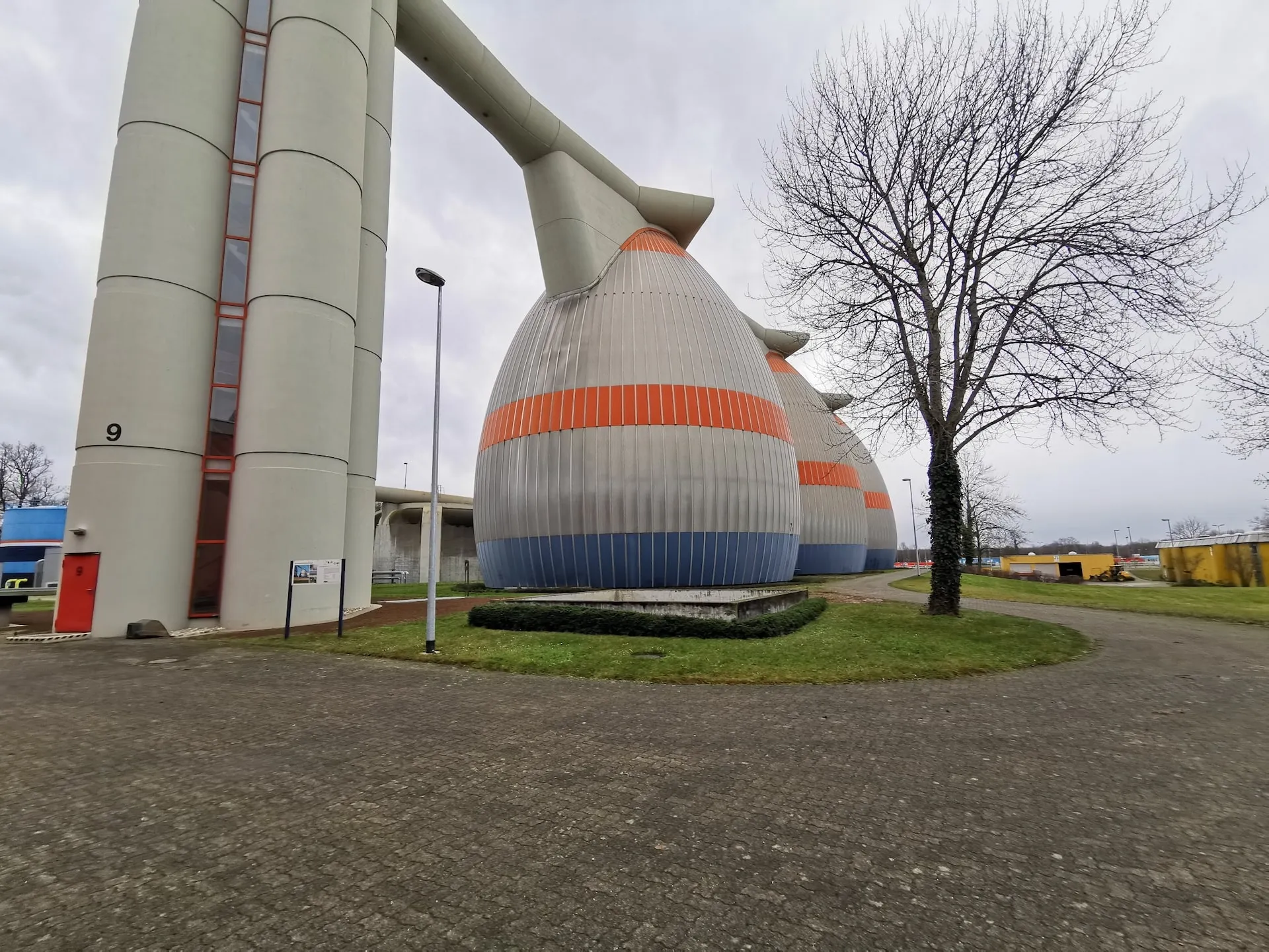
Drone Inspection for Water Management – Digesters, Clarifiers & Water Towers
Kopterflug inspects all safety-critical water management assets without human entry: digesters, clarification basins, water towers, channels and shafts – with the Flyability ELIOS 3, ROV and DJI M30T. GPS-free, collision-safe, 4K + LiDAR + thermography.
- No human entry into hazardous gas atmospheres
- Minimal operational disruption – inspection in hours, not days
- DVGW- and DWA-compliant documentation
What We Inspect in Water Management
Digesters, clarification basins, water towers and channels – confined spaces, aggressive atmospheres, barely accessible. We inspect all safety-critical water management assets without human entry:

Our Services – Inspection Without Human Entry
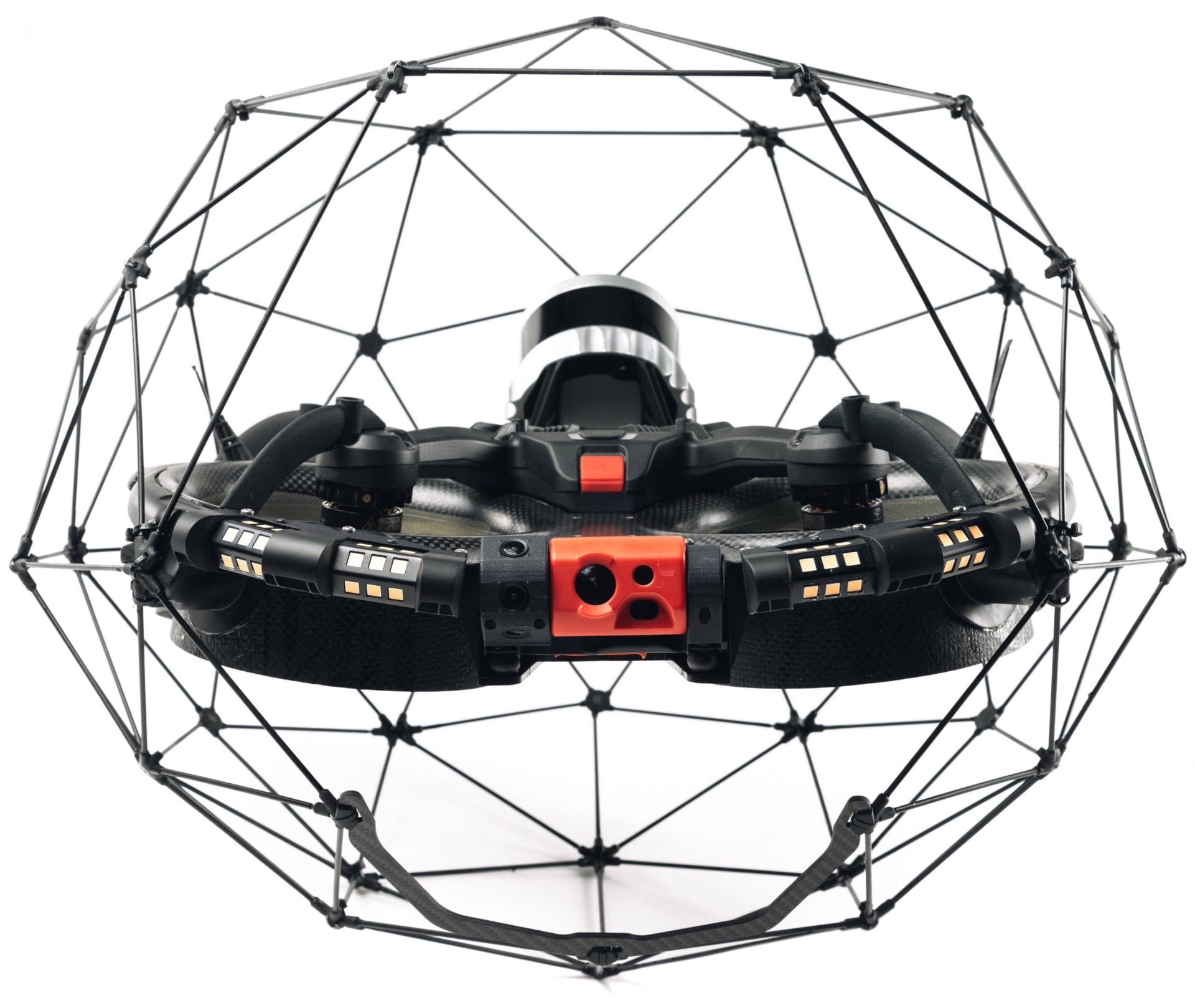
- Gas-Hazardous Confined Spaces: Digesters, channel shafts, pump shafts, water towers – GPS-independent via SLAM, 4K + LiDAR + thermography without human entry.
- 4K + Thermography + LiDAR: Visual inspection of concrete and coatings, thermal imaging for moisture inclusions and insulation damage, 3D geometry for as-built documentation.
- No Human Entry, No Breathing Apparatus Team: Drastically reduced safety requirements – no DGUV confined space entry, no rescue team, no gas-free measurement effort for the inspector.
- Drinking Water Protection & Hygiene Compliance: Low-contamination inspection for high-level tanks and drinking water reservoirs – no human entry means minimal hygiene risk.
Challenges in Water Management
Digesters, clarification basins, channels – confined spaces with toxic atmospheres, digestion gas and limited access. Conventional manned entries are complex, expensive and dangerous. The ELIOS 3 solves this – without human entry.
- Toxic Atmospheres: H₂S and Digestion Gas: Digesters and channels contain highly toxic gases – H₂S, methane, CO₂ in oxygen-depleted atmosphere. Entry requires breathing apparatus, rescue team and gas-free measurement. The drone flies in safely after gas-free measurement.
- Difficult-to-Access Interiors: Digesters are over 15 metres high with narrow access hatches and internal equipment. Channel shafts are damp and confined. Conventional inspection requires scaffolding, climbers and elaborate safety provisions.
- Operational Downtime Costs: Wastewater treatment plants run 24/7 – any shutdown of a digester or clarification basin means process interruption. Drone inspection reduces downtime to a few hours.
- Contamination and Corrosion: Aggressive wastewater, digestion sludge and biological deposits attack concrete and coatings. Damage must be detected early before it becomes structurally relevant.
- Drinking Water Protection and Contamination Risk: In drinking water tanks and high-level tanks, protection against contamination is the top priority. Human entry means a hygiene risk. The drone works with minimal contamination.
- Documentation Requirements under DVGW and DWA: Wastewater treatment plants and drinking water facilities are subject to strict inspection obligations. Complete, traceable documentation is legally required. We deliver auditable reports.
Damage Patterns & Sensor Use by Asset Type
With the ELIOS 3 (confined space / gas-hazardous), DJI M30T (exterior / thermal) and underwater drone (flooded), we cover the complete inspection needs of water and wastewater management – from dry to fully flooded, from aggressively gaseous to drinking water quality.
Digesters & Digestion Tanks
Interior wall coating for bubble formation, cracks and delamination. Heating coils for scaling, flow obstruction and leaks. Agitators and internals for twisting, wear and foreign body entanglement. H₂S corrosion in the gas space above the sludge surface. LiDAR scans the sludge surface for rough estimation of deposit height.
- Sensors: ELIOS 3, LiDAR, Thermography, M30T
- Typical findings: Concrete corrosion from H₂S, coating bubble formation, heating coil leaks, agitator wear, sludge build-up
Clarification Basins (Primary, Secondary, Aeration, Final, Grit Chamber)
ELIOS 3 for dry or partially filled basins: inlet/outlet structures, weirs and overflow constructions. ROV for water-bearing basins: basin floor for sediment thicknesses, lamella clarifiers and immersed walls for blockage and biofilm growth, aeration membranes for clogging and delamination.
- Sensors: ELIOS 3, ROV, LiDAR
- Typical findings: Concrete cracks, coating damage, sediment accumulations, clogged aeration membranes, biofilm growth, chain/rail wear
Drinking Water, Fire-Fighting Water & High-Level Tanks
ROV (often underestimated use case): coating for blistering, cracks, delamination and undercutting; corrosion on climbing irons, pipelines and fittings; sediment/sludge deposits on the floor with LiDAR volume measurement; inlet/outlet pipes for ochreous deposits and foreign bodies. ELIOS 3 for empty or partially drained areas.
- Sensors: ROV, ELIOS 3, LiDAR, M30T
- Typical findings: Coating damage, corrosion on steel parts, sediment build-up, ochreous deposits, floating roof damage
Channels, Shafts, Siphons & Retention Spaces
ELIOS 3 for dry channels and large profiles: cracks, shards, ingrowths, roots; shaft structures – access shafts, drop shafts; pump shafts, screens and suction lines. ROV for partially filled or flooded channels and siphons: floor and lower invert for deposits, erosion and subsidence damage.
- Sensors: ELIOS 3, ROV, LiDAR, M30T
- Typical findings: Cracks, root ingrowth, deposits, floor erosion, infiltration ingress, shaft damage
Biogas Lines, Gas Storage & Cooling Towers
M30T with thermal imaging for biogas lines and gas storage from the exterior: detecting leaks and condensate formation. Cooling towers and recirculation cooling systems: ELIOS 3 for interior walls, trickling filter media and irrigation systems – without operational interruption in shut-down sections.
- Sensors: M30T, Thermography, ELIOS 3
- Typical findings: Gas leaks, condensate formation, clogged trickling filter media, corrosion on irrigation systems
Dams & Flood Retention Basins
ROV for the water side: sealing surfaces, inlet screens and floor erosion without divers. M30T for aerial overview of dam crest, slopes and overflow structures. Combination of both allows complete condition documentation without operational interruption.
- Sensors: ROV, M30T, LiDAR
- Typical findings: Floor erosion, screen blockages, sealing damage, slope damage
Your Advantages as a Water Supplier or Wastewater Treatment Plant Operator
- No Human Entry into Digestion Gas Atmospheres: No life risk for your staff in digesters and channels. The drone takes over the inspection after gas-free measurement.
- Minimal Operational Disruption: Treatment plants continue running – digester or basin briefly out of service, inspected in a few hours, quickly back in operation.
- Early Detection of Concrete Damage: Cracks, corrosion and coating damage are detected before they become structurally relevant and expensive. 4K + LiDAR makes the invisible visible.
- Cost Savings vs. Manned Entry: No scaffolding, no breathing apparatus team, no elaborate DGUV confined space entry logistics. Drone inspection costs a fraction of conventional methods.
- DVGW- and DWA-Compliant Documentation: Auditable reports with 4K recordings and LiDAR data as the basis for your expert inspection under water law.
- Comparative Inspections Across Cycles: Stored flight paths and georeferenced 3D data enable direct comparison between inspection periods – damage progression becomes measurable.
Inspection Procedure
Step 1: Initial Consultation (Free)
We analyse your requirements and advise you free of charge on all technical and organisational questions – from gas-free measurement to documentation requirements.
Step 2: Scheduling & Quotation
You receive a transparent quotation. Together we plan the timing, operational interruption, access and safety concept.
Step 3: On-Site Inspection
Gas-free measurement, clearance, flight. We carry out the inspection with state-of-the-art drone technology – usually within a few hours.
Step 4: Evaluation & Inspection Report
You receive a detailed report with 4K recordings, 3D models, thermography analyses and systematic findings overview – auditable for your expert inspector.
Your Contacts for Water Management Inspections
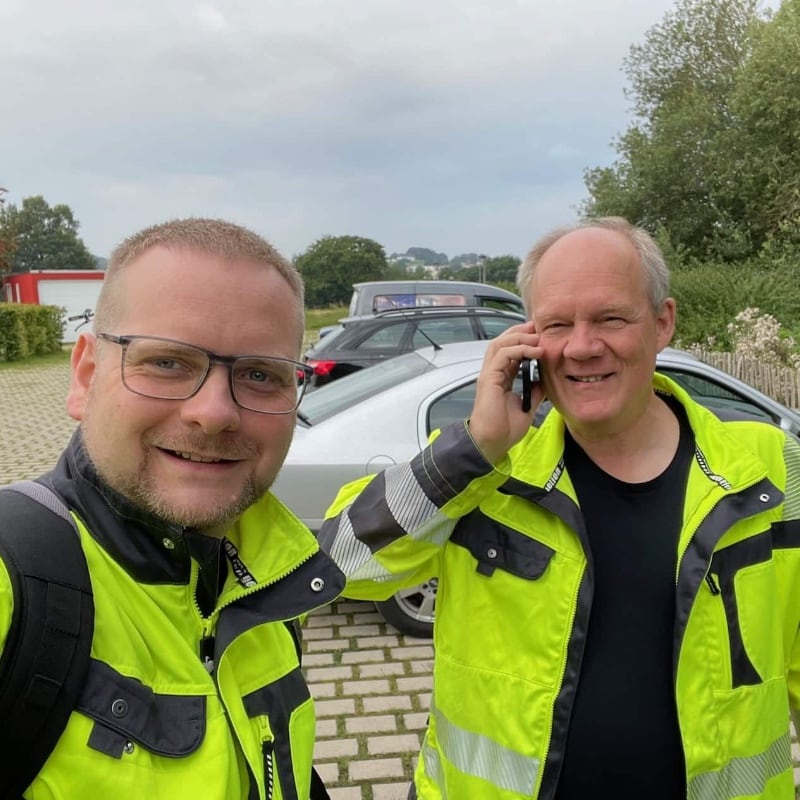
Christian Engelke and Dipl.-Ing. Karsten Lehrke – your direct contacts for water management inspection projects.
Years of experience in digesters, channels and water towers. We understand the specific requirements of water management – gas-free measurement, drinking water protection, documentation obligations and minimal operational disruption.
We advise without sales pressure – even when that means: commission the service rather than purchase equipment.
Related Services
- Confined Spaces Inspection – The primary ELIOS 3 use case: digesters, pump shafts and channels without human entry.
- Tank Inspection – Corrosion, coating damage and wall thickness in storage and process tanks.
- Underwater Inspection (ROV) – Drinking water tanks, fire-fighting tanks and basins without draining.
- Industrial LiDAR Survey – 3D point clouds with the ELIOS 3 for geometry, deformation analysis and digital twins.
- Industrial Drone Inspection – Overview of all inspection services with ELIOS 3 and complementary systems.
Frequently Asked Questions about Water Management Inspection
Can the drone really be used in digesters?
Yes – with the right preparation. Digesters must be degassed and cleared before the drone flies in. We carry out a gas-free measurement beforehand with a calibrated multi-gas sensor (O₂, LEL, H₂S, CO). We only fly after confirmed gas-freedom. We then document interior walls, heating coils, agitators and internals – without any personnel having to enter.
Which wastewater treatment plant components can be inspected?
We inspect all relevant confined spaces at a wastewater treatment plant: digesters, primary clarification basins, secondary clarification basins, grit chambers, pump shafts, gate chambers, inlet structures and pressure zone tanks. Open basins can also be overflown and documented by drone.
How is drinking water protection ensured during inspections of high-level tanks?
The ELIOS 3 is thoroughly cleaned before use in drinking water tanks. Decontamination in accordance with DVGW specifications is possible by arrangement with the operator. We coordinate the hygiene protocol and access procedure in advance with your operating staff. If in doubt: inspection with minimal residual volume or after partial draining.
Which standards apply to the inspection of wastewater treatment plants and channels?
Relevant standards are DIN EN 13508 (condition assessment of sewer channels), DWA guidelines on wastewater treatment plant technology and operation, and DGUV Rule 113-004 for confined spaces. Drinking water facilities are additionally subject to DVGW guidelines W 300 ff. Since no human entry takes place, the DGUV confined space entry obligation does not apply to the inspector.
Does the wastewater treatment plant need to be shut down for the inspection?
Not necessarily. Depending on the asset, a partial operational intervention is sufficient: for digesters, gas-freedom is a prerequisite; for clarification basins, often just a sluice gate needs to be closed. Many inspections can be integrated into planned maintenance windows. Channels and shafts can frequently be inspected with reduced flow.
Can the drone detect concrete damage in clarification basins?
Yes – and this is one of the most important applications. The 4K camera shows cracks, delamination, efflorescence and carbonation damage on concrete walls and floors. LiDAR can record deformations and geometry changes. For more extensive testing (e.g., wall thickness measurement by ultrasound), we refer to accredited testing companies.
How does LiDAR data help with digester inspection?
LiDAR creates a complete 3D model of the digester interior – regardless of lighting. This enables precise recording of sediment heights and volumes, detection of deposits on heating coils, and comparison of geometries across multiple inspection cycles. Sludge accumulation can be quantified and cleaning requirements planned.
Can thermography help with water tower inspection?
Yes. Thermography detects moisture behind coatings, thermal anomalies at welds and insulation defects. In high-level tanks, it shows temperature gradient zones and potential leaks. Thermography is an indicative method – it provides indications for further testing but does not replace normative non-destructive testing.
What data does Kopterflug deliver after the inspection?
You receive: 4K recordings of all documented areas with finding markings, LiDAR 3D point clouds for sediment volumes, geometries and deformation analyses, thermography recordings as required, and a structured inspection report as the basis for your expert inspector, maintenance planning or operational documentation.
Can the drone be used in very small shafts and channels?
The ELIOS 3 requires a minimum opening of DN 600 for safe flight. For small channels and pipe cross-sections, we recommend our partner services for conventional channel inspection. For shafts and channels from DN 1200, deployment is generally straightforward.
How does drone inspection differ from conventional CCTV camera survey in channels?
Camera vehicles drive along the channel invert and document from below. The drone flies freely within the cross-section and can capture all walls, the soffit and internals from various angles – even above water. LiDAR simultaneously records the complete 3D cross-section. For standard channel inspection per EN 13508, conventional CCTV survey is the norm – the drone complements by accessing difficult-to-reach areas.
How long does a drone inspection in water management take?
Duration depends on the asset type. A single digester (Ø 8–12 m, H 15–25 m) is typically inspected in 2–4 hours – including gas-free measurement, set-up and documentation. Larger wastewater treatment plants with multiple basins are typically planned for 1–2 days. Water towers and high-level tanks: 3–5 hours. Detailed planning after initial consultation.
Can damage be precisely located?
Yes. The ELIOS 3 creates a LiDAR 3D model in parallel with the video recording, in which every finding is georeferenced. Cracks, delamination and corrosion spots are thus locatable to within a decimetre – even in completely dark tanks without GPS signal. The inspection report contains coordinates and image extract for every finding.
Does drone inspection completely replace scaffolding or human entry?
In most cases yes. For visual condition assessment, LiDAR geometry and thermography, no human entry is required. The drone reaches all walls, internals and hard-to-access areas without scaffolding, ladders or protective equipment. Exception: sampling, wall thickness measurement by ultrasound or weld testing per standard still require direct access. We advise honestly about what the drone can deliver and where conventional methods make more sense.
Is drone inspection compatible with BetrSichV and DGUV?
Yes. Since no personnel enter the confined space, the requirements of DGUV Rule 113-004 for the person entering do not apply – no rescue team, no breathing apparatus for the inspector. The BetrSichV prescribes regular inspections; our drone inspection delivers the required documentation as the basis for the expert inspector. We recommend coordinating the procedure with your safety officer and the responsible authority.
What hygiene requirements apply to drone inspection of drinking water tanks?
Drinking water tanks are subject to the strict requirements of the German Drinking Water Ordinance (TrinkwV) and the DVGW technical standards W 300 ff. Before deployment, all equipment components are cleaned with approved disinfectants. We coordinate the hygiene protocol individually with your water utility and document all disinfection steps without gaps. For particularly sensitive installations, the inspection can also be conducted at reduced water level without direct water contact.
Can the ELIOS 3 fly in humid or condensation-heavy environments?
Yes. The ELIOS 3 is designed for deployment in industrial environments with high humidity and condensation. The protective cage shields the sensors from dripping water and light spray mist. We routinely fly in digesters, treatment basins and reservoirs with residual moisture. When standing water is present at the bottom, we combine the drone flight with our ROV system (Chasing M2 Pro Max) for the underwater areas.
How are inspection results prepared for authorities and regulatory bodies?
Our reports are structured to serve directly as a basis for expert inspections under BetrSichV and regulatory approval procedures. You receive georeferenced finding images, measurements from LiDAR data and a prioritised damage list. The format meets the requirements of environmental agencies, water authorities and trade associations. On request, we also deliver data in DWA-compliant format for your operational documentation.
Is drone inspection of dams and barrages possible?
Yes. For dams and barrages we deploy the DJI Matrice 30T with zoom and thermography camera for the exterior inspection. This documents cracks, washouts, seepage outflows and vegetation growth on the dam crest and air side. Inspection galleries and revision tunnels inside are inspected with the ELIOS 3. This delivers a complete condition documentation in accordance with DIN 19700 without complex rope access equipment.
How often should water management assets be inspected by drone?
Inspection intervals depend on asset type and regulatory framework. Drinking water tanks should be inspected every 3–5 years according to DVGW W 300. For digesters we recommend intervals of 2–3 years, as biogenic sulphuric acid corrosion can progress rapidly. Sewer systems are subject to inspection cycles of 5–10 years depending on municipality. We advise you on the optimal inspection frequency for your asset portfolio.
Can recurring inspections be compared to detect damage progression?
Yes, and this is one of the greatest advantages of drone-based inspection. Using LiDAR 3D models we can quantitatively compare geometry changes, crack progression and sediment build-up across multiple inspection cycles. Every finding is stored with georeferencing so the exact same location can be re-found in subsequent flights. This creates a seamless damage history that enables well-founded maintenance decisions.
What does a drone inspection in water management cost?
Costs depend on asset type, number of objects to be inspected and required sensor technology. A single digester or reservoir typically starts in the low four-figure range. Compared to conventional methods with scaffolding, rescue team and DGUV entry process, you typically save 40–60 % of total costs while achieving significantly shorter asset downtime. We prepare a specific quote based on a brief preliminary assessment or your asset documentation.
Get in Touch
Questions about drone inspection for water management or need a quote for your project? Fill out the form and we'll get back to you within 24 hours.