
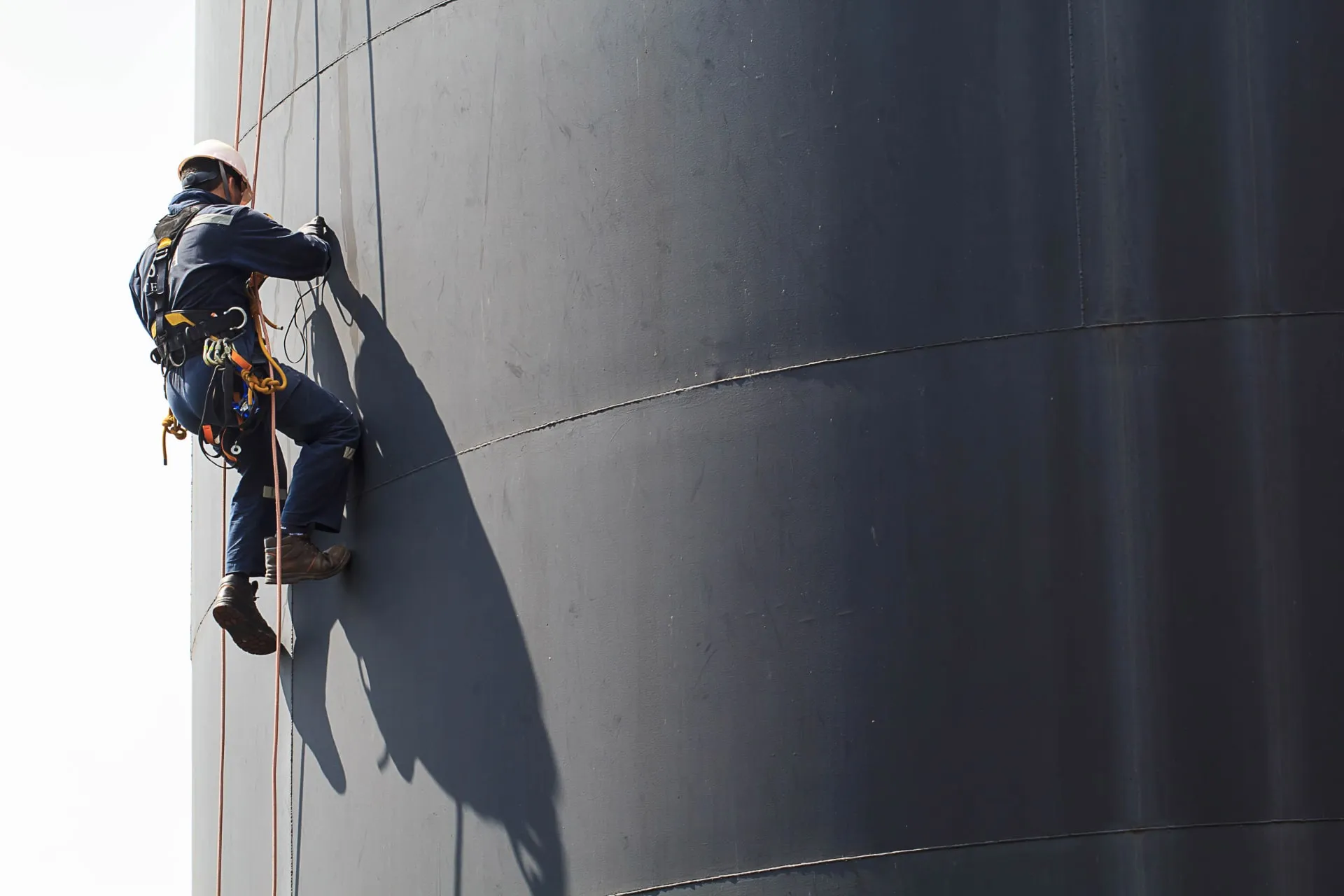
80% Cost Savings: Modern Hybrid Inspection in Industry
Drone technology + targeted conventional NDT = maximum efficiency. Up to 80% cost savings and 60–80% time savings – through the combination of Flyability ELIOS 3 and DJI M30T with conventional NDT (UT, MT, PT). No full-area scaffolding, minimal downtime.
- Drone screens quickly – conventional NDT checks only suspicious areas
- No full-area scaffolding – only targeted where needed
- Experience since 2017 – hundreds of hybrid inspections across Germany
What is Hybrid Inspection?
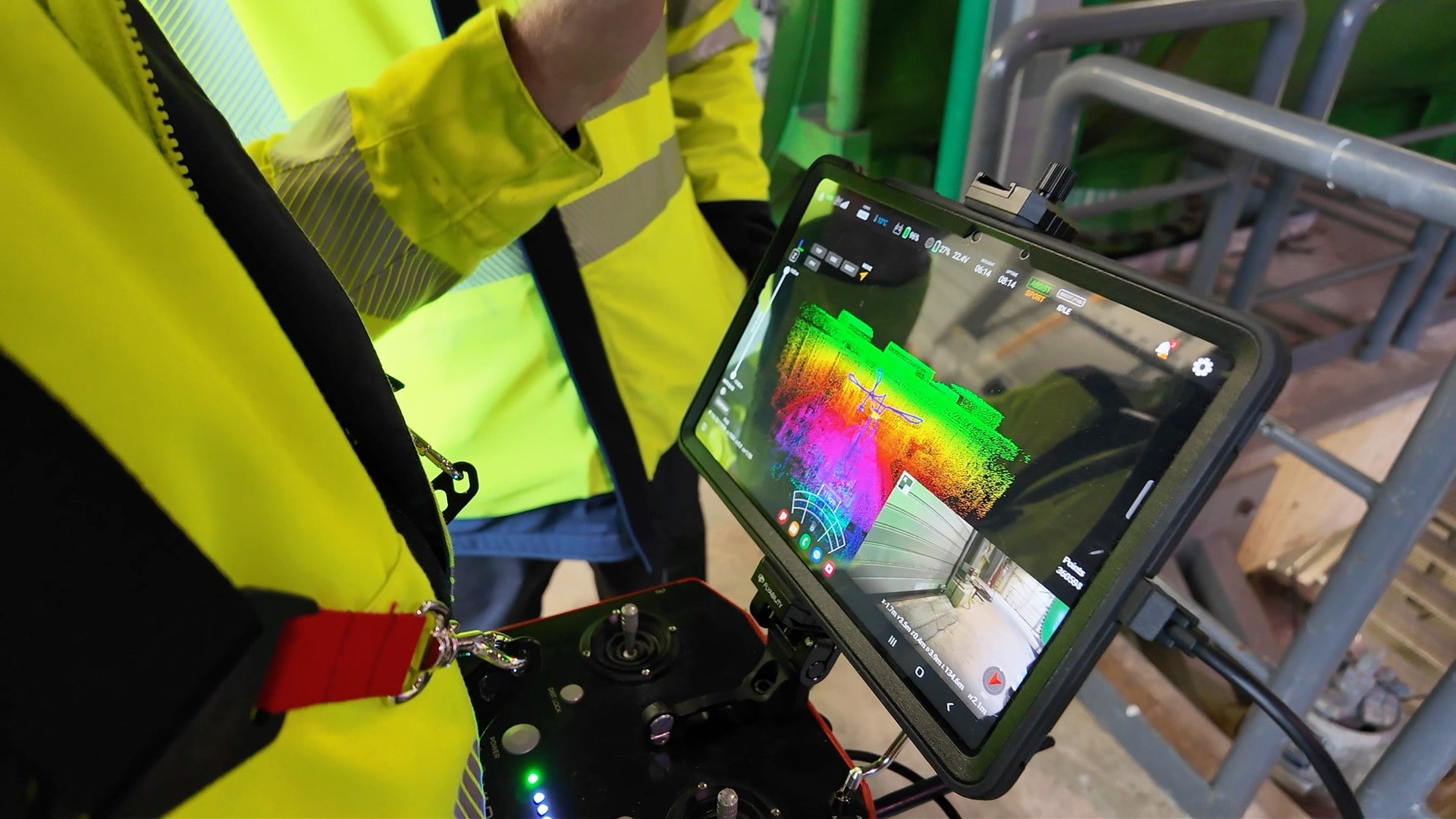
Karsten and Christian during hybrid inspection – view of the Flyability controller during a tank inspection.
Hybrid inspection means: The drone screens the entire plant quickly – conventional NDT then checks only the suspicious areas in detail. No full-area scaffolding, minimal downtime – and often even better inspection quality.
The principle: The Flyability ELIOS 3 provides an initial assessment in hours via 4K, thermography and LiDAR. Only at suspicious areas is conventional testing subsequently performed (UT, MT, PT). The DJI M30T complements for external inspections.
Our expertise since 2017: As an inspection service provider we have been combining drone technology with conventional NDT for years – experience shows: the hybrid approach is not just cheaper, it is often also better.
The 3-Step Hybrid Process
Step 1: Rapid Drone Inspection (Screening)
Comprehensive overview in a few hours: 4K footage, thermography, LiDAR 3D scan. No scaffolding, no human entry. Result: risk assessment – where are the anomalies?
Step 2: Targeted Detailed Inspection (Conventional NDT)
Only at suspicious areas: UT (ultrasound), MT (magnetic particle), PT (penetrant testing). Only 10–20% of the surface needs conventional testing instead of 100%. Scaffolding reduced to a minimum.
Step 3: Transfer of Findings (Risk Assessment)
Findings feed into the assessment of identical sister plants. Risk-based inspection strategy: critical = full inspection, non-critical = drone sufficient, medium risk = hybrid.
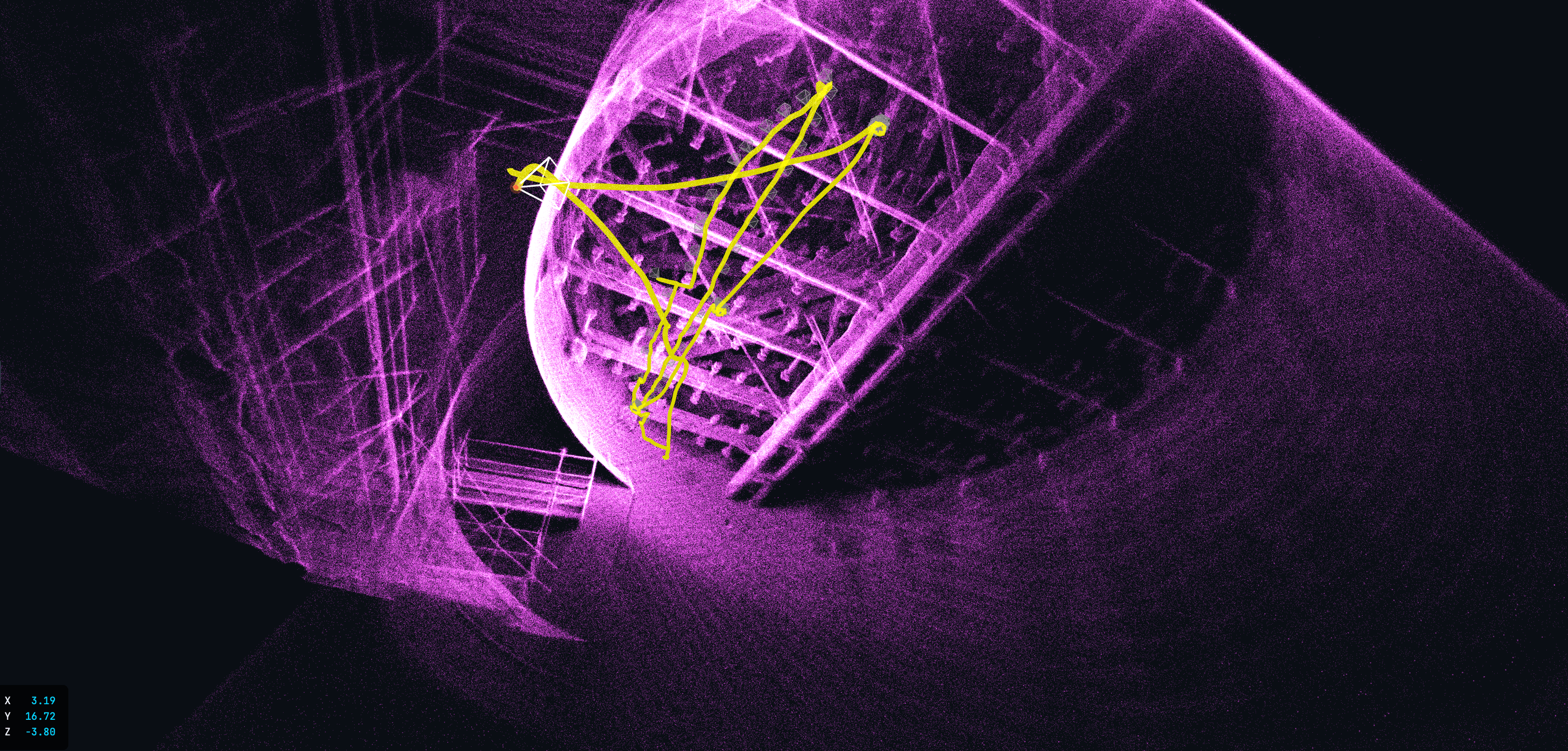
LiDAR 3D point cloud – the geometric reference for hybrid inspection and targeted NDT follow-up.
When Hybrid Inspection Pays Off Most
Tank Farms with Identical Tanks
Rapid initial assessment of all tanks by drone. Only at anomalies: detailed inspection. Findings transferable to identical sister plants – enormous leverage for large tank farms.
- Screen all tanks by drone
- Only inspect anomalous tanks conventionally
- Transfer findings to identical plants
- Savings: 60–75%
New Plants / Good Maintenance History
Drone inspection confirms the expected condition. No scaffolding if all is OK. Conventional NDT only at unexpected findings.
- Drone confirms expected condition
- No scaffolding if everything is OK
- Conventional NDT only at anomalies
- Savings: up to 85%
Hard-to-Access Plant Components
Tank roofs, boiler inner walls, chimneys, pipe bridges – areas otherwise only reachable with enormous scaffolding or hazardous entry. The ELIOS 3 is ready in minutes.
- Tank roofs and floor zones
- Boiler inner walls and reactors
- Chimneys and cooling towers
- Savings: 85–95%
Large Plant Complexes
With hundreds of plants: screen all by drone, prioritise based on risk, only inspect critical plants conventionally with full effort. The leverage is greatest with large complexes.
- Screen all plants by drone
- Prioritise by risk
- Only inspect critical plants conventionally
- Savings: 60–70%
Savings and Digital Value
Cost Savings
- Scaffolding costs drastically reduced: No full-area scaffolding needed – only targeted at suspicious areas, if at all.
- Downtime minimised: Shorter downtime means less production loss. Hybrid inspection typically saves many production days.
- Time savings: 60–80%: Days instead of weeks per plant. More plants inspectable in less time.
The combination of drone screening and targeted conventional NDT typically reduces costs by 60–80% – with equal or better inspection quality.
Digital Added Value
- Digital Twin & LiDAR: 3D point clouds (±2 cm), trend analysis over years, data-based 5–10-year maintenance plans.
- Compliance & traceability: BetrSichV conformity, DGUV requirements, insurance evidence – objective damage documentation for all stakeholders.
- Optimised maintenance planning: Risk assessments data-based, interval optimisation, precise budget planning.
Conclusion: The Efficient Path to Modern Plant Inspection
Up to 80% cost savings and drastically shortened inspection times – through the combination of Flyability ELIOS 3 (Confined Spaces) and DJI M30T (Outdoor) with conventional NDT (UT, MT, PT).
Our expertise since 2017: Hundreds of hybrid inspections – experience collaborating with TÜV, Dekra and other certification organisations. Digital documentation with 3D models and digital twins for long-term maintenance planning.
Your Contacts
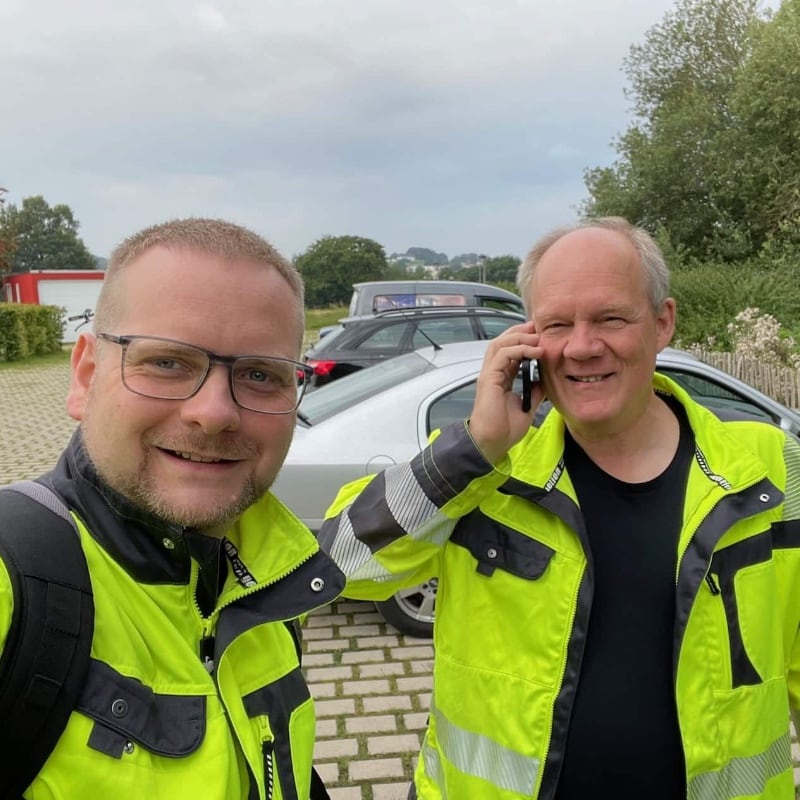
Christian Engelke and Dipl.-Ing. Karsten Lehrke – your direct contacts for hybrid inspection projects.
“Hybrid inspection is the best of both worlds: the drone screens large areas quickly and cheaply, conventional NDT delivers detail accuracy where it really matters. With our clients we regularly see 70–80% cost savings – and inspection quality is often even better than full inspection.”
— Christian Engelke, Founder, Kopterflug
Related Services
- Tank Inspection – Hybrid inspection of tanks with drone screening and targeted follow-up.
- Industrial Inspection – Cost-efficient inspection of industrial plants with hybrid approach.
- Confined Spaces Inspection – Confined spaces inspected by drone instead of costly entry.
- Flyability ELIOS 3 – The inspection drone for screening and initial assessment of plants.
- Boiler Inspection – Boilers and steam generators checked cost-efficiently with hybrid inspection.
- Chimney Inspection – Chimneys inspected and documented by drone without scaffolding.
Frequently Asked Questions about Hybrid Inspection
Is inspection quality comparable to conventional methods?
Yes, modern drones often deliver higher image quality than the human eye: 4K resolution (often better than direct visual contact in dark/confined areas), supplemented by sensors like thermography (CUI detection), LiDAR (3D surveying) and optional UT measurement (wall thickness). Hybrid inspection combines these advantages with conventional NDT (UT, MT, PT) at suspicious areas – achieving the best quality.
What approvals are needed for drone deployment?
Important: EU drone regulations only apply to outdoor airspace. Indoor inspections with the ELIOS 3 require no operating permit and no drone licence. For outdoor deployments (e.g. DJI M30T): EU drone licence per drone regulation, liability insurance, and approvals for special deployments (night flights, >120m altitude). We hold all required approvals and insurance since 2017.
How weather-dependent is the inspection?
Differs by drone type: ELIOS 3 (internal inspections): weather-independent, flies in tanks/boilers/shafts. DJI M30T (external inspections): IP55 protection, tolerates light rain, wind up to 12 m/s, temperature −20°C to +50°C. In extreme weather (storm, heavy rain): postponement possible. Advantage: drone quickly ready, flexible scheduling around weather windows.
What happens when anomalies are found during drone inspection?
That is exactly the core of hybrid inspection: immediate assessment of anomalies (critical? non-critical?). For critical findings: targeted detailed inspection with conventional NDT (UT, MT, PT), only targeted scaffolding at suspicious areas (instead of full-area), rapid decision on necessary measures. You still save 60–80% costs but have the security of thorough testing where it matters.
How large are the savings from the hybrid approach?
Typical savings: total costs: 60–80% (depending on plant and quantity), scaffolding costs: 85–95% (only targeted instead of full-area), time savings: 60–80% (days instead of weeks), production downtime costs: significantly reduced (shorter shutdowns). Concrete savings depend on plant size, quantity and complexity – we calculate project-specific figures.
Is drone inspection in confined spaces possible?
Yes – that is exactly what the Flyability ELIOS 3 was developed for: compact enough for openings from 50×50 cm (standard manholes), collision-protected, GPS-independent LiDAR-SLAM navigation, 16,000-lumen LED lighting for dark spaces, IP44 protection against dust and water. Ideal for tanks, boilers, reactors, shafts, pipelines.
How are results documented?
Comprehensive digital documentation: 4K video of the entire inspection, high-resolution photos of critical areas, LiDAR 3D point clouds (digital twin), thermography footage (optional), detailed inspection report with condition documentation, damage assessment by severity, prioritised finding overview, all raw data for your own analysis. Complies with BetrSichV, DGUV and norms.
Can a drone fly inside tanks or vessels?
Yes – the Flyability ELIOS 3 is specifically designed for tanks: flies in fire water tanks, chemical tanks, silos, pressure vessels, reactors, boilers without human entry. No DGUV entry measures required, no gas-free measurement for human entry, 16,000-lumen LED illuminates dark tanks, optional thermography for CUI detection. Significantly shorter inspection time than conventional methods including scaffolding.
What sensors are used in drone inspections?
Multi-sensor technology for comprehensive assessment: 4K camera (visual inspection, cracks, corrosion), thermography (CUI detection, hotspots, insulation damage), LiDAR (3D point clouds, deformation analysis, surveying), UT payload (wall thickness measurement), optional gas sensor for flammable gases (LEL). Sensor combination adapted to requirements. All data archived digitally for comparisons over years.
How long does a drone inspection take?
Drastically shortened inspection time compared to conventional methods. Total on-site effort depends on plant size and complexity but is significantly less than conventional methods with scaffolding (which often take weeks). For plant complexes: multiple plants per day possible. For hybrid inspection including follow-up: a few days total. Precise figures after clarification of your specific conditions.
Get in Touch
Have questions about hybrid inspection or need a quote for your plant? Fill out the form below and we’ll get back to you within 24 hours.