
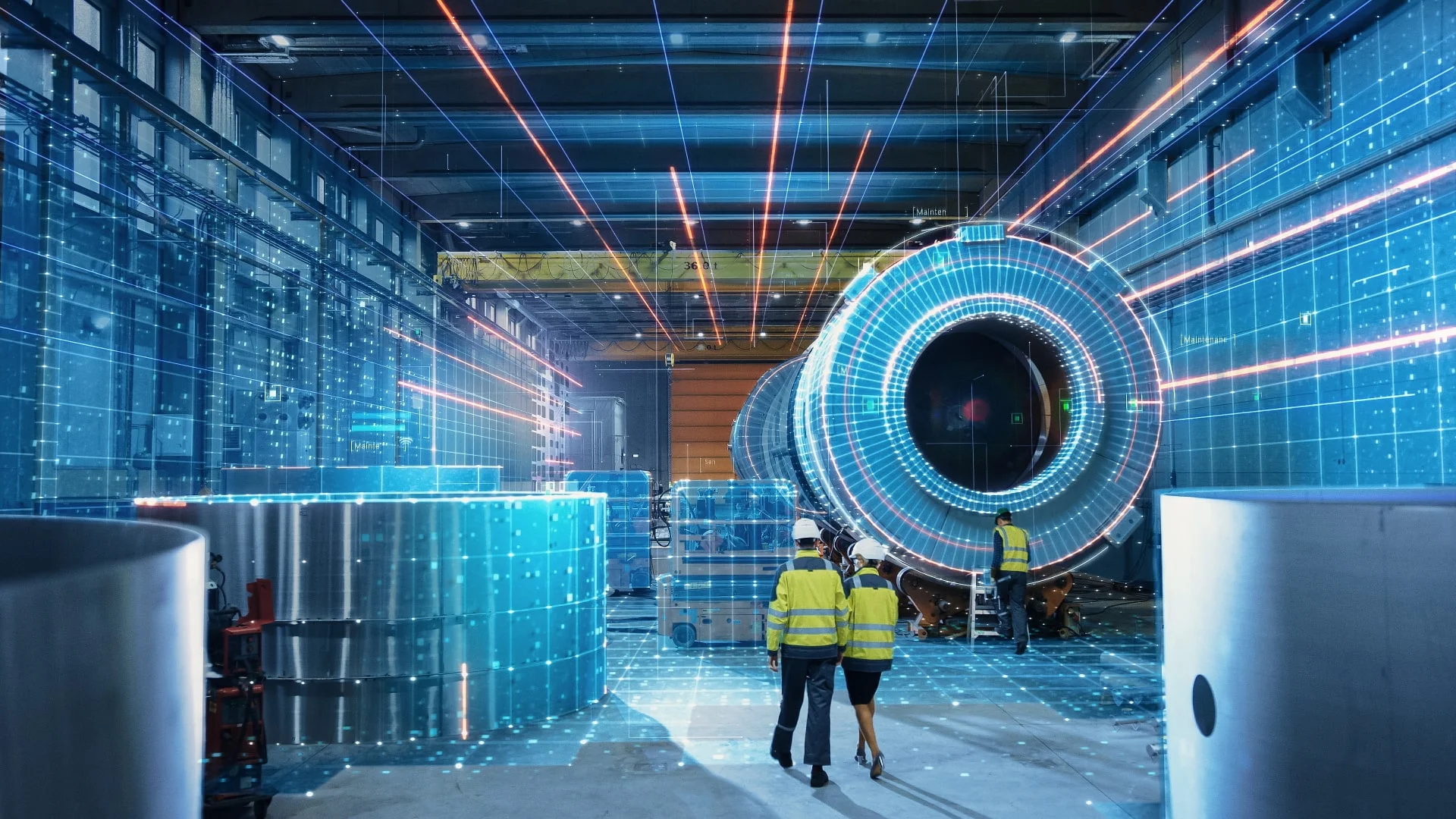
Digital Twin from Drone Data – From Point Cloud to 3D Model
From LiDAR point cloud to 3D model: digitally map, measure and compare industrial plants. The ELIOS 3 creates digital twins in confined spaces – tanks, boilers, silos and chimneys – where terrestrial laser scanners cannot go.
- Every finding has an exact 3D position – navigable and measurable
- Colorization since 2025: photorealistic 3D models with visible corrosion
- CAD/BIM export – .las, .e57 compatible with AutoCAD, Revit, Navisworks
What is a Digital Twin in Industrial Inspection?
A digital twin is a three-dimensional digital image of a physical plant. In industrial inspection this means: a 3D model of your tank, boiler, chimney or silo – centimetre-accurate, colour-textured and with all findings georeferenced.
Why is this relevant?
Previously an inspection ended with a PDF report: text descriptions, a few photos, perhaps a sketch with position information. If you read the report a year later you have to reconstruct what was meant.
A digital twin changes this fundamentally: every finding has an exact 3D position, the model is navigable and measurable, and two models from different years can be overlaid.
The ELIOS 3 is the tool that creates these digital twins in confined spaces – where terrestrial laser scanners cannot go.


How the Digital Twin is Created: The LiDAR Workflow
Step 1: LiDAR Data Collection During the Flight
The Ouster OS0-128 LiDAR sensor sends 128 laser beams – 1.31 million points per second. Each point contains distance information (accuracy in the centimetre range). During the flight a growing 3D point cloud is created.
Step 2: SLAM Registration
The FlyAware™ Engine registers all points in a consistent coordinate system. The result: a connected point cloud – even with multiple flights through different areas.
Step 3: Colorization (since 2025)
The 4K camera images are automatically projected onto the LiDAR point cloud. Every 3D point receives its real colour. Result: a photorealistic 3D model with recognisable surfaces, corrosion and deposits.
Step 4: Post-Processing in Flyability Cloud
In Inspector 5 the point cloud is cleaned, optimised and prepared for evaluation. Mark findings, carry out measurements and create cross-sections.
What You Can Do with the Digital Twin

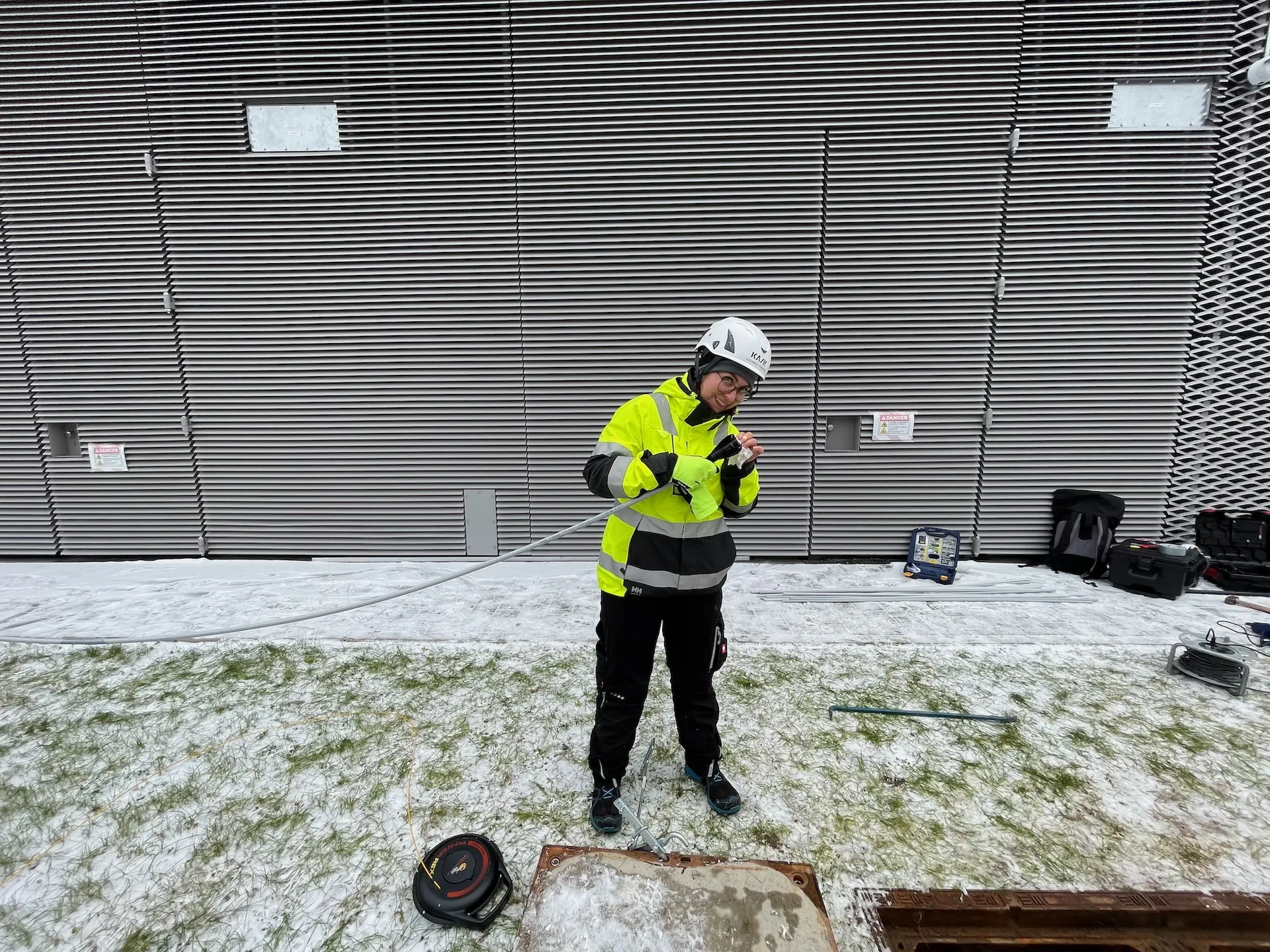
Digital analysis – processing LiDAR point clouds and creating digital twins.
Colorization: The Most Important Innovation since 2025
Until 2024, LiDAR point clouds were grey or coloured by intensity. Technically precise, but difficult for non-experts to interpret. Where exactly is the corrosion in this grey point cloud?
Colorization changes this: The 4K camera images of the ELIOS 3 are automatically projected onto every individual 3D point. The result is a photorealistic 3D model – you see the actual colours of the surface in 3D space.
Practical example: A tank roof with several corrosion spots. In the grey point cloud: barely recognisable. In the coloured model: the rust spots are immediately obvious, with exact position and area.



Typical Applications: Digital Twin in Practice
Tanks and Vessels
Interior completely in 3D: wall, floor, roof. Corrosion localised, coating condition documented. Geometry comparison on repeat inspection.
Boilers and Steam Generators
3D model of all heating surfaces, baffles, internals. Thermography overlay shows hotspots. Exact planning of refractory repairs.
Chimneys
Complete 3D model from base to crown. Cracks and spalling measurable. Wear progression visible over years.
Silos and Bunkers
Volumetrics: quantify build-ups and hangups. Calculate actual usable space.
Maritime (Ballast Tanks)
3D model for class survey: frames, floor girders, coating condition – traceable and reproducible.
Drainage (Large-Profile)
3D profile of channel cross-section: deformation, offset, crack widths – all measurable in the digital twin.
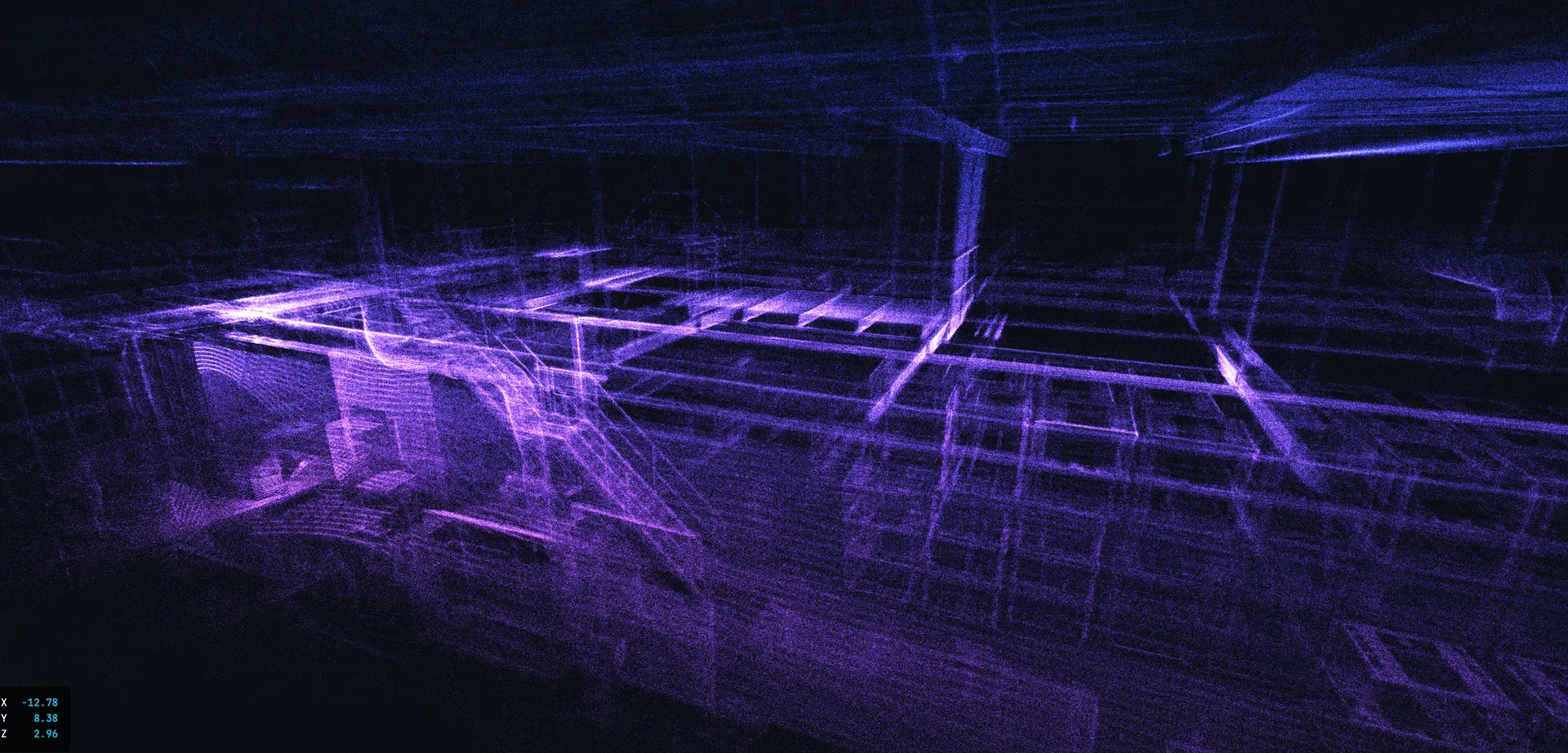
Isometric LiDAR point cloud – the geometric basis for digital twins.
Technical Specifications: ELIOS 3 LiDAR
- Sensor: Ouster OS0-128 (128 channels)
- Range: up to 50 m
- Accuracy: centimetre range (1 sigma)
- Point rate: 1.31 million points/sec
- FOV (field of view): 360° horizontal × 90° vertical
- Protection class: IP68 (payload)
- Data format: .las, .e57, .ply (CAD/BIM-compatible)
- Colorization: automatic projection of 4K camera images onto point cloud (since 2025)
Software: Flyability Cloud (Inspector 5) – post-processing, visualisation, measurement, export. Compatible with CloudCompare, AutoCAD, Revit, Navisworks, Cyclone 3DR and other 3D/BIM platforms.
Practical tip: For maximum point cloud quality we recommend slow, systematic flight patterns with overlap. The FlyAware live map shows the pilot in real time which areas are already sufficiently covered.
Limits and Honest Assessment
A digital twin from drone data is impressive – but it has limits:
1. Not a CAD model in the classical sense: The point cloud is a geometrically exact image of reality – but not a parametric CAD model. Conversion to a BIM model requires additional effort (mesh creation, object recognition). We deliver the point cloud – BIM modelling is handled by your planning office or CAD service provider.
2. Accuracy vs. terrestrial laser scanner: A stationary terrestrial laser scanner (e.g. FARO) is more precise at individual standpoints (±1–2 mm). The ELIOS 3 is in the centimetre range – but it reaches areas inaccessible to terrestrial scanners (over internals, behind baffles, in narrow shafts).
3. Drift with very large structures: With extremely long flights in large spaces, the SLAM algorithm can drift minimally. In practice: for the vast majority of industrial confined spaces accuracy is more than sufficient.
4. No wall thickness: LiDAR measures the surface – not wall thickness. For absolute wall thickness values UT remains the method of choice. LiDAR can however measure geometry changes between two time points and thus indirectly indicate material removal.
| Criterion | ELIOS 3 (LiDAR) | Terrestrial Laser Scanner | Photogrammetry |
|---|---|---|---|
| Precision | Centimetre range | ±1–2 mm | cm range |
| Confined space access | Yes (flies through manhole) | No (must be carried in) | Limited (needs access + light) |
| Darkness | Yes (active laser) | Yes (active laser) | No (needs light) |
| Coloured 3D model | Yes (Colorization) | Yes | Yes (natively coloured) |
| Human entry required | No | Yes | Yes |
| CAD/BIM export | Yes (.las, .e57) | Yes (.las, .e57, .rcp) | Limited (post-processing) |
| Ideal use area | Confined spaces, interiors | Freely accessible areas | Textured exterior surfaces |
Your Contacts for Digital Twin Projects
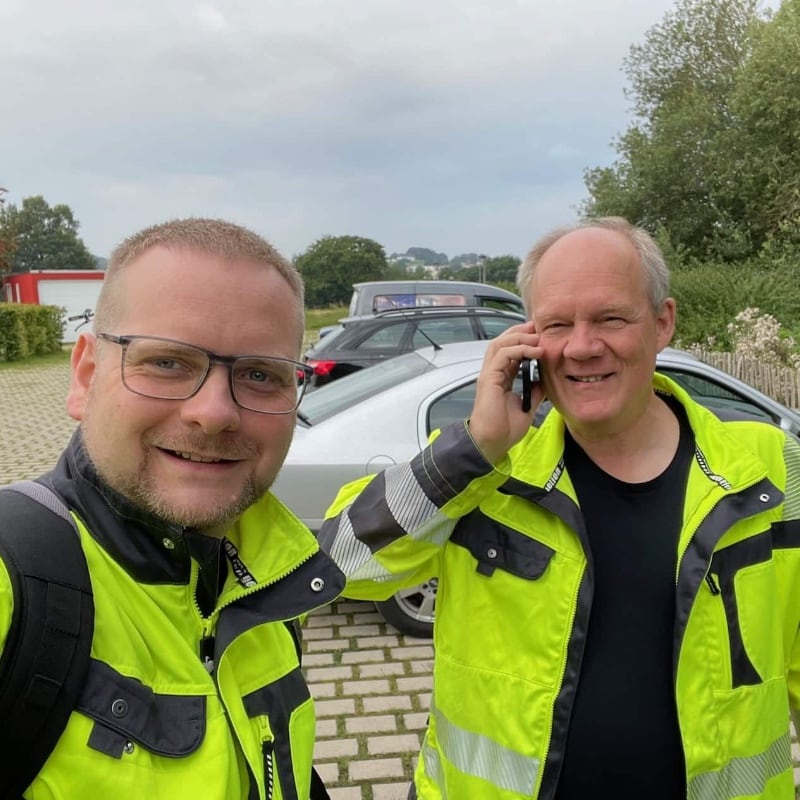
Dipl.-Ing. Karsten Lehrke and Christian Engelke – your direct contacts for digital twin and LiDAR projects.
We assess whether a LiDAR-based digital twin makes sense for your plant. Send us your requirements – we respond with a feasibility assessment and a quote.
Related Services
- Flyability ELIOS 3 – The LiDAR drone for digital twins in tanks, boilers and silos.
- Tank Inspection – 3D surveying and digital documentation of tanks by LiDAR drone.
- Boiler Inspection – Digital twin of boilers and steam generators with LiDAR point cloud.
- Silo Inspection – Volumetrics and 3D model of silos for capacity determination.
- Maritime Inspection – Ballast tanks and cargo holds digitally measured and documented.
- Industrial Inspection – Digital 3D documentation of industrial plants for maintenance planning.
Frequently Asked Questions about the Digital Twin
Do I need special software to view the point cloud?
Flyability Cloud (Inspector 5) is browser-based and requires no installation. For further analysis and CAD integration you can open .las/.e57 files in common software: CloudCompare (free), AutoCAD, Revit, Cyclone 3DR, Navisworks and many others.
How large are the data sets?
Depends on the inspection scope. A typical tank inspection generates LiDAR data in the range of 500 MB to 5 GB. With colorization and video it can be 10–50 GB. We deliver the data on hard drive or via secure cloud download.
Can I integrate the digital twin into my existing BIM model?
Yes, via .las/.e57 export. The point cloud can be imported into any common BIM system. The actual modelling (mesh, objects) requires additional CAD effort – we deliver the geometric foundation.
How does the digital twin from ELIOS 3 differ from a terrestrial scan?
Main difference: the ELIOS 3 reaches areas inaccessible to terrestrial scanners (over internals, in narrow shafts, behind baffles). A stationary scanner is somewhat more precise at individual standpoints (±1–2 mm vs. centimetre range). In practice both complement each other: drone for the interior, terrestrial for the exterior area.
How long until I receive the digital twin?
Raw data (point cloud) is available promptly after post-processing. Colorized point clouds take somewhat longer depending on data volume. Annotated models with all findings are delivered within the overall report. The exact timeline depends on scope and complexity of the deployment.
What is Colorization and why is it important?
Colorization means the 4K camera images are automatically projected onto every 3D point in the LiDAR cloud. Before Colorization, point clouds were grey – geometrically exact but hard to interpret visually. With Colorization the surfaces are shown in their real colours: corrosion spots, coating conditions, deposits – all immediately visible in the 3D model. A paradigm shift for communication with experts, operators and insurers.
Can the digital twin be used for regulatory purposes (BetrSichV, insurance)?
The digital twin is an excellent supplementary document: georeferenced finding documentation, measurable geometry, reproducible over time. For mandatory inspections per BetrSichV, the digital twin supplements the expert report – it is not a replacement. For insurance documentation the 3D model with findings provides significantly more evidence value than conventional photo documentation.
Get in Touch
Interested in having a digital twin of your plant created? Fill out the form below and we’ll get back to you within 24 hours.