
Glossary: Drone Inspection & Industrial Inspection (A–Z)
Over 100 technical terms explained in practical context – from API 653 to ZÜS. Distilled from hundreds of inspections since 2017. German terms are retained where they are the international industry standard.
Why This Glossary?
Drone inspection in industry combines drone technology, measurement engineering, safety standards and sector-specific requirements. In conversations with operators, maintenance managers and inspectors, the same questions come up time and again: What exactly is SLAM? When do I need LiDAR? What does DN 600 mean in practice? What is the difference between a turnaround and a maintenance window?
This glossary is our practical reference – not a Wikipedia copy, but distilled from hundreds of inspections since 2017. Each term is explained in the context of industrial drone inspection.
Over 100 technical terms from drone technology, standards, corrosion and operations – practically distilled from hundreds of inspections.
A – ATEX / IECEx / API Standards
ATEX / IECEx (Explosion Protection)
ATEX (Atmosphères Explosibles) is EU Directive 2014/34/EU for equipment and protective systems in potentially explosive atmospheres. IECEx is the international equivalent.
Practical relevance for drone inspection: The Flyability ELIOS 3 is NOT ATEX/IECEx-certified. This means: before every deployment in areas where explosive atmospheres could occur (e.g. tanks with residual media, oil/gas plants), a gas measurement (Gasfreimessung) must be carried out and documented. Only after clearance by the plant safety officer can the drone enter. The drone must never be deployed in an active ATEX Zone 0 or 1.
API 510 / API 570 / API 653
Standards of the American Petroleum Institute for inspection and repair of pressure vessels (API 510), pipelines (API 570) and storage tanks (API 653). These standards are globally recognised – also in Germany for refineries and petrochemical plants. API 653 defines inspection intervals for above-ground storage tanks (ASTs) and sets requirements for thickness measurement, weld seam inspection and repair documentation. Drone data is increasingly accepted as a basis for API 653 inspections.
Anfahrschaden (Racking Damage)
Structural damage to rack uprights, beams or floor anchoring caused by collision with forklift trucks or stacker cranes. Inspection obligation per DIN EN 15635 (annual inspection by qualified person, immediate action for damage categories orange/red). ELIOS 3 and DJI M30T inspect rack structures without blocking warehouse operations.
B – BetrSichV / Befähigte Person
BetrSichV (German Industrial Safety Regulation)
BetrSichV is the German regulation on safety and health protection in the use of work equipment. It governs, among other things, inspection obligations for notifiable plants (pressure vessels, lifts, installations in potentially explosive atmospheres).
Relevance: Many plants we inspect (boilers, pressure vessels, tanks) are subject to BetrSichV. The inspection results of the ELIOS 3 (4K video, 3D models, thermography) can serve as a basis for inspection documentation – the final assessment and acceptance remains the responsibility of the appointed inspector (ZÜS or befähigte Person).
Befähigte Person (Qualified Person)
In German health and safety law (BetrSichV §2 para. 7, DGUV regulations): a person who by virtue of professional training, occupational experience and recent professional activity possesses sufficient knowledge in a specialist area to assess the safety of work equipment. Not the same as a ZÜS inspector, but can carry out certain recurring inspections (e.g. rack inspections per DIN EN 15635).
Biogas / Faulturm (Digester Tower)
Anaerobic digestion processes produce methane (CH₄) as a by-product. Biogas plants and sewage treatment digesters are classic ATEX-relevant environments. The ELIOS 3 can inspect them after gas clearance – typical findings: concrete corrosion, lining defects, weld seam damage.
C – Confined Space / CUI
Confined Space (Enger Raum / Beengter Raum)
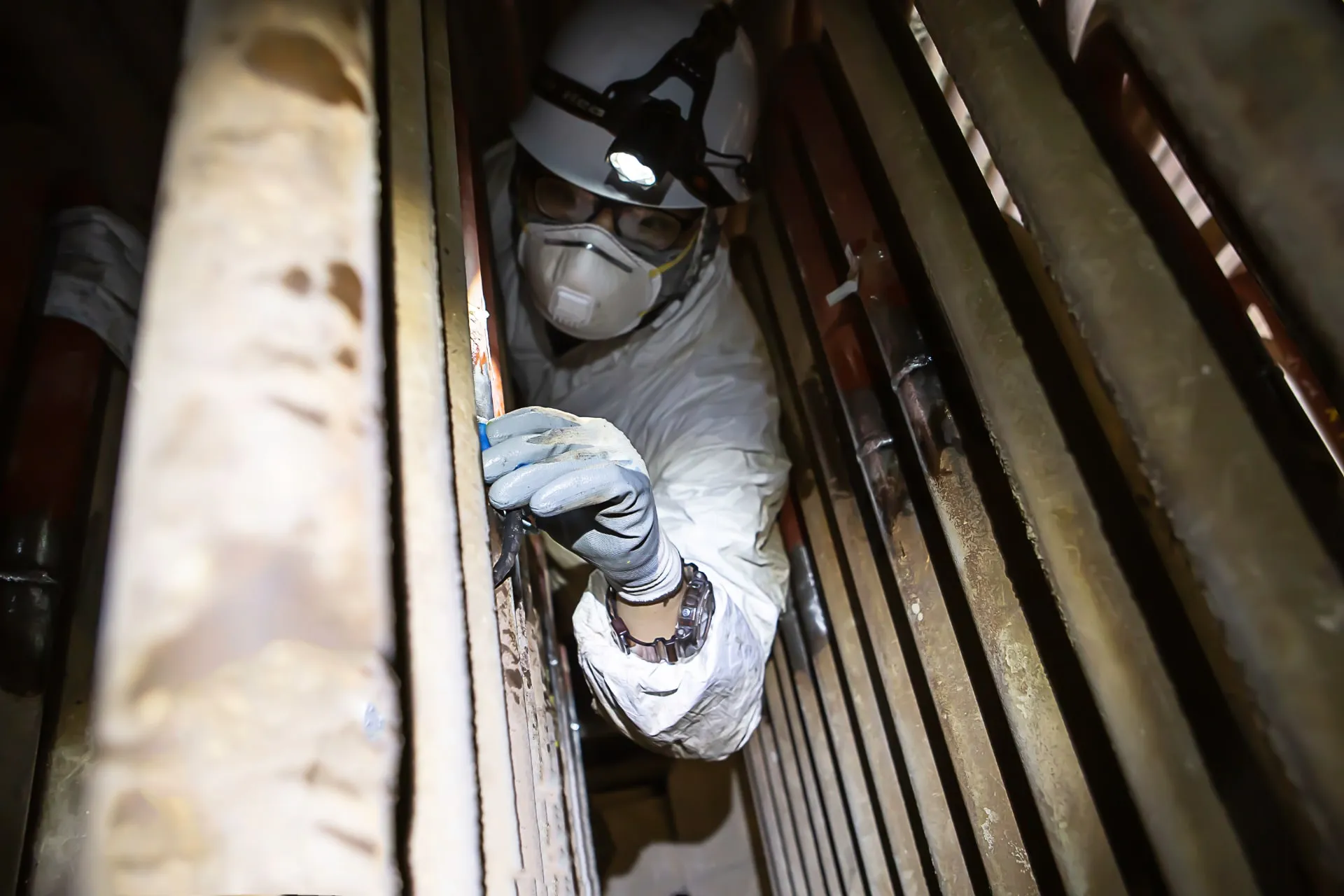
A space that: is not intended for permanent occupation by persons; has restricted access (e.g. manholes); and poses hazards from atmosphere, media or geometry. Examples: tanks, boilers, silos, chimneys, reactors, columns, shafts, ballast tanks, digesters.
Why relevant: Confined spaces are the core domain of the ELIOS 3. The promise: Zero Human Entry – the drone assumes the risk; your staff stays outside.
CUI (Corrosion Under Insulation)
One of the most common and costly damage causes in the process industry. CUI occurs when moisture accumulates between the steel surface and outer insulation – creating ideal corrosion conditions invisible from outside. The radiometric thermal camera of the ELIOS 3 detects CUI via temperature anomalies – but only when a temperature gradient exists (process running). Further detail: CUI inspection by drone.
D – DGUV 113-004 / DN 600 / Digital Twin
DGUV Regel 113-004
The German trade association rule for “Work in vessels, silos and confined spaces”. Governs risk assessment, gas measurements, rescue concepts and personal protective equipment. In practice: drone deployment eliminates personnel entry in many cases – and with it much of the laborious DGUV confined-entry measures (rescue chain, breathing apparatus, safety watchman).
DN 600 (Nominal Diameter 600 mm)
Standard manhole diameter in industry (approx. 60 cm internal diameter). The ELIOS 3 (approx. 50 × 45 cm) fits through most DN 600 manholes. Critical factors are insertion geometry, edges and clearance behind the opening. For very tight or non-standard openings, a check of the exact dimensions is required. Smaller openings (DN 450) can be a problem – assess individually.
Digital Twin (Digitaler Zwilling)
A digital 3D replica of a physical plant or component – created from LiDAR point clouds, photogrammetry or CAD data. In drone inspection: Flyability Inspector 5 creates a digital twin of the inspected confined space, in which all findings are georeferenced. Enables damage progression tracking over multiple inspection cycles.
E – ELIOS 3 / FlyAware™
Flyability ELIOS 3
One of the most capable collision-protected indoor inspection drones, developed by Flyability SA (Lausanne, Switzerland). Specifically designed for confined spaces.
Key data: Size approx. 50 × 45 cm (fits through DN 600) — Carbon fibre cage, fully collision-safe — Camera: 4K (3840×2160, 30 fps) — Lighting: 16,000 lm LED (IP44) — LiDAR: Ouster OS0-128, centimetre-level precision, 1.31 M points/sec — Thermography: radiometric (optional) — Navigation: GPS-independent via SLAM (FlyAware™) — Max. flight time: approx. 10 minutes (unlimited with tether since 2025).
FlyAware™ Engine
The proprietary navigation engine of the ELIOS 3. Combines computer vision, LiDAR and NVIDIA processor for real-time 3D mapping and GPS-independent navigation. Generates a real-time 3D live map that gives the pilot orientation during flight. Enables “Stable Hover” (position hold in GPS-free environment) and FlyAware Path Recording (automatic path replay for comparison scans).
Flyability Cloud / Inspector 5
Flyability’s cloud-based software for post-processing inspection data. Functions: 3D point cloud visualisation, Colorization (since 2025: automatic colour texturing of LiDAR data), measurements, annotations, defect reports. Inspector 5 enables frame-by-frame browsing of video in the 3D model – every finding is spatially localised.
G – Risk Assessment / GPS-Free Navigation / Galvanic Corrosion
Gefährdungsbeurteilung (Risk Assessment)
Legally required risk analysis before any work on plants (§5 ArbSchG, BetrSichV). Assesses physical, chemical, biological hazards. For drone deployment in confined spaces: gas measurement, temperature, atmospheric hazards, structural integrity of the space. We prepare this for every deployment.
GPS-Free Navigation
The ELIOS 3 uses SLAM (Simultaneous Localization and Mapping) instead of GPS. This makes it capable of operating in metal-enclosed spaces, underground and inside any industrial structure where GPS signal is absent or unreliable.
Galvanic Corrosion (Galvanische Korrosion)
Electrochemical corrosion at contact points between different metals in an electrolyte. Common at: aluminium/steel connections, copper/steel pipe connections, weld seams in mixed materials. Visible in 4K as discolouration and material loss at the contact zone.
H – Hybrid Inspection / Scaffolding / High-Temperature Corrosion
Hybrid Inspection (Hybridinspektion)
The combination of drone initial inspection and targeted manual follow-up: the drone carries out the screening (VT, IRT, LiDAR), the human follows up only at the identified critical locations (UT, MT, sampling, repair). Result: significantly less scaffolding, less personnel time in the confined space, faster turnaround. Full guide: Hybrid Inspection Practical Guide.
Scaffolding (Gerüstbau) as Inspection Access
Conventional method to provide access for inspectors in heights or interiors. Drawback: high costs (five to six-figure sums for large vessels), days to weeks for erection/dismantling. The drone eliminates the need for internal inspection scaffolding – access via manhole is sufficient.
Hochtemperaturkorrosion (High-Temperature Corrosion)
Corrosion mechanism at operating temperatures above approx. 550°C in furnaces, blast furnaces and waste incineration plants. Occurs as oxidation (scale formation), sulphidation or carburisation. The ELIOS 3 cannot fly in active high-temperature zones – inspection takes place after cooling to <45°C. LiDAR 3D scans document refractory lining wear quantitatively.
Hydrostatische Druckprüfung (Hydrostatic Pressure Test)
Leakage test in which the vessel is filled with water and pressurised above operating pressure (typically 1.5x). Required after repair welding or for initial commissioning under PED (Pressure Equipment Directive). Not a method the drone performs, but drone VT inspection takes place before and after the pressure test to document the structural condition.
K – Collision-Safe Cage / LiDAR / Lumens
Collision-Safe Cage (Kollisionssicher, Carbon-Schutzkäfig)
The unique selling point of the ELIOS series: a closed carbon fibre cage surrounds the entire drone. It can touch walls, pipes and fittings without crashing. After a flip (roll-over), it returns autonomously to the flight attitude. Perfect for narrow tanks, complex boilers and cluttered confined spaces.
LiDAR (Light Detection And Ranging)
Optical measurement method that uses laser pulses to measure distances and generate 3D point clouds. The ELIOS 3 uses an Ouster OS0-128 Rev 6 LiDAR sensor: 128-channel, 1.31 million points/sec, range up to 30 m, centimetre accuracy. Results: precise 3D models for geometry measurements, volume estimation and damage progression tracking. Combined with coloured video data (Colorization), the model becomes a photorealistic digital twin.
Lumen (lm)
Unit of luminous flux. The ELIOS 3 has 16,000 lm LED lighting – enough to fully illuminate the interior of a tank with 15 m diameter for 4K recording. For comparison: a construction site spotlight typically outputs 5,000–10,000 lm. Sufficient lighting is the decisive factor for VT image quality in dark confined spaces.
M – Manhole / NDT / Magnetic Particle Testing
Manhole (Mannloch)
Standardised access opening on vessels, tanks and boilers. Common nominal sizes: DN 450, DN 600 (most common), DN 800. The ELIOS 3 (approx. 50 × 45 cm) fits through most DN 600 manholes – the decisive factors are insertion geometry, edges and clearance behind the opening.
NDT / NZfP / ZfP (Non-Destructive Testing)
Generic term for all testing methods that do not damage the component. Methods relevant to drone inspection:
- VT (Visual Testing): The core method of the ELIOS 3
- IRT (Infrared Thermography): Optional thermal camera, CUI detection, hotspot identification
- UT (Ultrasonic Testing): Wall thickness measurement – requires physical probe contact; optional UT payload available for ELIOS 3
- MT (Magnetic Particle Testing): Surface crack detection in ferromagnetic materials – requires contact; not possible by drone
- RT (Radiography): Weld seam inspection by X-ray – not possible by drone
Magnetpulverprüfung (MT, Magnetic Particle Testing)
NDT method for detecting surface and near-surface cracks in ferromagnetic materials. The component is magnetised – cracks create stray magnetic fields that are made visible by fluorescent or coloured particles. Requires physical contact – not possible by drone. In hybrid inspection: the drone locates the suspect locations, the MT inspector confirms on site.
MFLT (Magnetic Flux Leakage Testing)
Automated magnetic testing method for the floor plates of above-ground storage tanks (API 653). Detects corrosion pits, material loss and weld defects in the floor. MFLT works robotically after emptying the tank – complementary to drone VT inspection of the inner walls.
P – Point Cloud / Phased Array / Inspection Report
Point Cloud (Punktwolke)
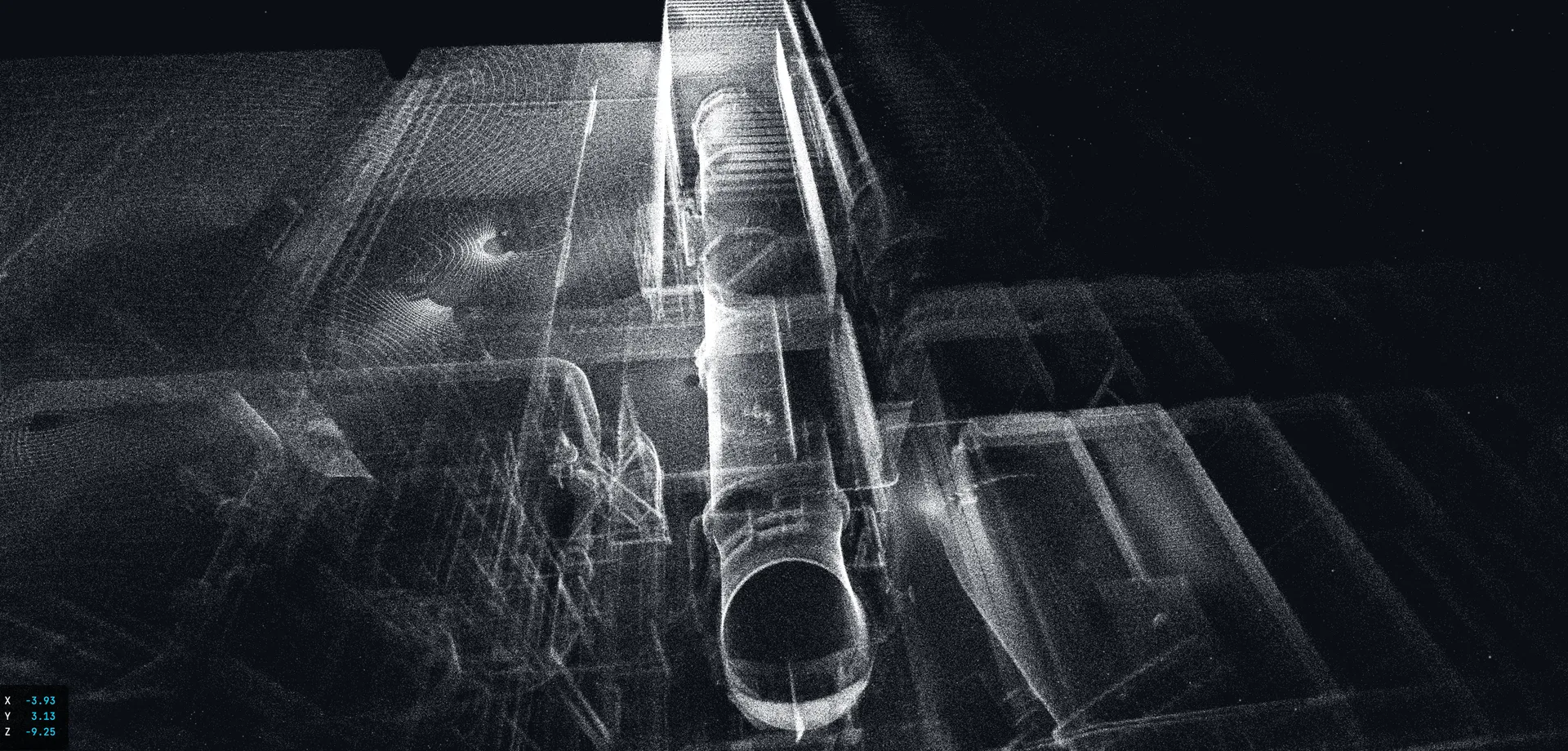
Three-dimensional representation of surfaces, generated by LiDAR. Every point has x/y/z coordinates and optionally colour values. The ELIOS 3 generates a point cloud during every flight – automatically registered in the coordinate system of the confined space. Used for: geometry measurements, volume calculations, dimensional comparison (as-built vs. as-designed) and damage progression tracking between inspection cycles.
Phased Array Ultrasound (PAUT)
Advanced UT method with phase-shifted multi-channel probe – the ultrasound beam sweeps electronically without mechanical movement. Enables faster weld seam inspection and more precise flaw characterisation. Not possible by drone; used by UT inspectors in hybrid inspection for follow-up measurement at drone-identified suspect locations.
Inspection Report / Prüfbericht
Documentation of inspection results. Kopterflug inspection reports contain: 4K video extracts with time stamps, thermography images with temperature mapping, LiDAR point cloud with defect annotations, measurement data and a text-based defect catalogue with location description, severity assessment and recommended action. All georeferenced via the 3D model.
R – RBI / Radiography / Weld Seam Inspection
RBI (Risk-Based Inspection)
Risk-based inspection approach per API 580/581 or DNV RP-G101. Prioritises inspection measures by probability of failure and consequence of damage. Drone inspection data feeds into RBI assessments: regular VT and thermography reduce uncertainties in the risk model and can extend inspection intervals for low-risk areas while focusing resources on high-risk zones.
Radiography / Röntgenprüfung (RT)
X-ray or gamma-ray based weld seam inspection. Detects volume defects (pores, slag inclusions, lack of fusion) in weld seams. Not possible by drone – requires film/detector placement on both sides of the weld and radiation safety zone. Used in hybrid inspection as follow-up to drone-identified weld seam anomalies.
Schweißnahtprüfung (Weld Seam Inspection)
Inspection of weld connections for defects. Methods by requirement: VT (visual), UT/PAUT (ultrasonic), RT (radiography), MT (magnetic particle), PT (penetrant testing). The drone delivers VT of all weld seams in a single flight – identifying suspect zones for targeted contact testing follow-up.
S – SLAM / Rope Access / Damage Progression Tracking
SLAM (Simultaneous Localization and Mapping)
Algorithm that simultaneously determines the sensor position and creates a 3D map of the environment – without GPS. Core of ELIOS 3 navigation in confined spaces. The FlyAware™ engine uses SLAM with Computer Vision + LiDAR + NVIDIA processor. SLAM enables: stable position hold in GPS-free environment; real-time 3D live map for the pilot; reproducible flight paths for repeat inspections.
Rope Access / Seilzugang (Industrial Climbing)
Access method in which industrial climbers access heights or interior structures via ropes and harnesses. Cheaper than scaffolding for spot inspections, but slower and with higher personal risk than drone inspection. Typical use: chimney exterior inspection, tower structures, bridge undersides. The DJI M30T replaces rope access for visual documentation; for UT and coating repair, climbers remain necessary.
Schadensfortschrittskontrolle (Damage Progression Tracking)
Comparison of inspection results over multiple inspection cycles to identify and quantify damage progression. With drone inspection: LiDAR point cloud comparison (e.g. 2023 vs. 2025) makes geometric changes measurable in millimetres. 4K image comparison documents visual changes. Prerequisite: consistent flight paths and defined reference points for each inspection.
T – Tether / Thermography / Turnaround / UT
Tether (Cable Supply)
Since 2025, an optional extension for the ELIOS 3: a thin cable supplies the drone with power, making flight time unlimited. Ideal for multi-hour missions in large tanks, tall chimneys (>100 m) or complex plants. The tether is managed by an additional team member and requires careful planning to avoid entanglement with internal structures.
Thermography (Radiometric)
Measurement technology that makes thermal radiation (infrared) visible. The ELIOS 3 has a radiometric thermal camera that delivers absolute temperature values – not just relative colour images. Typical findings: hotspots (indicating refractory damage or wall thinning), CUI (moisture under insulation), leaks, defective insulation zones. Condition: temperature difference must be present (>5 K).
TRBS (Technical Rules for Operational Safety)
Technical rules that concretise BetrSichV. Relevant for drone inspection: TRBS 1203 (qualification requirements for persons inspecting work equipment), TRBS 2153 (avoidance of ignition sources), TRBS 3145/TRGS 722 (work in potentially explosive atmospheres). TRGS 722 defines the requirements for gas measurement before confined space entry – mandatory for us before every deployment.
Turnaround (TAR / Plant Revision)
Planned full shutdown revision of an industrial plant (refinery, chemical plant, power station, paper mill, pharmaceutical plant). All systems go offline – everything is inspected, cleaned, maintained and repaired in parallel. Turnaround duration: days to weeks. Drone inspection as the first step after plant opening delivers the data basis for all subsequent work. Further: Turnaround Management with Drone Inspection.
UT (Ultrasonic Testing / Ultraschallprüfung)
NDT method for wall thickness measurement and flaw detection in metals using high-frequency sound waves. Requires physical probe-to-surface contact with couplant. Standard method for: wall thickness measurement (API 653, API 510), weld seam inspection (EN ISO 17640), detection of internal cracks and delaminations. The ELIOS 3 has an optional UT payload for direct wall thickness measurement during flight.
V – VT / Zero Entry / Access Technology
VT (Visual Testing / Sichtprüfung)
The most fundamental NDT method – and the core competence of the ELIOS 3. Visual inspection with 4K camera (3840×2160, 30 fps) and 16,000 lm LED. Standard: DIN EN ISO 17637. The ELIOS 3 extends VT with: zoom capability, aerial perspectives, access to otherwise unreachable locations, reproducible documentation, LiDAR-based localisation of findings in 3D space.
Zero Entry / Zero Human Entry
The core promise of drone inspection: no person needs to enter the confined space. The drone assumes the risk. This eliminates, depending on scope: DGUV confined entry measures, rescue chains, breathing apparatus, safety watchmen, TRBS 3145-compliant gas measurement for human entry. Result: faster, cheaper, safer. Note: gas measurement before drone deployment remains mandatory.
Zugangstechnik (Access Technology)
Generic term for methods of accessing heights and interiors: scaffolding, rope access (industrial climbing), elevated work platforms (cherry pickers), work cages, telescopic masts. Classic access technology is the largest cost block in industrial inspections. Drone inspection replaces access technology for the visual inspection phase – access technology is still required for contact testing (UT, MT) and repair.
W – Wall Thickness Measurement / Heat Exchanger
Wanddickenmessung (Wall Thickness Measurement)
Measurement of remaining wall thickness at pressure vessels, tanks, pipelines and boilers – one of the central methods for assessing structural integrity. Carried out by UT (ultrasonic testing) with direct probe contact. The ELIOS 3 has an optional UT payload for direct wall thickness measurement. Alternatively (hybrid strategy): drone identifies suspect zones, UT inspector measures there specifically.
Wartungsfenster (Maintenance Window)
Planned production interruption shorter than a full turnaround – typically hours to days for specific maintenance tasks. No full plant shutdown, other units continue operating. Drone inspections fit well into maintenance windows: faster preparation, no scaffolding, access via manhole is sufficient.
Wärmetauscher / Heat Exchanger (Rohrbündel-Wärmetauscher)
Core of a shell-and-tube heat exchanger: hundreds of parallel heat transfer tubes through which a medium flows. The shell side is the second medium. Typical inspection points: fouling deposits on the tube sheets, corrosion in the bundle, scale inside the tubes, weld seam condition on the tube sheets. The ELIOS 3 can inspect the shell side of heat exchangers if the manhole is ≥DN 600 and internal tube structures leave sufficient clearance.
Z – ZfP (in depth) / ZÜS / Cylindrical Vessels
ZfP – Zerstörungsfreie Prüfung (Non-Destructive Testing, in depth)
Generic term for all testing procedures that do not damage the component. Main methods: VT (visual), UT (ultrasonic), RT (radiography), MT (magnetic particle), PT (penetrant), ET (eddy current), IRT (thermography). Personnel qualification: DIN EN ISO 9712 (industry standard) or ASNT SNT-TC-1A (US). Drone inspection primarily delivers VT and IRT – the other methods require physical contact and are carried out in hybrid inspection by qualified inspectors on site.
ZÜS (Zugelassene Überwachungsstelle / Approved Monitoring Body)
Officially approved inspection body for notifiable plants per BetrSichV. In Germany: TÜV SÜD, TÜV NORD, TÜV Rheinland, DEKRA, GTÜ. They carry out mandatory inspections of pressure vessels, boilers and Ex-installations. Kopterflug works as a subcontractor for ZÜS bodies: we carry out the drone inspection, the ZÜS inspector assesses the results and carries out the formal acceptance inspection.
Zylindrische Behälter (Cylindrical Vessels)
The most common vessel geometry in industry. Divided into: horizontal cylinder (lying vessel, typically high-pressure gas vessels, LNG tanks), vertical cylinder (storage tanks, process columns, silos). The inspection strategy differs by geometry: the ELIOS 3 flies a systematic spiral or grid pattern to achieve 100% surface coverage in a single flight.
Frequently Asked Questions
Is the ELIOS 3 ATEX-certified?
No. The Flyability ELIOS 3 is not ATEX/IECEx-certified. Before every deployment in potentially explosive atmospheres, a gas measurement must be carried out. After clearance (explosive gas below LEL threshold, sufficient oxygen), the drone can enter. It must never be used in an active ATEX Zone 0 or 1 without prior gas-freeing.
What does DN 600 mean for drone inspection?
DN 600 is the nominal diameter of a standard manhole (approx. 60 cm internal diameter). The ELIOS 3 is approx. 50 × 45 cm and fits through most DN 600 manholes. Decisive factors are: edge geometry (rounded or sharp-edged), installation direction (horizontal or vertical), and clearance behind the opening (no abrupt obstructions). We check this in the project brief.
Can the ELIOS 3 be used underwater?
No. The ELIOS 3 is a flying drone (IP44 protection class). For water-filled areas we deploy ROVs (Remotely Operated Vehicles), e.g. the Chasing M2 Pro Max for ballast tank inspection of partly water-filled vessels or underwater structures.
What is the difference between VT and NDT?
NDT (Non-Destructive Testing) is the generic term. VT (Visual Testing) is one of many NDT methods – and the core competence of the ELIOS 3. VT is the simplest and fastest method, but detects only surface-visible defects. Other NDT methods (UT, MT, RT) are used in hybrid inspection for follow-up of suspect zones identified by VT.
What does Zero Entry mean?
Zero Entry means: no person needs to enter the confined space. The drone assumes the risk. This eliminates depending on scope: DGUV confined entry measures, rescue chains, breathing apparatus, safety watchmen – the decisive cost and safety advantage of drone inspection compared to conventional methods.
Term Not Found? We Are Happy to Help
Talk to us about your specific inspection requirement – we clarify technical terms, feasibility and next steps.