
Inspection Without Production Shutdown
Which plants can be inspected during live operation – and where shutdown is unavoidable. A clear guide to operational-parallel drone inspection with the ELIOS 3 and DJI M30T. Kopterflug has been in the field since 2017.
The Key Question: Shutdown or Operational-Parallel?
One of the most frequent questions put to Kopterflug is: “Can we carry out the inspection without shutting down the plant?” The answer depends on a clear distinction that is not always self-evident – and which has significant economic consequences.
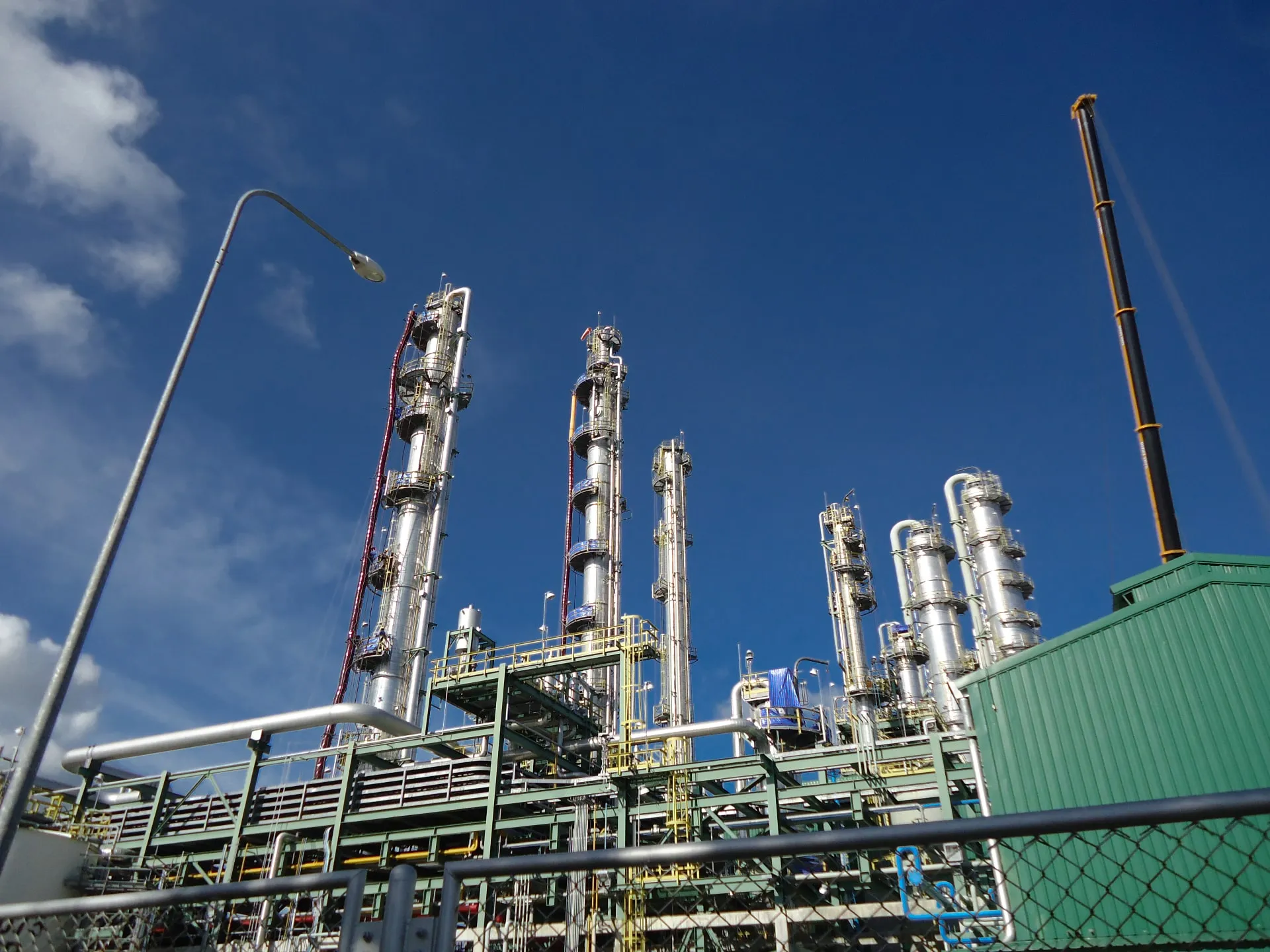
As a general rule: external structures (chimneys, facades, roof surfaces, pipe bridges, cable masts, wind turbines) can normally be inspected during live operation. The drone flies at a safe distance; there is no physical connection to the plant.
Internal inspections in confined spaces (tanks, vessels, boilers, pipes, shafts) in principle require the object to be out of service, drained, cleaned and cleared for deployment – even if the drone requires no personnel entry. The reason: in a filled or pressurised vessel, safe drone deployment is not possible, and DGUV requirements for confined-space-like activities apply.
Between these two poles lies an important grey area: partially drained or pressure-free vessels, plants in warm standby, accessible large structures. Here an individual case assessment is necessary.
The question is not ‘drone – yes or no?’ but ‘external or internal?’. External inspection during live operation is standard practice. Internal inspection requires shutdown – regardless of whether by drone or conventional means.


What Can Be Inspected Without Shutdown
The following inspections are carried out by Kopterflug as standard without production shutdown:


When is Shutdown Unavoidable?
Even though the drone enables many inspection tasks without shutdown, there are cases where shutdown is mandatory and unavoidable. A clear distinction protects against false expectations and safety-critical misjudgements.
Shutdown mandatory:
- Internal confined spaces: Every internal inspection of a tank, boiler, reactor, shaft or duct requires draining, purging and clearance in accordance with DGUV requirements – regardless of whether the drone or a person is deployed.
- ATEX zones with active explosive atmosphere: In active Ex-zones 0/1/20/21, no drone deployment is possible with the non-ATEX-certified ELIOS 3.
- Plants under operating pressure or operating temperature: Boilers, reactors and pressure vessels in operating condition are closed to any internal intervention.
- Areas with ionising radiation above defined limits: Nuclear zones with high dose rates require specific radiation protection conditions and shutdown conditions.
Operational-parallel only after individual case assessment:
- Partially drained tanks with residual product or residual gas still present
- Plants in warm standby (reduced operating temperature, no process pressure)
- Large structures with restricted access but no active process in the interior
The drone changes the economic calculation, but not the physics: a filled pressure vessel cannot be safely inspected internally – neither by drone nor conventionally.
Operational-Parallel Inspection as a Strategy: Pre-TAR
The most efficient use of operational-parallel inspection is the Pre-TAR strategy: all external structures and accessible areas are inspected during live operation – long before the next planned shutdown begins. The results flow directly into shutdown planning.

Related Services
Frequently Asked Questions
Can a drone really inspect a chimney during live operation?
Yes – for external chimney inspection. The DJI Matrice 30T flies around the outside of the chimney at a safe distance, recording the entire surface in 4K with zoom. The chimney continues to operate normally. For internal chimney inspection, a shutdown with cooling and gas measurement is required.
What about tanks: can they be inspected externally while filled?
Yes. External inspection of filled tanks is standard practice for us. The drone flies around the tank and records the outer wall, roof, fittings and insulation condition. For internal inspection, the tank must be drained and cleared.
Is an operational-parallel inspection compliant with BetrSichV?
Yes, for external inspections. The BetrSichV regulates inspection obligations for notifiable plants – these primarily refer to internal inspections. External drone surveys during live operation are a visual inspection from a safe distance and do not require any special permits beyond standard aviation law requirements.
How far in advance should Pre-TAR inspection be planned?
Ideally 4–8 weeks before the planned shutdown. This gives enough time to evaluate results and incorporate them into scope planning. The drone inspection itself takes 1–2 days depending on plant size. Technical coordination with the operator is the main planning effort – not equipment setup.
Can the drone operate near running machinery or hot surfaces?
The DJI M30T for external inspections operates at a safe distance – no contact with the plant, no risk from moving parts. The ELIOS 3 for internal inspections requires the plant to be shut down and cooled to below 45°C. Near high-voltage installations, safety clearances per operational instructions must be observed.
Which of Your Plants Can Be Inspected Without Shutdown?
Describe your plant and inspection goals – we will provide a feasibility assessment and show what is possible with and without shutdown.