
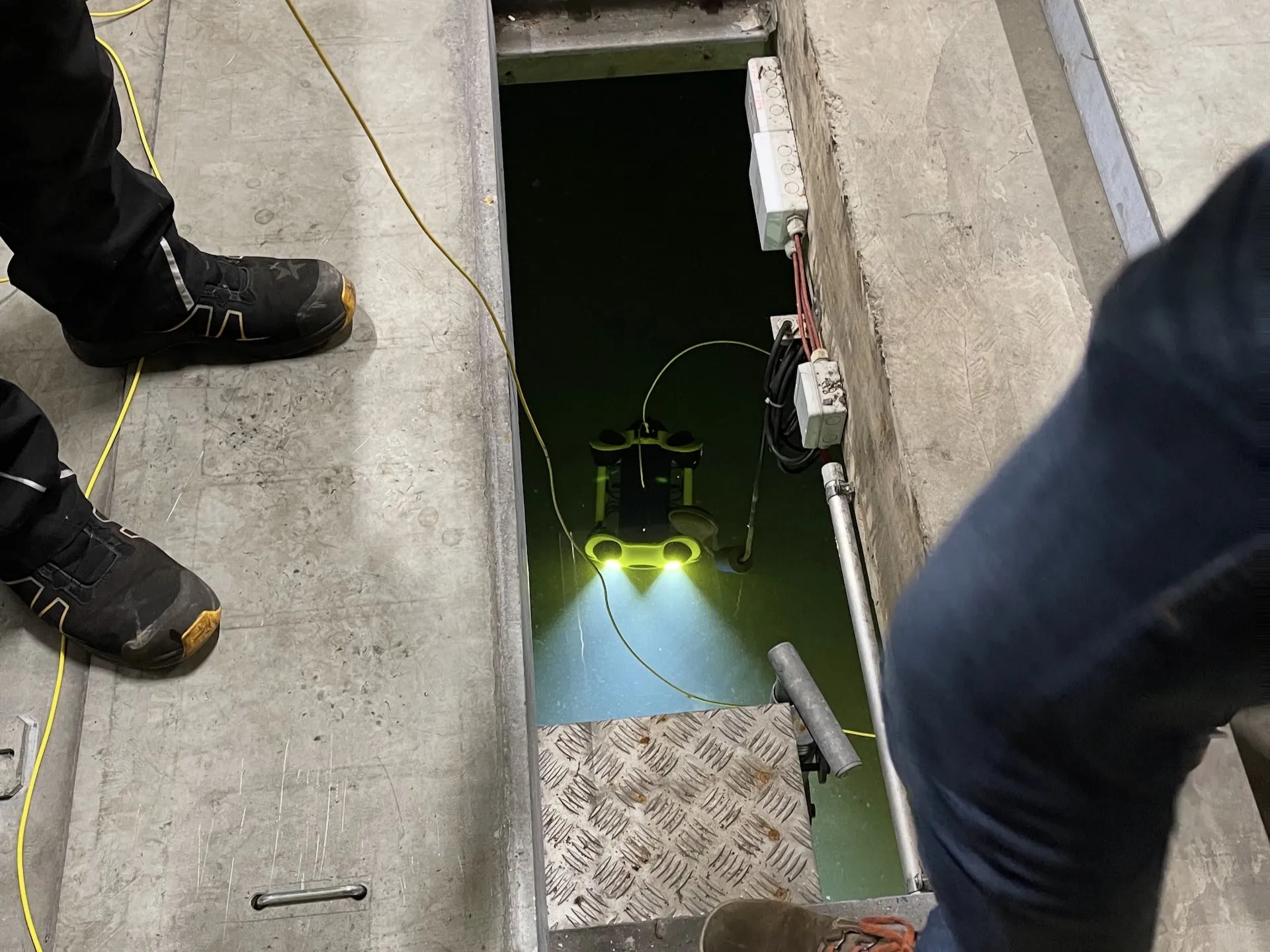
ROV & Underwater Inspection – When the Drone Cannot Dive
The Flyability ELIOS 3 is a flying drone – it cannot dive. But many industrial facilities have water-filled areas that must be inspected. For these areas we deploy ROVs (Remotely Operated Vehicles). Drone for the air, ROV for the water – both from a single source.
- No draining required – ROV inspects tanks and vessels in the filled state
- No divers – Zero Entry, no personnel risk in the water
- 4K video + optional sonar – navigation even in zero visibility
- Drone + ROV from one source – one team, one report, full coverage
The Problem: Water-Filled Confined Spaces
The Flyability ELIOS 3 is a flying drone – it flies through the air and captures surfaces with 4K, LiDAR and thermography. What it cannot do: dive.
But many industrial facilities have water-filled areas that must be inspected. For these areas we deploy ROVs (Remotely Operated Vehicles) – remotely controlled underwater vehicles. This way we offer inspection for the entire confined space: air/gas phase (drone) + underwater (ROV).



What Is an ROV?
An ROV (Remotely Operated Vehicle) is a remotely controlled underwater vehicle connected to the surface control unit by a cable (tether).


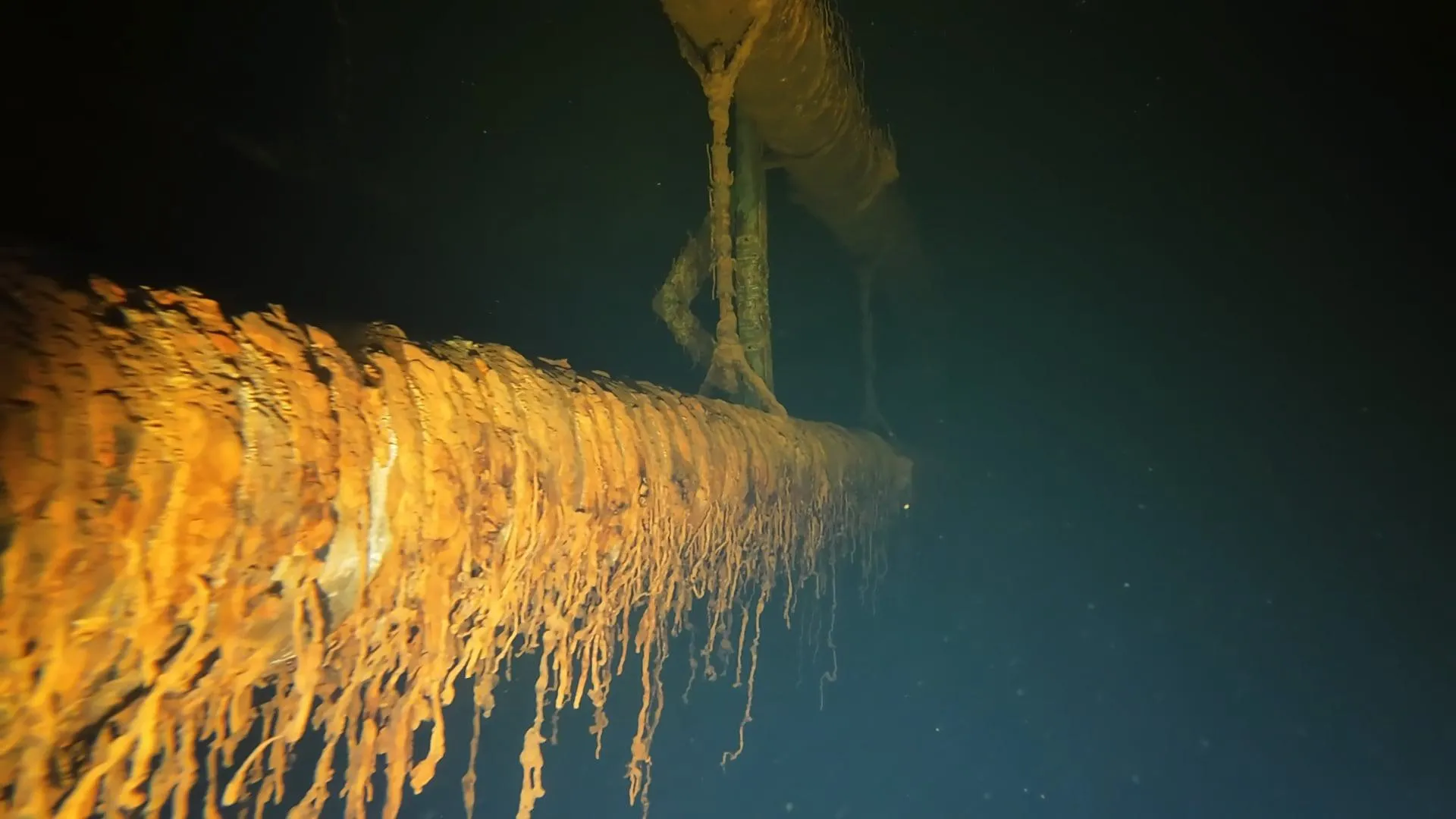
Typical underwater findings: corrosion on tank floor and walls, sediment and sludge deposits, pitting and crevice corrosion, coating damage, leaks and foreign objects.
Drone + ROV: Complementary Inspection
ELIOS 3 and ROV complement each other: the ROV inspects underwater without draining. The ELIOS 3 flies in the airspace above the waterline – it needs a dry gas phase (roof, upper shell). This way the entire tank is captured without human entry.
- Gas Phase (above water) – ELIOS 3: The flying drone inspects in the dry airspace above the waterline: roof, upper shell, float switches, pipe connections. Prerequisite: sufficient airspace for flight (the ELIOS 3 must not come into contact with water). Captures 4K video + LiDAR 3D.
- Underwater – ROV: The ROV dives and inspects the tank floor, lower shell, sediments and corrosion below the waterline. Captures 4K video + optional sonar.
- Result: Complete Inspection: ROV documents everything underwater without draining; ELIOS 3 documents the dry airspace above – without human entry, without divers. Important: The ELIOS 3 can only fly where airspace is available. For a complete inspection of the tank floor in the dry state (e.g. UT wall thickness measurement) draining is required.
When Drone, When ROV?
| Area | ELIOS 3 (Flying Drone) | ROV (Underwater) |
|---|---|---|
| Gas phase / roof / upper shell | ✓ | ✗ |
| Underwater / tank floor | ✗ | ✓ |
| Drained tank (dry) | ✓ | ✗ |
| LiDAR / 3D surveying | ✓ | ⚠ Sonar |
| Thermography | ✓ | ✗ |
| Sediment analysis | ✗ | ✓ |
Advantages Over Diver Inspection
Conventionally, water-filled tanks are inspected by industrial divers. ROV deployment offers significant advantages over diver inspection.


Limitation: Divers can physically intervene (operate valves, take samples). ROVs can only inspect and document – if action is required, a person or a gripper ROV must still be deployed.
Combination Package: Drone + ROV from One Source
Our advantage: both inspection methods from a single source. No coordination effort between drone team and underwater team. One point of contact, uniform documentation, efficient mobilisation.
Your Contact

Project Manager
Drone + ROV from a single source – we cover the entire confined space, above and below the waterline, without human entry and without divers.
Related Services
- Tank Inspection – Professional tank inspection with drone – inside and outside without scaffolding
- Maritime Inspection – Ballast tanks, cargo holds and ship structures efficiently inspected by drone
- Confined Spaces Inspection – Safe inspection of confined spaces without human entry with indoor drone
- Flyability ELIOS 3 – The collision-safe indoor drone for confined spaces and industrial plants
- Industrial Inspection – Holistic drone inspection for all industries and plant types
- Power Plant Inspection – Drone inspection for power plants, turbines and energy generation facilities
Frequently Asked Questions: ROV & Underwater Inspection
- Can the ROV also inspect in turbid water?
- Yes, with limitations. With heavy turbidity optical inspection becomes more difficult. Strong LED illumination and sonar support help. In extremely turbid media (sludge water, digesters) visibility is reduced – we clarify feasibility in advance.
- Does the tank need to be drained for the ROV inspection?
- No – that is exactly the advantage. The ROV inspects in the filled state. Only when the tank floor needs to be inspected dry (e.g. for coating inspection) is draining required.
- How deep can the ROV dive?
- Our systems are designed for depths up to 100 m – sufficient for the vast majority of industrial tanks and vessels.
- How long does a typical ROV inspection take?
- A standard inspection typically takes 4–8 hours – a time saving of around 70% compared to multi-day diver deployments.
- Is the ROV suitable for drinking water installations?
- Under certain circumstances yes – but this must be carefully reviewed in each individual case. The decisive factors are the ROV’s material approvals for drinking water contact, the disinfection protocol and any regulatory or operator-specific requirements. Please contact us before deployment so we can jointly assess feasibility.
- What are the dimensions of the ROV?
- Our micro-ROVs are compact (approx. 40–60 cm length, 30–40 cm width) and fit through standard manholes – no cutting or modification of the plant required.
Contact – Underwater Inspection Enquiry
Drone + ROV from one source – for the complete inspection of your water-filled plants.