
Thermography in Industrial Inspection – Thermal Camera Meets Drone
The Flyability ELIOS 3 with radiometric thermal camera detects CUI (Corrosion Under Insulation), hotspots and leakages inside tanks, boilers and pipelines – without scaffolding, without human entry. Three sensors in a single flight: 4K video, LiDAR and thermal imaging.
- Radiometric thermal imaging – absolute temperature values per pixel, not just colour images
- CUI detection – moisture under insulation detectable thermally before visible corrosion develops
- Internal deployment – inside boilers, chimneys, tanks and reactors without human entry
- Triple sensor in one flight: 4K visual + thermography + LiDAR 3D
Why Thermography + Drone is a Decisive Advance
Thermography was long tied to handheld cameras. The problem: to find hotspots, leakages or insulation damage in a 30-metre high boiler, access had first to be created – via scaffolding, rope access or human entry.
The Flyability ELIOS 3 with radiometric thermal camera changes this: the drone flies through the boiler, tank or chimney and simultaneously captures 4K video, LiDAR 3D data and thermal images – without human entry.
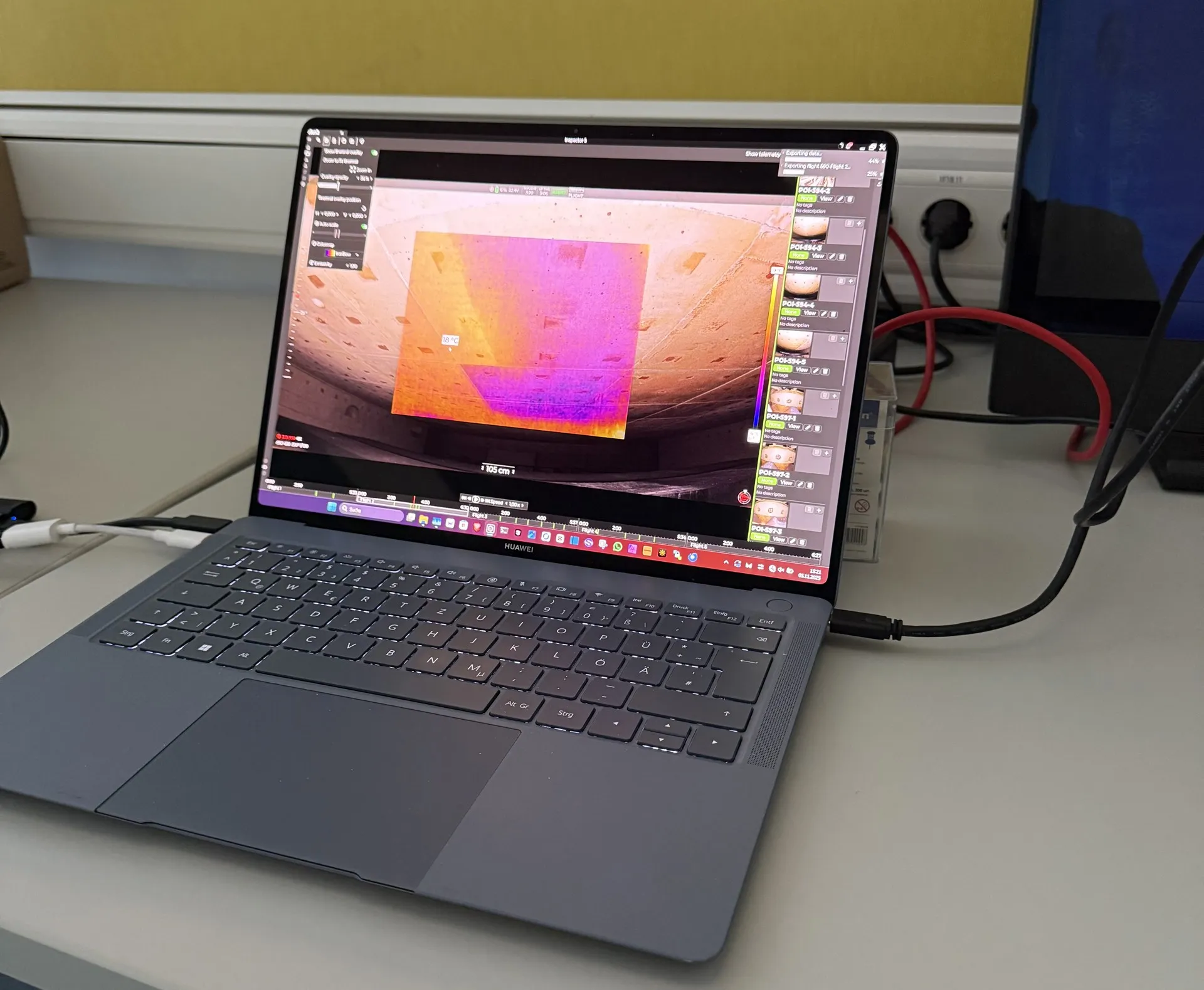
The difference “radiometric”: The ELIOS 3 does not just deliver colourful heat images – it delivers absolute temperature values per pixel. This enables quantitative analysis: is this hotspot at 85°C or 185°C? That difference is critical for assessment.
What Thermography Detects in Industrial Facilities
The radiometric thermal camera of the ELIOS 3 detects a wide range of concealed and visible anomalies in industrial facilities:

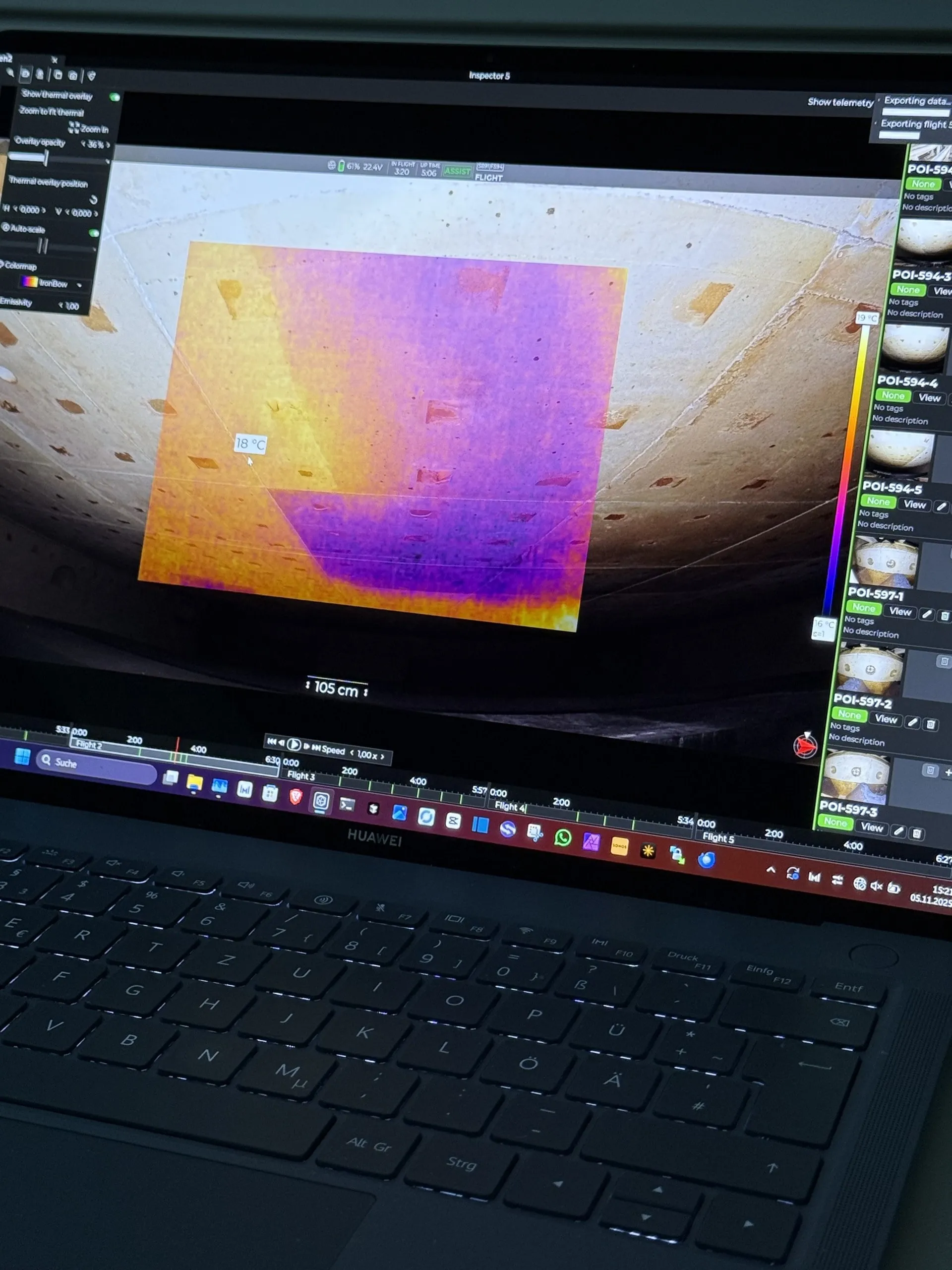
Wet insulation has a different thermal profile than dry. The thermal camera detects temperature anomalies beneath insulation – one of the most common and costly damage types in process industry. German term: Korrosion unter Isolierung.
Overheated components in boilers, furnaces and reactors: hotspots indicate refractory damage (Ausmauerungsschäden), blocked cooling systems or insulation failures.

Escape of hot or cold media creates local temperature differences that become thermally visible – even with small volumes.

In tanks and vessels, the thermal camera shows the fill level of the medium as a clear temperature boundary – useful for inventory assessment and drainage control.
Overloaded cables, switching contacts or transformers in switchrooms and cable ducts become visible through their thermal signature.
ELIOS 3 Thermal Payload: Technical Specifications
The thermal camera of the ELIOS 3 is available as an optional payload and is used in addition to the 4K camera:
- Type: Radiometric thermal camera
- Resolution: 320×256 px (sufficient for industrial finding assessment)
- Temperature range: −10°C to +400°C
- Sensitivity (NETD): <50 mK
- Frame rate: 30 fps
- Payload protection class: IP68
- Simultaneous recording: 4K visual + thermal + LiDAR
Practical note: The thermal camera delivers raw data (radiometric), which is evaluated in Flyability Cloud (Inspector 5) or compatible software. The thermal images can be overlaid on the LiDAR point cloud – showing exactly where in 3D space the hotspot is located.
Typical Application Areas: Thermography + ELIOS 3

Detection of refractory damage (Ausmauerungsschäden, German for lining damage) via hotspots on the inner wall. Previously only possible with scaffolding – with the drone in hours rather than weeks.
Thermal anomalies in the lining indicate wear, cracks or missing insulation. The drone captures the complete thermal profile from inside.
CUI detection on insulated tanks, level determination, leakage detection at connections and weld seams.
CUI screening on insulated pipelines, detection of blockages or flow problems through temperature differentials.
Turbine halls, steam generators, condensers – anywhere temperature differentials are critical.
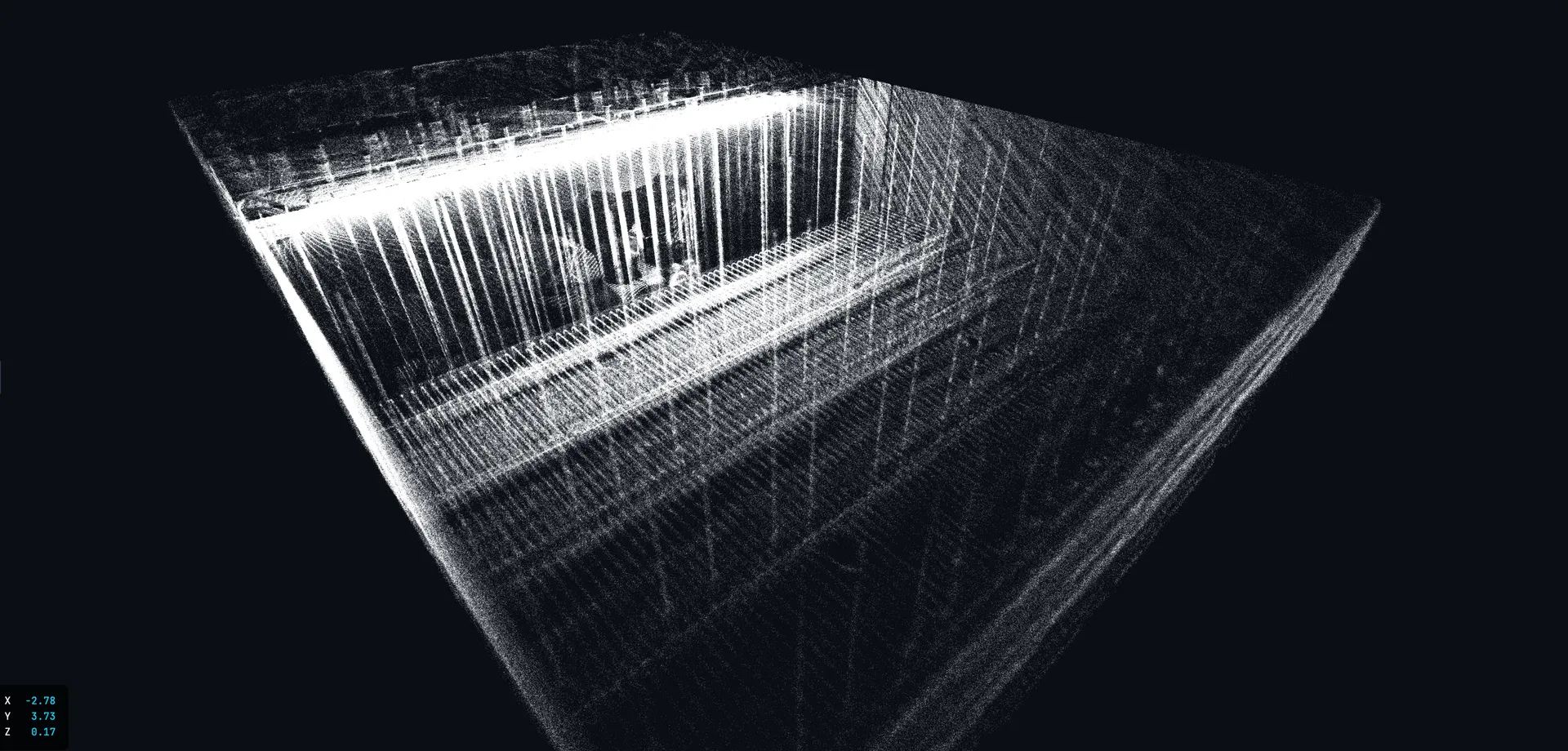
Thermography vs. Visual Inspection: What Finds What?
Visual Inspection (VT / 4K camera) detects:
- Visible corrosion and rust
- Cracks and delaminations
- Deposits, build-up, contamination
- Coating damage and spallings
- Missing components, mechanical deformation
Thermography additionally detects:
- Concealed corrosion beneath insulation (CUI)
- Internal hotspots (not visible)
- Leakages (even small volumes)
- Insulation defects
- Thermal bridges
- Fill levels
Recommendation: Deploy both methods simultaneously. The ELIOS 3 captures VT + thermography + LiDAR in a single flight. That is the advantage over separate inspections.
| Finding | Visual Inspection (4K) | Thermography | LiDAR |
|---|---|---|---|
| Visible corrosion / rust | ✓ | – | – |
| Cracks / delaminations | ✓ | ⚠ | – |
| Deposits / build-up | ✓ | – | ✓ |
| Coating damage | ✓ | – | – |
| Mechanical deformation | ✓ | – | ✓ |
| CUI (corrosion under insulation) | ✗ | ✓ | – |
| Internal hotspots | ✗ | ✓ | – |
| Leakages (small) | ⚠ | ✓ | – |
| Insulation defects | ✗ | ✓ | – |
| Fill levels | ✗ | ✓ | – |
| 3D measurement / geometry | ✗ | ✗ | ✓ |
Limits of Drone Thermography
Honestly: drone thermography has limits that need to be understood:

320×256 px is sufficient for industrial finding assessment but not for detailed component-level analysis. For high-resolution thermography, stationary cameras are better suited.

Different surfaces (bare metal vs. coated metal vs. plastic) have different emissivity values that must be taken into account during evaluation. German term: Emissionsgrad.
In open areas or chimneys with strong draught, convective effects can distort measurements.
The ELIOS 3 is specified for max. 50°C. Deployment in actively fired furnaces or directly above burners is not possible.

Even with the thermal camera, the ELIOS 3 is not approved for use in potentially explosive atmospheres – gas measurement (Gasfreimessung) is always required. German: ATEX-Zertifizierung.
Conclusion: Thermography as Standard Tool of Drone Inspection
Thermography extends drone inspection from pure visual testing to multi-sensor condition assessment. In a single flight, the ELIOS 3 captures:
- 4K video: Visible damage (VT)
- Thermography: Concealed damage (CUI, hotspots, leakages)
- LiDAR: Geometry and measurement
This trinity of data – optical, thermal, geometric – delivers a complete picture that no single method achieves alone.
Our recommendation: For every inspection assignment we assess whether thermography makes sense for your application. In many cases it is a standard module with no additional deployment effort.
Your Contacts at Kopterflug
Our team has been performing drone-based thermography inspections in industrial facilities since 2017.
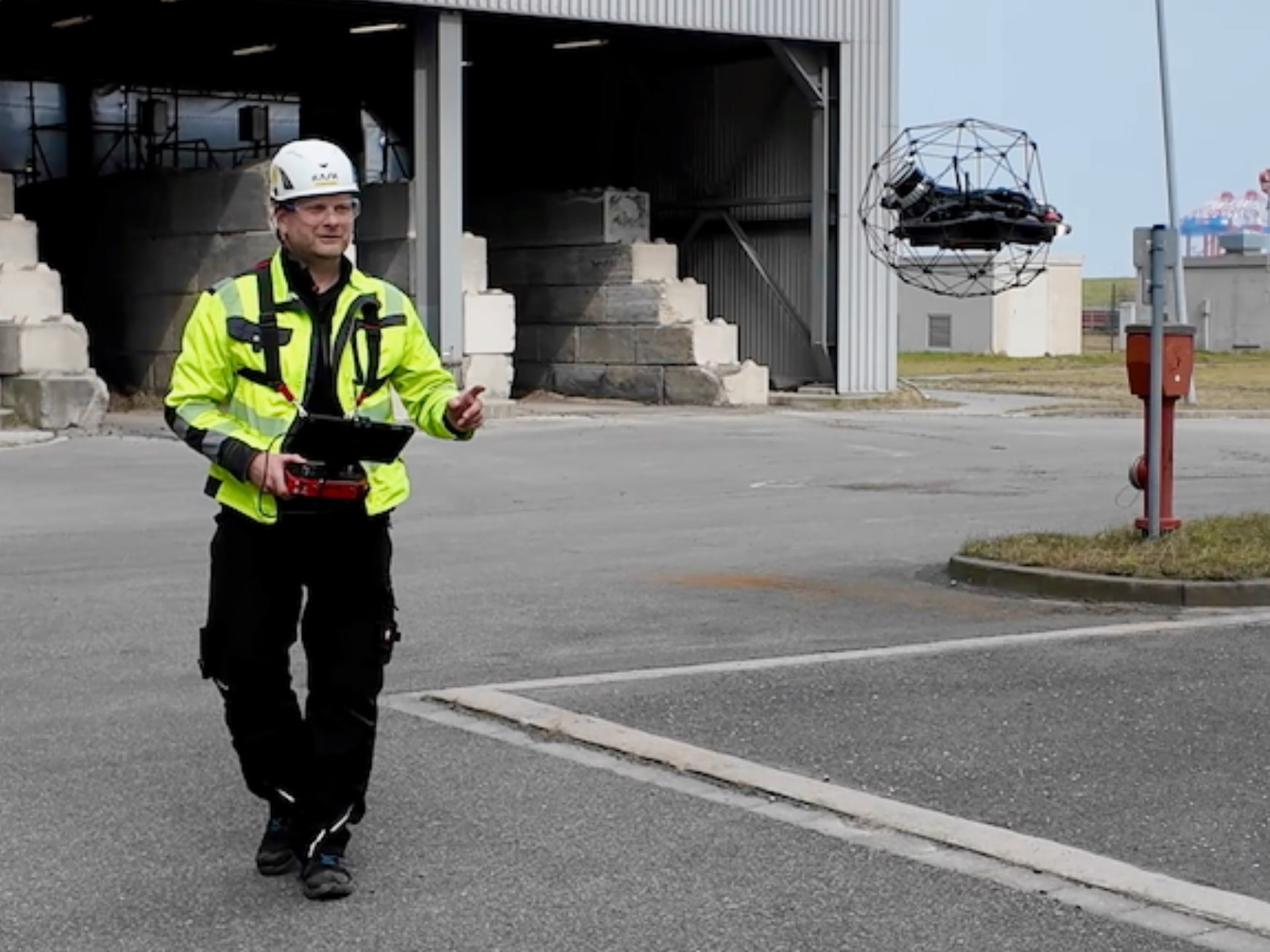 Christian Engelke
Founder & Drone Pilot
Christian Engelke
Founder & Drone PilotConfined Spaces since 2017
 Karsten Lehrke
Project Manager
Karsten Lehrke
Project ManagerDipl.-Ing. Mechanical Engineering
 Philipp
Drone Pilot
Philipp
Drone PilotIndustrial Inspection
 Max
Inspection Specialist
Max
Inspection SpecialistData Analysis
 Benjamin
Drone Pilot
Benjamin
Drone PilotField Operations
Related Services
- Industrial Drone Inspection – Comprehensive inspection for all industrial sectors
- Boiler Inspection – Water tube boilers and steam generators by drone
- Chimney Inspection – Internal chimney inspection without scaffolding
- Flyability ELIOS 3 – The collision-safe indoor drone with thermal camera payload
- Power Plant Inspection – Drone inspection for power plants and turbines
- Confined Spaces Inspection – Safe inspection without human entry
- Thermal Camera & Drone Guide – Complete practical guide for industrial thermography
- Visual Testing (VT) by Drone – Indirect VT to ISO 17637
Frequently Asked Questions
Does thermography cost extra?
It depends on the inspection scope. In many cases the thermal camera can be deployed as an additional payload during the same flight – the additional effort lies primarily in evaluation. We clarify this on a project-specific basis.
Can the ELIOS 3 reliably detect CUI?
The ELIOS 3 can detect temperature anomalies indicating CUI (wet insulation, thermal bridges). A definitive CUI diagnosis often requires supplementary measures (e.g. opening insulation at suspect locations). The drone localises the suspect areas – this drastically reduces the effort of targeted follow-up inspections.
How accurate are the temperature measurements?
The radiometric camera has a sensitivity of <50 mK (NETD) and measures in the range −10°C to +400°C. Absolute accuracy depends on the emissivity of the surface and correct calibration – for industrial finding assessment (hotspot yes/no, temperature comparison) the accuracy is sufficient.
What is the difference between radiometric and non-radiometric thermal imaging?
A non-radiometric thermal camera delivers only a visual colour image showing relative temperature differences. A radiometric camera stores the absolute temperature value for every single pixel – enabling later software analysis, temperature comparisons between inspections and quantitative assessment. The ELIOS 3 uses a radiometric camera.
Can thermography replace ultrasound wall thickness measurement?
No. Thermography detects thermal anomalies indicating wall thinning or CUI – but cannot measure the actual remaining wall thickness. For that, ultrasound testing (UT) is always required. The typical workflow: drone thermography localises suspect areas, UT inspector measures precisely at those specific points.
Contact Us
We will advise whether thermography is worthwhile for your inspection – and deliver results, not just images.
Inspectomatic GmbH
Im Hollergrund 175A, 28357 Bremen, Germany
+49 421 408 937-0 ·
[email protected]
Source page: /en/knowledge-base/thermografie-industrieinspektion