
Thermal Camera & Drone – Thermography Guide for Industrial Facilities
How thermography with drones works, typical findings in industrial facilities and the limits of the method – a complete practical guide. Covers both the Flyability ELIOS 3 (internal deployment) and the DJI Matrice 30T (external inspection).
- Passive thermography – the plant itself is the heat source; no external heating required
- Two systems: ELIOS 3 for internal deployment, DJI M30T for external inspection
- Normative basis: DIN EN 13187, ISO 18434-1, DIN EN ISO 9712 (TT Level)
- Radiometric – absolute temperature values, not just colour images
Fundamentals: How Drone Thermography Works
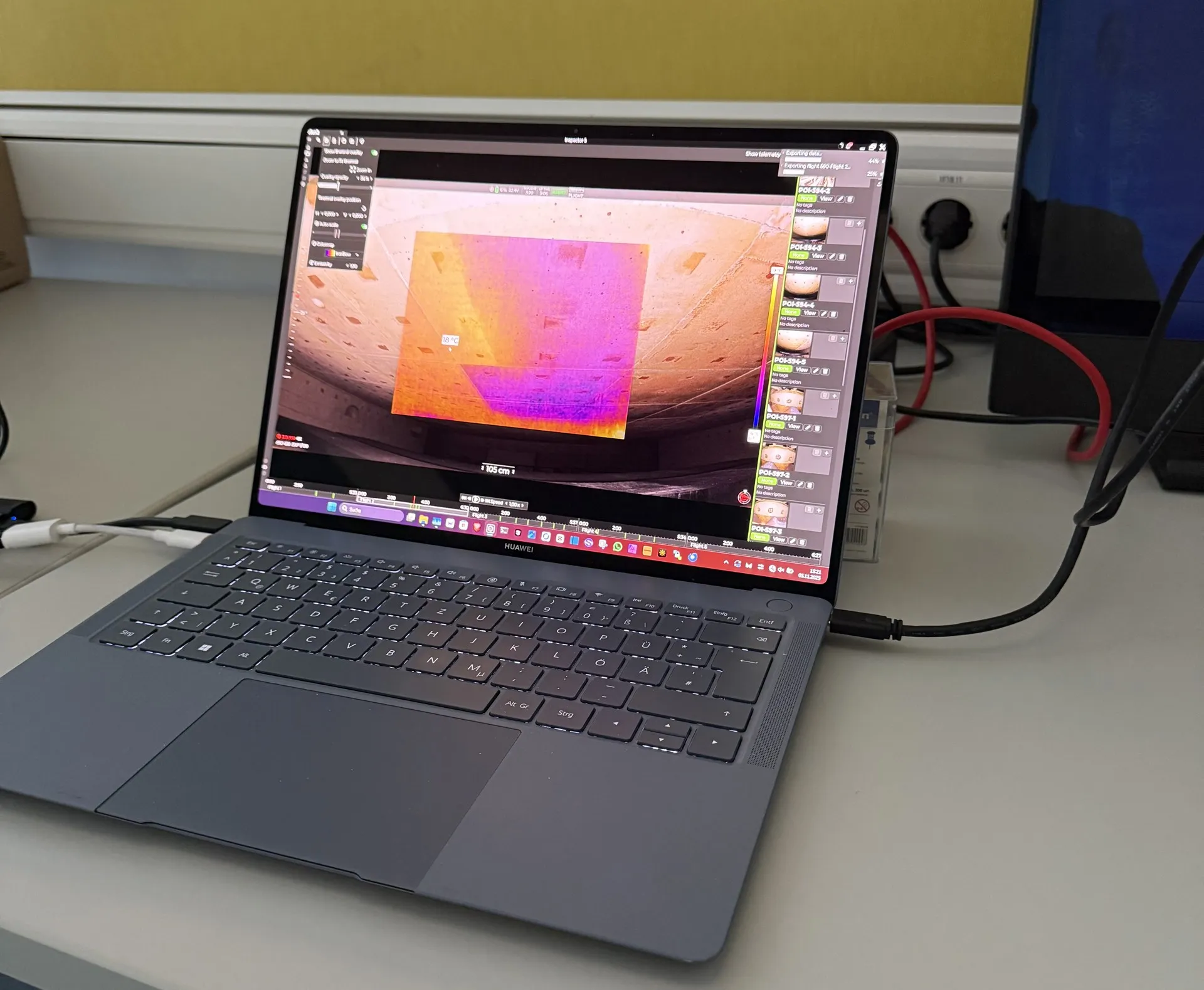
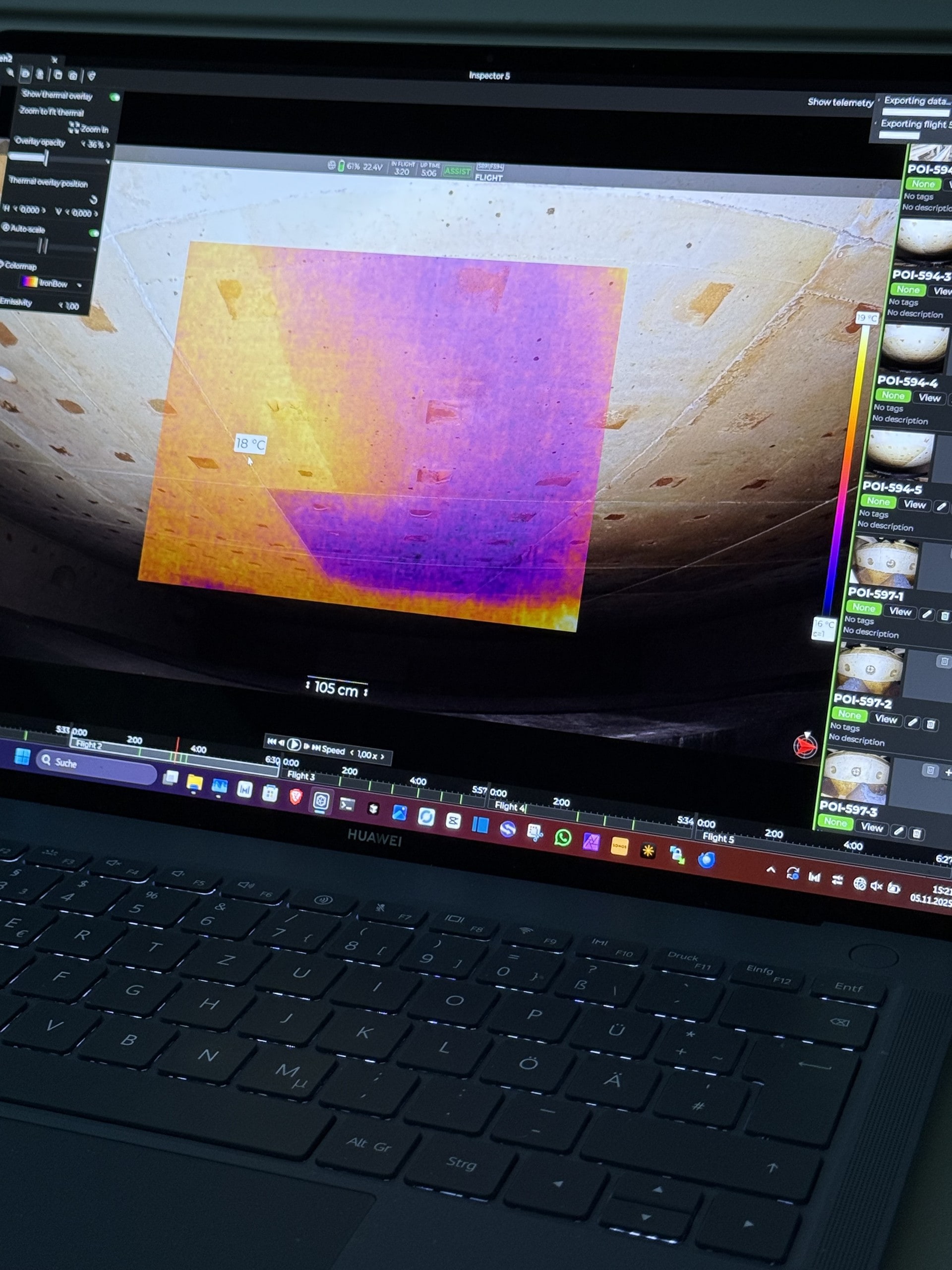
Infrared thermography (German: Infrarot-Thermografie) is a non-destructive testing method that makes temperature differences on surfaces visible. Every object above absolute zero emits thermal radiation (infrared radiation). A thermal camera (infrared camera) receives this radiation and converts it into a visible thermal image – warm areas appear bright or red, cool areas dark or blue.
For industrial inspections, thermography is particularly valuable because many damage types reveal themselves through temperature differentials relative to the environment, before they become visually apparent. Drones with thermal cameras can systematically, comprehensively and safely capture these temperature differentials.
Two Primary Systems at Kopterflug

Integrated FLIR camera with 640×512 px resolution, radiometric temperature measurement (±2°C), measurement range −40°C to +550°C. Plus 200× hybrid zoom camera for simultaneous visual documentation. Ideal for external inspections of pipelines, building envelopes, transformers, overhead lines.
Compatible with FLIR Lepton modules. For indoor thermography in boilers, furnaces, reactors – detects hotspots in refractory lining (Ausmauerung), thermal anomalies at internals. More limited resolution and measurement range than the Matrice 30T.
Passive vs. Active Thermography
For industrial inspections with drones, almost exclusively passive thermography is used: the plant itself is the heat source. Temperature differences arise from operating conditions (hot process fluids, combustion processes) and are passively detected. Active thermography (requiring an external heat source) is not practical for drone deployments.
The ideal temperature differential for passive thermography is at least 10 K between object and environment. For process plants at 200–400°C operating temperature, the differential is more than sufficient. For room-temperature objects (e.g. static storage tanks not in operation), passive thermography is only limitedly applicable.
Typical Findings: What Thermography Makes Visible in Industrial Facilities
The application areas of industrial drone thermography are diverse. The following finding types are particularly relevant in practice:
Hotspots in Electrical Systems
Electrical connections, circuit breakers, transformers and overhead lines show elevated surface temperatures when overloaded or when contact quality is poor. The DJI Matrice 30T detects these hotspots from 30–100 m distance without approaching live components – a decisive safety advantage over manual inspection:
- Poor electrical connections (elevated contact resistance)
- Transformer overload or cooling circuit faults
- Hotspots on power cables and cable joints
- Overheated fuse boxes and switchgear (external inspection)
Insulation Damage and Heat Loss
Damaged or missing thermal insulation on pipelines, vessels and industrial furnaces causes elevated surface temperatures that the Matrice 30T makes visible from the air:
- Gaps in pipeline insulation (flange areas, supports, penetrations)
- Wet insulation (significantly worse insulating effect than dry – visible as a cold patch on hot processes)
- Damaged or lost insulation blankets on combustion chambers and furnaces
- Heat losses on building envelopes (industrial halls with inadequate insulation)
CUI Detection (Corrosion Under Insulation)
As described in the corrosion article: wet insulation has a different thermal conductivity than dry. On pipelines with hot media (>80°C), wet insulation spots are recognisable as cool patches in the thermal image. These CUI suspect zones indicate where insulation should be removed and UT wall thickness measurement carried out. German: Korrosion unter Isolierung (CUI).
Refractory Damage in Boilers and Furnaces (ELIOS 3)
Thin or damaged refractory lining (Feuerfestauskleidung) lets more heat through the wall – recognisable as a hotspot on the external wall. Conversely, deposits of slag or ash on the internal surface show altered temperature patterns. The ELIOS 3 with thermography documents these findings directly at the internal surface.
Evaluation of Thermal Images: Method and Interpretation
Correctly evaluating thermal images requires expertise – a pure colour spectrum image without interpretation is worthless. The following factors must be considered during evaluation:
Emissivity (Emissionsgrad)
The biggest source of error in thermography: every material has a specific emissivity (ε) between 0 (perfect mirror) and 1 (black body). Polished metals have ε ≈ 0.05–0.1, oxidised steel surfaces ε ≈ 0.7–0.9, painted surfaces ε ≈ 0.85–0.95. If the wrong emissivity is set in the camera, the measured temperatures are incorrect. For radiometric measurements with the DJI Matrice 30T, the emissivity of the target surface must be known or estimated.
Reflections and Ambient Temperature
Reflective surfaces (polished stainless steel, aluminium cladding) mirror the thermal radiation of the environment – the thermal image shows not the surface's own temperature but a reflection of the surroundings. Inspections should therefore preferably be conducted at early dusk (low solar radiation) or under overcast sky.
Minimum Temperature Differential and Detectability
The sensitivity of a FLIR camera (NETD: Noise Equivalent Temperature Difference) is typically 0.05–0.1°C. In practice, anomalies from approx. 2–3°C temperature differential are reliably detectable and distinguishable from background noise. Smaller differentials require frame averaging.
Normative Basis: DIN EN 13187 and ISO 18434
Thermography inspection is normatively governed by DIN EN 13187 (thermal protection in buildings) and ISO 18434-1 (condition monitoring and diagnostics of machines – thermography). For inspection personnel, DIN EN ISO 9712 applies with Grade TT Level 1–3 (thermographic testing). Kopterflug works with TT-qualified evaluation specialists and ensures standard-compliant reporting.
Limits of Drone Thermography: What It Cannot Do
Thermography is a powerful tool – but it has inherent limits that must be considered in task planning:
No Quantitative Wall Thickness Measurement
Thermography cannot measure wall thickness. It identifies thermal anomalies indicating damage – but for quantitative assessment (how thick is the wall now?) ultrasound wall thickness measurement (UT) is always required.
Limited Effectiveness on Static Plant
Passive thermography requires a temperature differential. On shutdown, unflushed plant without operational heat, insulation damage and internal structural defects are not detectable. Thermography is an operational inspection method – ideal deployment is during running plant or shortly after shutdown.
Surface-Near Defects Preferred
Thermography preferentially detects near-surface damage. Deep internal defects (e.g. deep cracks in thick walls) cause too little thermal gradient to be reliably detected. For deep defects, other NDT methods (UT, RT) are more suitable.
Weather Conditions Affect Results
Direct sunlight on inspected surfaces causes solar heating that can be confused with operational temperature anomalies. Inspections should preferably be conducted in early morning, evening or under overcast sky – particularly for building envelopes and pipeline networks.
When Thermography is Indispensable
Despite the limits, the combination of drone and thermal camera is the first choice for: CUI screening of large pipeline networks, hotspot detection at electrical systems, insulation damage mapping, refractory monitoring in furnaces and boilers, and moisture detection in building structures.
Your Contacts at Kopterflug
Contact us to find out whether thermography is the right tool for your specific inspection problem.
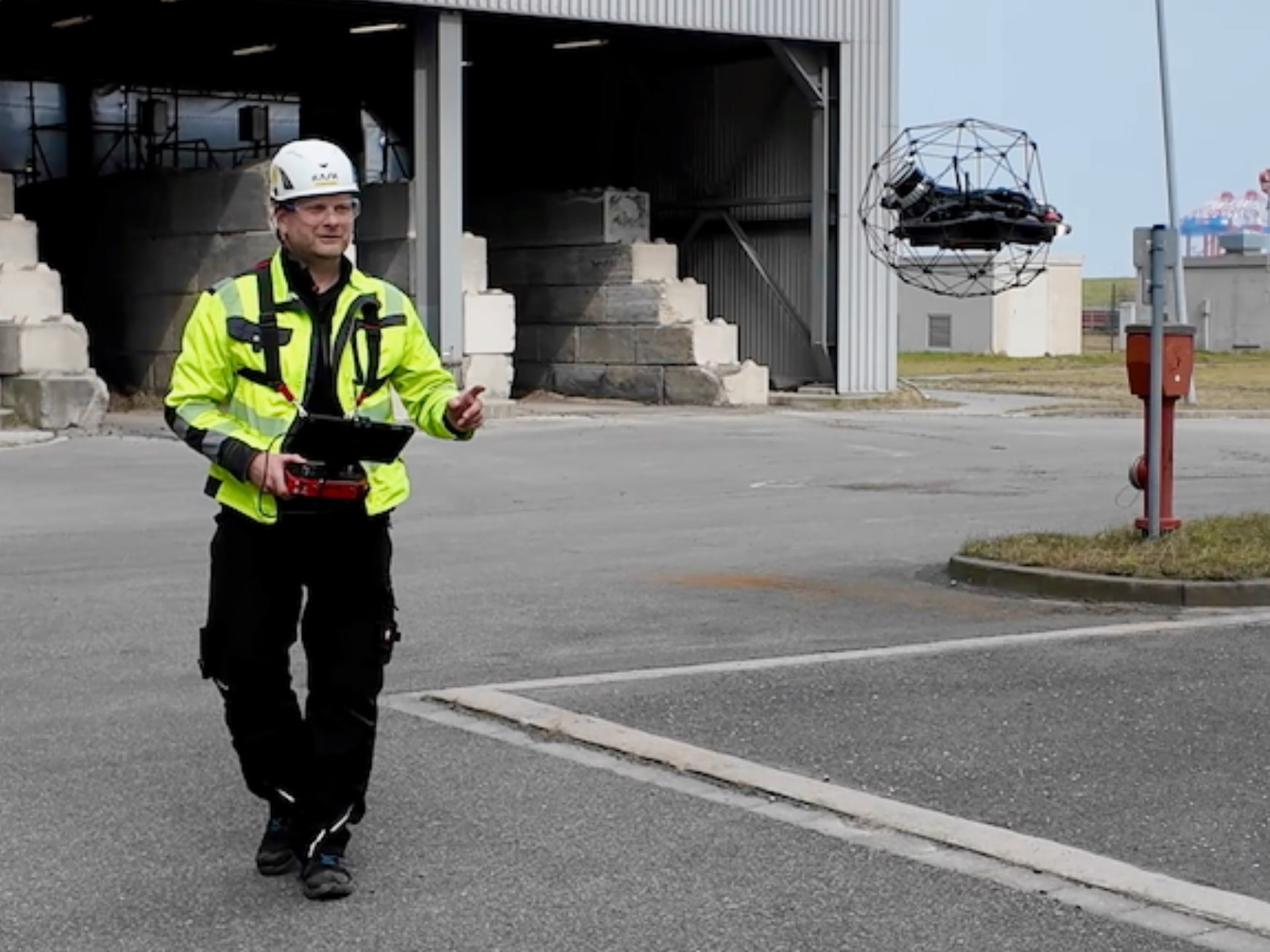 Christian Engelke
Founder & Drone Pilot
Christian Engelke
Founder & Drone PilotConfined Spaces since 2017
 Karsten Lehrke
Project Manager
Karsten Lehrke
Project ManagerDipl.-Ing. Mechanical Engineering
 Philipp
Drone Pilot
Philipp
Drone PilotIndustrial Inspection
 Max
Inspection Specialist
Max
Inspection SpecialistData Analysis
 Benjamin
Drone Pilot
Benjamin
Drone PilotField Operations
Related Services
- Thermography in Industrial Inspection – Application areas and benefits
- Visual Testing (VT) by Drone – Indirect VT to ISO 17637
- Boiler Inspection – Water tube boilers and steam generators by drone
- Power Plant Inspection – Drone inspection for power plants
- Chemical Industry Inspection – Drone inspection for chemical plants
- Pipe Rack Inspection – Drone inspection of pipeline bridges, internal and external
Frequently Asked Questions
What is the difference between radiometric and non-radiometric thermal imaging?
A non-radiometric camera delivers only a visual colour image showing relative temperature differences. A radiometric camera stores the absolute temperature value for every pixel – enabling software analysis, temperature comparisons between inspection cycles, and quantitative assessment. Both the ELIOS 3 thermal payload and the DJI Matrice 30T are radiometric.
What is emissivity and why does it matter for thermography?
Emissivity (ε, German: Emissionsgrad) is a material property describing how efficiently a surface emits thermal radiation compared to a perfect black body (ε = 1). Polished metal has ε ≈ 0.05; painted steel ε ≈ 0.9. Setting the wrong emissivity value in the camera results in incorrect absolute temperature readings. For qualitative finding detection (anomaly yes/no) this is less critical; for quantitative temperature measurements it is essential.
Can thermography detect CUI reliably?
Thermography can detect thermal anomalies that indicate CUI (wet insulation showing different thermal profile). It is a very effective screening method to prioritise which sections of insulated pipeline require physical inspection (insulation removal + UT measurement). For a definitive CUI diagnosis, insulation removal and direct wall inspection are required.
What temperature range can the ELIOS 3 thermal camera measure?
The ELIOS 3 thermal payload measures from −10°C to +400°C with a sensitivity of <50 mK (NETD). The DJI Matrice 30T measures from −40°C to +550°C (±2°C accuracy). For process plants with operating temperatures above 400°C, external inspection with the M30T is recommended; internal inspection with the ELIOS 3 is limited to equipment below 50°C ambient temperature.
What are the normative requirements for thermography inspection personnel?
DIN EN ISO 9712 defines three qualification levels for thermographic testing (TT): Level 1 (execution under supervision), Level 2 (independent inspection and evaluation), Level 3 (method specification and training). Kopterflug works with TT Level 2/3 qualified evaluation specialists. ISO 18434-1 governs the application of thermography for condition monitoring of machines.
Under what weather conditions should thermography inspections be conducted?
For external inspections: ideally on overcast days or in early morning/evening to avoid solar heating distorting results. Rain and high humidity can also influence results. For internal inspections with the ELIOS 3 (inside tanks, boilers), weather conditions are irrelevant – the controlled internal environment is consistent regardless of outside conditions.
Contact Us
Whether CUI, refractory hotspots or heat losses on pipelines – we assess free of charge how thermography drone inspection can cover your facility.
Inspectomatic GmbH
Im Hollergrund 175A, 28357 Bremen, Germany
+49 421 408 937-0 ·
[email protected]
Source page: /en/knowledge-base/waermebildkamera-drohne-thermografie-guide