
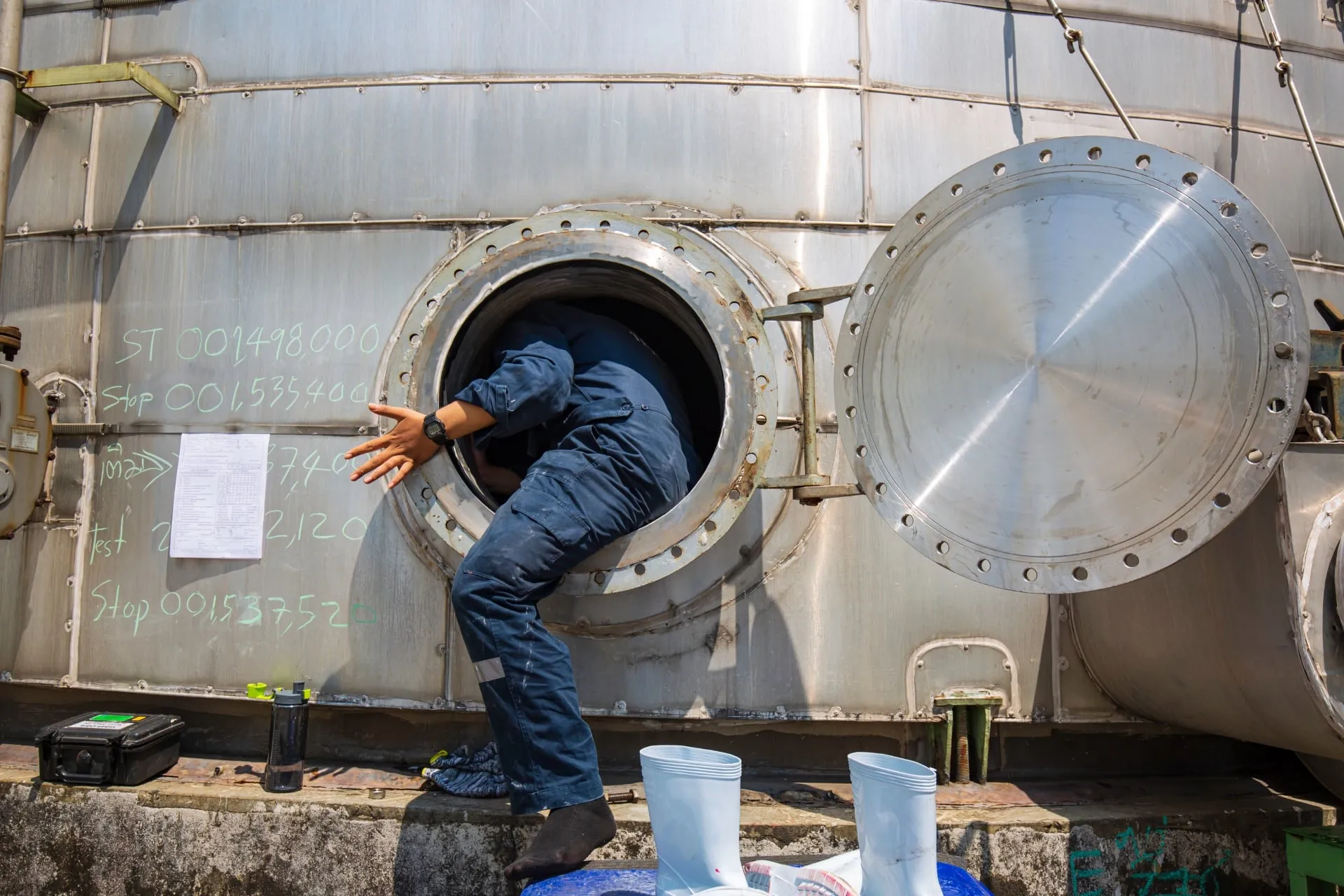
20 Hazards in Confined Spaces – and How Drones Defuse Them
Working in confined spaces is extremely dangerous. The Flyability ELIOS 3 radically reduces these risks: no human entry, no rescue chain, no exposure to atmospheric, physical or biological hazards. Since 2017, we have been making dangerous confined space entry redundant.
- 20 hazards – one solution: zero human entry
- DGUV 113-004 (Deutsche Gesetzliche Unfallversicherung: German statutory accident insurance regulation for confined spaces) – relevant entry measures can often be avoided
- Atmospheric, physical, chemical, biological hazards all addressed
The 20 Greatest Hazards when Working in Confined Spaces
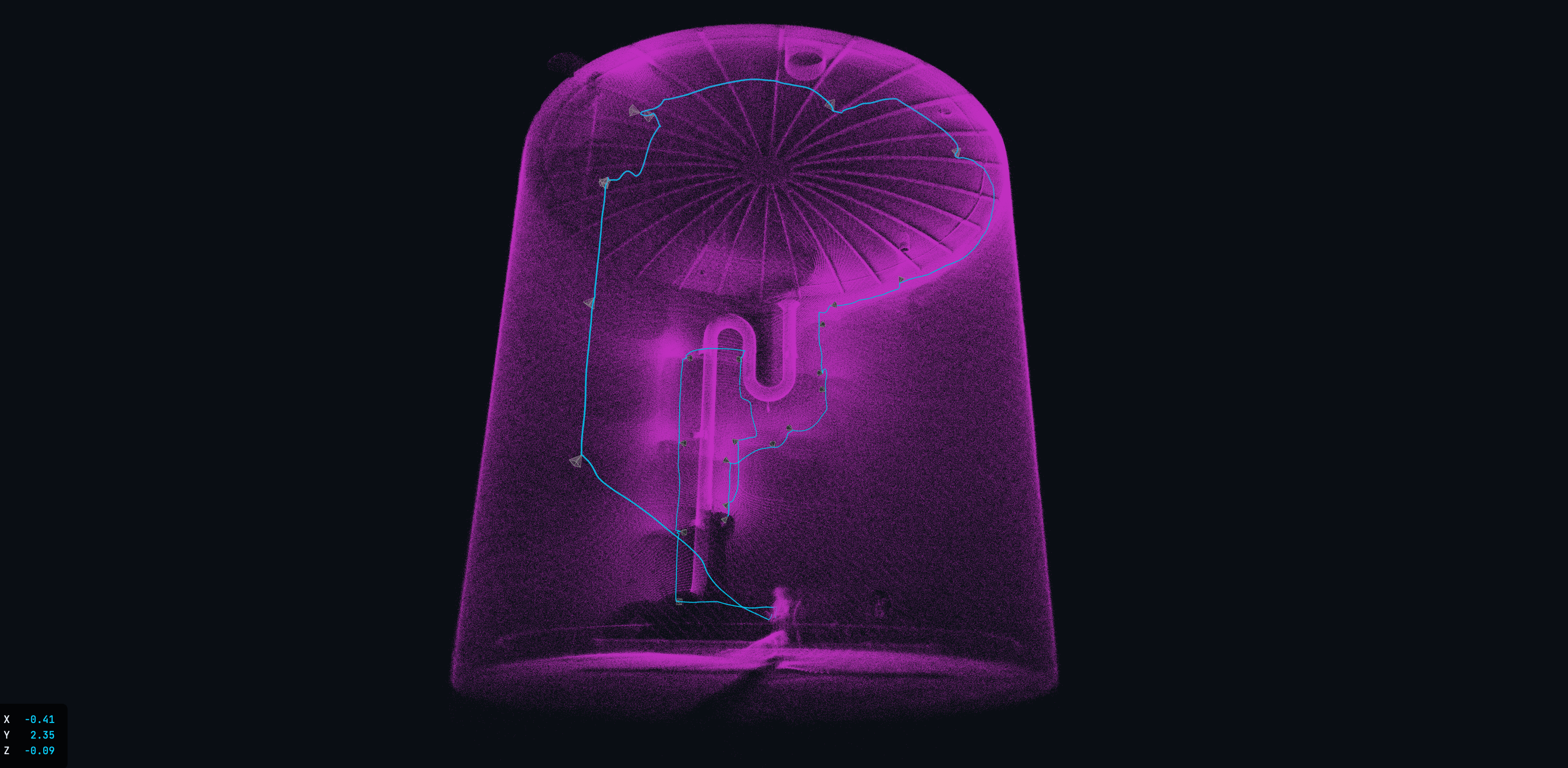
LiDAR 3D scan of a cold condensate tank – inspected with the Flyability ELIOS 3 without human entry.
Confined spaces (enge Räume or Confined Spaces) are difficult to access, poorly ventilated and harbour unpredictable hazards. A thorough hazard assessment (Gefährdungsbeurteilung) is essential before any person enters these environments.
Our expertise since 2017: Hundreds of inspections in tanks, boilers, reactors and shafts have shown us: the ELIOS 3 makes many dangerous confined space entries unnecessary. All 20 hazards listed below are either eliminated or massively reduced when the drone inspects instead of a person.




Atmospheric Hazards (1–5)
1. Oxygen Deficiency
O₂ below 19.5% → respiratory distress, dizziness, asphyxiation. Below 16% loss of consciousness without warning. The ELIOS 3 requires no oxygen – it flies even in O₂-free atmospheres.
- Causes: Displacement by gases, oxidation processes, inadequate ventilation
- Drone solution: Drone flies even in O₂-free atmosphere
2. Oxygen Excess
O₂ above 20.9% → increased ignition risk. Even normally non-flammable materials catch fire. The ELIOS 3 is spark-protected.
- Causes: O₂ cylinder leaks, faulty ventilation, welding equipment
- Drone solution: No ignition sources from drone
3. Toxic Gases
H₂S, CO, methane, CO₂ – often invisible and odourlessly lethal. The ELIOS 3 is unaffected; optionally equipped with a flammable gas sensor (LEL: Lower Explosive Limit).
- Particularly dangerous: H₂S (lethal from 100 ppm), CO (odourless), CH₄ (explosive)
- Drone solution: No human exposure; optional LEL sensor for real-time gas monitoring
4. Explosion Hazard
Gases between LEL and UEL (Upper Explosive Limit) + ignition source = explosion. The ELIOS 3 minimises ignition sources: no tools, no sparks. The collision-safe cage prevents sparks from wall contact.
5. Dust Explosion & Toxic Dust
Combustible dusts (metal, grain, coal) are explosive; asbestos and quartz dust are carcinogenic. The ELIOS 3 creates minimal turbulence and is spark-protected – no agitation by persons.
Physical Hazards (6–12)
6. Burial by Bulk Material
Bridge formation, subsequent sliding, suction effect – burial in silos is often fatal. The ELIOS 3 inspects without human entry. No burial risk whatsoever.
7. Mechanical Hazards
Rotating mixers, conveyors, agitators – accidental activation can be fatal. The drone inspects when systems are safely locked out (LOTO: Lock-Out Tag-Out).
8. Fall Hazard
Tank roofs (10–30 m), shafts (up to 100 m depth) – even a 2–3 m fall onto hard surfaces can be fatal. The ELIOS 3 flies instead of climbs. Inspection team stays on the ground.
9. Electrical Hazards
Humid, conductive metal walls massively increase electric shock risk. The ELIOS 3 operates on low voltage (battery), no 230V cables required. 16,000 lumen LED illumination without mains power.
10. Extreme Temperatures
Residual boiler heat 100–300°C, cryogenic tanks -196°C. The ELIOS 3 operates from -10 to +50°C, optionally with thermography. The drone feels no heat or cold.
11. Falling Objects
A 300g tool from 20 m = 60 joules impact (skull fracture from 80 J). No evading in confined spaces. With the drone: no tools, no risk. No humans below the drone.
12. Noise & Vibrations
Hall effects amplify sounds by 10–20 dB, welding reaches 120 dB. The ELIOS 3: approximately 65 dB (conversation level). Inspections without hearing damage to personnel.
Access & Rescue Risks (13–15)
13. Missing Rescue Options
Openings 40–60 cm, rescue from 20+ m depth takes 30–60 minutes. If nobody enters, nobody needs to be rescued. No rescue chain (Rettungskette) required.
14. Narrow Access Openings
Manholes (Mannlöcher) 400–600 mm, person with PPE needs 700–900 mm. The ELIOS 3 fits through openings from 50 × 50 cm – where humans barely fit.
15. Inadequate Lighting
Tanks and boilers are completely dark; 230V lighting in conductive environments is dangerous. The ELIOS 3: 16,000 lumen LED, 360° illumination. Its own light – everywhere.
Chemical, Biological & Psychological Hazards (16–20)
16. Chemical Reactions
Acids + metals = hydrogen (explosive), residues + cleaner = toxic fumes. The ELIOS 3 inspects BEFORE cleaning without chemical contact. Inspection before cleaning decision.
17. Biological Hazards
Legionella, mould, bacteria in humid tanks and sewage plants. The ELIOS 3 has no immune system – biological hazards are irrelevant. IP44-protected and decontaminable.
18. Slip & Trip Hazards
Sludge, oil, biofilms on tank floors – falls onto metal with contact to hot or cold surfaces. The ELIOS 3 flies – it doesn't slip. No ground contact required.
19. Inadequate Atmosphere Monitoring
Atmosphere can change suddenly. The ELIOS 3 with optional LEL sensor detects flammable gases BEFORE human entry. Measure first, then decide.
20. Psychological Hazards
Claustrophobia (5–7% of the population), isolation, darkness, time pressure. Operators stay outside in a safe environment. The drone has no fear.
Summary: All 20 Hazards Eliminated through Zero Human Entry
| Hazard Category | Drone Solution | Result |
|---|---|---|
| Atmospheric (1–5) | Drone requires no oxygen, is spark-protected, optional gas sensor | No atmospheric exposure for personnel |
| Physical (6–12) | Drone flies, LOTO for machinery, 16,000 lumen LED, battery power | No fall, burial, electrical or thermal risk |
| Access & Rescue (13–15) | Fits from 50×50 cm, no rescue chain needed | No rescue chain, no rescue personnel required |
| Chemical (16) | Inspects before cleaning decision, no chemical contact | No reactive exposure |
| Biological (17) | IP44, decontaminable, no immune system vulnerable | No infection risk |
| Physical/Ergonomic (18–19) | Flies, does not walk; gas monitoring before entry | No slip/trip, gas situation clarified first |
| Psychological (20) | Operators outside in safe environment | No claustrophobia, no psychological stress |
Your Contacts

Related Services
- Confined Spaces Inspection – The primary ELIOS 3 use case: tanks, boilers, silos and shafts without human entry.
- Flyability ELIOS 3 – The collision-safe indoor inspection drone for confined spaces.
- Tank Inspection – Safe inspection of storage tanks and pressure vessels.
- Boiler Inspection – Steam boilers without DGUV confined space entry.
- Silo Inspection – Liner damage, buildup and volume measurement without entry.
- Industrial Drone Inspection – Overview of all inspection services.
Frequently Asked Questions
What are Confined Spaces?
Confined spaces (enge Räume or Confined Spaces) are restricted spaces with difficult access and egress, unsuitable for permanent occupation by persons. Typical examples: tanks and pressure vessels, silos and bunkers, sewage systems and shafts, boilers and heat exchangers, reactors and columns, tunnels and pipelines. In Germany, work in confined spaces is regulated by DGUV 113-004 (Deutsche Gesetzliche Unfallversicherung).
Why are inspections in confined spaces particularly dangerous?
The 20 hazards described in this article make confined spaces among the most dangerous working environments of all: oxygen deficiency or excess, toxic and explosive gases, mechanical and thermal hazards, narrow access points with difficult rescue options, biological contamination and psychological stress. Statistics show that many confined space accidents are fatal – and many victims are rescuers, not the original workers.
How can drones help with confined space inspections?
Drones like the Flyability ELIOS 3 eliminate most risks: no human entry required (no exposure to all 20 hazards), high-resolution 4K footage for visual inspection, LiDAR-3D for geometry and deformation analysis, optional thermography for hidden damage, GPS-independent navigation even in total darkness, collision-safe cage for wall contact without crash.
Which drone types are best suited for confined space inspections?
The Flyability ELIOS 3 was specifically developed for confined spaces: compact enough for openings from 50 × 50 cm (standard manholes), collision-protected through carbon protective cage (can touch walls without crashing), GPS-independent LiDAR-SLAM navigation, IP44 protection against dust and splash water, and 16,000 lumen LED for total darkness.
What sensors are necessary for drone deployments in confined spaces?
Standard sensors of the ELIOS 3: 4K camera for visual inspection (VT), LiDAR for 3D measurement and navigation, 16,000 lumen LED illumination, distance sensors for collision avoidance. Optional sensors: thermography (hotspots, moisture, CUI), flammable gas sensor (LEL), radiation measurement (nuclear facilities), UT payload for wall thickness measurement.
What are the typical limits of drone deployment in confined spaces?
Technical limits: minimum access opening 50 × 50 cm required (for ELIOS 3), limited flight time per battery (battery change in seconds possible), strongly magnetic environments may affect navigation. Inspection limits: visual inspection only detects surface findings; no substitute for NDT methods (UT, MT, PT) for sub-surface defects; no replacement for certified inspectors' assessment.
What safety preparations are needed before drone deployment in confined spaces?
Reduced but necessary preparation: hazard assessment (also for drone deployment), clarification of explosion protection zone (ATEX), release by plant operator, ensuring no residual media that could damage the drone, and brief safety briefing. What is NOT required: full DGUV 113-004 confined space entry protocol, rescue chain, breathing protection, safety standby person inside.
What must be observed during a drone deployment?
Operational aspects: experienced ELIOS 3 operator (manufacturer certification), systematic flight planning (complete area coverage), communication with plant operator (plant knowledge), live monitoring of drone data, systematic documentation of all findings with positional reference, and immediate communication of critical findings.
What legal requirements apply to drone deployments in confined spaces?
Important: EU drone regulations only apply to outdoor flights. Indoor inspections with the ELIOS 3 require no operating permit and no drone pilot licence. Occupational safety: hazard assessment necessary, plant-specific safety instructions apply. ATEX: not applicable if the area has been gas-free measured. We work according to your plant standards.
What advantages do drone deployments in confined spaces offer compared to conventional inspection methods?
Summary of all advantages: Safety: all 20 hazards eliminated, no personnel risk. Time: hours instead of days (no complex preparation). Cost: 60–80% cheaper (no PPE, scaffolding, safety chains). Data quality: 4K video, LiDAR-3D, optional thermography – more data than any person could capture. Repeatability: documented flight paths for comparable follow-up inspections.
Get in Touch
Do you need confined space inspections without human entry? Fill out the form below – we'll get back to you within 24 hours.