
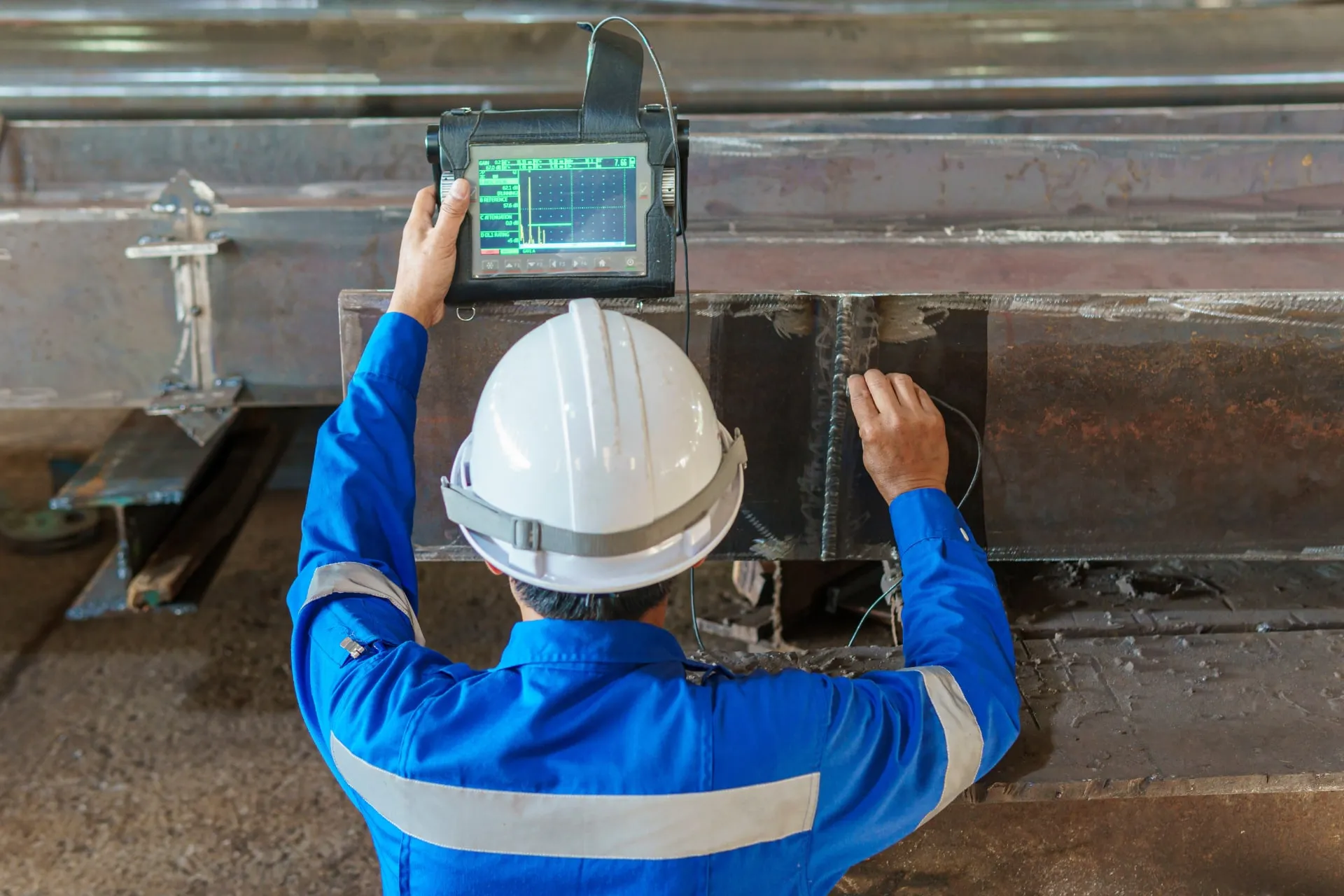
The 8 Methods of Non-Destructive Testing (NDT / ZfP) – A Comprehensive Overview
VT, UT, RT, MT, PT, ET, AE and Thermography – modern NDT methods for safe industrial plants. The Flyability ELIOS 3 extends NDT with drone-assisted visual inspection and thermography in confined spaces, without human entry.
- All 8 NDT methods explained with practical applications
- 3 methods directly drone-compatible – VT, UT payload and thermography with ELIOS 3
- Experience since 2017 – hundreds of plants inspected across Germany
What is Non-Destructive Testing (NDT / ZfP)?
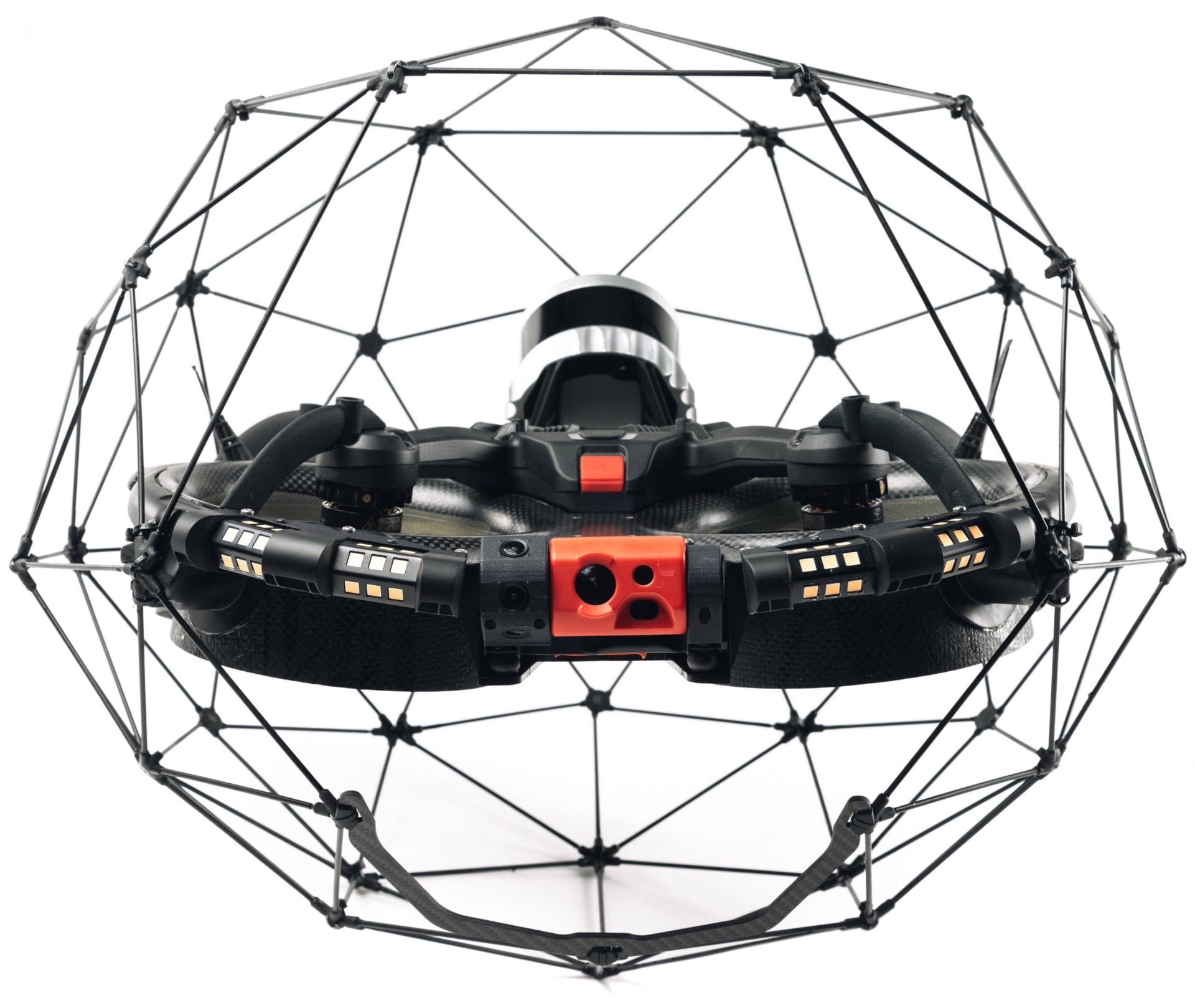
The Flyability ELIOS 3 – extends NDT with drone-assisted visual inspection and thermography in confined spaces.
NDT methods (in German: Zerstörungsfreie Prüfung, ZfP) examine materials and components for defects without damaging their structure. In safety-critical industries – aerospace, construction, oil & gas, energy generation – NDT is indispensable for the integrity and longevity of plants.
The Flyability ELIOS 3 expands NDT by adding drone-based visual inspection (VT) and thermography in confined spaces – without human entry. The DJI M30T complements with 200x zoom and infrared for external inspections.






The 8 NDT Methods at a Glance
From visual testing to thermography – each method has specific strengths and application areas.
1. Visual Testing (VT) – The Foundation of All NDT
The most fundamental NDT method: detection of visible surface defects such as cracks, corrosion and deformation. With drones massively enhanced – the ELIOS 3 brings a 4K camera and 16,000-lumen LED into confined spaces, the DJI M30T provides 200x zoom for external inspections.
Applications:
- Welds, concrete and steel structures
- Tanks, boilers, reactors (ELIOS 3)
- Pipe bridges, chimneys, facades (M30T)
- Surface cracks from approx. 0.5 mm detectable
Qualification levels VT1–VT3 (per DIN EN ISO 9712): VT1 (Level 1) carries out inspections under instruction; VT2 (Level 2) independently conducts and evaluates inspections; VT3 (Level 3) develops inspection programmes and certifies other inspectors.
In drone inspections, the drone pilot conducts the image capture – he does not necessarily need VT qualification. Finding assessment requires VT2/VT3 qualification. In practice Kopterflug has both certified pilots and NDT-qualified personnel in the team who conduct the evaluation.
Direct vs. indirect inspection with drone: DIN EN 13018 distinguishes between direct visual inspection (inspector has direct visual contact with the surface) and indirect visual inspection (using optical aids such as endoscopes, mirrors – or drone video systems). Drone inspection is classified as indirect visual inspection in current professional practice.
2. Ultrasonic Testing (UT) – Looking Inside the Material
High-frequency sound waves penetrate the material and reflect at defects. Detects cracks, voids and wall thickness changes in the interior – particularly important for thick-walled pressure vessels and pipelines. The UT payload of the ELIOS 3 enables wall thickness measurements without human entry.
Applications:
- Welds, pipes and pressure vessels
- Wall thickness measurement for corrosion monitoring (CUI)
- Defect sizing and depth determination
Drone compatibility: The ELIOS 3 UT payload makes contact with the inner wall and measures wall thickness. This enables precision measurements in confined spaces without human entry – a significant advantage for BetrSichV (German Industrial Safety Regulation) inspections.
3. Radiographic Testing (RT) – X-Ray for Industrial Plants
Radiographic testing uses electromagnetic radiation (X-rays or gamma rays) to image the internal structure of materials. Similar to medical X-rays, radiation is sent through the material and a film or digital detector records differences in absorption – revealing volumetric flaws, porosity and inclusions.
Applications:
- Weld seam internal inspection (volumetric)
- Cast parts and complex geometries
- Piping and pressure vessel inspections per EN 1435
Drone compatibility: RT is currently not drone-compatible due to radiation safety requirements. RT is used in combination with drone-based VT: the drone identifies the suspicious areas, RT then provides volumetric confirmation.
4. Eddy Current Testing (ET) – Electromagnetic Defect Detection
Eddy current testing is an electromagnetic method used to detect surface and near-surface defects in electrically conductive materials. An alternating magnetic field induces eddy currents in the component; defects disrupt the eddy current field and are measured.
Strengths:
- Very fast scanning of large areas
- No coupling medium required (unlike UT)
- Works through thin coatings
- Heat exchanger tube inspection
Drone compatibility: Currently limited – requires direct surface contact. Research into drone-assisted ET probes is ongoing; not yet in routine use.
5. Magnetic Particle Testing (MT) – Making Cracks Visible through Magnetism
Magnetic particle testing is used to detect surface and near-surface defects in ferromagnetic materials. A magnetic field is induced in the material; defects disrupt the field and create leakage flux that attracts fine magnetic particles – making the defect visible.
Applications:
- Weld seam testing in steel construction
- Crankshafts, axles, pressure vessels
- Forgings and castings
In hybrid inspection: MT is used at specific points identified by drone-VT as suspicious – instead of full-area testing. This significantly reduces scaffolding and preparation effort.
6. Penetrant Testing (PT) – Dyes Reveal Cracks
Penetrant testing is used to detect surface-open defects. A liquid penetrant is applied to the material that penetrates cracks and pores by capillary action. After a cleaning phase, a developer is applied that draws the penetrant out of defects – making them visible as coloured indications.
Strengths:
- Works on all non-porous materials (steel, aluminium, titanium, ceramics)
- Very sensitive: cracks from 0.1 mm detectable
- Cost-effective and straightforward to apply
In hybrid inspection: Like MT, PT is used targeted at suspicious points identified by drone-VT. The drone identifies where to test – PT confirms and characterises the finding.
7. Acoustic Emission Testing (AE) – Listening to the Material
Acoustic emission testing uses acoustic signals caused by stress or material fatigue inside a component to detect defects. When a defect grows or material fails, it releases energy as high-frequency elastic waves that are detected by piezoelectric sensors on the surface.
Unique capability:
- Real-time monitoring of active defects during operation
- Can cover entire structures with few sensors
- Particularly valuable for pressurised vessels and bridges under load
Drone relationship: AE is a structural monitoring method – typically used during operation, not inspection downtime. It complements drone inspection data for risk-based maintenance decisions.
8. Thermographic Testing (TT) – Thermal Images Reveal Defects
Thermography uses infrared radiation to measure temperature differences on the surface of materials. These temperature differences can be caused by defects such as cracks, delaminations or corrosion under insulation (CUI) – which change local heat transfer.
Applications:
- CUI (Corrosion Under Insulation) detection
- Hotspot detection in electrical systems
- Delaminations in composite materials
- Moisture infiltration in facades and roofs
Drone compatibility: Excellent – the ELIOS 3 integrates a radiometric thermography camera directly. This enables thermographic inspection in confined spaces (tanks, boilers, shafts) without human entry. The DJI M30T (640×512 FLIR sensor) is used for external thermography of chimneys, pipe racks and buildings.
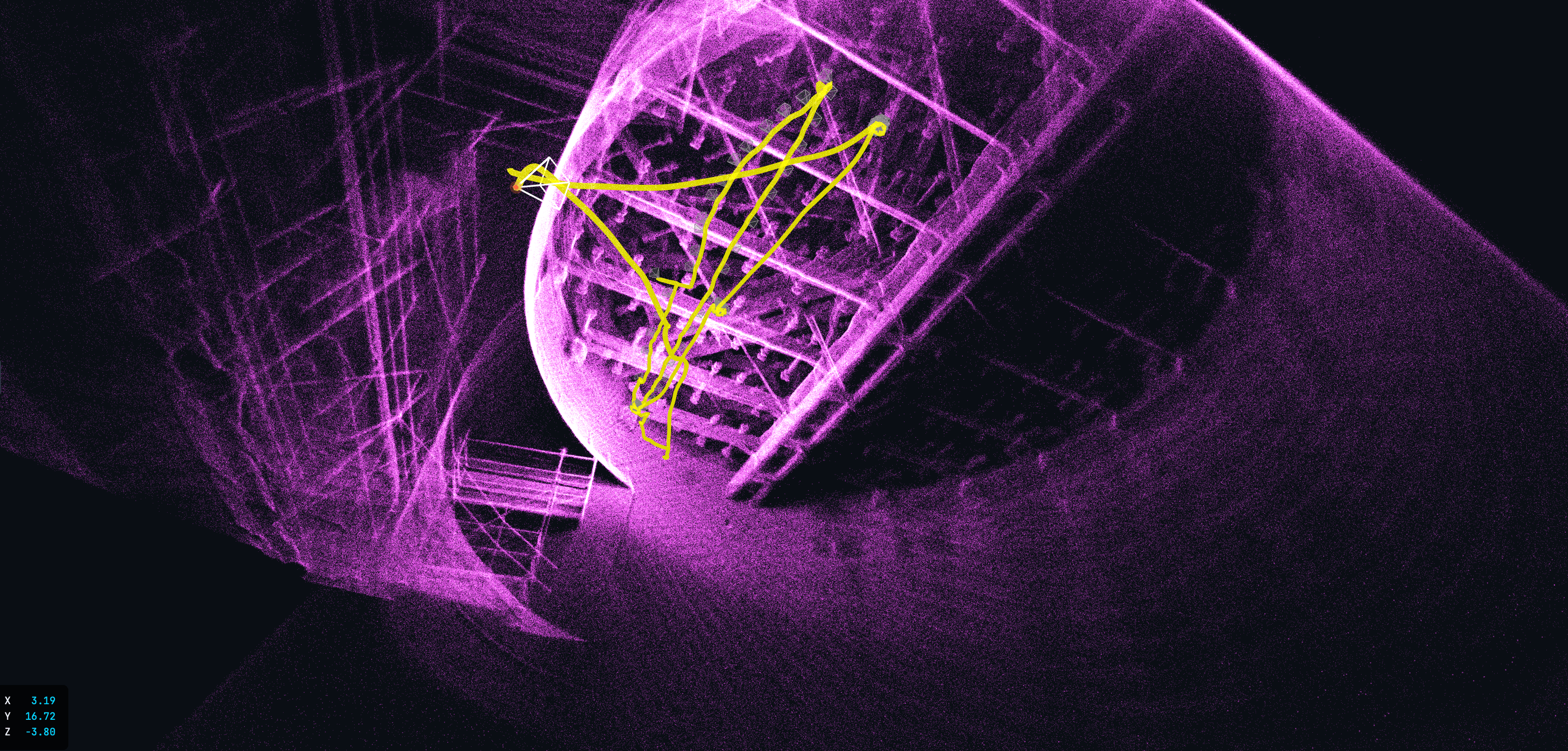
LiDAR 3D point cloud of an industrial absorber – geometric data as positioning reference for NDT findings.
Conclusion: NDT as the Key to Safe, Efficient Plants
Of the 8 NDT methods, 3 are directly drone-compatible: Visual Testing (VT), Ultrasonic (UT payload) and Thermography (TT) – all deployable with the Flyability ELIOS 3 in confined spaces. The DJI M30T complements with thermography and zoom for external inspections.
RT, MT and PT are used targeted at suspicious points identified by drone-VT – this is the hybrid inspection principle: drone for screening and localisation, conventional NDT only where needed.
Our expertise since 2017: Hundreds of plants inspected. We combine drone-VT with conventional NDT methods for comprehensive condition assessment.
Your Contacts for NDT Questions
Christian Engelke and Dipl.-Ing. Karsten Lehrke – your direct contacts for NDT and drone inspection.
“The ELIOS 3 has transformed visual inspection (VT) from a manual, risky activity into a systematic, reproducible data collection process. In confined spaces this is a paradigm shift.”
— Christian Engelke, Founder, Kopterflug
Related Services
- Industrial Drone Inspection – All NDT-complementary drone inspection services.
- Flyability ELIOS 3 – The drone for VT and thermography in confined spaces.
- Tank Inspection – Tanks with drone-VT and optional UT payload.
- Confined Spaces Inspection – NDT-compatible inspection without human entry.
- Boiler Inspection – Boilers and pressure vessels – findings for certified inspectors.
- Oil & Gas Inspection – NDT in refineries and petrochemical plants.
Frequently Asked Questions about NDT Methods
What is a visual inspection with drones and what is it used for?
Drone-based visual inspection (VT) is an indirect visual testing method per DIN EN 13018. The drone acts as a camera platform that brings 4K imaging and lighting into confined spaces – without human entry. It is used for surface defect detection, corrosion monitoring and condition documentation in tanks, boilers, silos and shafts.
Which drone models are suitable for visual inspection?
For confined spaces (tanks, boilers, silos): the Flyability ELIOS 3 – GPS-free, collision-safe, 4K + thermography + LiDAR. For external structures (chimneys, pipe bridges, facades): the DJI Matrice 30T with 16x optical zoom and 640×512 thermography sensor.
What requirements are needed for visual inspection in confined spaces?
Three things are essential: gas-free measurement and release by the plant operator (standard procedure for all confined space work), minimum access of approximately DN 600 (depending on installation geometry), and clear communication between pilot, spotter and plant personnel. No confined space entry per DGUV regulations is required.
How do LiDAR and mapping support visual inspection?
LiDAR provides a 3D reference model of the interior space. Each visual finding is georeferenced in the 3D model – an expert knows to within 5 cm exactly where a crack is in an 8-metre-high vessel. For follow-up inspections the same positions can be approached exactly – making damage progression trackable.
What typical damage is detected during visual inspection?
Surface cracks, corrosion (all types), coating damage (delamination, blistering, rust), deposits and fouling, geometric deformations (dents, bulges), weld defects (lack of fusion, porosity, undercuts), and erosion damage.
How does image quality in reflective surfaces get improved?
The ELIOS 3 has a 16,000-lumen LED lighting system with adjustable power. Reflective metal surfaces are typically approached at an oblique angle to minimise direct reflections. Additional camera settings (exposure, white balance) are adjusted on site. In extreme cases, polarisation filters can help.
What documentation is required to make VT results traceable?
A complete VT drone inspection report contains: inspection scope (which areas, which not and why), 4K video with timestamped findings, annotated 4K still images for each finding, LiDAR 3D point cloud with georeferenced findings, thermography evaluation (where applicable), and a findings list per finding ID with position, description, category and action recommendation.
Can drone NDT replace conventional methods?
Drone-VT and thermography replace conventional visual inspection in many confined space scenarios. UT, MT and PT cannot currently be fully replaced – but they are used targeted at suspicious points identified by drone-VT. The result: significantly less scaffolding and preparation effort for the same inspection quality.
Do certification bodies accept drone NDT data?
Acceptance is steadily growing. Many certification bodies (TÜV, DEKRA, DNV and others) already work with drone-assisted inspection data. Each organisation decides independently on the scope of acceptance. We clarify this in advance with the relevant bodies.
What is hybrid NDT inspection?
Hybrid inspection combines drone-VT screening with targeted conventional NDT methods (UT, MT, PT). The drone identifies and localises suspicious areas – conventional NDT then provides detailed confirmation and characterisation only at these points. Result: typically 60–80% cost savings compared to full-area conventional inspection.
Get in Touch
Have questions about NDT methods or need a quote for your plant? Fill out the form below and we’ll get back to you within 24 hours.