

Drone Inspection for Asset Owners – What You Need to Know Before Commissioning
Selection criteria, qualification proofs, reporting standards and typical cost drivers – the complete guide for plant operators. Operating since 2017.
- How to identify serious providers vs. hobby-drone operators
- RFQ checklist: what belongs in every tender for drone inspection
- Insurance, liability and GDPR in industrial drone operations
The Market: What Distinguishes Serious Providers
The market for industrial drone inspection has grown significantly in recent years – and so has the range of provider quality. From experienced industrial inspection specialists with certified NDT inspectors to photographers with hobby drones positioning themselves as industrial service providers, everything is represented. For operators of plant subject to mandatory inspection, this distinction is not trivial: the quality of the inspection has direct implications for safety, compliance and liability.
What Qualifications Should a Reputable Provider Demonstrate?
- EU Drone Licence A2/A3 and/or operating permit: For deployments in industrial plants, at minimum the EU drone licence A2 is required. For specific applications (e.g. over gatherings of people, near airports) additional permits may be required.
- NDT qualification of evaluating personnel: For visual testing according to DIN EN ISO 17637, the evaluating personnel should be certified at minimum VT Level 2. Request the certification document and the issuing body (DGZfP, TÜV, SGS or similar).
- Experience with indoor drones: The Flyability ELIOS 3 is the only serial production system for indoor confined-space inspections. Ask about the number of deployments carried out and reference customers in your sector.
- Insurance cover: Minimum requirement is an operational liability insurance (Betriebshaftpflichtversicherung) with adequate coverage for industrial deployments (typically: ≥€5 million).
- Data protection and data security concept: For sensitive industrial plants, ask about the data processing concept – where is data stored, how is it encrypted, who has access?
Red Flags When Selecting a Provider
Be cautious of providers who cannot present references in your sector, cannot demonstrate NDT qualification of the evaluating personnel, deliver reports without finding classification or without a normative basis, or whose price is conspicuously far below the market average.
Tender Criteria & RFQ Checklist
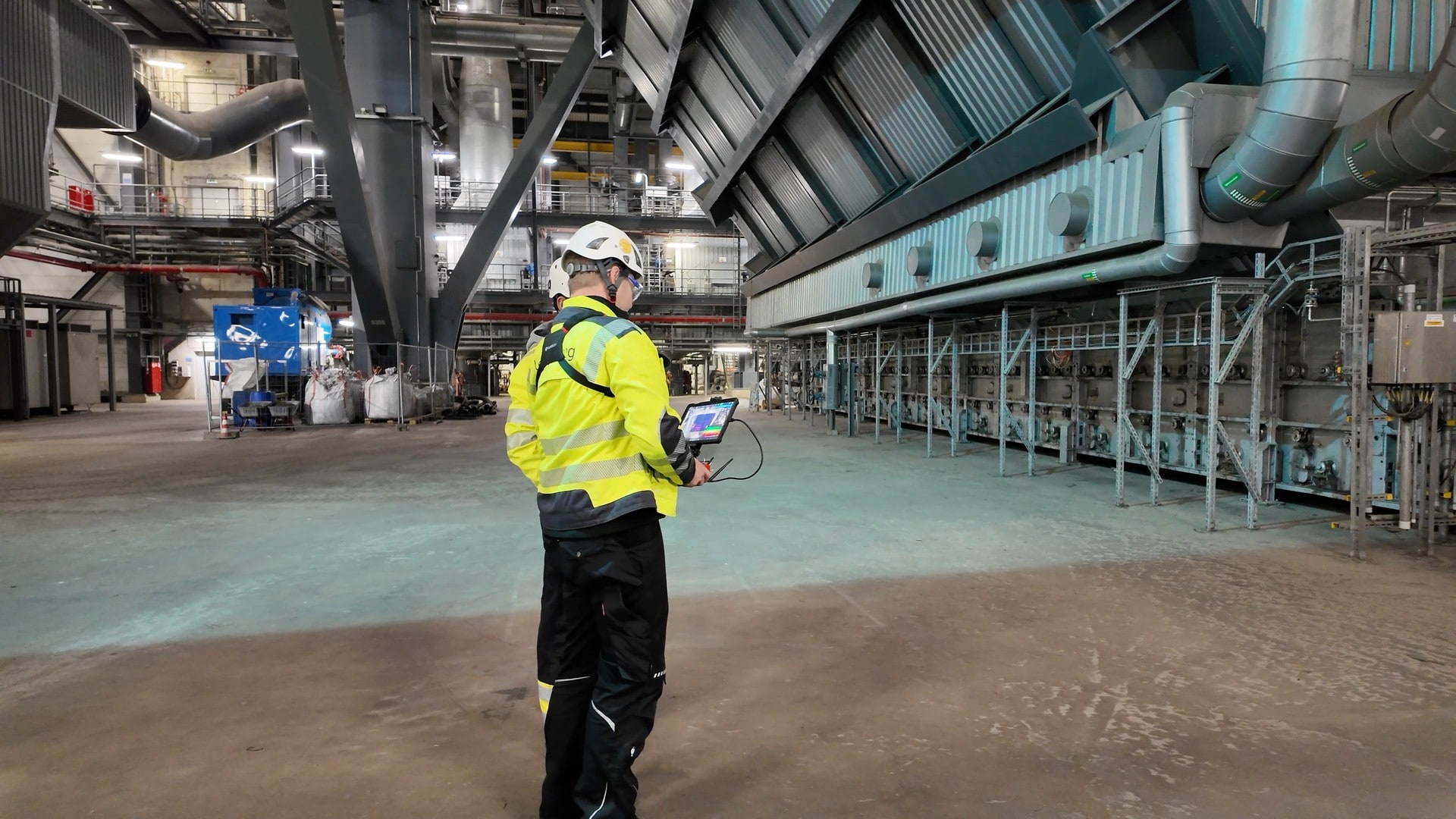
Structured tendering prevents misunderstandings and enables valid quotation comparison.
A structured tender (Request for Quotation, RFQ) prevents misunderstandings and enables valid quotation comparison. The following criteria should be included in every RFQ for drone inspections:
Technical Scope
- Equipment designation and equipment ID (tag number from plant drawing)
- Access points: manway sizes (DN specification), location (top/side), quantity
- Areas to be inspected (interior walls, floors, roof, internals, welds)
- Required inspection methods: VT, thermography, LiDAR scan
- Normative basis for the inspection (e.g. DIN EN ISO 17637, API 510, DIN EN 13018)
- Expert requirements: should a notified body inspector (ZÜS-Prüfer) be present or is the service provider report sufficient?
Reporting Requirements
- Desired report format: PDF findings report, 4K video raw data, LiDAR point cloud
- Finding classification system: per API 510/653, ASME, or company-internal system
- Delivery deadline for preliminary report (often: same-day preliminary findings) and final report
- Report language (German/English)
Compliance & Insurance
- Proof of operational liability insurance with minimum coverage amount
- NDT qualification proof of evaluating personnel
- Proof of drone licences and, where applicable, operating permits
- Signed non-disclosure agreement (NDA) for plant data
On-Site Safety Requirements
- Induction requirements (is a company-specific safety briefing required?)
- PPE requirements: hard hat, safety glasses, safety boots, chemical protection if applicable
- Permit to Work requirements: who issues, what lead time is required?
Insurance, Liability & Compliance
The insurance question in industrial drone inspections is more complex than for simple camera flights. Several liability layers need to be considered:
Insurance Cover on the Service Provider Side
A professional drone inspection service provider requires at minimum:
- Aviation liability insurance (Luftfahrt-Haftpflichtversicherung): Mandatory under EU aviation law for all commercial drone operators. Minimum coverage per EU Regulation 2021/664 depending on drone mass (MTOM).
- Operational liability insurance (Betriebshaftpflichtversicherung): Covers damages from operational activities. For industrial deployments the coverage amount should be at least €5 million.
- Professional indemnity insurance (Vermögensschadenshaftpflicht): For faulty inspection reports that lead to damage (e.g. if an overlooked finding leads to a plant failure).
Liability Limits & Compliance
Important for operators: a drone findings report does not replace an inspection by an authorised inspection body (Zugelassene Überwachungsstelle, ZÜS) where this is prescribed under BetrSichV §15 for the equipment. Drone inspection is a tool for the expert inspection – it provides the visual basis, but the ZÜS remains responsible for the normative assessment.
For plant that is not subject to mandatory inspection under BetrSichV (e.g. many steel structures, non-pressure vessels, chimneys without special inspection requirements), the drone findings report can serve as complete inspection documentation.
Data Processing under GDPR
Drone video material of industrial plants may under certain circumstances contain personal data (identifiable persons in the footage). Clarify in the contract: how is such data handled? Kopterflug operates in accordance with the requirements of the EU GDPR – raw data is not passed to third parties, data processing agreements (DPA) are concluded on request.
Typical Cost Drivers & Budget Guidance
Drone inspection costs vary considerably depending on equipment, requirements and deployment conditions. The main cost drivers at a glance:
Main Cost Drivers
- Set-up time and travel (Rüstzeit und Anfahrt): Mobilisation costs (travel time, overnight stay if applicable) are a fixed cost component that becomes cheaper per unit when multiple equipment units are at the same site. Bundle inspection objects for an optimal price-performance ratio.
- Number and complexity of equipment units: A tank costs more than a chimney (more volume, more complex interior surface). Vessels with many internals require more flight time.
- Sensor technology: Standard VT with 4K camera is the cheapest option. LiDAR scanning typically doubles deployment time and thus costs. Thermography adds as a third cost component.
- Report depth: A simple video protocol is cheaper than a complete findings report with normative classification and 3D location of all findings.
- Safety requirements: Deployments in ATEX zones, with extensive Permit to Work processes or with a ZÜS inspector present increase effort.
Rough Orientation Values
Without binding pricing, the following orders of magnitude can serve as orientation (day rates, excl. travel costs):
- Simple visual inspection (VT), 1–3 vessels: from approx. €1,500–3,000 daily service
- VT + LiDAR scan, 1–2 vessels: from approx. €3,000–5,000 incl. 3D model
- Full package VT + LiDAR + thermography + findings report: from approx. €5,000–8,000 per deployment day
The decisive comparison figure is not the price of the drone inspection, but the total cost of the inspection. A saved day of scaffolding (typically €2,000–8,000 for erection and dismantling) and reduced downtime make the drone the more economical option in most cases. Request a no-obligation initial assessment from us for your equipment.
Talk Directly to Our Team
We provide honest assessments – including when a different approach would serve you better.
 Christian Engelke
Managing Director & Chief Pilot
Christian Engelke
Managing Director & Chief Pilot
 Karsten Lehrke
Dipl.-Ing., Senior Inspector
Karsten Lehrke
Dipl.-Ing., Senior Inspector
 Philipp
Drone Pilot & Inspector
Philipp
Drone Pilot & Inspector
 Juliana
Project Coordination
Juliana
Project Coordination
 Stephan
Drone Pilot & Inspector
Stephan
Drone Pilot & Inspector
Related Services
- Drone Inspection Costs – Cost comparison between drone inspection and conventional methods.
- Tank Inspection (Tankinspektion) – Professional tank inspection by drone – inside and outside without scaffolding.
- Confined Spaces Inspection – Safe inspection of tight spaces without personnel entry with indoor drone.
- Boiler Inspection (Kesselinspektion) – Water-tube boilers and steam generators safely inspected by drone.
- Insurance & Compliance – Insurance, compliance and documentation requirements.
- Chemical Industry Inspection – Drone inspection for chemical plants, columns and reactors.
Frequently Asked Questions: Asset Owner Guide
What minimum qualifications should a drone inspection provider demonstrate?
At minimum: EU drone licence A2/A3 for outdoor deployments, VT Level 2 certification (DIN EN ISO 9712) of the evaluating personnel for visual testing, liability insurance ≥€5 million, and for indoor deployments with the ELIOS 3: demonstrable experience (number of deployments, references in your sector). Ask specifically about certification documents – serious providers present these proactively.
Does a drone report replace a ZÜS inspection under BetrSichV?
No. A drone findings report provides the visual basis for the expert inspection – but it does not replace the normative assessment by an authorised inspection body (ZÜS) where this is prescribed under BetrSichV §15. Drone inspection is a tool for the inspector: it delivers the data, but the ZÜS remains responsible for the assessment and acceptance. For plant not subject to mandatory inspection, the drone report can serve as complete documentation.
What should an RFQ for drone inspection contain?
At minimum: equipment designation and tag number, access point details (manway size DN, location), areas to be inspected, required inspection methods (VT, thermography, LiDAR), normative basis, reporting requirements (format, language, deadline), proof requirements (insurance, NDT qualification, licences), safety requirements on site (PPE, Permit to Work). A structured RFQ prevents misunderstandings and enables valid quotation comparison.
How are findings classified in drone inspection reports?
Classification depends on the normative basis agreed. Common systems: API 510/653 (USA standard for pressure vessels/storage tanks), ASME, or company-internal classification systems. Good practice: findings are classified into urgent action required, medium-term action, observation/monitoring, and no action required – with photographic documentation and 3D position reference. Clarify the desired system in the RFQ.
What GDPR requirements apply to drone inspection data?
Drone video material may contain personal data (identifiable persons). Clarify in the contract: data storage location (within/outside the EU), access rights, retention period for raw data, and whether a data processing agreement (DPA) is required. Kopterflug operates in accordance with EU GDPR requirements – raw data is not passed to third parties, DPAs are concluded on request.
How can I optimise costs for drone inspection?
The biggest levers: bundle multiple inspection objects at the same site (mobilisation costs are shared), plan during an existing shutdown (avoids additional downtime), align the report depth with actual requirements (video protocol vs. full findings report), and bundle recurring inspections into framework agreements (better conditions). We advise you individually on cost optimisation for your inspection portfolio.
What insurance does the drone inspection provider need?
Minimum: aviation liability insurance (mandatory under EU aviation law) and operational liability insurance ≥€5 million for industrial deployments. For inspection services that serve as basis for maintenance decisions: additionally professional indemnity insurance. Request copies of the insurance documents – serious providers present these as standard.
Can I request drone inspection for ATEX zones?
The ELIOS 3 is not ATEX-certified. Deployment in potentially explosive atmospheres is only possible after confirmed gas-free clearance (LEL <10%, O&sub2; 19.5–23%, no toxic gases above limit values). The gas measurement is the responsibility of the operator according to TRGS 722 and BetrSichV Annex 2 Section 3. After successful measurement, the drone deployment is released. Inertised zones (N&sub2;) must be completely flushed with fresh air before deployment.
Initial Consultation: Drone Inspection for Your Plant Type
Describe your plant type and inspection needs – we provide a free initial assessment of feasibility, sensor setup and added value of drone inspection.