
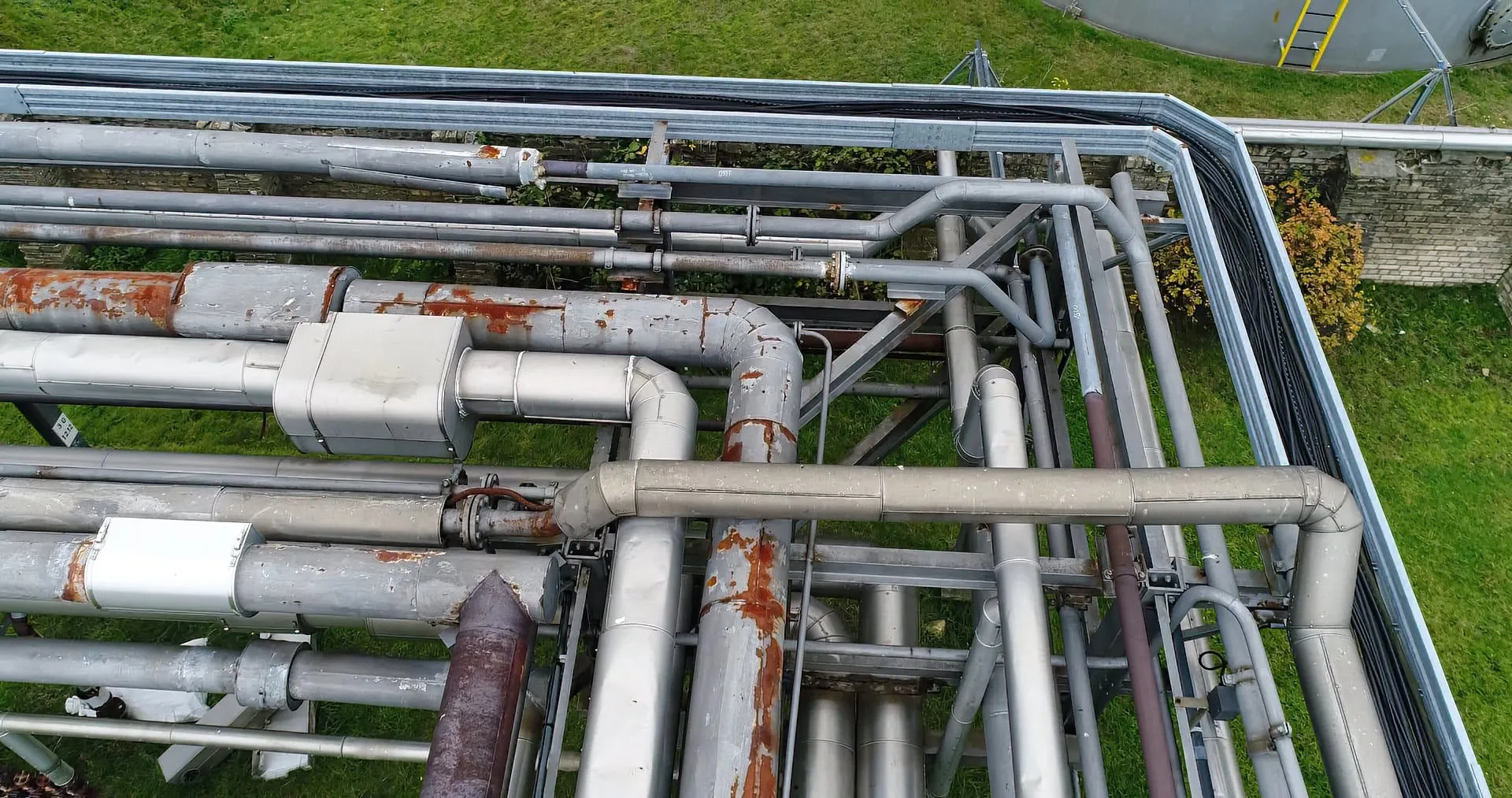
Pipe Rack Inspection by Drone – WITHOUT Scaffolding, WITHOUT Aerial Work Platform
Kopterflug inspects pipe racks with thermography, 4K documentation and 3D surveying – without scaffolding, without aerial work platforms, without rope access. CUI detection by thermography, corrosion monitoring, structural assessment. Nationwide across Germany.
- No scaffolding, no aerial work platform – inspection during live operation
- CUI detection by thermography – without removing insulation
- 4K + Thermography + 3D LiDAR in a single deployment
- Findings report within 48 hours
Pipe Rack Inspection by Drone: Fast, Safe, Complete
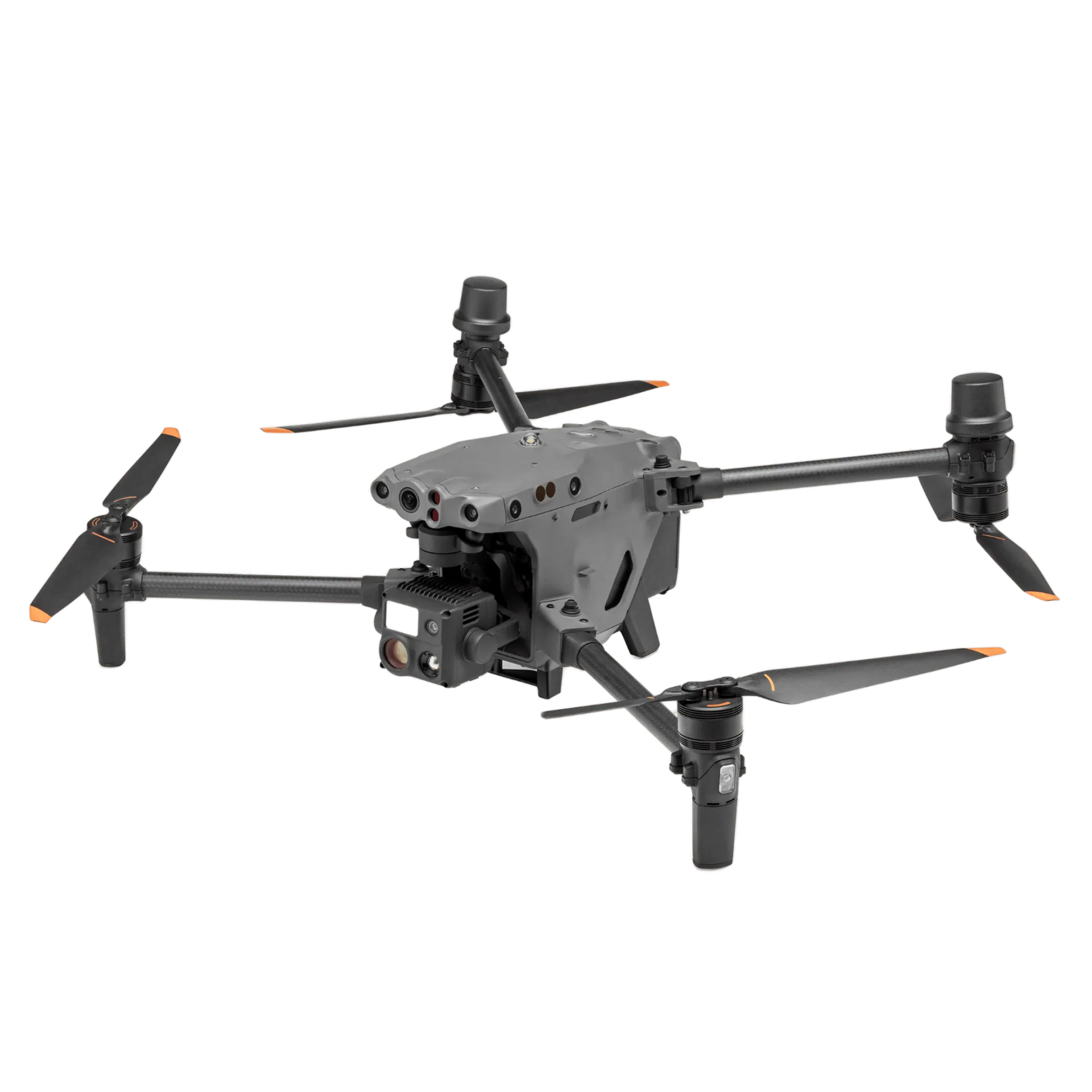
The DJI Matrice 30T with 200x zoom and radiometric thermography – for systematic pipe rack inspection during live operation.
Pipe racks are the lifeblood of every process plant – they transport media, energy and resources across extensive industrial sites. At the same time, they are permanently exposed to weathering, thermal cycles and mechanical stress.
At Kopterflug, we inspect pipe racks using a hybrid approach: the DJI Matrice 30T with 200x zoom and radiometric thermography for exterior inspection, the Flyability ELIOS 3 for enclosed sections from the inside. No scaffolding, no aerial work platforms, no access restrictions – everything during live operation.
The radiometric thermography of the M30T is particularly valuable: it detects Corrosion Under Insulation (CUI) – the most common and costly damage type at pipe racks – without removing the insulation.
Typical damage patterns at pipe racks: CUI develops when moisture penetrates under the insulation and attacks the pipe surface – thermographically detectable as a temperature anomaly, long before the damage is visible from outside. On the supporting structure we check for corrosion at gusset plates, weld failures and deformations from overloading or wind loads. At flange connections, thermography detects leaks through temperature differences. On the pipelines themselves: external corrosion, wall thickness loss at bends and T-pieces, and support damage from vibration.
DJI M30T – Pipe Rack Inspection Without Scaffolding
Our services for pipe racks:
- External inspection with DJI M30T: 200x hybrid zoom, radiometric thermography, IP55 protection. Efficiently captures kilometre-long structures from the air.
- CUI screening by thermography: Radiometric infrared camera detects temperature anomalies under insulation – without opening the insulation.
- Internal inspection with ELIOS 3: For enclosed pipe tunnels and accessible cable ducts – the ELIOS 3 flies through tight areas inaccessible from outside.
- 3D surveying & documentation: LiDAR 3D point clouds for as-built documentation, deformation analysis and planning basis for maintenance measures.
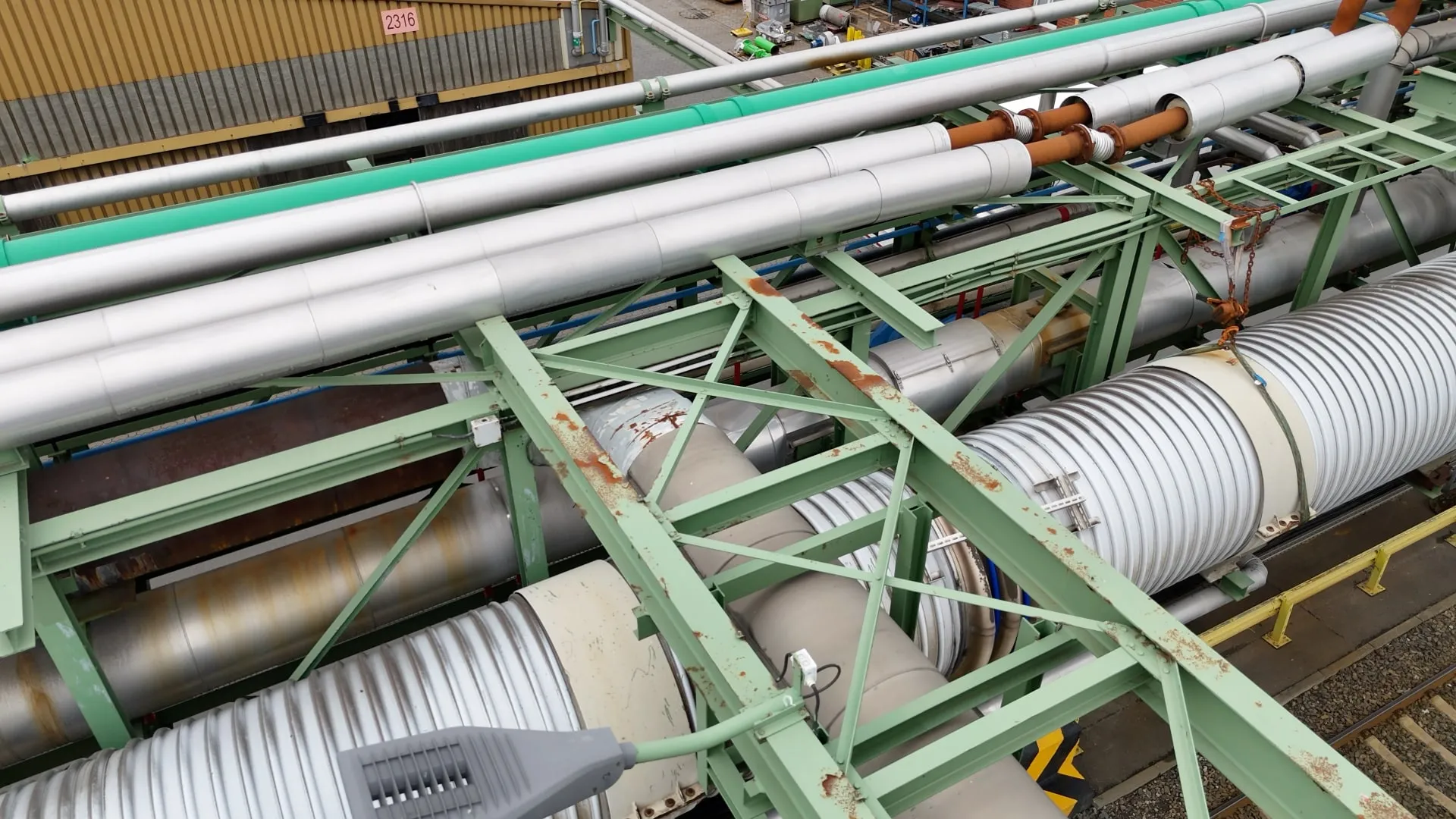
What We Document During Pipe Rack Inspections
We fly the DJI M30T along your pipe racks and systematically document all safety-relevant areas. For enclosed pipe tunnels, the ELIOS 3 is deployed:
Supporting Structure & Columns
What we check: 4K footage of corrosion, cracks, deformations, weld damage at steel columns and cross-beams.
Why it matters: Structural weakening of the supporting structure can cause the entire pipe rack to fail. Early detection prevents consequential damage.
How we do it: 4K zoom (200x) documents detail shots from safe distance, thermography shows moisture ingress at joints.
Pipelines & Insulation (CUI)
What we check: Thermography screening of the entire insulation for temperature anomalies – indication of Corrosion Under Insulation.
Why it matters: CUI is the most common and costly damage cause at insulated pipelines. Without thermography, CUI remains invisible until line failure.
How we do it: Radiometric infrared camera of the M30T captures temperature differences indicating moisture ingress and corrosion under insulation.
Pipe Supports & Clamps
What we check: Condition of pipe clamps, sliding bearings, fixed points, expansion bends and hangers.
Why it matters: Defective supports lead to uncontrolled pipe movements, stress cracks and leaks. Every missing clamp is a risk.
How we do it: 4K detail shots of every support along the entire pipe rack – systematically documented.
Foundations & Base Areas
What we check: Foundation settlements, cracks in concrete foundations, erosion, undermining, vegetation.
How we do it: Aerial shots identify settlements and displacements, 4K zoom documents concrete damage and cracks.
Pipe Sagging & Support Failure
What we check: Visible deflection of individual pipe segments between supports, missing or broken clamps, displacements at sliding and fixed points.
How we do it: 4K footage from various angles makes deflections visible that are not recognisable from ground level – particularly for pipe racks at 10–30 m height.
Valves & Fittings
What we check: Operating condition (open/closed), visible leaks, corrosion at valve housings, damage to actuating elements and drives.
How we do it: 200x zoom of the M30T captures fitting details from safe distance – position, leak indicators and corrosion grade are recorded in the report.
Challenges in Pipe Rack Inspection
Pipe racks are among the most complex and least accessible plant components in industry. Conventional inspection methods are expensive, risky and often incomplete.
- High access overhead and long lead times: Pipe racks often run for hundreds of metres at great heights. Scaffolding, aerial work platforms or rope access mean high logistical overhead, long planning times and interference with live operation. Inspections can drag on for days or weeks.
- Safety risk for personnel: Working at pipe racks is among the most dangerous activities in plant operation: fall risk at height, narrow working areas between pipelines, hot surfaces and aggressive media, restricted escape routes.
- CUI – corrosion under insulation remains undetected for long: CUI is one of the most critical damage mechanisms: moisture penetrates under insulation, corrosion develops invisibly over years, damage is often only recognised at leakage. Visual inspection alone is insufficient.
- Incomplete inspection: In practice, often only easily accessible areas are checked. Undersides of pipelines, insides of pipe bundles and hidden welds and supports are frequently missed.
- Downtime and production losses: The build-up of access equipment directly affects operation: partial areas must go offline, workflows are restricted, downtime extends.
- Complexity of the plants: Pipe racks consist of densely packed pipeline bundles with hard-to-follow routing. Unambiguous assignment of individual areas, supports and fittings is often difficult.
- Environmental conditions complicate inspection: Dust and contamination, aggressive atmosphere in chemical and coastal areas, and wind and weather at outdoor plants complicate both conventional and modern inspection methods.
- High documentation requirements: Regulations and internal standards require comprehensible condition assessment, complete documentation and reproducible results.
Pipe Rack Types We Inspect
Refinery Pipe Racks
Kilometre-long pipe racks with hundreds of lines. CUI screening, column corrosion, supports – during live operation.
- Sensors: Visual, Thermography
- Typical findings: CUI, column corrosion, defective supports, insulation damage, leaks
Chemical Plant Pipe Racks
Media-carrying pipe racks in chemical plants. Aggressive media and atmosphere accelerate corrosion.
- Sensors: Visual, Thermography
- Typical findings: Chemical corrosion, CUI, flange leaks, damaged coatings
Power Plant Pipeline Systems
Steam, feedwater and cooling water lines on pipe racks in power plants. High thermal stress.
- Sensors: Visual, Thermography, LiDAR
- Typical findings: Thermal fatigue, CUI at steam lines, expansion problems, support failure
Enclosed Pipe Tunnels
Closed pipe channels and enclosed line routes – ELIOS 3 flies through and documents the interior condition.
- Sensors: Visual, LiDAR
- Typical findings: Corrosion, leaks, deposits, structural damage inside
Multi-Level Pipe Racks
In large industrial plants, pipe racks often run over several levels. Restricted access to upper and lower levels and concealed areas between pipe bundles.
- Sensors: Visual, Thermography, LiDAR
- Typical findings: Corrosion in poorly ventilated areas, support damage, thermal expansion problems
Pipe Racks Over Roads, Rail or Water
Independent supporting structures with large spans over traffic routes or waterways. Restricted access without traffic disruption and high safety requirements.
- Sensors: Visual, Thermography
- Typical findings: Corrosion at structural components, vibration damage
Conventional Pipe Rack Inspection vs. Drone
| Aspect | Conventional (scaffolding / aerial platform) | Drone |
|---|---|---|
| Access | Aerial platform/scaffolding, section by section | Overflight of entire route |
| Time | 3–6 weeks | 3–5 days |
| Operation | Closures, lockouts required | During live operation |
| CUI detection | Only by removing insulation | Thermography – non-destructive |
| Documentation | Photos per section | 4K + Thermography + LiDAR 3D |
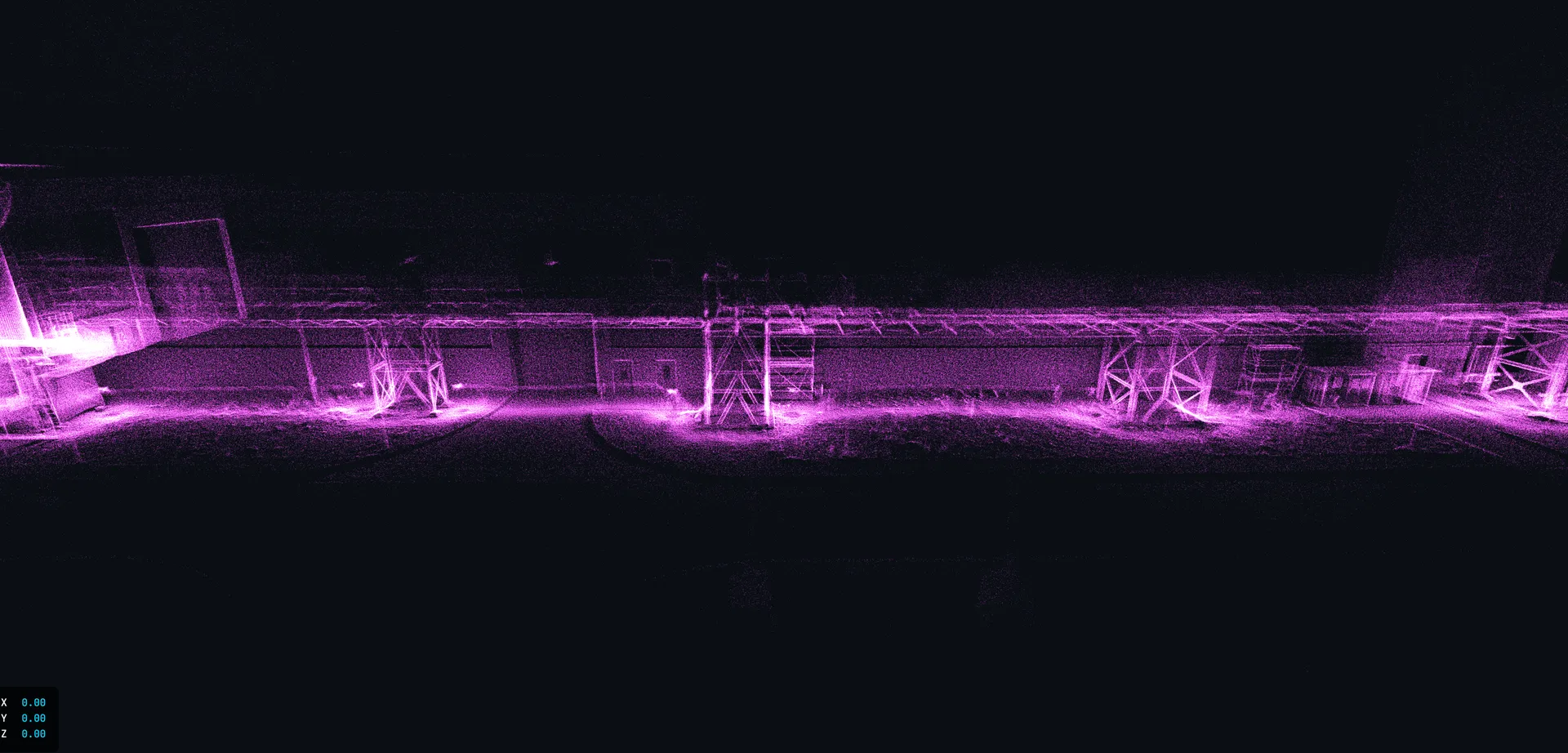
Benefits of Drone Inspection for Pipe Racks
- No scaffolding: Inspect kilometre-long pipe racks without scaffolding or aerial work platforms – often weeks faster and tens of thousands of euros cheaper.
- CUI detection by thermography: Detect Corrosion Under Insulation early – without opening the insulation. The most common and costly damage cause becomes visible.
- No production downtime: Exterior inspections by drone during live operation – no shutting down the plant, no production losses.
- Complete documentation: 4K footage with 200x zoom, radiometric thermography and 3D surveying of the entire pipe rack – systematic and reproducible.
- Up to 80% cheaper: No scaffolding, no aerial work platform, no access restrictions. Inspection for a fraction of conventional method costs.
- Recurring inspections efficient: Regular monitoring with comparable flight paths – changes over time systematically traceable.
How the Pipe Rack Inspection Works
Step 1: Initial Consultation & Feasibility Analysis
We analyse your pipe rack: length, height, media, accessibility, flight restrictions. We check feasibility and advise you free of charge.
Step 2: Scheduling & Quotation
You receive a transparent quotation. Together we plan the deployment – coordinated with your plant operation and maintenance team.
Step 3: On-Site Inspection
Our pilot and assistant fly systematically along your pipe racks – M30T for exterior, ELIOS 3 for enclosed areas. On request with your inspectors on site.
Step 4: Evaluation & Inspection Report
You receive a detailed report with 4K footage, thermography maps for CUI suspect areas, damage classification and optional 3D models for your maintenance planning.
Your Contacts for Pipe Rack Inspections
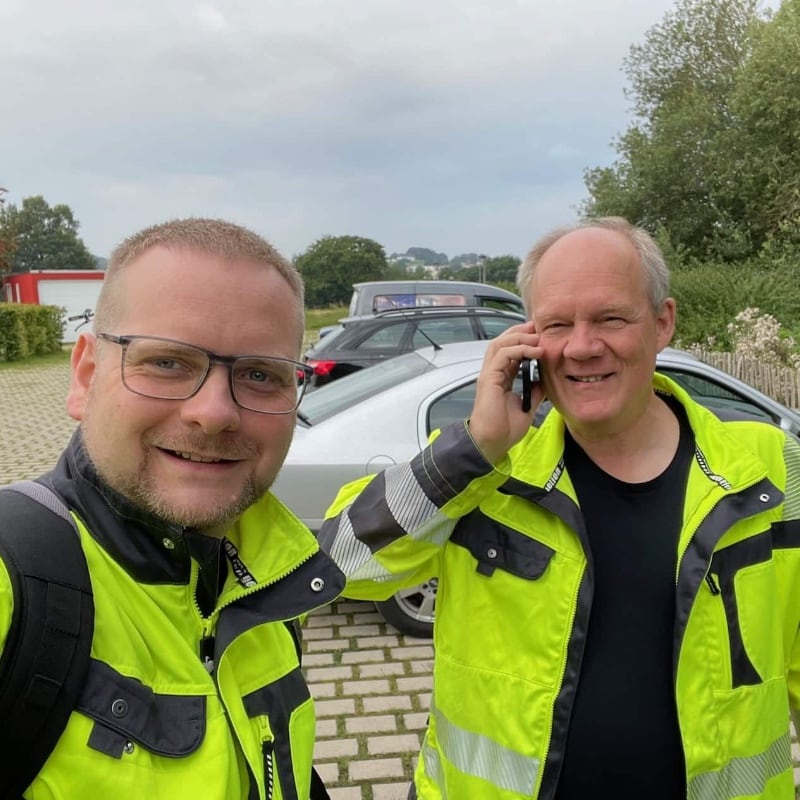
Christian Engelke and Dipl.-Ing. Karsten Lehrke – your direct contacts for pipe rack inspection projects.
Since 2017, we have been inspecting industrial plants with drones – experience from hundreds of pipe rack and pipeline inspections in refineries, chemical parks and power plants. Our hybrid approach combines the DJI M30T for exterior inspections with the ELIOS 3 for enclosed areas. We deliver the data, your maintenance teams make the decisions.
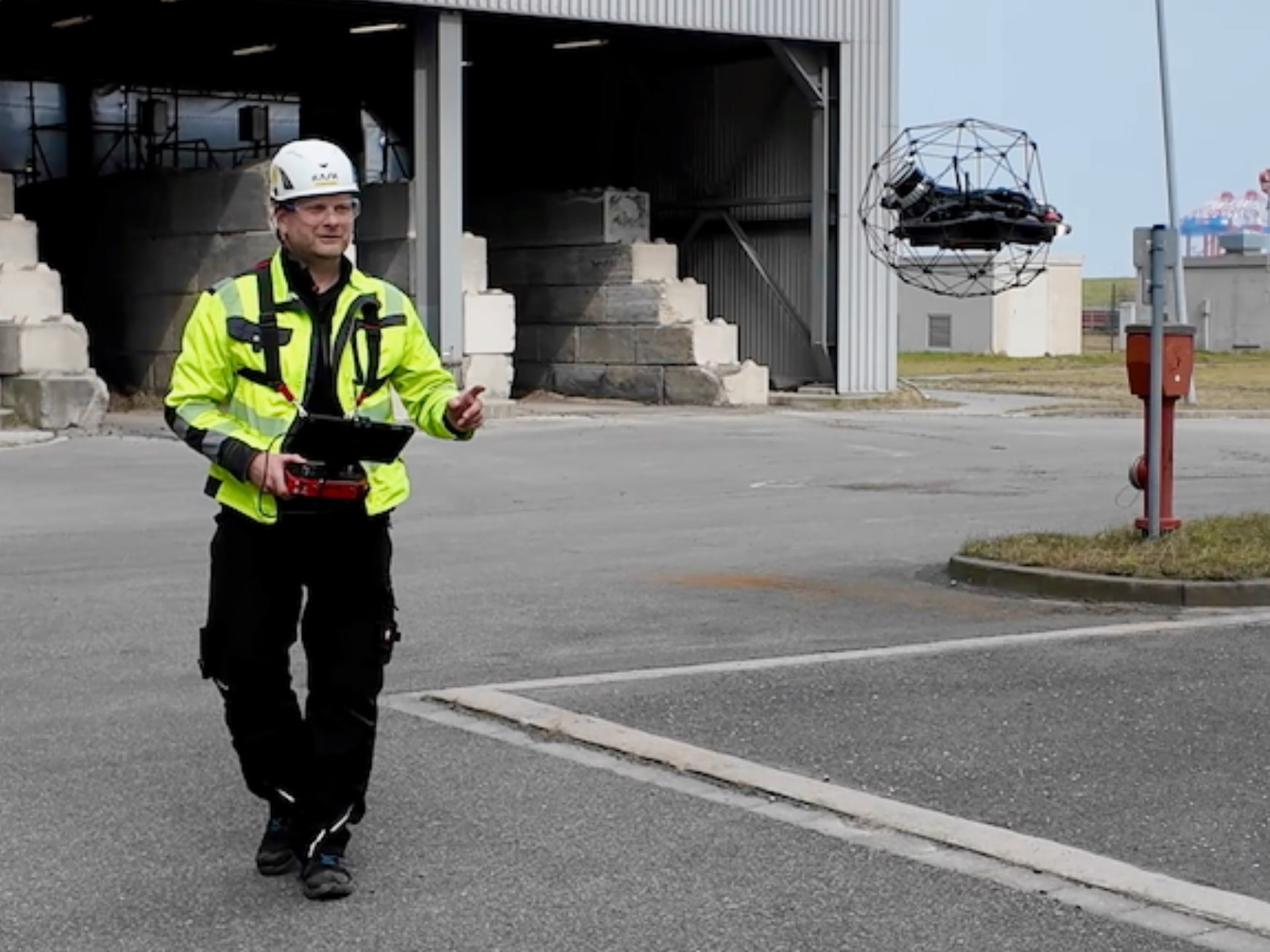 Christian
Founder & Drone Pilot
Christian
Founder & Drone Pilot
 Karsten
Project Manager
Karsten
Project Manager
 Philipp
Founder, Operations & Logistics
Philipp
Founder, Operations & Logistics
 Juliana
Drone Pilot
Juliana
Drone Pilot
 Stephan
Operations & Logistics
Stephan
Operations & Logistics
Related Services
- Oil & Gas – Pipelines, reactors and refineries – CUI detection in potentially explosive areas.
- Chemical Industry – Process pipelines and columns in chemical plants.
- Chimney Inspection – Interior and exterior inspection of industrial chimneys.
- Infrastructure Inspection – Bridges, masts and infrastructure from the air.
- Industrial LiDAR Survey – 3D point clouds for as-built documentation and deformation analysis.
- Condition Documentation – Systematic 4K + LiDAR documentation for asset management.
Frequently Asked Questions
What is actually checked in a pipe rack inspection?
We check the condition of the entire pipe rack – including supporting structure, pipelines, insulation, supports and foundations. The aim is to detect corrosion, CUI, structural damage and support defects early, before they lead to leaks or failures.
Which drone is used for pipe rack inspections?
For exterior inspections we use the DJI Matrice 30T – with 200x hybrid zoom, radiometric thermography and IP55 weather protection. For enclosed pipe tunnels and enclosed cable ducts, the Flyability ELIOS 3 is deployed – GPS-free, collision-safe, with LiDAR.
Is the entire pipe rack captured or just spot checks?
The pipe rack inspection is carried out systematically along the entire route. Even hard-to-access areas – undersides, tight pipe bundles, concealed supports – are covered without additional access equipment.
How does a pipe rack inspection by drone work in practice?
Typical process: 1. Overview flight for visual capture of the entire structure, 2. Thermography screening to identify anomalies (CUI, leaks, hot spots), 3. Detail documentation of conspicuous areas with 200x zoom, 4. LiDAR scan on request for deformation analysis and as-built documentation.
Can corrosion damage to the supporting structure be detected?
Yes. Corrosion, coating damage and rust pitting at columns, cross-beams and joints can be captured visually very well – even in hard-to-access areas that are typically skipped in conventional inspections.
Can deformations or structural problems be detected?
Yes. Typical signs such as deflection, deformation and buckling are made visible by high-resolution shots from various angles – particularly well detectable at pipe racks in 10–30 m height.
Can cracks at welds be detected?
Yes – with high-resolution zoom, many critical areas can be inspected in detail. Conspicuous spots can be specifically documented and flagged for further assessment by inspectors – very hard to achieve with conventional methods at height.
Can moisture ingress at the structure be detected?
Partially yes. Thermography can provide indications of moisture or water ingress – particularly at joints, transitions and other critical points where temperature deviations make moisture visible.
Can CUI (Corrosion Under Insulation) be detected by drone?
The radiometric thermography of the M30T detects temperature anomalies under insulation indicating moisture ingress and corrosion. CUI suspect areas are marked in the report for further assessment – without removing a single piece of insulation.
What can be detected on the insulation of pipelines?
Typical damage such as open or damaged cladding, missing bands or sheets and mechanical damage can be reliably documented – important indicators, since insulation damage is the entry point for CUI.
Can temperature differences within pipelines be detected?
Yes. Thermography shows temperature distributions along the lines and makes anomalies visible – for example uneven media flow, possible leaks or unusual temperature gradients.
Are non-insulated pipe areas also checked?
Yes. Particularly bends, flanges and transitions frequently show elevated corrosion and are systematically captured – areas that are often skipped in conventional inspections due to access situation.
Can damage to pipe supports be detected?
Yes. Typical problems such as damaged or missing clamps, bent supports and corrosion at contact points between pipe and support are systematically documented along the entire pipe rack.
Can pipe sagging be detected?
Yes. Sagging pipelines between supports are clearly visible and documented – a clear indication of defective or missing supports with consequential risk for weld cracks.
Can movements or displacements at pipelines be detected?
Partially yes. Misalignments, play in sliding bearings or unusual positions of lines can be visually detected and documented – relevant for assessing thermal expansion problems.
Can leaks at flanges be detected?
Indirectly yes. Thermography can show temperature anomalies at flange connections indicating leaks or tightness issues – often before deposits or visible traces appear.
Are valves and fittings also checked?
Yes. We capture the condition of valves and flanges, visible corrosion at housings and drives, and mechanical damage – via 200x zoom also from safe distance. All fittings are systematically documented.
Can the condition of foundations be assessed?
Yes. From the air, cracks, spalling, settlements and displacements at foundations can be detected – indicators of structural problems often better visible from above than from ground level.
Are environmental conditions also considered?
Yes. Influences such as standing water, vegetation and contamination are documented alongside, as they promote damage in the long term – for example through moisture ingress into insulation or increased corrosion.
Can vibrations or dynamic loads be detected?
Partially yes. Video recordings allow unusual movements or vibrations to be made visible – particularly relevant for pipelines near pumps, compressors or other vibration sources.
Does the plant have to be shut down for the inspection?
No – exterior inspections by drone take place during live operation. No lines are blocked, no scaffolding is erected, no areas are cordoned off. Only for internal inspections of enclosed pipe tunnels is local coordination required.
How long does the inspection of a pipe rack take?
Depends on length and complexity. Typical: a 500 m pipe rack inspected in half a day, including thermography screening. Kilometre-long pipe rack networks in refineries: typically 3–5 days for the complete route.
Can hard-to-access pipe racks also be inspected?
Yes – that is precisely the advantage of drone inspection. Crossing areas, overlaps, areas between closely spaced lines are often barely accessible for climbers. The M30T reaches these areas from the air – systematically and without additional access overhead.
What damage is typically found during pipe rack inspection?
The most common findings are CUI (Corrosion Under Insulation), surface corrosion at columns and cross-beams, defective pipe supports and clamps, insulation damage as entry points for moisture, and flange anomalies as potential leak indicators. In older plants, foundation settlements are also found.
What data is delivered after the pipe rack inspection?
We deliver 4K footage of the entire pipe rack, radiometric thermography maps with marked CUI suspect areas, damage classification with GPS-referenced damage points, and optionally 3D point clouds. The georeferenced damage points allow your maintenance planners to precisely locate every finding without a repeat inspection.
How often should pipe racks be inspected?
Depends on age, media and environmental conditions. Common practice: full inspection every 2–5 years, more frequently for CUI-susceptible lines. Drone inspections make annual screening economically feasible – a significant improvement over conventional methods that often only allow 5–10 year intervals.
Get in Touch
Questions about drone inspection for pipe racks, or need a quote? Fill out the form and we will get back to you within 24 hours.