
When Does Drone Inspection Make Sense for Sewers & Drainage?
Shafts, collectors and sewer structures (Sielbauwerke) – ELIOS 3 in tight cross-sections without personnel entry. Operating since 2017.
- No person enters – no H&sub2;S risk, no rescue chain required
- ELIOS 3 from DN 600, including irregular cross-sections
- 4K + LiDAR documentation, findings report per DIN EN 13508-2
Why Conventional Methods Reach Their Limits
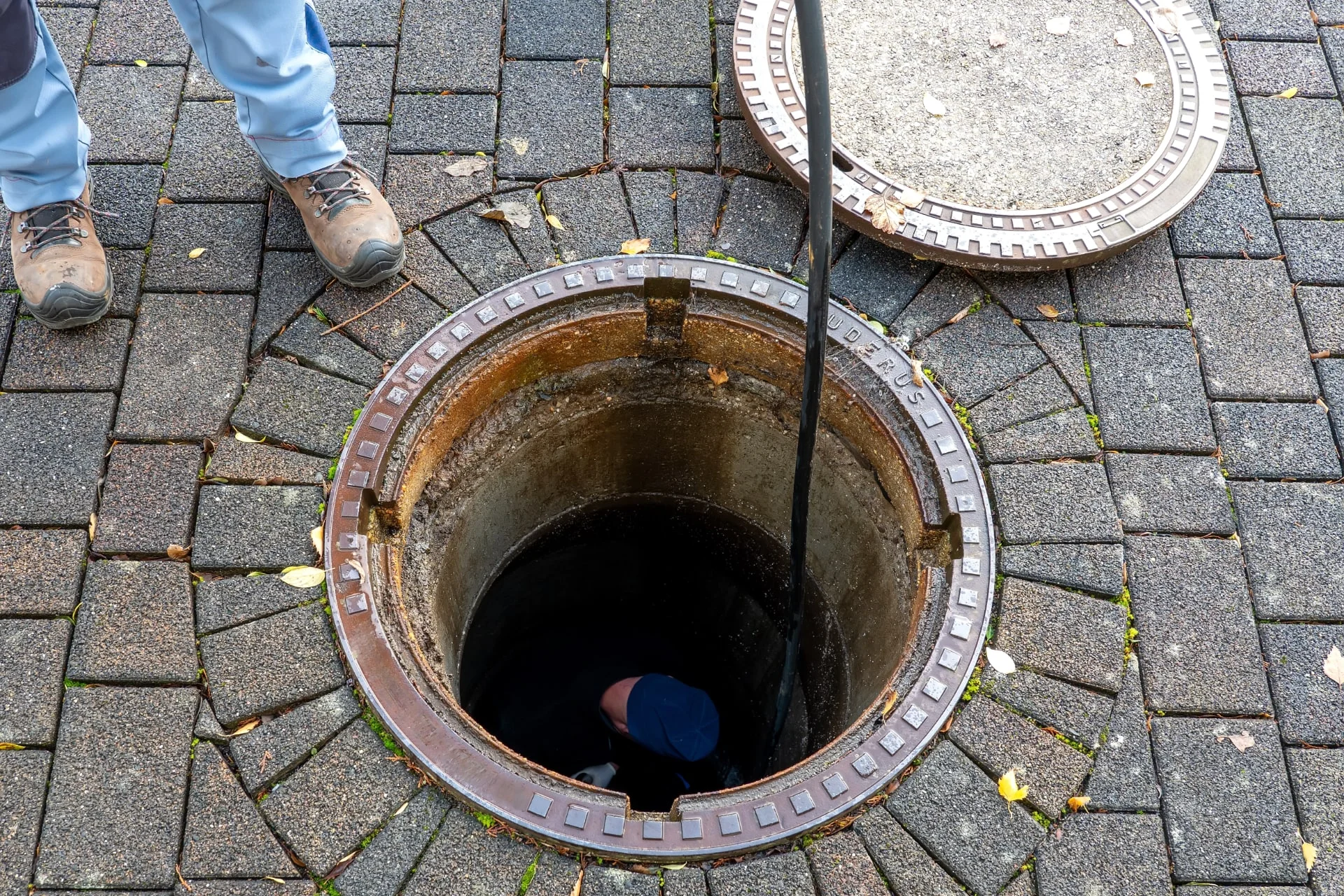
Wastewater sewers, collectors and sewer structures (Sielbauwerke) are among the most difficult-to-access infrastructure objects of all. Tight cross-sections, toxic atmospheres from hydrogen sulphide (H&sub2;S), methane-filled chambers and lack of escape routes make personnel entry under DGUV Rule 103-003 (Working in Confined Spaces) a complex safety operation – with gas measurement, rescue chain, respiratory protection and at least three persons on site.
Classic camera robots (CCTV pipe inspection) deliver reliable data for free-flowing reaches, but reach their limits in the following situations: heavily silted or filled cross-sections, complex branch junctions, shaft structures with multiple connections, large-profile sewers (DN >800) with internals, and special municipal structures such as siphons (Düker), stormwater overflow basins (Regenüberlaufbecken) and pump station inlets.
The ELIOS 3 closes these gaps: as a cage-protected indoor drone with its own lighting system (16,000 lumens) and LiDAR-guided navigation it flies through shafts from DN 600, bridges over sewer reaches and documents damage patterns from every perspective – without any person needing to enter.
Hydrogen sulphide, oxygen deficiency, no escape routes: personnel entry into sewer shafts is under DGUV rules one of the most hazardous workplaces of all. The ELIOS 3 eliminates this risk entirely.


Typical Findings in Sewer Drone Inspection
Wastewater infrastructure ages continuously. Corrosion, mechanical load from traffic, settlement and biological influences lead to a broad spectrum of damage. The ELIOS 3 captures these findings reliably:




Municipal Sewer Networks vs. Industrial Wastewater Systems
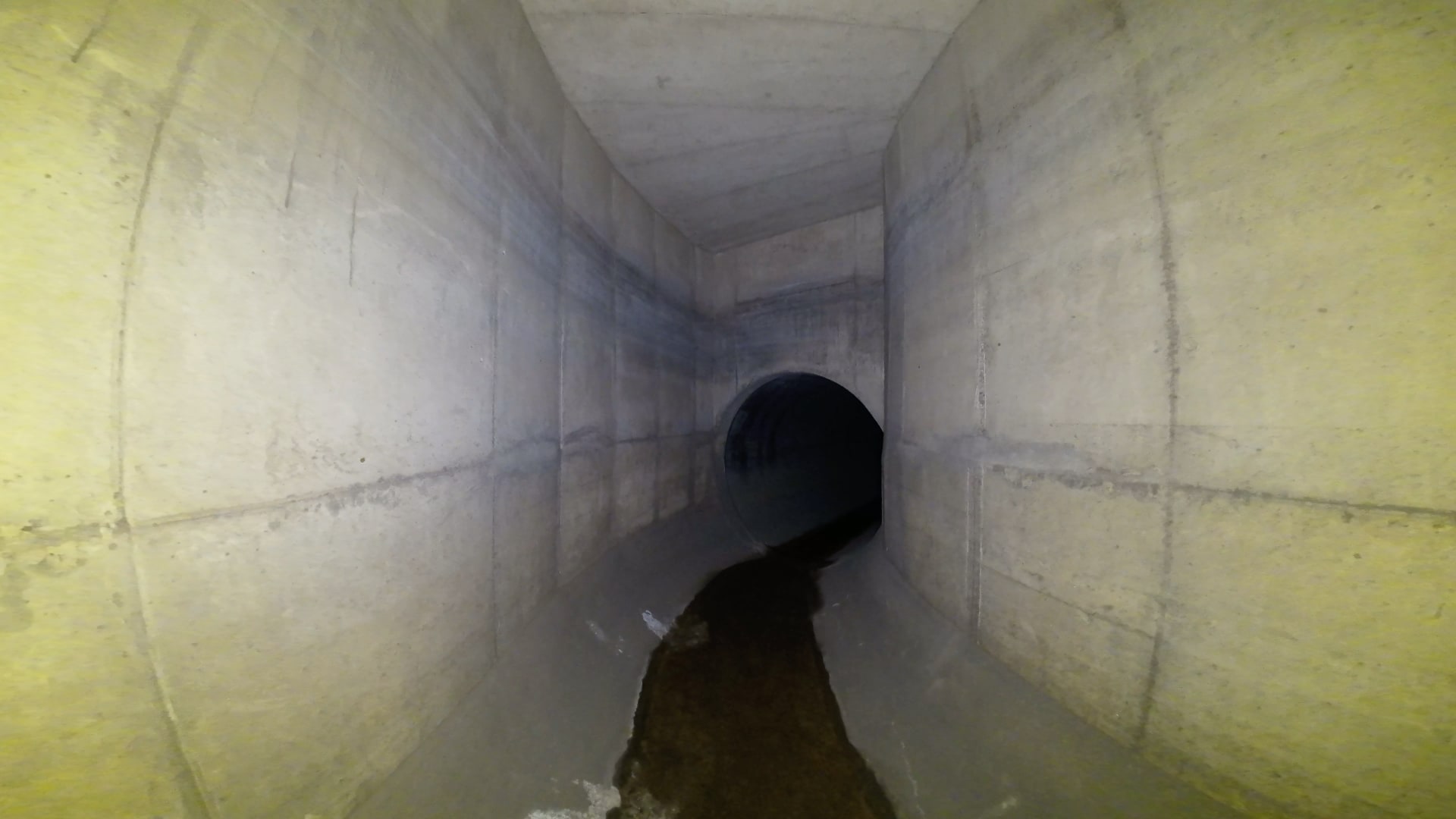
The ELIOS 3 in a sewer shaft – documentation from every angle, without personnel entry, without rescue chain.
Sewer drone inspections are used in two fundamentally different contexts – each with its own requirements for documentation, safety management and finding classification.
Municipal sewer systems: Urban wastewater systems consist of reaches, shaft structures, collector routes and special structures. In the north German coastal area, the specific Bremen sewer structures (Bremer Sielbauwerke) serve as a reference – an extensive network of Siele (brick-built historical sewers, some from the 19th century), pumping stations and storage basins that takes account of the special topography of the Hanseatic city. Many of these Siele are difficult to access for CCTV robots because cross-sections are oval or trapezoidal and have geometric changes. The ELIOS 3 navigates these cross-sections freely.
Industrial wastewater systems: Chemical parks, refineries and production plants operate their own wastewater networks with elevated requirements: contaminated fractions, neutralisation plants, oil separators, stormwater retention basins and discharge channels to the sewage treatment plant or into surface waters (water law permit, indirect dischargers per §58 WHG). Damage in these systems has immediate environmental liability relevance.
Inspection documentation for municipal sewers follows the standard DIN EN 13508-2 (condition assessment with optical methods) and the requirements of DWA-M 149 (condition classes 0–4). Industrial systems additionally comply with the requirements of authorities and the operating permit.
Bremen sewer structures, historical brick-built collectors, complex junction structures: the ELIOS 3 documents even irregular cross-sections that are inaccessible to CCTV robots.
Inspection Process with the ELIOS 3
A professional sewer inspection with the ELIOS 3 follows a standardised process that ensures safety, data quality and usability of results.

Talk Directly to Our Team
We have extensive experience with sewer and drainage inspections – both municipal and industrial. We advise you on feasibility and process.
 Christian Engelke
Managing Director & Chief Pilot
Christian Engelke
Managing Director & Chief Pilot
 Karsten Lehrke
Dipl.-Ing., Senior Inspector
Karsten Lehrke
Dipl.-Ing., Senior Inspector
 Philipp
Drone Pilot & Inspector
Philipp
Drone Pilot & Inspector
 Juliana
Project Coordination
Juliana
Project Coordination
 Stephan
Drone Pilot & Inspector
Stephan
Drone Pilot & Inspector
Related Services
- Sewer Inspection by Drone (Kanalinspektion Drohne) – Sewer and drainage pipes inspected by drone – fast, safe and without construction overhead.
- Confined Spaces Inspection – Tight and hard-to-access spaces safely and without personnel entry.
- Industrial Inspection Overview – All drone inspection deployment areas in industry.
- Water Management (Wasserwirtschaft) – Drone inspection in water management – basins, storage and plant.
- Underwater Inspection ROV – Submerged structures and basins inspected non-invasively with the ROV.
- Inspection Without Shutdown – When and how plant can be inspected during live operation.
Frequently Asked Questions: Sewer Inspection by Drone
Can the drone inspect through partially filled sewers?
Partially filled sewers are inspectable – the ELIOS 3 flies above the water surface and documents walls, joints and internals. Fully flooded cross-sections are not flyable (this is the domain of the underwater ROV). Best condition for drone inspection: emptied or low-flow section. For active wastewater systems, coordination with the network operator for a low-flow window is recommended.
What is the minimum cross-section the drone can fly through?
The ELIOS 3 navigates sewer cross-sections from DN 600 (60 cm diameter). For oval and trapezoidal cross-sections, the minimum dimension applies to the narrowest point. The cage design allows wall contact, so irregular cross-sections and bends are passable. Cross-sections below DN 600 are not flyable with the ELIOS 3 – here CCTV robots remain the appropriate tool.
Does drone inspection replace CCTV sewer inspection?
Not entirely – it complements it. CCTV robots are optimised for standard pipe cross-sections in free-flowing condition and deliver standardised data per EN 13508-2. The drone replaces CCTV when: cross-sections are too irregular, there are shaft structures with multiple connections, the sewer is partially filled or silted, or complex structures (siphons, basins, junction structures) need to be documented. The two technologies are ideally combined.
Which gas measurements are required before the deployment?
Before opening the shaft and before every drone deployment: measurement of H&sub2;S (hydrogen sulphide, limit <1 ppm), CH&sub4; (methane/LEL, limit <10% LEL), CO (carbon monoxide, limit <30 ppm), and O&sub2; (oxygen, target range 19.5–23 vol%). Measurement by trained personnel with calibrated equipment. If limit values are exceeded: ventilation measures, then re-measurement before drone deployment is released.
Is the drone inspection report accepted by authorities?
Yes. Our findings reports follow the standardised structure of DIN EN 13508-2 (damage coding for visual inspection) and the urgency levels of DWA-M 149. For municipal sewer operators, the reports are accepted as documentation for rehabilitation planning by water authorities. For industrial systems, compliance with the requirements of the operating permit applies additionally.
Can thermography also be used for sewer inspection?
Yes, and it is particularly valuable for infiltration detection: infiltrating groundwater is colder than the wastewater – these temperature differences are made visible by the thermography camera of the ELIOS 3. Active infiltration points can thus be identified even without visible moisture signs. This is particularly relevant for industrial sewer systems with environmental liability relevance.
Which documentation standard applies for sewer drone inspections?
For municipal systems: DIN EN 13508-2 (condition assessment of drain and sewer systems using CCTV inspection – coding system for visual inspection) and DWA-M 149 (condition classes 0–4, urgency levels for rehabilitation). GPS-referenced damage location, 3D cross-section profile from LiDAR, recommended actions per urgency level. For industrial systems: additional requirements from the operating permit and authority specifications.
Who is responsible for traffic safety during sewer drone inspection?
Traffic safety (Verkehrssicherung) for shaft openings in public roads is the responsibility of the sewer network operator in coordination with the road authority. We coordinate with you before the deployment regarding traffic safety requirements. For private plant roads and industrial areas: coordination with the plant operator. We adapt our on-site workflow to the existing safety measures.
Sewer Inspection Without Personnel Entry – Request a Quote
Describe your sewer network or wastewater structures – we check the suitability of the ELIOS 3 and prepare a quote. No entry permit required, no rescue chain, complete documentation.