
Indoor Drone Inspection with ELIOS 3 – Technology, Applications & Limits
GPS-free flight in tanks, boilers and chimneys – how SLAM navigation and cage protection make indoor inspection possible. Kopterflug has operated the ELIOS 3 in confined spaces since 2017.
Why Conventional Drones Fail in Industrial Interiors
Off-the-shelf drones are designed for outdoor use: GPS signal for position stabilisation, open airspace without collision risk, adequate visibility for the pilot. In industrial interiors – tanks, boilers, chimneys, silo systems, pipe galleries – all of these basic prerequisites fail completely.
The result: drones without specialised indoor technology are unflightable in confined spaces. They drift uncontrollably, collide with walls and are useless for precise inspection work. Exactly this gap is closed by the Flyability ELIOS 3 – the world's leading indoor industrial drone with a technology package specifically developed for GPS-free environments.
The Three Core Technologies of the ELIOS 3
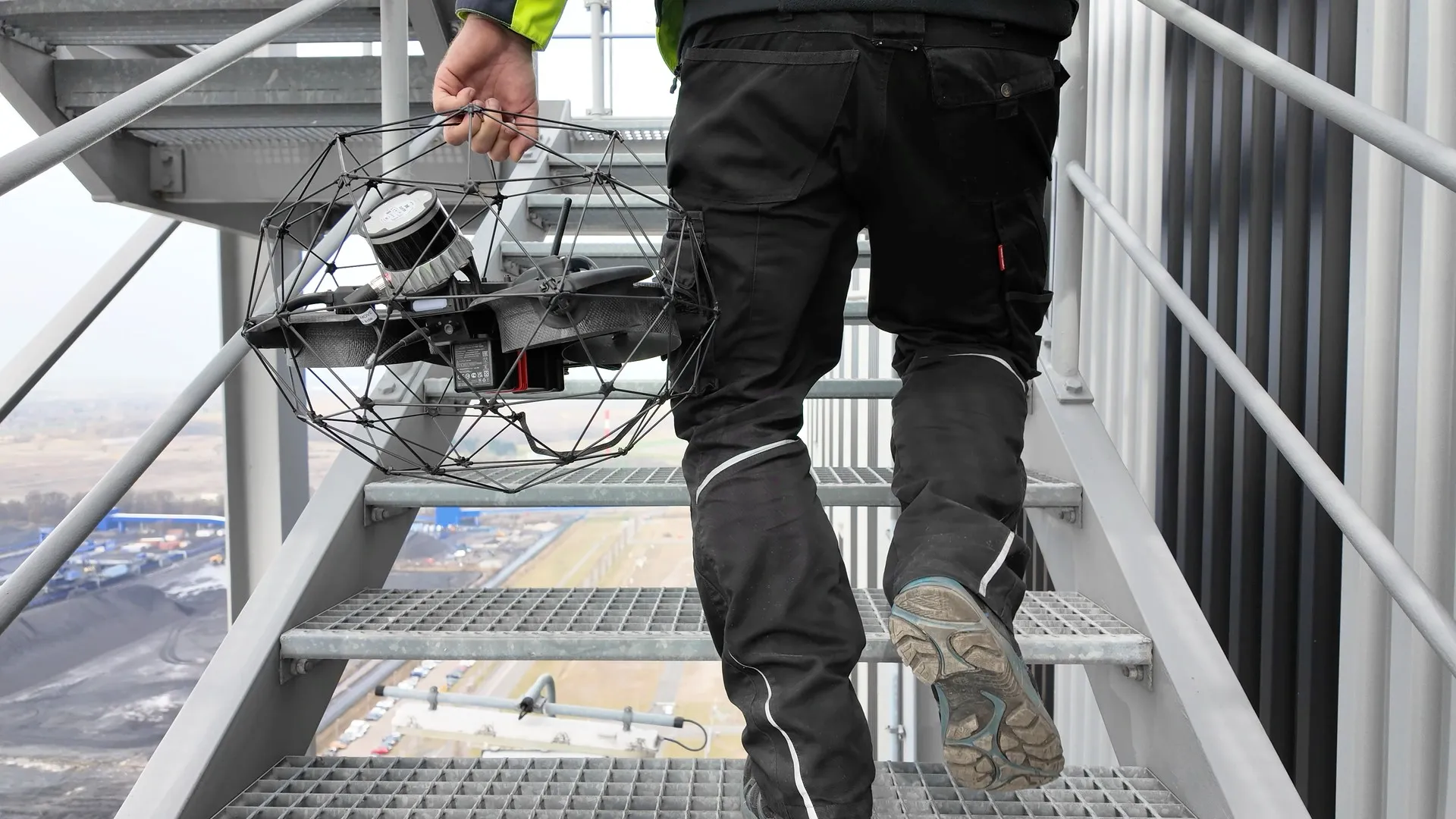
- SLAM Navigation (Simultaneous Localization and Mapping): Without GPS signal, the ELIOS 3 orients itself using a multi-sensor SLAM system. Depth sensors, optical flow (downward-facing camera), a 6-axis IMU and the integrated LiDAR scanner create a real-time 3D map of the environment – and locate the drone within it precisely.
- Impact-Resistant Cage Protection: The spherical carbon fibre cage absorbs collisions with walls, fittings and structures. The drone bounces off and continues flying – no crash, no camera damage. In a narrow chimney or between boiler tubes, contact is unavoidable; the cage makes it irrelevant.
- Integrated LiDAR Mapping: The Ouster OS0-32 LiDAR scanner generates a georeferenced 3D point cloud of the inspected structure during every flight. This data flows directly into Flyability Inspector 4.0 and allows precise geometry measurements, volume estimates and comparison scans over time.
The combination of these three technologies makes the ELIOS 3 the only drone that can reliably operate in industrial spaces with confined conditions, difficult lighting and without GPS signal.
Camera System and Image Quality: 4K in the Dark
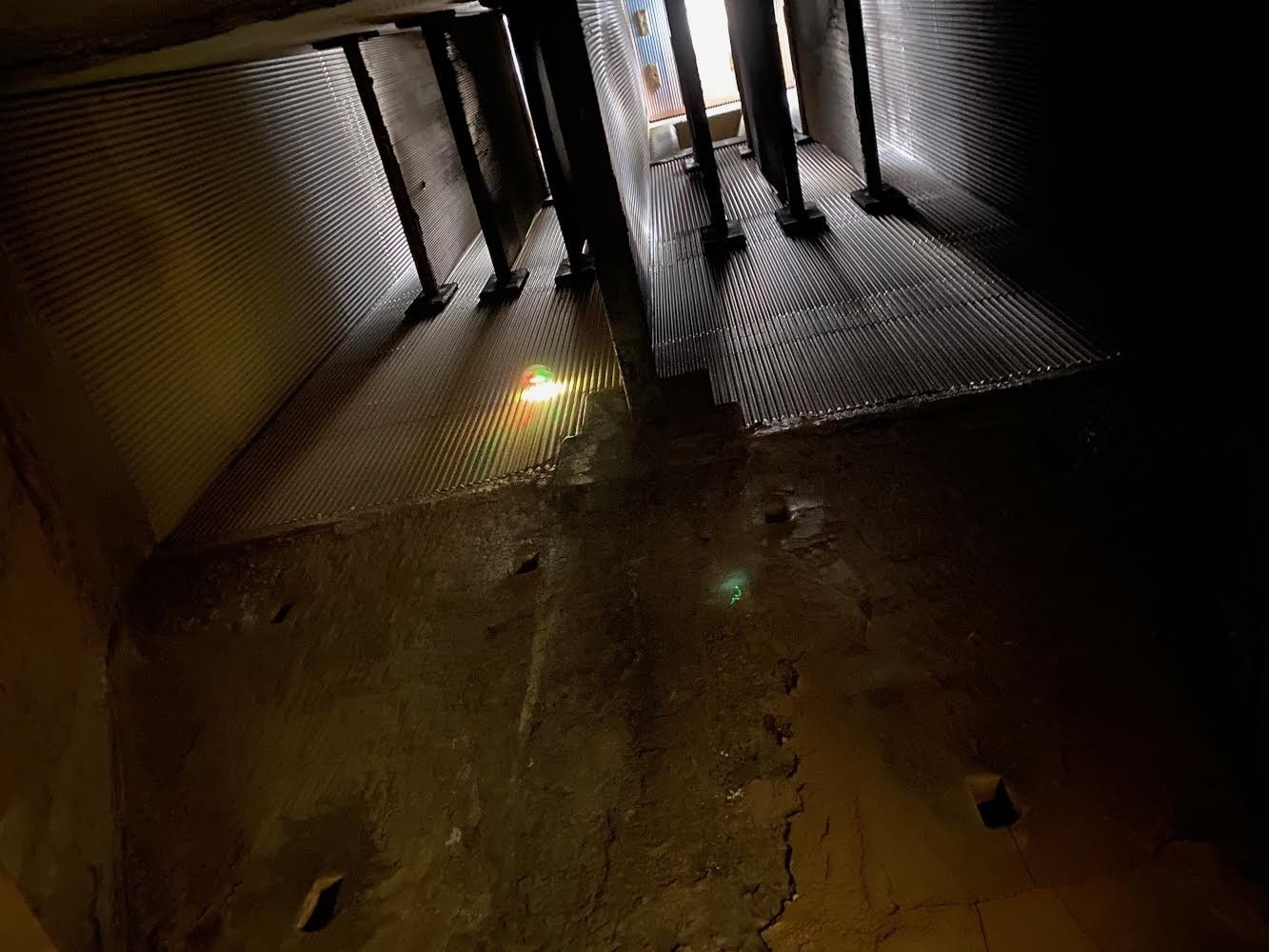
In the indoor environment, image quality is a system-level question: poor lighting, complex geometries and dust particles in the air challenge camera systems in ways that are unsolvable for normal drone cameras.
Camera Configuration of the ELIOS 3
- Main camera: Sony 1/2” CMOS sensor, 4K at 60fps, variable aperture f/1.8–f/8, Dual Native ISO for extreme low-light performance
- Lighting: 16,000 lm LED floodlight – fully illuminates dark vessels. For boilers with 10 m diameter, the illumination is sufficient for detailed 4K recordings.
- Optional thermal camera: Integrated FLIR Lepton or compatible radiometry camera for thermography inspections. Findings such as hot spots in refractory linings, active leaks or insulation-free areas become visible directly during flight.
- Gimbal stabilisation: 3-axis gimbal compensates for drone vibrations – sharp images even during turbulent flight in confined spaces.
Typical Image Quality in Practice
The 4K-60fps camera delivers footage that supports a visual inspection to DIN EN ISO 9712 VT Level 2. Cracks from approximately 0.5 mm width, corrosion pitting from approximately 1 mm depth and coating defects from a few square centimetres are recognisable in the recordings – provided the distance to the surface is less than 1 metre. For close-up shots of individual findings, the drone can be manoeuvred close to the wall.
The inspection report is compiled from the video material and LiDAR data. Flyability Inspector 4.0 allows frame-by-frame browsing of recordings in the 3D model – every finding is three-dimensionally localised and measurable.
Typical Indoor Inspection Objects: From DN 600 to Blast Furnace
The ELIOS 3 fits through openings from DN 600 (60 cm diameter) and can be introduced into all closed spaces that have manholes, inspection nozzles or access hatches. The range of applications is broad:
Vessels and Equipment
- Storage tanks (AST, PST): Inner wall corrosion, floor corrosion, roof structure, coating condition – without draining when residual content is suitable, or fully after draining
- Pressure vessels (PED vessels): Internal weld seam inspection, lining condition, fittings, nozzle inner surfaces
- Boilers and steam generators: Heating surfaces, flue gas-side corrosion, refractory damage, superheater fittings
- Columns and reactors: Trays, packings, distributors, inner wall condition without dismantling fittings
Ducts, Chimneys and Silos
- Flue gas ducts and routing: Corrosion, erosion damage, lining cracks, condensate nests
- Steel chimneys: From base to top internally without a riding apparatus – typical for chimneys 30–120 m high
- Silos and bunker systems: Wall and floor corrosion, fitting inspection, silo roof assessment
Infrastructure and Pipelines
- Pipe galleries and tunnels: Structural integrity, pipe corrosion, support points
- Cooling towers: Fittings, drift eliminators, concrete shell, water distribution decks
- Sewer systems and drainage structures: Concrete corrosion, crack detection, inflow areas
Preparation, Execution and Limits of Deployment
A successful indoor drone inspection requires careful preparation. The following points must be clarified before every deployment:
Before Deployment
- Geometry and access points: Manhole diameter, location of opening (top/side/bottom), internal obstacles (fittings, agitator shafts, stirrers). Ideally, isometric drawings or P&IDs are available.
- Atmospheric safety: Explosive gas analysis per TRGS 722, oxygen content (>18 vol%), toxic gases (H₂S, CO, NH₃). Deployment only begins after clearance from the safety officer.
- Temperature: Operating temperature of the ELIOS 3: −10°C to +45°C ambient. If residual temperatures in the vessel are higher, cooling time must be planned.
- Lighting situation: As a rule, the drone’s own lighting is sufficient. For very large volumes (tanks >15 m diameter), additional portable lighting may be beneficial.
Limits of Indoor Inspection
Despite its capabilities, the ELIOS 3 is not a universal tool. The following situations lie outside its optimal operating range:
- Very narrow pipelines: Below DN 600 the cage is too large – here ROVs or special pipe inspection cameras are used.
- Strong air currents: Pressurised gas flows above approx. 2 m/s can destabilise the drone.
- High-temperature zones: Above 45°C air temperature, the batteries and electronics are outside specification.
- Explosive atmospheres (ATEX Zone 0/1): The ELIOS 3 is not ATEX-certified. No deployment is possible in an ignitable atmosphere – the object must be purged and cleared for an explosion-free atmosphere.
Where the drone reaches its limits, we supplement it with conventional methods – our hybrid inspection combines the strengths of both approaches for optimal results.
Related Services




Frequently Asked Questions
What is the minimum opening size for the ELIOS 3?
The ELIOS 3 requires an opening of at least DN 600 (60 cm diameter). This is the standard manhole size for most industrial tanks and boilers. If your opening is smaller, alternative inspection methods such as ROVs or push cameras are used.
Does the ELIOS 3 require GPS?
No. The ELIOS 3 is specifically designed for GPS-free environments. It navigates using SLAM (Simultaneous Localization and Mapping), which combines depth sensors, optical flow, a 6-axis IMU and LiDAR to create a real-time 3D map and localise the drone within it.
Is the ELIOS 3 ATEX-certified?
No. The ELIOS 3 is not ATEX-certified and cannot be deployed in active explosive atmospheres (Zone 0/1). Before every deployment in a confined space, a gas measurement must confirm an explosion-free atmosphere. In certified ATEX environments still under process conditions, the drone cannot be used.
What data does the ELIOS 3 capture?
The ELIOS 3 captures simultaneously: 4K video (up to 60fps), radiometric thermography images, and LiDAR 3D point cloud. All data is georeferenced within the 3D model and processed in Flyability Inspector 4.0 for the final report.
How long does an indoor drone inspection take?
A typical tank or boiler inspection (diameter up to 15 m) takes 2–4 hours including setup, flight and preliminary evaluation. Large structures such as 80 m chimneys or multi-level boilers may take a full day. This compares to days or weeks of scaffolding preparation for conventional inspection.
Request an ELIOS 3 Inspection
We assess free of charge whether and how the ELIOS 3 is suitable for your confined spaces – opening dimensions, atmosphere, temperature. Describe your plant and we will get back to you.