
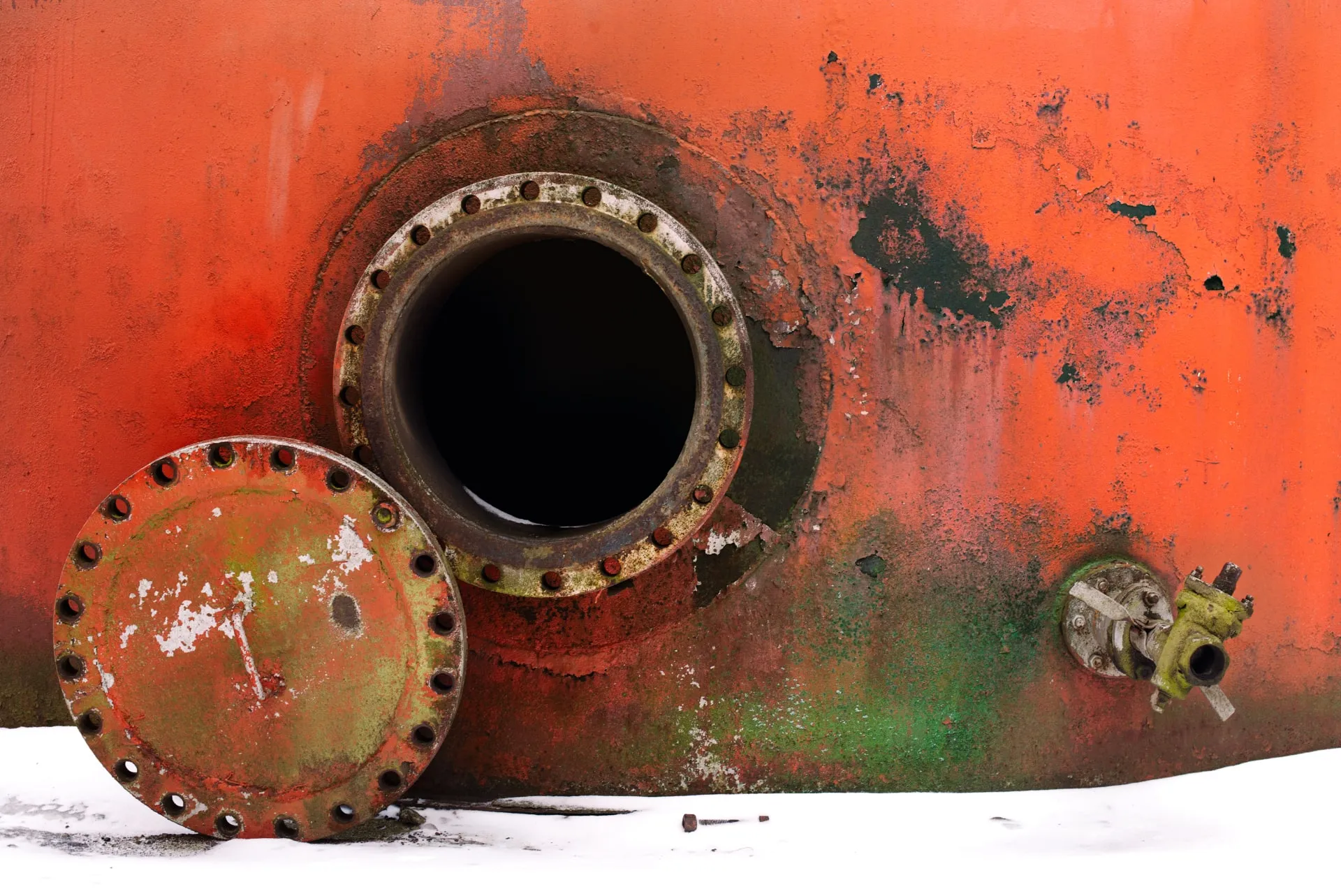
Confined Space Inspection by Drone – Without Human Entry
Kopterflug inspects tanks, boilers, silos, chimneys, reactors and channels using the Flyability ELIOS 3 – without personnel entry, without scaffolding, without a DGUV-Befahrung (German confined space entry permit). The drone flies in, your team stays outside.
- No human entry – DGUV confined space procedures do not apply to the inspection team
- GPS-free SLAM navigation in tanks, boilers, shafts and enclosed structures
- 4K + Thermography + LiDAR data capture in a single flight
- Up to 80% cost savings compared to conventional confined space entry
What Is a Confined Space? (German: enger Raum / umschlossener Raum)
A confined space (German: enger Raum or umschlossener Raum) is defined under DGUV Regel 113-004 (German statutory accident insurance rules for working in vessels, silos and confined spaces) as any area that:
- is not intended for continuous human occupation,
- has restricted entry and exit options, and
- may present hazards such as oxygen deficiency, toxic gases, explosion risk, or structural collapse.
Typical industrial examples: tanks, boilers, silos, chimneys, columns, reactors, sewers and industrial furnaces.
The Challenge: Human Entry into Confined Spaces
Working in confined spaces is among the most hazardous activities in industry. Tanks, silos, boilers and shafts are often difficult to access, poorly lit, and carry significant risks.







Our Solution: The Flyability ELIOS 3 Drone
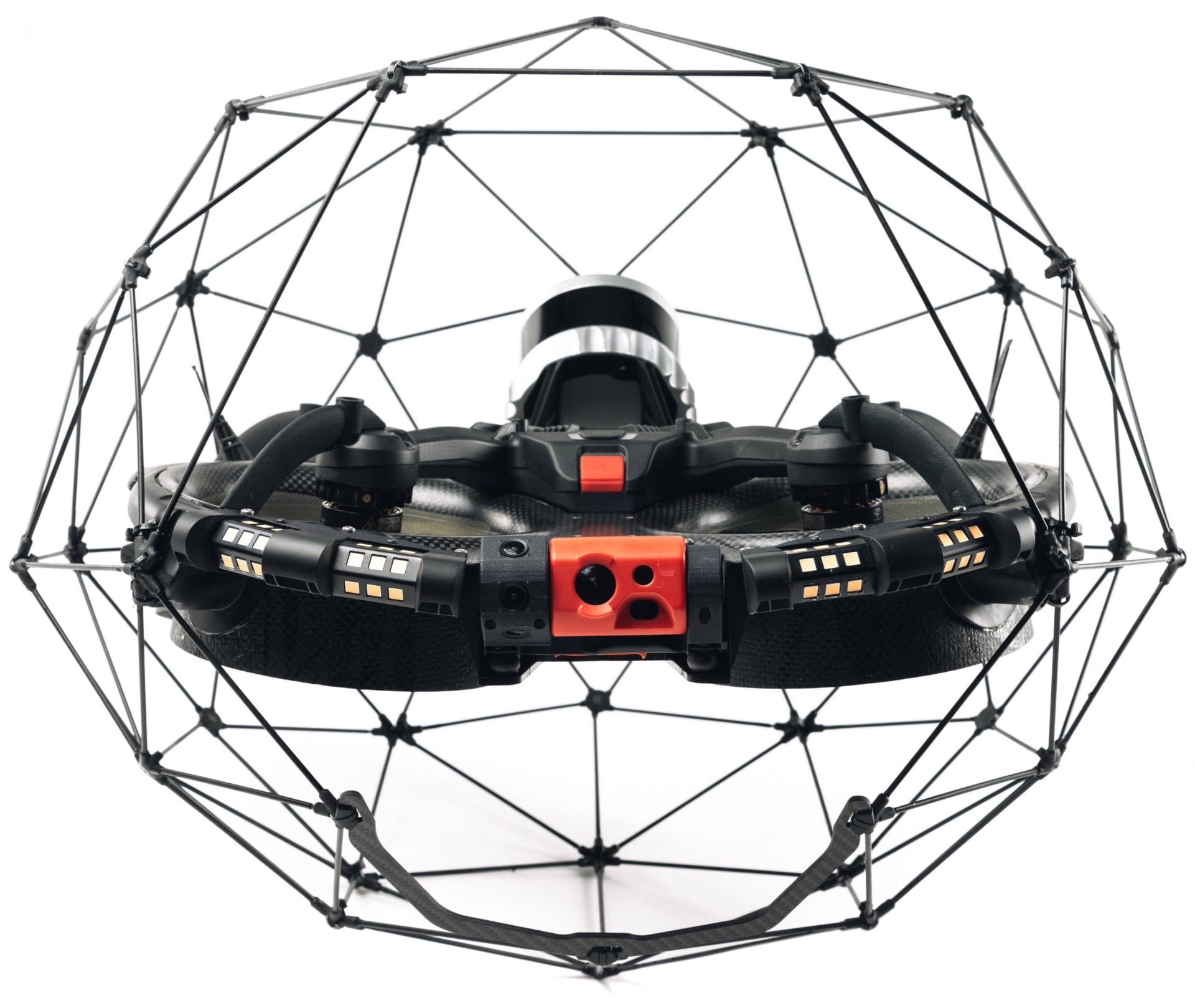
The ELIOS 3 with its collision-safe carbon cage – designed for confined, dark and hazardous industrial environments.
At Kopterflug, we offer confined space inspection by drone to document hazardous interiors safely and efficiently. Our drone services set new standards: no human entry, no DGUV-Befahrung (confined space entry permit), no scaffolding, no rescue chain. The ELIOS 3 navigates GPS-independently using SLAM technology and LiDAR through confined spaces – collision-safe thanks to its fully enclosed protective cage. This allows us to precisely document corrosion, cracks, coating damage and structural anomalies.
A major advantage: drastically reduced downtime and costs compared to conventional entry. No gas measurement preparation, no ventilation, no safety guards – in many cases up to 80% cheaper. Our high-resolution 4K images, thermography recordings and LiDAR point clouds provide a reliable basis for assessment by your maintenance teams.
- No human entry – DGUV confined space procedures do not apply to the inspection team
- GPS-independent navigation in enclosed spaces (SLAM + LiDAR)
- Collision-safe drone for narrow, complex interiors
- 4K + thermography + LiDAR data capture in a single flight
- Up to 80% cost savings compared to conventional confined space entry
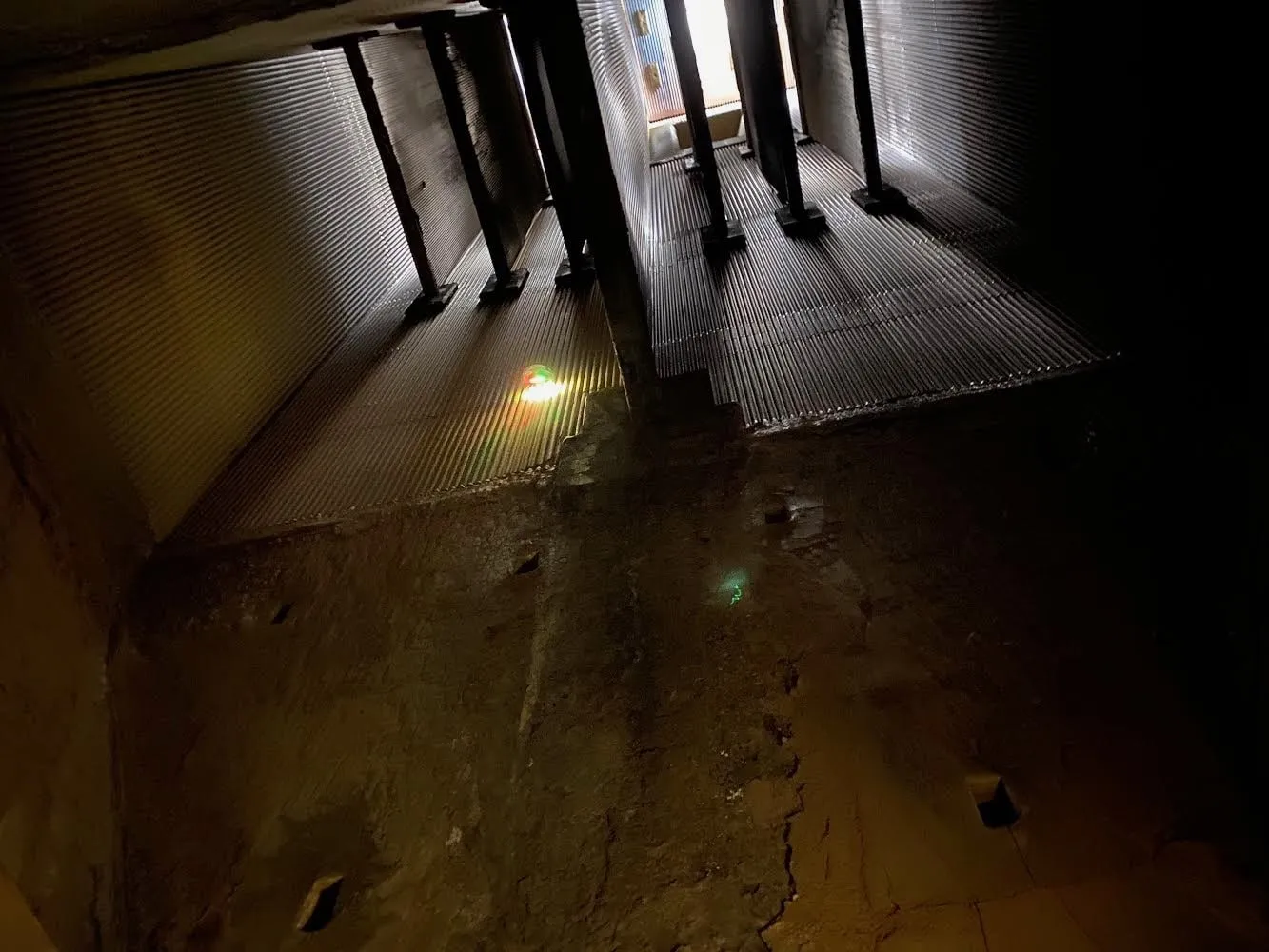
The ELIOS 3 in action inside an industrial power plant boiler – zero human entry required.
What the ELIOS 3 Documents in Confined Spaces
We inspect with the ELIOS 3 and systematically document all safety-relevant areas in confined spaces. The technical assessment is carried out by your maintenance teams – we deliver the data:
Walls, Weld Seams & Coatings
What we capture: 4K recordings of corrosion, wall thinning, pitting, weld seam damage, coating failures and cracks.
Why it matters: Corrosion in confined spaces is often invisible until failure occurs. Early detection prevents leakage, contamination and structural failure. Your experts assess findings based on our data.
How we do it: 4K camera from close proximity (ELIOS 3), thermography for hidden hotspots and moisture damage.
Floors, Residues & Corrosion Indicators
What we capture: Product residues and deposits from the previous medium, corrosion traces, coating damage, pitting and area-wide material loss at the vessel floor.
Why it matters: The floor of a vessel often gives the clearest indication of the overall asset condition. Media residues may have accelerated corrosion – visible through discolouration, pitting or exposed base material.
How we do it: 4K camera documents floor and wall transitions at close range; LiDAR captures geometry and unevenness precisely.
Internals, Pipework & Structures
What we capture: Condition of agitators, pipelines, ladders, connections, internals and support structures.
Why it matters: Loose or damaged internals are safety hazards. We document the condition of all accessible components – without anyone needing to enter.
How we do it: 360° documentation with the ELIOS 3, 16,000-lumen LED lighting for the darkest environments.
Geometry & 3D Survey
What we capture: Deformations, settlements, wall thickness changes, volume changes and comparison measurements.
Why it matters: LiDAR point clouds deliver centimetre-accurate 3D models. Digital twins enable comparison inspections over years – damage progression becomes measurable.
How we do it: The ELIOS 3 LiDAR sensor generates real-time 3D point clouds (SLAM-based).
At the end, we hand over a detailed inspection report with 4K images, thermography evaluation (on request), LiDAR point clouds (optional) and a systematic findings overview. Your maintenance teams assess the findings and make the decisions.
Confined Spaces We Inspect
Safe, precise, without human entry – and without complex DGUV confined space procedures or scaffolding: the ELIOS 3 handles all types of narrow, dark, hazardous or inaccessible spaces.




Tanks & Vessels
Crude oil tanks, fuel tanks, chemical tanks, water/wastewater tanks, ballast tanks (ships), pressure vessels – inspection without human entry and without DGUV-Befahrung.
- Sensors: Visual (4K), LiDAR, thermography, UT (optional)
- Typical findings: Corrosion & wall thickness reduction, sediment/sludge deposits, coating damage, weld seam defects, deformations
Boilers, Furnaces & Combustion Chambers
Steam boilers, waste heat boilers, industrial furnaces, firing systems, reactor boilers, FCC units – documentation of wear and damage without DGUV-Befahrung. Findings list for certified inspectors (TÜV/DEKRA) in accordance with BetrSichV (German Industrial Safety Regulation).
- Sensors: Visual, thermography
- Typical findings: Refractory lining damage (spalling, cracks), thermal hotspots, corrosion, soot/ash deposits, structural deformations
Columns, Reactors & Process Vessels
Distillation columns, reactors, separators, scrubbers, process vessels in chemical/petrochemical plants – inspection in toxic or explosive atmospheres without risk (after gas-free measurement).
- Sensors: Visual, LiDAR
- Typical findings: Corrosion (including in ATEX zones after gas-free clearance), coating defects, loose internals/tray damage, deformations, deposits, blockages
Chimneys, Stacks, Flares & Flue Gas Ducts
Chimneys, flares, flue gas lines, smoke ducts, industrial stacks – vertical and horizontal inspection without scaffolding or industrial climbers.
- Sensors: Visual, LiDAR, thermography
- Typical findings: Refractory lining detachment, cracks & corrosion, structural deformations, thermal anomalies, deposits
Silos, Bunkers & Storage Rooms
Cement silos, grain/feed silos, coal bunkers, raw material/ore silos, bulk material storage – condition survey without human entry.
- Sensors: Visual, LiDAR
- Typical findings: Wall wear & abrasion, material bridging/buildup, cracks, deformations, corrosion, fill level & volume control
Channels, Pipelines & Shafts
Walkable profiles (from DN 1200), main collectors, sewers, special structures, penstocks, pressure pipelines, mining shafts – inspection without entry.
- Sensors: Visual, LiDAR
- Typical findings: Deposits & blockages, cracks, infiltration & leaks, deformations, corrosion, root intrusion, hang-ups (mining)
Ballast Tanks & Ship Compartments
Ballast tanks, cargo tanks, double bottoms on ships and offshore platforms – inspection without scaffolding, without confined space entry.
- Sensors: Visual, LiDAR, UT (optional)
- Typical findings: Corrosion, coating damage, structural defects
Tunnels & Underground Areas
Old adits, access drifts, ventilation tunnels in mining and infrastructure – mapping and condition capture without personnel risk.
- Sensors: Visual, LiDAR
- Typical findings: Rockfall risk, convergence, cracks, water ingress, volume & mapping data
Note: The ELIOS 3 is not ATEX-certified. Deployments in potentially explosive zones (Ex zones) are carried out only after gas-free measurement and operator clearance. Minimum access opening: approx. DN 600 (50–60 cm). Internal clearance of approx. 1.5 m recommended for full sensor use.
Complementary Systems for Water-Filled Confined Spaces
The ELIOS 3 is our primary system for confined spaces – tanks, boilers, shafts and pipes. Two complementary systems extend coverage:
- Chasing M2 Pro Max (underwater drone): Inspects tanks and vessels with standing water – no diver, no draining. Ideal for water-filled confined spaces and ship compartments. See: /unterwasserinspektion
- Handheld LiDAR scanner: Ground-level 3D capture of pipelines, foundations and outer contours of adjacent areas. No tripod. Complements the ELIOS 3 LiDAR scan for a complete model (E57/LAZ). See: /lidar-vermessung-industrie
Key Benefits: Why Drone Instead of Conventional Entry?
- No human entry – the decisive safety advantage: Your staff stay safe. The drone carries out the inspection – no DGUV-Befahrung, no respiratory protection, no rescue chain.
- Minimal downtime: Inspection in hours instead of days or weeks. No weeks of preparation for confined space entry procedures.
- 4K + Thermography + LiDAR: High-resolution images, thermal analysis and 3D point clouds – complete documentation in a single flight.
- Up to 80% cost savings: No gas measurement preparation, ventilation or rescue chain costs. No scaffolding, no entry teams – drastically cheaper.
- Reproducible inspections: Stored flight paths and 3D maps enable comparison inspections over years. Damage progression becomes measurable.
- Report quality for certified inspectors: Structured reports with 4K screenshots, thermography evaluation and 3D models. Suitable as a basis for certified inspectors (TÜV/DEKRA) and BetrSichV documentation.
Conventional Confined Space Entry vs. Drone Inspection
| Aspect | DGUV-Befahrung (conventional entry) | Drone Inspection (ELIOS 3) |
|---|---|---|
| Human entry | Required – respiratory protection and safety guard (Sicherungsposten) mandatory | No entry – drone flies in, team stays outside |
| DGUV entry permit | Mandatory under DGUV Regel 113-004 | Does not apply to the inspection team |
| Rescue readiness | At least one person permanently standing by outside | Not required |
| Preparation | Gas measurement, ventilation, safety guards, permits – days | Gas-free measurement, access point – deployment in hours |
| Downtime | 2–5 days including pre- and post-processing | A few hours |
| Documentation | Photos by technician, spot-check and incomplete | 4K full coverage, thermography, LiDAR 3D model |
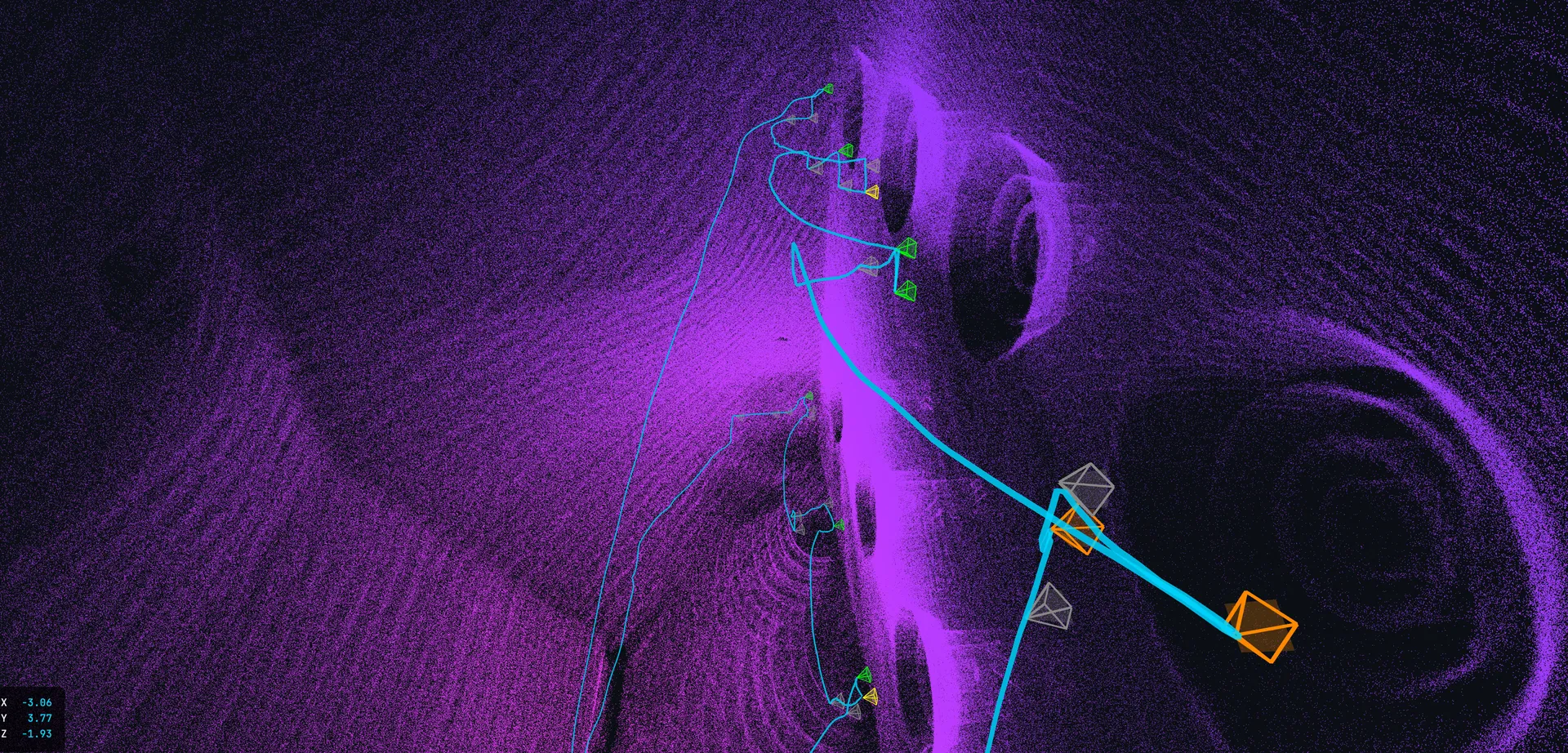
LiDAR 3D point cloud generated by the ELIOS 3 inside an industrial boiler – centimetre-accurate geometry data for documentation and digital twins.
Applicable Standards & Compliance
The use of drones in confined spaces follows the relevant German regulations. The decisive advantage: no human entry means that DGUV Regel 113-004 (entry into vessels, silos and confined spaces) does not apply to the inspection personnel.
| Standard / Regulation | Relevance to Drone Inspection |
|---|---|
| DGUV Regel 113-004 | Governs entry into vessels, silos and confined spaces (German statutory accident insurance rules). With drone deployment: no human entry – DGUV 113-004 does not apply to the inspection team. |
| BetrSichV (German Industrial Safety Regulation) | Basis for inspection obligations on safety-critical plant. Kopterflug delivers findings data as a basis for certified inspectors (TÜV/DEKRA). |
| EN 12952 / EN 12953 | Standards for water-tube and shell boilers – basis for recurring inspections. Drone data as documentation foundation. |
| API 653 | Standard for tank inspections – drone data as basis for assessment by accredited inspectors. |
Inspection Process: Step by Step
Step 1: Initial Consultation & Analysis (free)
We analyse your confined space: which asset? which hazards? We select the optimal inspection method and assess technical feasibility based on your drawings. Free of charge and without obligation.
Step 2: Scheduling & Quotation
You receive a transparent quotation. Together we plan the timing, access and safety concept – coordinated with your teams and revision planner.
Step 3: On-Site Inspection
We carry out the inspection – always with at least two people (pilot + assistant) for maximum safety. Significantly faster than conventional entry. No human entry into the confined space.
Step 4: Data Processing & Inspection Report
You receive a detailed report with 4K images, thermography analysis (on request), LiDAR point clouds (optional) and a systematic findings overview. Typically delivered within a few working days.
Your Contacts for Confined Space Inspections
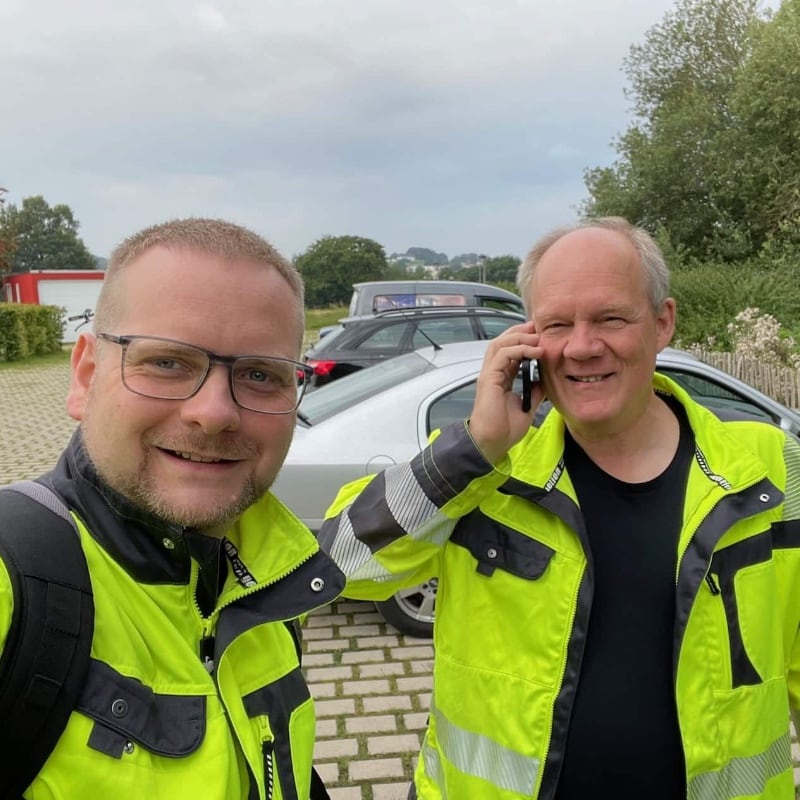
Christian Engelke and Dipl.-Ing. Karsten Lehrke – your direct contacts for confined space inspection projects.
Since 2017, Kopterflug has been inspecting confined spaces throughout Germany – from small boilers to large industrial tanks. As ELIOS 3 specialists, we document corrosion, thermography findings and 3D point clouds wherever human entry is hazardous or impossible. Our certified drone pilots have carried out hundreds of deployments in tanks, boilers, silos and shafts.
We work as a standard two-person team – pilot and assistant – with our own safety concept and gas-free measurement capability. We advise openly and without sales pressure.
Related Services
- Flyability ELIOS 3 – The collision-safe indoor drone: technology, sensors and operational limits in detail.
- Tank Inspection – Inner walls, floors and coatings in storage tanks without draining or entry.
- Boiler Inspection – Steam boilers and pressure vessels – findings for certified inspectors without DGUV-Befahrung.
- Silo Inspection – Structural survey and volume determination in silos and bunkers without entry.
- Chimney Inspection – Vertical inspection of industrial chimneys and stacks without climbing teams.
- Industrial LiDAR Survey – 3D point clouds with the ELIOS 3 Surveying Payload for digital twins and volume measurement.
- Condition Documentation – 4K video, findings list and PDF report – audit-proof documentation after every inspection.
- Costs & Effort – Why eliminating rescue concepts and scaffolding reduces costs dramatically.
Frequently Asked Questions
24 questions on confined space drone inspection – from technical basics to practical deployment planning.
What exactly is a confined space?
A confined space (German: enger Raum / umschlossener Raum) is defined under DGUV Regel 113-004 as any area not intended for continuous human occupation, with restricted entry and exit options, that may present hazards such as oxygen deficiency, toxic gases, explosion risk or structural collapse. Typical examples are tanks, boilers, silos, chimneys, columns, reactors and sewers.
What types of confined spaces can the ELIOS 3 inspect?
The ELIOS 3 inspects virtually all types of confined spaces: tanks and storage vessels, boilers and combustion chambers, silos and bunkers, chimneys and shafts, columns and reactors, channels and large-diameter pipelines (from DN 1200), and industrial furnaces. The key requirements are an opening for drone entry and sufficient space inside.
How does the drone navigate without GPS in confined spaces?
The ELIOS 3 navigates GPS-independently using SLAM technology (Simultaneous Localization and Mapping). The integrated LiDAR sensor captures the surroundings in real time and creates a 3D map, from which the drone determines its position. Additionally, the fully enclosed protective cage ensures collision safety – the drone can touch walls and internals without crashing.
How is gas safety ensured during confined space inspections?
Before every deployment, we carry out a gas-free measurement (Gasfreimessung) with our multi-gas sensor, measuring O&sub2;, LEL (explosion limit), H&sub2;S and CO. The ELIOS 3 is not ATEX-certified – a gas-free atmosphere must be confirmed before the drone enters. We work as a standard two-person team (pilot and assistant) with our own safety concept; for some assignments also as three.
What minimum opening size does the ELIOS 3 need to enter?
The ELIOS 3 can enter through a DN 600 manhole as the access point to the confined space. Inside, the drone requires approx. 1.5 m clear diameter to fly in a controlled manner and use all sensors. During the free initial consultation, we assess feasibility based on your plant drawings.
Does the drone inspection completely eliminate human entry?
In many cases, the drone inspection fully replaces human entry – especially for visual condition surveys, thermography and LiDAR measurement. For certain checks (e.g. contact ultrasonic wall thickness measurement or repairs), a human entry may still be necessary. Our data allows your inspectors to decide precisely whether and where an entry is truly required – significantly reducing risk and effort.
What data is delivered from a confined space inspection?
You receive a detailed inspection report with 4K images of all documented areas, LiDAR 3D point clouds for geometry measurement and digital twins, and on request thermography recordings for hotspots, leaks and insulation damage. All findings are systematically documented with positional reference.
Which standards apply to confined space inspections?
Our inspections follow DGUV Regel 113-004 (working in vessels, silos and confined spaces) and BetrSichV (German Industrial Safety Regulation). Since no human entry occurs, the confined space entry requirements of the DGUV do not apply to the actual inspection. The documentation is structured so that your inspectors and experts can assess findings on this basis.
What risks does drone inspection reduce in confined spaces?
The decisive advantage: nobody has to enter the vessel. This eliminates the greatest confined space risks: no exposure in hazardous atmospheres, no respiratory protection inside the vessel, no rescue chain required. Gases, oxygen deficiency, falls, narrow escape routes – all these affect only persons, not the drone. We have carried out hundreds of deployments in tanks, boilers and silos – more on our pages for Tank Inspection, Boiler Inspection and Silo Inspection.
How much time and cost can be saved with confined space drone inspection?
Savings arise primarily from three factors: no scaffolding, no complex DGUV confined space preparation, and significantly shorter deployment duration. What classically takes days is often completed in a few hours with the drone. In many cases, up to 80% cost savings are achievable. We have inspected hundreds of vessels, boilers and silos ourselves – more on our Tank Inspection and Boiler Inspection pages.
Can the drone detect corrosion and damage in confined spaces?
Yes – and this is one of the primary application areas. The 4K camera of the ELIOS 3 enables close-up imaging of weld seams, wall areas and internals that are often difficult to reach in conventional entry. Corrosion, cracking, coating breakdown and erosion become clearly visible and documentable. We have confirmed this in numerous own deployments – more on our Tank Inspection and Condition Documentation pages.
Can thermography be used in confined spaces?
Yes. The ELIOS 3 is equipped as standard with an integrated thermography camera (Thermografiekamera). This makes temperature differences visible – indicating moisture, insulation defects or thermal anomalies in vessel walls. Thermography is an indication method, not a substitute for further testing procedures. We deploy thermography in many of our confined space assignments – more at Confined Spaces Inspection and Condition Documentation.
How long does a typical confined space inspection take?
Depending on vessel size and sensor package, typically just a few hours – compared to the multi-day preparation and execution time of conventional entry. In many cases, multiple assets can be processed in a single deployment day. We plan the deployment in advance with your revision planner. More on the process: Confined Spaces Inspection.
What happens if the drone touches internals in the confined space?
The ELIOS 3 is built precisely for these situations: the carbon protective cage absorbs light collisions, and the drone stabilises autonomously. In the event of a flip, it independently returns to normal orientation. Reverse motors enable active manoeuvring when caught. In our own deployments in tanks, boilers and silos we have experienced this repeatedly – no crash, no damage. More on the technology: ELIOS 3 at Kopterflug.
Can the drone get stuck in a confined space?
The risk is very low by design, but cannot be fully excluded. Therefore, all deployments are planned with a clear retrieval and safety concept. In our long-standing experience with hundreds of vessels, boilers and shafts, this is not an obstacle – but a calculable risk with appropriate planning. We discuss our safety concept openly during the initial consultation.
Can the drone carry out UT wall thickness measurements in confined spaces?
Yes – with the optional Cygnus Ultrasonic Payload (Ultraschall-Payload), the ELIOS 3 enables georeferenced wall thickness measurements in flight. This allows corrosion mapping without human entry. We offer this service in our deployments for Tanks and Boilers. The UT payload makes physical contact with the inner wall to measure wall thickness; LiDAR alone only measures geometry.
Are confined space drone inspections repeatable and comparable?
Yes – this is one of the strategic advantages. Georeferenced LiDAR data and structured 4K image series enable direct comparison between inspection cycles. Corrosion progression, new damage and geometry changes become measurable and documentable. This forms the basis for condition-based maintenance (zustandsbasierte Instandhaltung) and RBI decisions. More: LiDAR Survey, Condition Documentation.
Is the ELIOS 3 also suitable for tall shafts and chimneys?
Yes. Vertical structures such as shafts, industrial chimneys and flue gas ducts are among the classic applications of the ELIOS 3. The drone flies vertically, documenting inner walls along their full height without scaffolding or industrial climbers. We offer this as a standalone service: Chimney Inspection.
Does the drone work in dusty or wet confined spaces?
Yes, within its technical limits. The ELIOS 3 has IP44 protection rating (dust and splash water); the LiDAR payload is even IP68 rated. It operates reliably in humid, dusty and dimly lit environments. In cases of extreme dust concentration or aggressive media, we discuss suitability with you in advance. We have confirmed this in many own deployments – e.g. in Silos, Sewer Systems and Tanks.
Who carries out the confined space inspections?
Our certified drone pilots have been specialised in confined space deployments since 2017. We work as a standard two-person team – pilot and assistant – with our own safety concept and gas-free measurement equipment; for some assignments also as three. We know the specific characteristics of tanks, boilers, silos and shafts from practical experience with hundreds of deployments. More on our team and approach: Confined Spaces Inspection.
Are there real references from your own confined space deployments?
Yes – since 2017 we have personally inspected hundreds of vessels, boilers, silos and shafts. On our sector-specific pages you will find deployment descriptions: Tank Inspection, Boiler Inspection, Silo Inspection, Chimney Inspection, Sewer Inspection. External references from Flyability: Tank and Boiler case studies.
Why is the Flyability ELIOS 3 specifically used for confined spaces?
The ELIOS 3 is the only drone that makes real confined spaces reliably flyable: collision-safe carbon cage, GPS-independent SLAM navigation, 16,000-lumen lighting for completely dark spaces, LiDAR and optional thermography. Other drones are either too fragile, too large or not designed for narrow, dark interiors. We have deployed the ELIOS 3 in our own operations since 2017 and know its strengths and limits from practice. More on the technology: Flyability ELIOS 3 at Kopterflug.
When is the drone not suitable for confined spaces – and what are the limits?
Drone inspection reaches its limits with: openings below approx. DN 600 (too narrow for the ELIOS 3), active ATEX zones without gas-free measurement (the ELIOS 3 is not ATEX-certified), temperatures above approx. 50–55°C inside the vessel (plant must be fully cooled), contact-based testing procedures such as direct manual ultrasonic wall thickness measurement, and legally prescribed inspections by licensed inspection personnel – here the drone can do preparatory work, but cannot replace the certified inspector. When in doubt, we assess feasibility in advance during a free initial consultation.
What do we need to prepare as a company for a smooth confined space inspection?
As a rule, the effort on your side is minimal: access to the plant (manhole, inspection opening), information on atmospheric conditions in advance (we carry out our own gas-free measurement), a brief safety briefing by your on-site safety officer, and – for vessel inspections – a cooled-down, depressurised plant. We draw up the safety concept, coordinate permits and align the process with your revision planner in advance.
Get in Touch
Questions about confined space drone inspection? Need a quote or want to assess feasibility for your plant? Fill out the form below – we respond within 24 hours.