
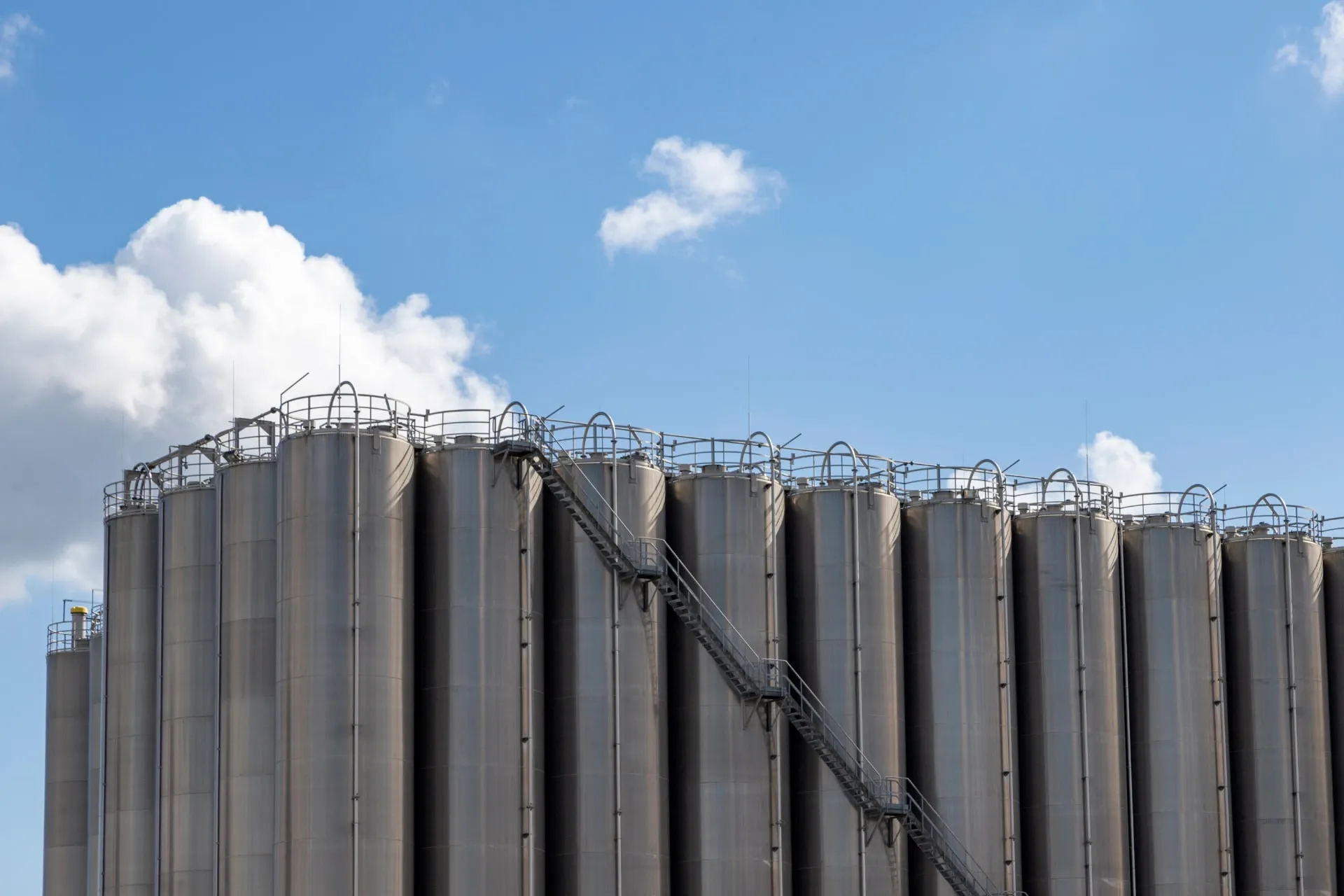
Silo Inspection by Drone – Without Entry, Without Scaffolding
Kopterflug inspects silos of all types with the Flyability ELIOS 3 – cement, grain, chemical, coal and industrial silos – without personnel entry (Personeneinstieg), without confined space authorisation (Befahrungsgenehmigung), and without lengthy shutdowns. 4K video, thermography and LiDAR 3D point clouds in a single flight.
- No personnel entry – drone flies in, your team stays outside
- DN 600 as practical minimum opening (standard inspection manholes)
- 4K + Thermography + LiDAR in one deployment
- DGUV-compliant – no confined space entry procedure required
The Challenge: Why Silos Are Difficult to Inspect
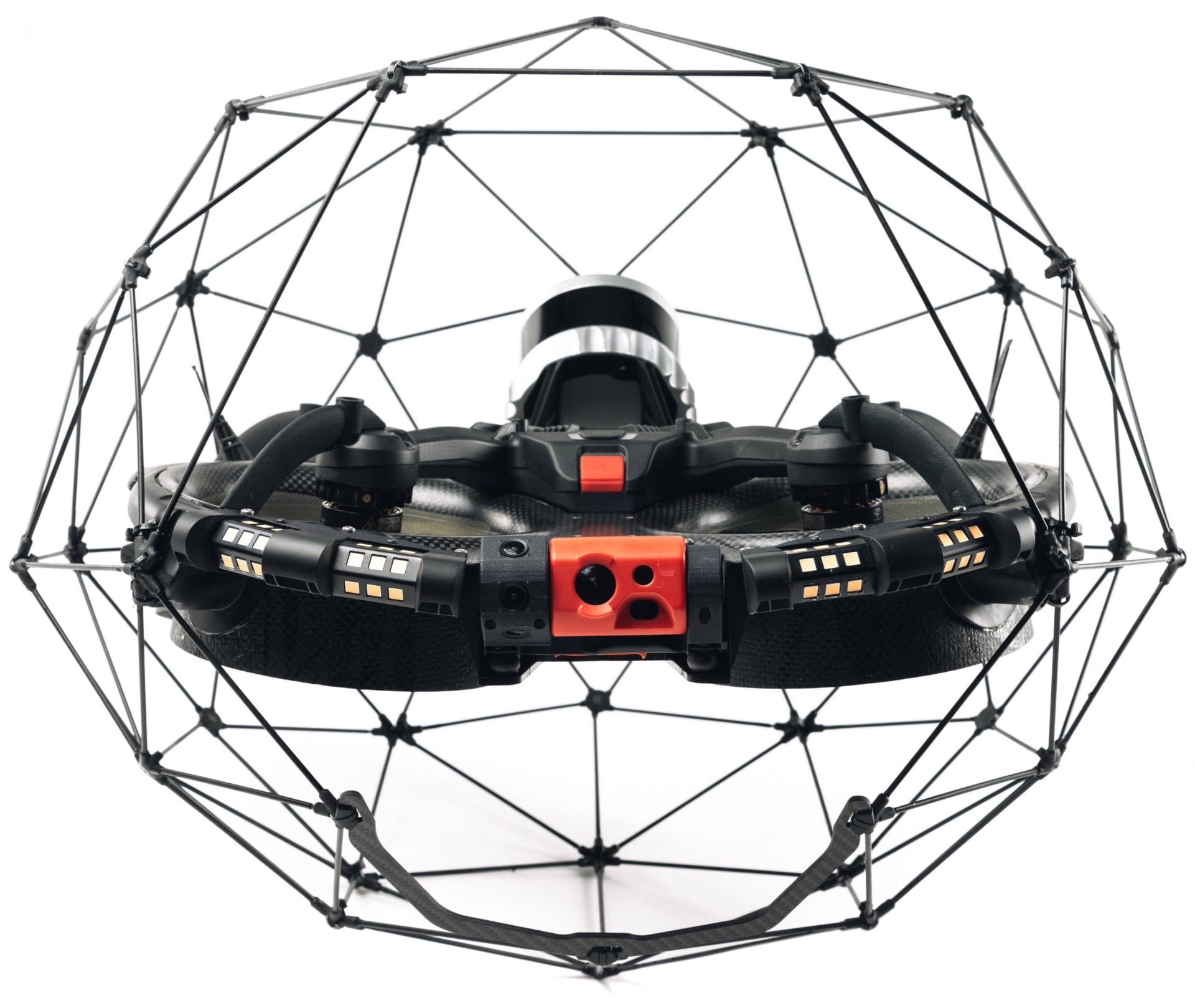
The ELIOS 3 with its collision-safe carbon cage – designed for the confined, dusty interiors of industrial silos.
Silos are operationally indispensable – and one of the most demanding inspection challenges in industry. Whether cement clinker, grain, hydrated lime or ore: the inside of a silo is tall (typically 20–80 m), narrow, dusty and often contaminated. Emptying means days of shutdown. Entering (Befahren) means asphyxiation risk, engulfment hazard and extensive safety measures under DGUV Regel 113-004.
The DGUV Regel 113-004 (Arbeiten in Behältern und engen Räumen – Working in Vessels and Confined Spaces) makes silo entry (Silo-Befahrung) a permit-required process with rescue chains, gas-free measurement (Gasfreimessung) and safety observers (Sicherungsposten). For many operators, this is why inspections are deferred or limited to external visual checks – with serious consequences for structural integrity and discharge reliability.
The Flyability ELIOS 3 fundamentally changes this situation: it flies into silos without GPS, without external lighting and without fixed geometry – and delivers 4K video, thermography and a precise 3D LiDAR point cloud of the interior. No personnel entry, no confined space permit, minimal shutdown time.
Typical damage patterns vary strongly by silo type. In cement silos: buildup (Anbackungen) and bridging (Brückenbildung), abrasion of the liner from sharp clinker particles, corrosion at the aeration unit. In grain silos: pest infestation in joints and weld seams, condensation corrosion on the roof from temperature cycling, coating cracking from swelling pressure. In chemical silos: chemical attack on interior coatings, pitting corrosion from aggressive media, sensor fouling from deposits. In concrete silos: carbonation (Carbonatisierung), reinforcement corrosion and cracking at the cone transition – weaknesses that are simply invisible from the silo floor level.
What the ELIOS 3 Documents Inside a Silo
We fly the ELIOS 3 into your silo and systematically document all relevant areas. The technical assessment of findings is carried out by your process experts and inspectors – we deliver the data:
Wall Areas & Liner
4K footage of corrosion, coating damage, wear on liners (ceramic, plastic, stainless steel), cracks and deposits on the silo walls. The liner protects the silo structure from abrasive bulk material and chemical stress. Damage can lead to accelerated wear of the load-bearing structure. Your specialists assess from our data whether repairs or liner replacement are needed.
How we do it: 4K camera at close range for surface detail, LiDAR for geometric deviations and deformations, thermography to detect moisture infiltration behind liners.
Discharge Hopper & Cone (Auslauftrichter & Konus)
Wear patterns, material bridges (Materialbrücken), buildup (Anbackungen), deformations and blockages in the hopper area. The hopper is the most mechanically stressed zone of the silo – bridging and buildup disrupt material flow and can cause uncontrolled discharge. Our documentation shows your engineers the current condition for maintenance planning.
How we do it: 4K close-up of hopper geometry and wear zones, LiDAR survey for volume changes and geometric deviations relative to previous inspections.
Roof Structure & Head Section (Dachkonstruktion & Kopfbereich)
Structural damage, corrosion on roof beams, moisture ingress, leaks, condition of fill openings and ventilation systems. The head section is difficult to access with conventional inspections and is frequently neglected. Moisture ingress can cause bulk material to cake and damage the load-bearing structure. Our footage provides your specialists with a solid assessment basis.
How we do it: 4K documentation of roof structure and connections, thermography to detect moisture ingress and thermal anomalies, LiDAR for structural deformations.
Internal Fittings & Level Sensors (Einbauten & Füllstandssensorik)
Condition of level indicators, measuring probes, aeration nozzles, fluidisation floors and mechanical fittings – deposits, damage, deformations. Defective sensors deliver incorrect level data; damaged fittings impair material flow. From outside these areas cannot be seen. Our 4K footage enables your engineers to assess condition without personnel entry.
How we do it: 4K detail shots of fittings and sensors at close range, LiDAR survey of fluidisation floor geometry and fitting dimensions.
Weld Seams & Wall Transitions (Schweißnähte & Wandübergänge)
Cracks, corrosion and material fatigue at weld seams, pipe penetrations, cylinder/cone transitions and roof support points. Weld seams are the structurally most critical locations in a silo. Microcracks and corrosion spread along weld seams significantly faster than through the base material. Late discovery can lead to leaks or structural problems. Your experts receive a precise assessment basis.
How we do it: 4K close-up along all weld seam lines, LiDAR for geometric deviations at connection points, targeted approach flights at structurally critical areas such as the cone-cylinder transition.
At the end we hand over a detailed inspection report with 4K images, thermography evaluation and 3D point cloud of the silo interior. Volume calculations and geometry comparisons across inspection cycles are possible. Your process experts and inspectors assess the findings and make the decisions.
Silo Types We Inspect
With the Flyability ELIOS 3, we inspect all types of silos – safely, precisely and without personnel entry:
Cement & Clinker Silos (Zement- & Klinker-Silos)
Large industrial silos for cement, clinker and raw meal. Sensors: Visual, LiDAR. Typical findings: buildup (Anbackungen), bridging (Brückenbildung), discharge blockages, wall corrosion, cracks.
Grain & Feed Silos (Getreide- & Futter-Silos)
Agricultural silos for grain, feed, pellets. Sensors: Visual, Thermography. Typical findings: moisture damage, mould, structural cracks, discharge problems.
Chemical & Powder Silos (Chemie- & Pulver-Silos)
Silos for chemicals, powder, granulates. Sensors: Visual, LiDAR. Typical findings: coating damage, contamination, buildup (Anbackungen), corrosion.
Mining & Ore Silos (Bergbau- & Erz-Silos)
Silos for ore, coal, bulk materials. Sensors: Visual, LiDAR. Typical findings: liner wear, bridging, discharge blockages, structural damage.
Plastic & Granulate Silos (Kunststoff- & Granulat-Silos)
Silos in the plastics industry (PE, PP, PVC, masterbatch). Often electrostatically charged, with buildup and high cleanliness requirements. Sensors: Visual, LiDAR, Thermography. Typical findings: buildup on walls and hoppers, contamination, coating wear, weld seam cracks.
Lime & Hydrated Lime Silos (Kalk- & Kalkhydrat-Silos)
Silos for quicklime, hydrated lime and similar fine-grained materials in power plants, cement works and water treatment. Sensors: Visual, LiDAR. Typical findings: heavy abrasion, moisture-related blockages (hydration), corrosion, bridging, material adhesion.
Coal & Biomass Silos (Kohle- & Biomasse-Silos)
Silos for coal, wood pellets or wood chips in energy plants. Dust explosion risk and thermal processes play a major role. Sensors: Visual, Thermography, LiDAR. Typical findings: hotspots and self-ignition risks, moisture zones, buildup, wear, dust deposits.
Fly Ash & Filter Dust Silos (Flugasche- & Filterstaub-Silos)
Silos from flue gas cleaning systems (e.g. power plants, waste incineration). Very fine, abrasive and moisture-sensitive materials. Sensors: Visual, LiDAR. Typical findings: moisture-induced caking, blockages, corrosion, coating damage, bridging.
Food & Powder Silos (Lebensmittel- & Pulver-Silos)
Silos for flour, sugar, starch, milk powder or similar products with high hygiene requirements. Sensors: Visual, Thermography, LiDAR. Typical findings: buildup, contamination, mould growth, condensation problems, residues in dead zones.
Salt & Road Salt Silos (Salz- & Streusalz-Silos)
Silos for road salt or industrial salt. High corrosion load from chlorides and moisture. Sensors: Visual, LiDAR. Typical findings: wall and roof corrosion, caking, discharge problems, structural damage.
Ash & Slag Silos (Asche- & Schlacke-Silos)
Silos for combustion residues in power plants and waste incineration facilities. Thermally and chemically highly stressed. Sensors: Visual, Thermography, LiDAR. Typical findings: buildup, corrosion, thermal damage, wear, material changes.
Drone vs. Conventional Silo Inspection
| Aspect | Conventional (entry / scaffolding) | Drone – Flyability ELIOS 3 |
|---|---|---|
| Emptying (Entleerung) | Complete emptying + cleaning required | Partial emptying often sufficient |
| Shutdown (Stillstand) | 1–3 weeks | 1–2 days |
| Personnel entry (Personeneinstieg) | Yes – asphyxiation, engulfment, Ex hazards | No – drone flies in, team stays outside |
| Inspection scope | Often only lower half reachable | Complete – including roof and cone |
| Documentation | Photos + handwritten notes | 4K + LiDAR + Thermography |
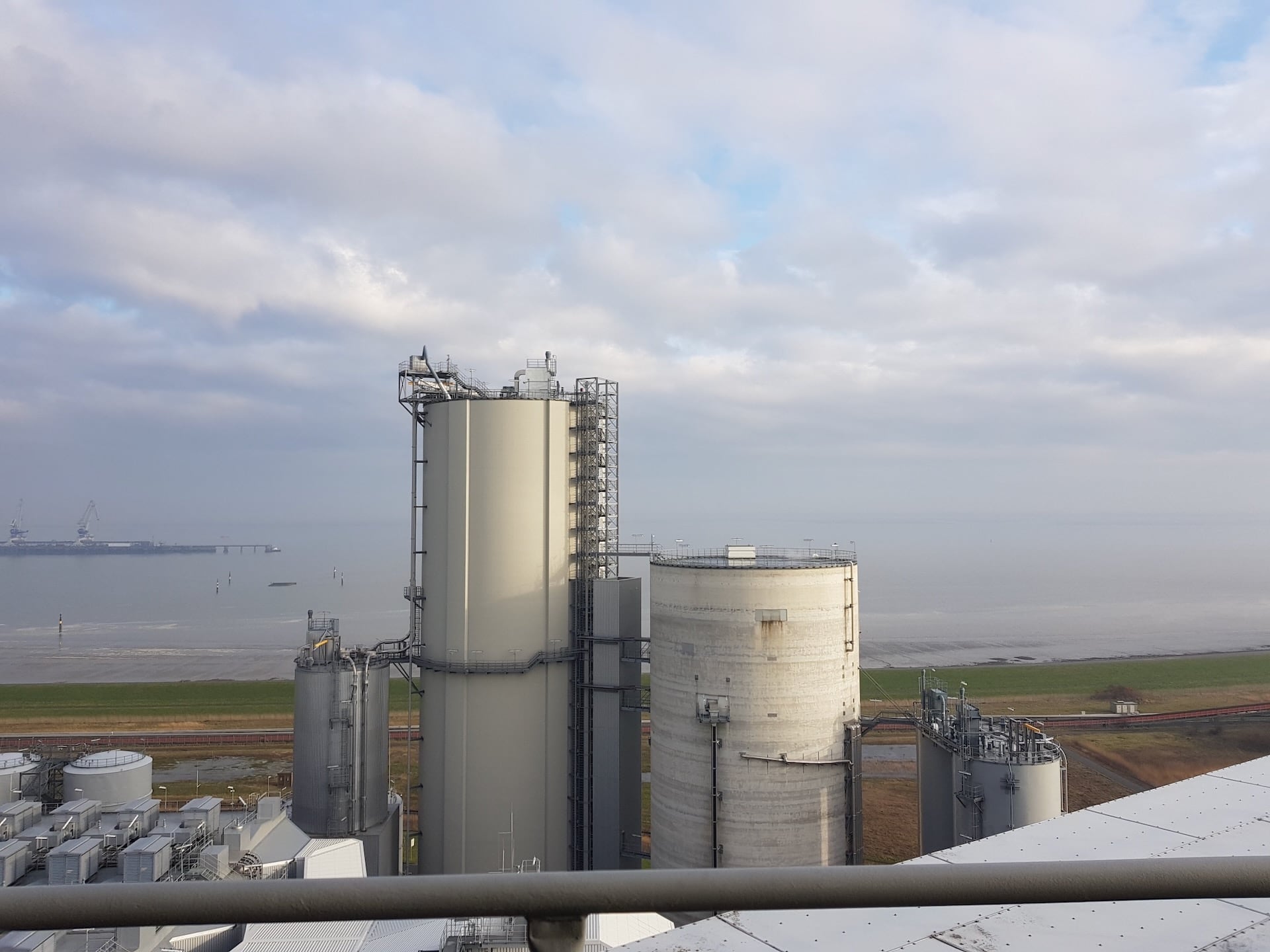
Interior silo inspection at a coal-fired power plant – the ELIOS 3 documents the full interior including roof, walls and cone without personnel entry.
Key Advantages of Drone Silo Inspection
- No personnel entry (kein Personeneinstieg): No DGUV confined space authorisation (Befahrungsgenehmigung), no asphyxiation risk, no engulfment hazard. The drone takes on the risk – your team stays safe.
- Minimal emptying required: Partial emptying or inspection in the empty state before refilling is often sufficient. No days-long shutdown for full draining and cleaning.
- LiDAR 3D survey: Precise 3D point cloud of the silo interior. Volume calculation, geometry capture, measurement of buildup – centimetre-accurate.
- DGUV-compliant without entry: Inspection in line with DGUV Regel 113-004 without personnel entry. Inspector coordinates on site and decides on procedure.
- Significantly lower cost: No confined space entry teams, no rescue chains, minimal shutdown. Up to 80% cost reduction compared to conventional entry procedures.
- Reproducible over years: Flight paths and finding positions are documented so that follow-up inspections take place at exactly the same locations. Corrosion progress and damage development become traceable over time.
Technology Used for Silo Inspection
ELIOS 3 – Silo Interior & Cone Floor
GPS-free SLAM navigation in the dust-laden cavity. Collision tolerance for tight fittings and internals. 16,000 lumens of integrated lighting. Minimum opening DN 600 – sufficient for standard inspection manholes (Mannlöcher). No dust protection equipment required for operators.
DJI Matrice 30T – Silo Roof, Outer Shell & Filling Equipment
External inspection of roof structure, weld seams, fill openings and external corrosion. 200× zoom – no climbing work on the roof.
LiDAR – Volume Determination & Wall Deformation
3D point cloud (Ouster OS0-128, centimetre-accurate, 1.31 million points/sec) for precise residual volume calculation and wall geometry analysis. Deformations, bulges and wall deviations are mapped to centimetre accuracy.
Handheld LiDAR – Accessible Areas & External Contours
Ground-level 3D capture of the installation base, support structure and silo base. No tripod required, immediately deployable. Supplements the ELIOS 3 scan for a complete building model (E57/LAZ format).
Inspection Process: From Enquiry to 3D Report
Step 1: Telephone Pre-Clarification (Telefonische Vorabklärung)
We discuss silo type, material, dimensions, access (manhole, DN dimension) and your inspection objective – visual inspection, volume measurement or both. This takes typically 15–30 minutes and is free of charge.
Step 2: Quote & Scheduling (Angebot & Terminplanung)
Fixed-price quote including sensor configuration (4K / LiDAR / thermography), on-site time and report scope. Scheduling aligned with your planned shutdown window (Stillstandplan).
Step 3: On-Site Inspection (Inspektion vor Ort)
Two-person team on site. Entry via manhole (Einflug über Mannloch), complete survey of the silo interior. Live feed for your process experts. No personnel entry.
Step 4: Report & 3D Model (Bericht & 3D-Modell)
4K footage with annotated findings, LiDAR point cloud with volume report, thermography evaluation. Archived in audit-proof format (revisionssicher archiviert).
Standards & Safety Compliance
Our silo inspections meet the applicable safety and documentation requirements:
- BetrSichV & DIN EN 1991-4: The German Industrial Safety Regulation (Betriebssicherheitsverordnung) and DIN EN 1991-4 (load assumptions for silos and tanks) form the legal and normative basis for recurring inspections. Our documentation is structured for your expert assessors and inspection bodies.
- DGUV Regel 113-004 & DGUV Information 213-055: Working in vessels and confined spaces: using the ELIOS 3 eliminates personnel entry – and with it the complex confined space entry procedures under DGUV Regel 113-004. DGUV Information 213-055 (BG RCI) supplements specific rescue concepts and PPE requirements for the exceptional case where human entry is unavoidable.
- Dust explosion protection – ATEX / TRGS 509: Deployment only in emptied and cleaned condition without hazardous dust concentrations. ELIOS 3 is not ATEX-certified – coordination with your explosion protection officer (Explosionsschutzbeauftragter) on site is required. For silos with hazardous substances, TRGS 509 (storage of hazardous substances in stationary vessels) applies additionally.
- DIN EN 617 & BG RCI checklists: DIN EN 617 (safety requirements for bulk storage facilities) is recommended by BG RCI for safe silo operation. BG RCI checklists serve as a practical basis for inspection lists.
- DIN EN 1992-3 (Eurocode 2, Part 3): For concrete silos: governs the structural design of reinforced concrete vessels and silos. For inspections assessing structural damage (cracks, reinforcement corrosion, carbonation), this standard is authoritative for your assessors.
- Customer-specific safety concepts: Coordination with your HSE team before every deployment. We comply with all site-specific safety regulations, DGUV Regel 100-500 and permit procedures – including BG RCI requirements.
Your Contacts for Silo Inspection
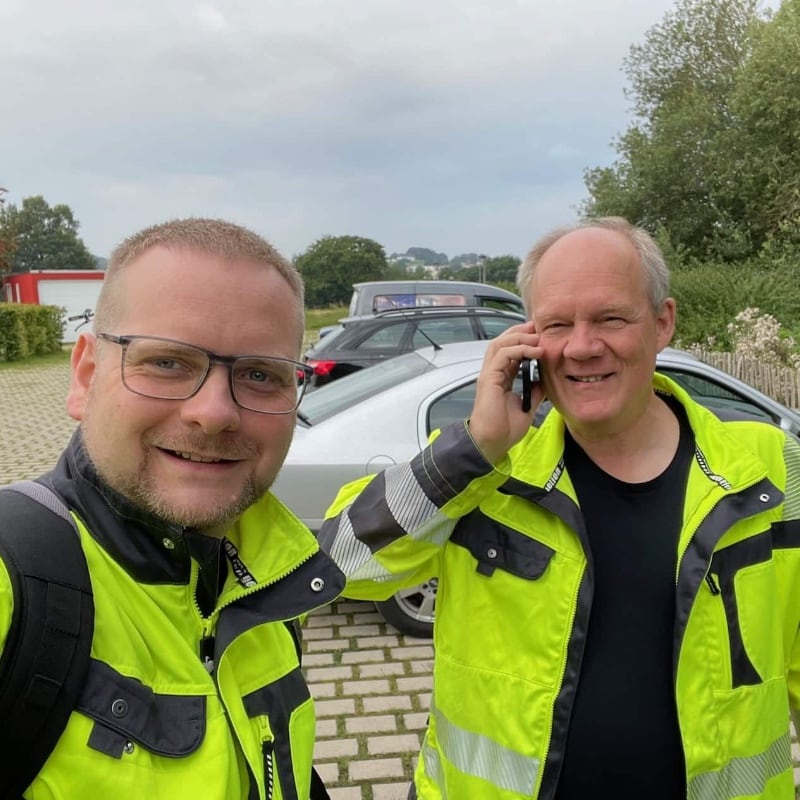
Christian Engelke and Dipl.-Ing. Karsten Lehrke – your direct contacts for silo inspection projects since 2017.
Christian Engelke and Dipl.-Ing. Karsten Lehrke are your direct contacts. Since 2017, we have been inspecting silos of all types in cement, chemical, mining and agricultural operations across Germany – standardly as a two-person team, on individual assignments also three-person, always according to DGUV standards. No subcontracting, no call centre.
Related Services
- Confined Spaces Inspection – All enclosed interior spaces without personnel entry – ELIOS 3 for silos, tanks, boilers and shafts.
- Tank Inspection – Inner walls, floors and coatings in tanks without emptying and confined space entry.
- Boiler Inspection – Steam boilers and pressure vessels – findings for certified inspectors without DGUV confined space entry.
- Industrial LiDAR Survey – 3D point clouds with the ELIOS 3 Surveying Payload for volume calculation and geometry documentation.
- Industrial Drone Inspection – Overview of all inspection services with ELIOS 3 and complementary systems.
- Flyability ELIOS 3 – Technology details, specifications and mission planning for the ELIOS 3 system.
Frequently Asked Questions – Silo Inspection by Drone
What is the biggest advantage of drone silo inspection over a conventional confined space entry (Befahrung)?
No personnel entry. This eliminates typical confined space risks such as oxygen deficiency, engulfment and dust exposure, as well as the bulk of the organisational safety measures required under DGUV Regel 113-004. Shutdown (Stillstand), confined space authorisation (Befahrungsgenehmigung) and rescue chain (Rettungskette) can be dispensed with in many cases.
Can the ELIOS 3 inspect silos from the inside?
Yes. The Flyability ELIOS 3 flies into silos of any construction and documents the complete interior – from the roof structure down through the wall areas to the discharge hopper (Auslauftrichter). The drone navigates GPS-independently via SLAM, illuminates everything with 16,000 lumens even at 60 m height, and flies safely past tight fittings thanks to its collision protection.
Does the silo have to be completely empty for the inspection?
Not necessarily. In many cases an inspection is possible even with residual fill or buildup. The ELIOS 3 can inspect partially emptied silos (teilentleerte Silos) – the exposed area above the bulk material is documented. For a complete silo inspection including the discharge hopper, the silo should be largely emptied. We advise you on the optimal emptying level for your inspection objective.
How large does the entry opening need to be?
Typically a manhole or opening from DN 600 onwards is sufficient – standard inspection manholes (Revisionsluken) or fill openings are adequate. We check the specific conditions in advance. In practice, almost all industrial silos can be flown via existing openings.
Which silo types can be inspected?
We inspect cement silos, clinker silos, grain silos, coal bunkers, hydrated lime silos, chemical silos, plastic silos, food silos and ore silos – in steel, concrete and aluminium construction. Regardless of content and material, the ELIOS 3 delivers high-resolution documentation of wall condition, liner and internal fittings.
What damage is typically found during silo inspection?
The most common findings are buildup and bridging (Anbackungen und Brückenbildung), liner wear (ceramic, plastic, stainless steel), cracks in wall areas and weld seams, corrosion on the steel shell, deformations, and anomalies at fittings and discharge areas. Many of these damage patterns are invisible from outside and are only discovered through drone inspection.
What data do we receive after the silo inspection?
We deliver structured 4K video footage, high-resolution detail photos, thermography analysis and optionally LiDAR 3D point clouds for documentation and evaluation. The 3D data enables volume calculations (Volumenberechnungen) and geometry comparisons across inspection cycles. All results are compiled in a detailed inspection report.
Is the inspection documentation suitable for expert assessors (Sachverständige)?
Yes. The data serves as a basis for assessment by operators, engineers or external inspectors. We document the condition – the technical assessment of findings and the resulting decisions are handled by your specialist departments or expert assessors. We do not replace the certified inspector; we deliver the visual evidence they need.
Can the inspection be carried out in explosion-hazard areas (ATEX)?
Silos with combustible dusts (e.g. flour, sugar, plastic, coal) may be classified as ATEX zones. The systems used are not Ex-certified. Deployment is therefore only possible after an individual risk assessment (Gefährdungsbeurteilung) and in coordination with the operator – as a rule in the emptied and cleaned condition without hazardous dust concentration. Coordination with your explosion protection officer (Explosionsschutzbeauftragter) is required.
Does drone silo inspection work in heavily dusty silos?
Yes. The systems are designed for dusty environments. The carbon protective cage protects the rotors; the 16,000-lumen lighting penetrates light dust haze. In very high dust concentrations, visibility can be limited – but SLAM navigation remains stable. With heavy residual dust, the drone can briefly hold position until stirred-up dust settles.
How long does a drone silo inspection take?
The actual flight time on site is typically one to several hours depending on silo size and complexity. Add preparation and briefing on site, plus post-processing and report creation. Overall significantly shorter than a conventional confined space entry. Multiple silos per day are possible for compact installations.
How accurate is the 3D data from the silo inspection?
LiDAR data achieves centimetre-level accuracy – typically ±2–5 cm depending on distance, flight speed and surface properties. This is well suited for geometry capture, deformation analysis and digital twins. Volume calculations, measurement of buildup (Anbackungen) and geometry comparisons across inspection cycles are possible as a basis for your maintenance planning.
Are comparisons across multiple inspection cycles possible?
Yes. Through structured and reproducible data capture, changes over time can be tracked. LiDAR point clouds and 4K footage can be compared across inspection cycles – a clear advantage over person-dependent hand-held recordings. Corrosion progress, material fatigue and damage development become traceable over months and years as a basis for maintenance planning and risk-based inspection (RBI) decisions.
Can internal fittings such as sensors or discharge elements be inspected?
Yes. Internal fittings such as level sensors (Füllstandssensoren), temperature probes (Temperatursonden), aeration nozzles (Belüftungsdüsen) or discharge elements (Austragselemente) can be targeted and visually assessed – without maintenance personnel having to enter the silo.
Does thermography work for silo inspection?
Yes, provided suitable temperature differences are present. Thermography helps make moisture ingress, thermal anomalies behind liners or hotspots in coal and biomass silos visible. In coal and biomass silos, thermography can detect self-ignition risks (Selbstentzündungsrisiken) before they become critical. For cement or grain silos, thermography is used more selectively for specific areas of concern.
What happens during collisions inside the silo?
The ELIOS 3 is specifically designed for confined spaces. The carbon protective frame (Carbon-Schutzrahmen) absorbs contact with walls or fittings – light collisions are a normal part of operation and affect neither the drone nor data quality. The drone mass and energy are too low to cause significant impact on steel walls or concrete surfaces.
Can silo inspection be carried out during ongoing operation?
As a rule, no. Moving material, filling operations or active discharge systems affect safety and data quality. Inspection takes place typically during shutdown (Stillstand) – though usually for a significantly shorter period than a conventional confined space entry would require.
How often should a silo inspection be carried out?
This depends strongly on the stored medium, utilisation intensity and mechanical stress. Common intervals are regular silo inspection cycles (e.g. annually or every two years) or event-driven inspections (anlassbezogene Inspektionen) when operational problems occur such as blockages or discharge failures. Your local regulations (BetrSichV, employer liability insurance association requirements) may specify minimum intervals for your asset type.
How does the interior inspection differ from an external inspection?
External inspections capture roof, shell and external structure – flyable from outside by drone (DJI M30T). Interior inspections with the ELIOS 3 provide the view of wall surfaces, cone, roof structure and fittings from the inside – areas that are fundamentally invisible from the outside. Both methods complement each other for a complete condition assessment.
How does the planning of a silo inspection work?
After a brief telephone discussion of silo type, access (manhole, DN dimension), material and inspection objective, we produce a fixed-price quote and align the date with your shutdown plan (Stillstandplan). Our team – standardly two people, on request three – then comes directly to your site. Typically within a few working days from enquiry to on-site deployment.
Do you work together with expert assessors (Sachverständige) on silo inspections?
Yes. Inspection frequently takes place in close cooperation with operators, maintenance teams and external specialist bodies. We deliver the data – your specialists or commissioned expert assessors handle the technical assessment. Many operators use our inspection as a preparation step for the formal certified inspection, allowing the assessor to focus on findings rather than access logistics.
Get in Touch
Have questions about silo inspection by drone or need a quote for your project? Fill out the form below and we'll get back to you within 24 hours.