
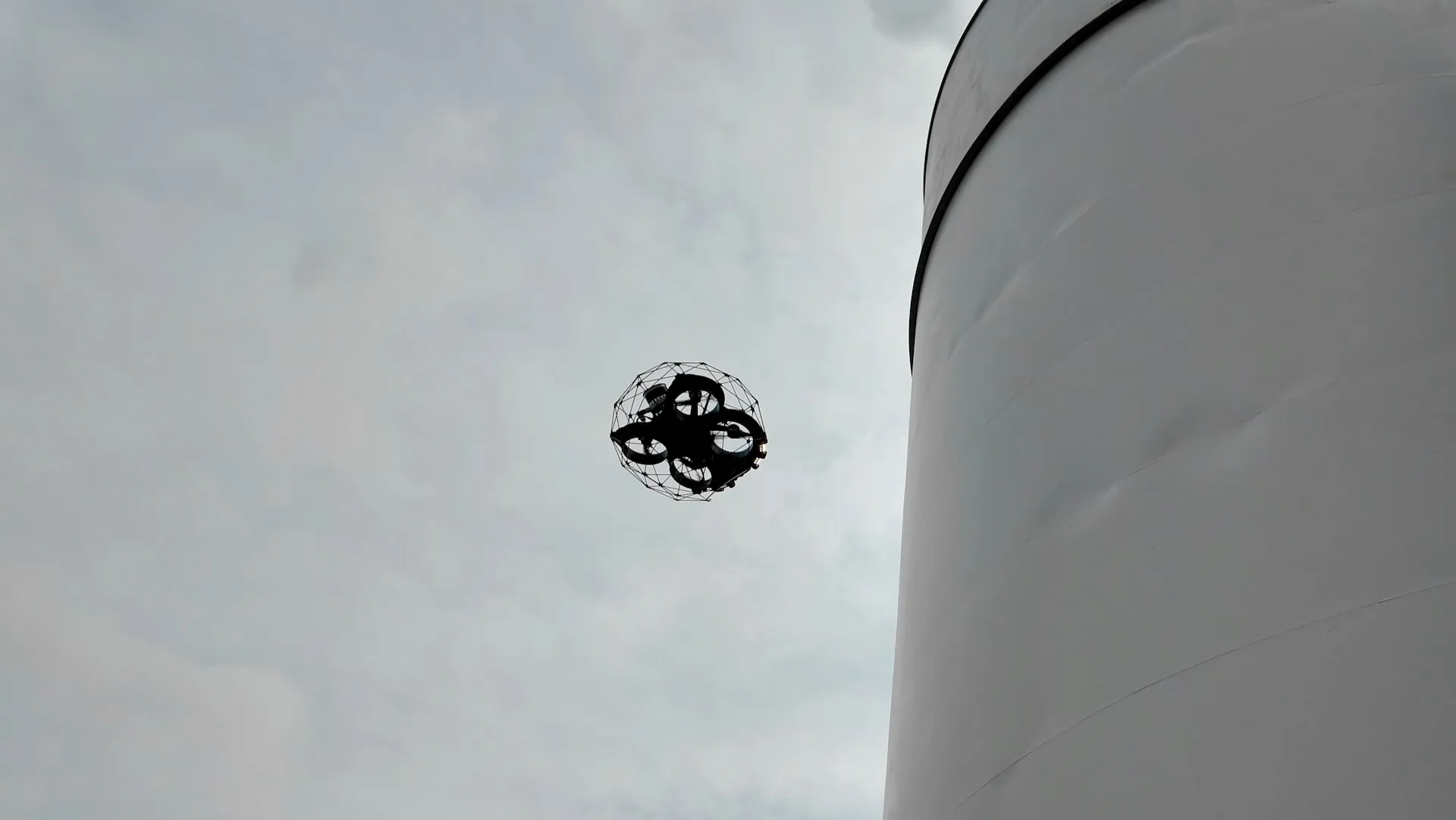
Non-Destructive Testing (NDT) by Drone – VT, Thermography & LiDAR from the Air
The Flyability ELIOS 3 brings three NDT-relevant sensor systems simultaneously to every point inside a facility – without human entry, without scaffolding. ZfP (German: Zerstörungsfreie Prüfung) meets drone technology: faster, safer, better documented.
- Non-contact NDT: VT (visual testing), IRT (thermography) and LiDAR – all without touching the surface
- Contact methods (UT, MT, PT, ET) delivered by inspector at drone-identified locations only
- Hybrid inspection: drone first, human only where needed
- Normative basis: ISO 17637 (VT), DIN 54190 / ISO 10878 (IRT), BetrSichV, DGUV 113-004
ZfP/NDT in Industry: Access is the Real Problem
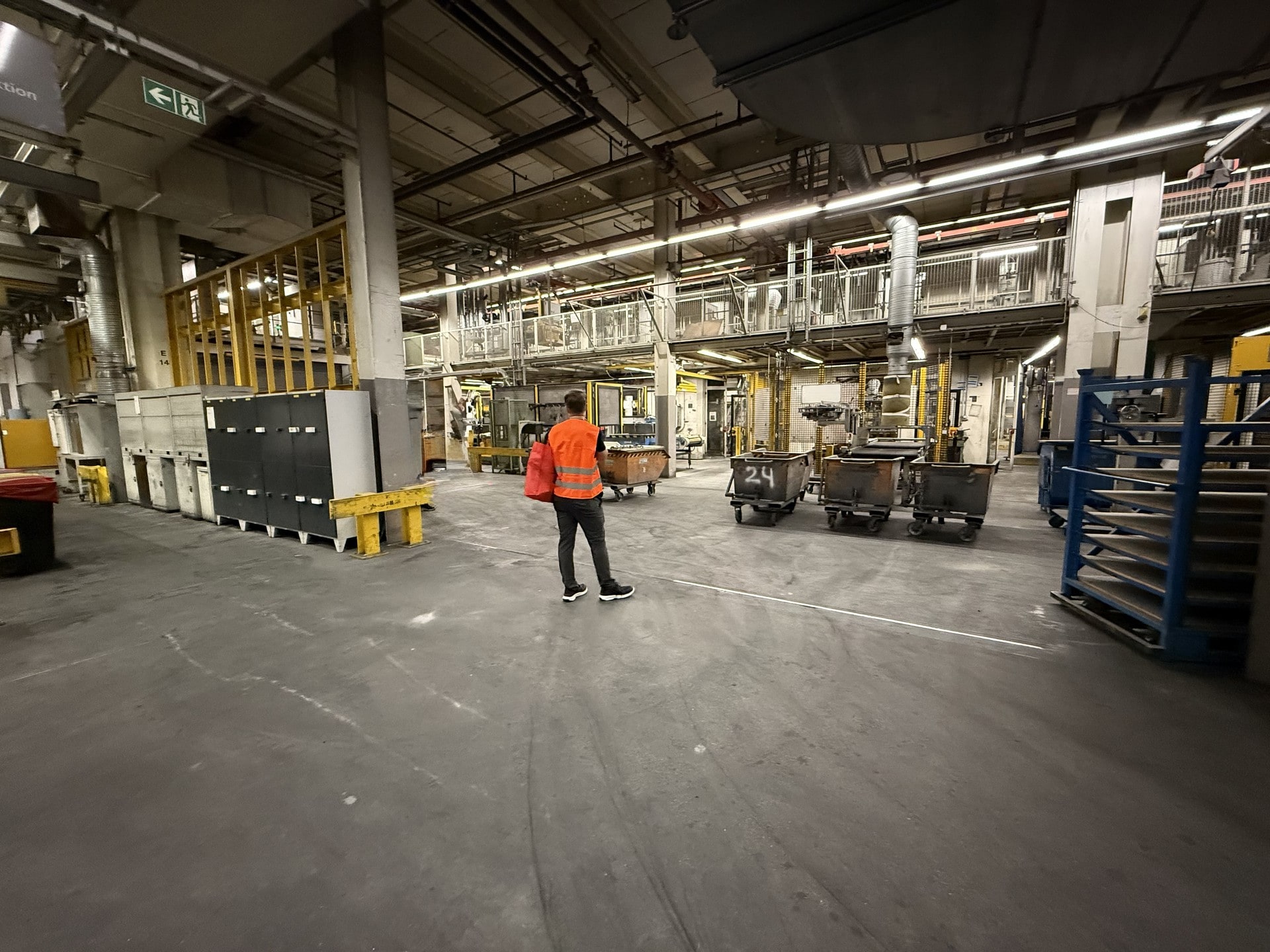
Flyability ELIOS 3 – three NDT sensor systems in one platform.
Non-destructive testing (NDT / ZfP – Zerstörungsfreie Prüfung) is the standard for assessing plant integrity. The problem was never the measurement technology – it was the access. Scaffolding, rope access or human entry cost time, money and carry risk.
The Flyability ELIOS 3 brings three NDT-relevant sensor systems simultaneously to every point inside a facility – without any human entry.

Visual testing: visible damage, corrosion, cracks, deposits – high-resolution documented.
Concealed damage: CUI, hotspots, leakages, insulation defects – with absolute temperature values.
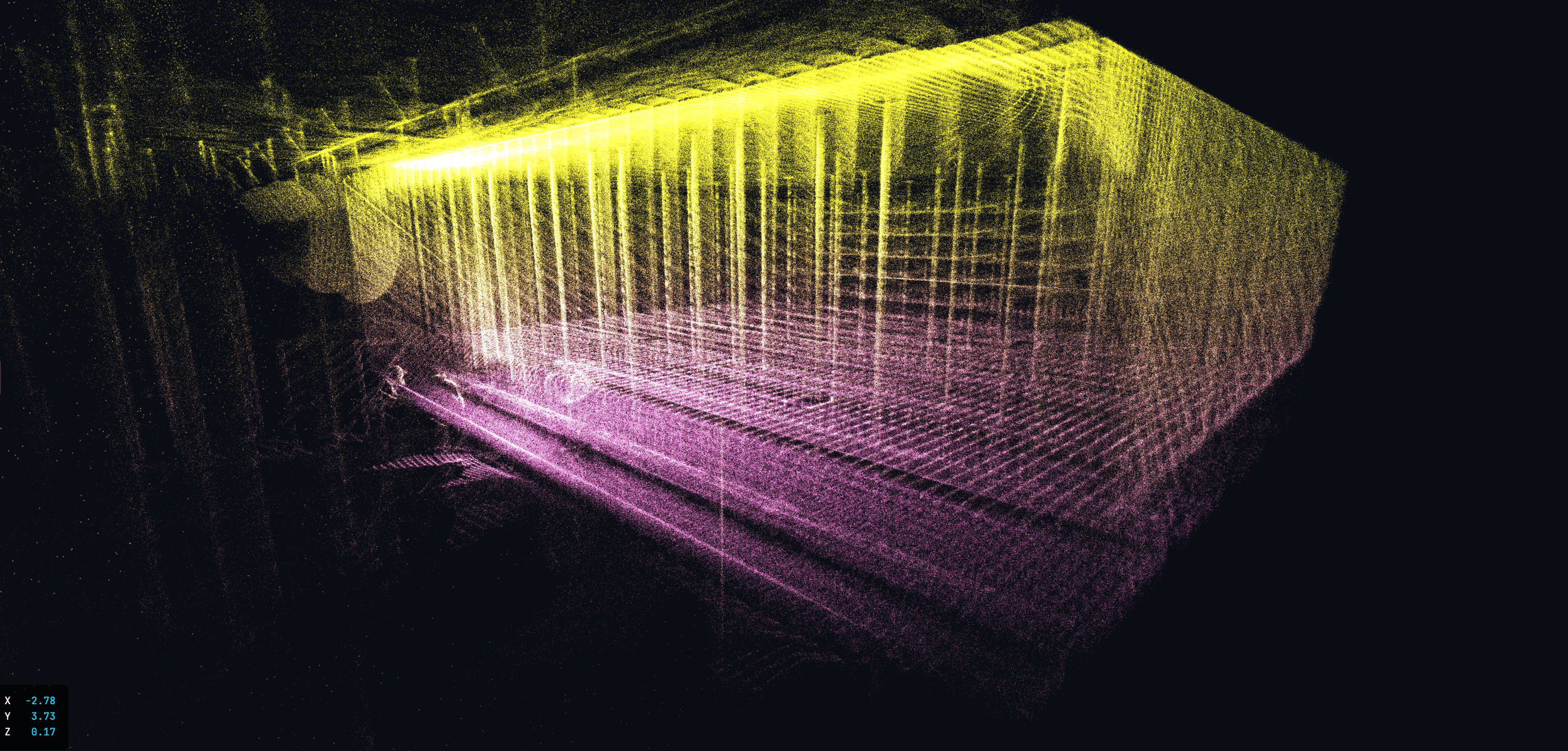
Geometry, deformation, volumetrics, digital twin – with centimetre-level precision.
Note: This article is for general information and does not constitute legal advice. Always refer to current versions of applicable regulations.
What the ELIOS 3 Covers – and What It Cannot
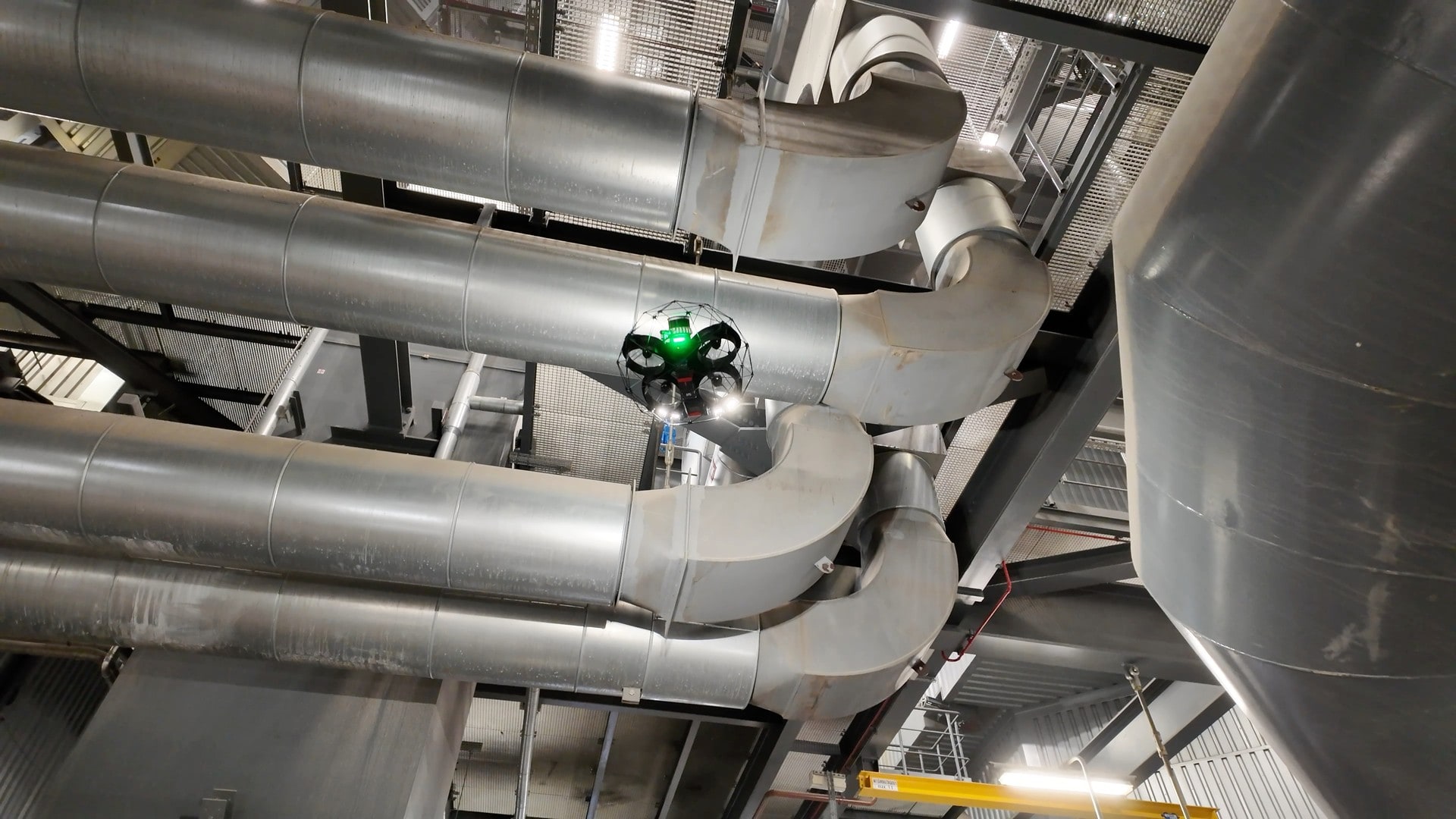
ELIOS 3 performing non-contact inspection of an ash duct in a power plant.
Transparency is important to us. The ELIOS 3 covers non-contact NDT methods. Contact methods (UT, MT, PT, ET, RT) require physical contact with the surface – a flying drone cannot achieve this.
In practice we rely on hybrid inspection: the drone identifies and localises problem areas by VT, thermography and LiDAR – and only where necessary does a targeted contact inspection by an NDT inspector follow.
NDT Methods and Drone Suitability
Non-contact methods are flown by the drone – contact methods are performed by the inspector, targeted at drone-marked locations.
| Method | Standard | Drone Suitable? | Notes |
|---|---|---|---|
| Visual Testing (VT) | DIN EN ISO 17637, DIN EN 13018 | Yes – ELIOS 3 | 4K, 16,000 lm. Acceptance by TÜV growing steadily. Pre-screening + documentation. |
| Thermography (IRT) | DIN 54190 / ISO 10878 | Yes – ELIOS 3 | 320×256 px radiometric, −10°C to +400°C. CUI, hotspots, leakages. Especially valuable in boilers and furnaces. |
| LiDAR 3D Scanning | Ouster OS0-128 | Yes – ELIOS 3 | Centimetre precision, 1.31M points/sec. Deformation, volumetrics, digital twin. Damage progression monitoring. |
| Ultrasound (UT) | DIN EN ISO 17640 | No (contact method) | Wall thickness and internal defects. Hybrid inspection: drone localises, inspector measures at marked locations. Optional UT payload available. |
| Magnetic Particle (MT) | DIN EN ISO 17638 | No (contact method) | Surface and near-surface cracks. Hybrid inspection: drone identifies suspect locations, MT inspector follows up specifically. |
| Liquid Penetrant (PT) | DIN EN ISO 3452 | No (contact method) | Open surface defects. Drone pre-screening reduces PT scope to specific areas. |
| Eddy Current (ET) | DIN EN ISO 15549 | No (contact method) | Near-surface defects and conductivity measurement. Drone localises; ET inspector measures. |
| Radiography (RT) | DIN EN ISO 17636 | No | Requires physical setup of radiation source and detector. Drone data can support positioning. |
Hybrid Inspection: Optimising the NDT Workflow with Drone
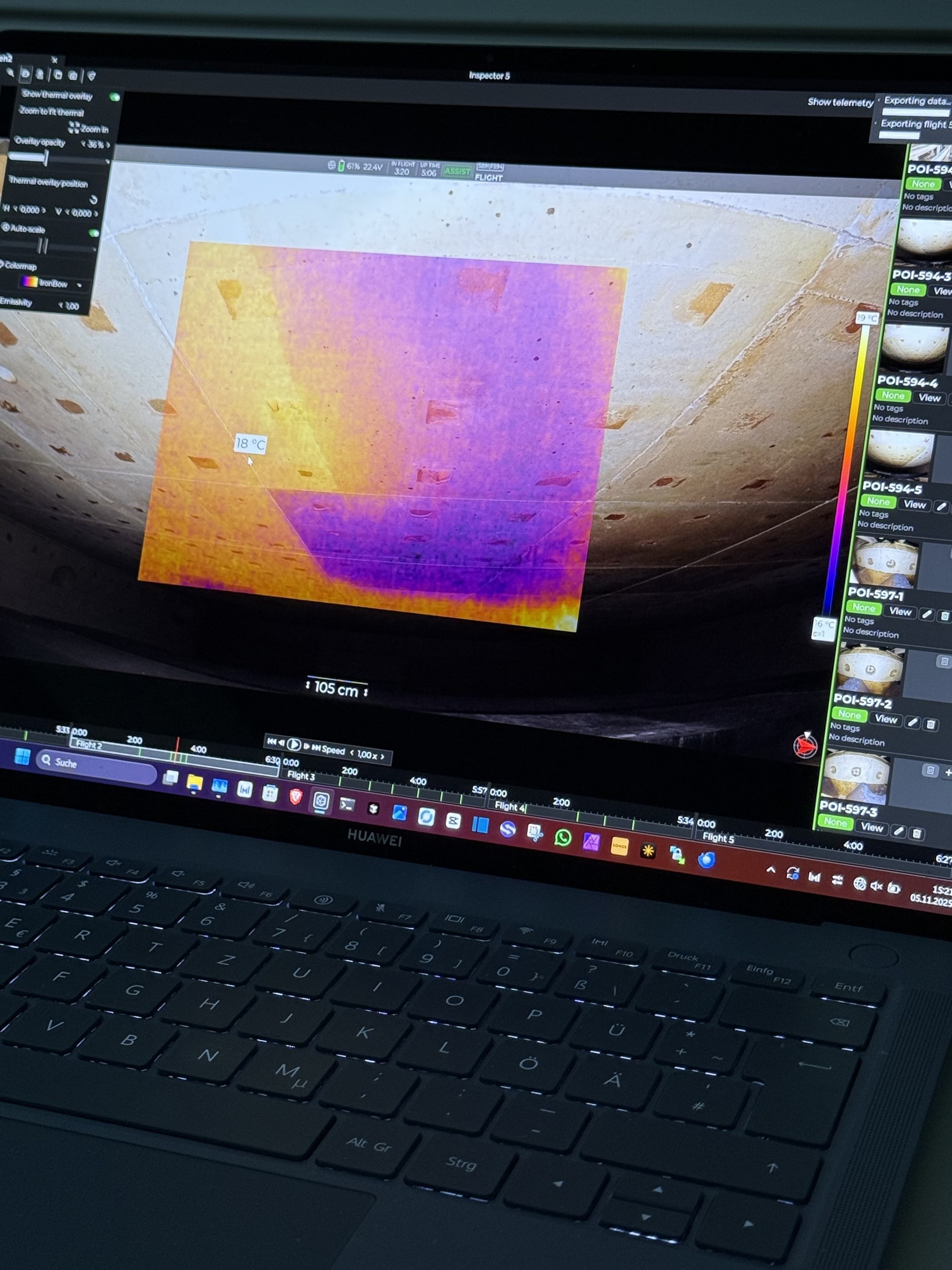
Thermography finding evaluation on laptop – findings available directly after the flight.
The most efficient approach for NDT in confined spaces is not drone only or classical only, but the combination:
The ELIOS 3 covers the facility completely, capturing 4K video, thermography and LiDAR. Result: complete documentation of current condition, localisation of all anomalies in 3D.
Data is evaluated in Flyability Cloud (Inspector 5). Damage locations are marked, classified and prioritised in the 3D model. The inspector decides where contact inspection is needed.
Only at the identified locations does manual deployment occur (UT, MT etc.) – with exact position data from the 3D model. This reduces human entry into confined spaces to the absolute minimum.
Relevant Standards and Norms
The integration of drones into NDT processes is normatively in development. Whether an inspection body (TÜV, DEKRA, DNV) accepts drone-supported VT/IRT is decided project-specifically. Acceptance is growing steadily.
DIN EN ISO 17637 (weld seam VT), DIN EN 13018 (general VT), API 510/653 (pressure vessels/tanks).
DIN 54190 / ISO 10878 (thermographic testing), VDI/VDE 3511 (technical temperature measurement).

BetrSichV (German Industrial Safety Regulation), DGUV Regel 113-004 (confined spaces), TRBS 1112 (maintenance). German: Betriebssicherheitsverordnung.
Conclusion: NDT by Drone – Extension, Not Replacement
The ELIOS 3 does not replace the NDT inspector – it extends their reach. Instead of entering a confined space themselves, the inspector flies the drone and evaluates the data from the safe area.
Zero human entry – no human entry into confined spaces required.
First inspection in hours rather than days. Multiple facilities inspectable on the same day.

4K + thermography + LiDAR simultaneously – more data than in a classical walkdown, reproducible.

Scaffolding, rope access, rescue chain eliminated. Substantial cost saving at equivalent quality.
Your Contacts at Kopterflug
Our team has been performing drone-based NDT data collection in industrial facilities since 2017.
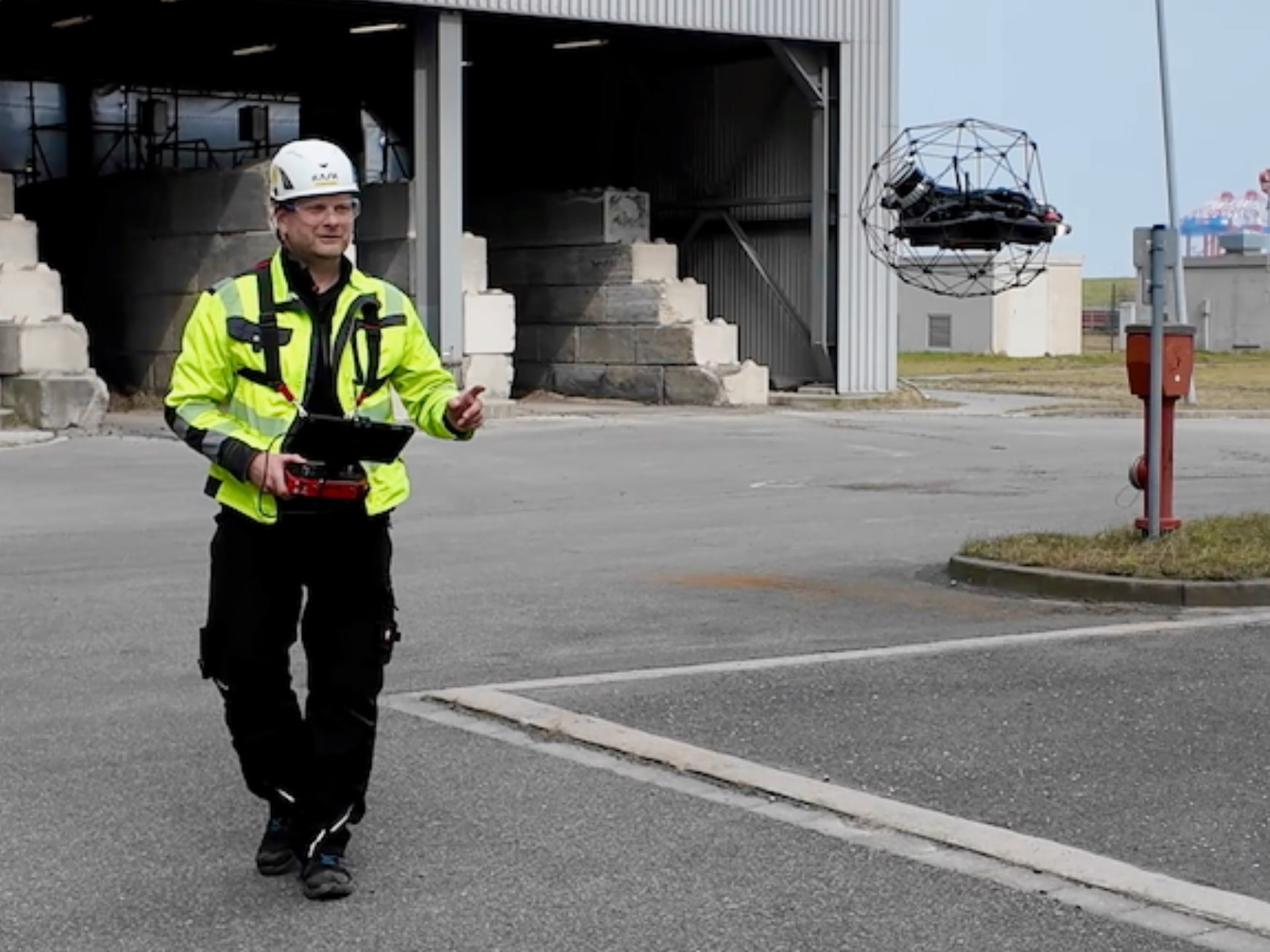 Christian Engelke
Founder & Drone Pilot
Christian Engelke
Founder & Drone PilotConfined Spaces since 2017
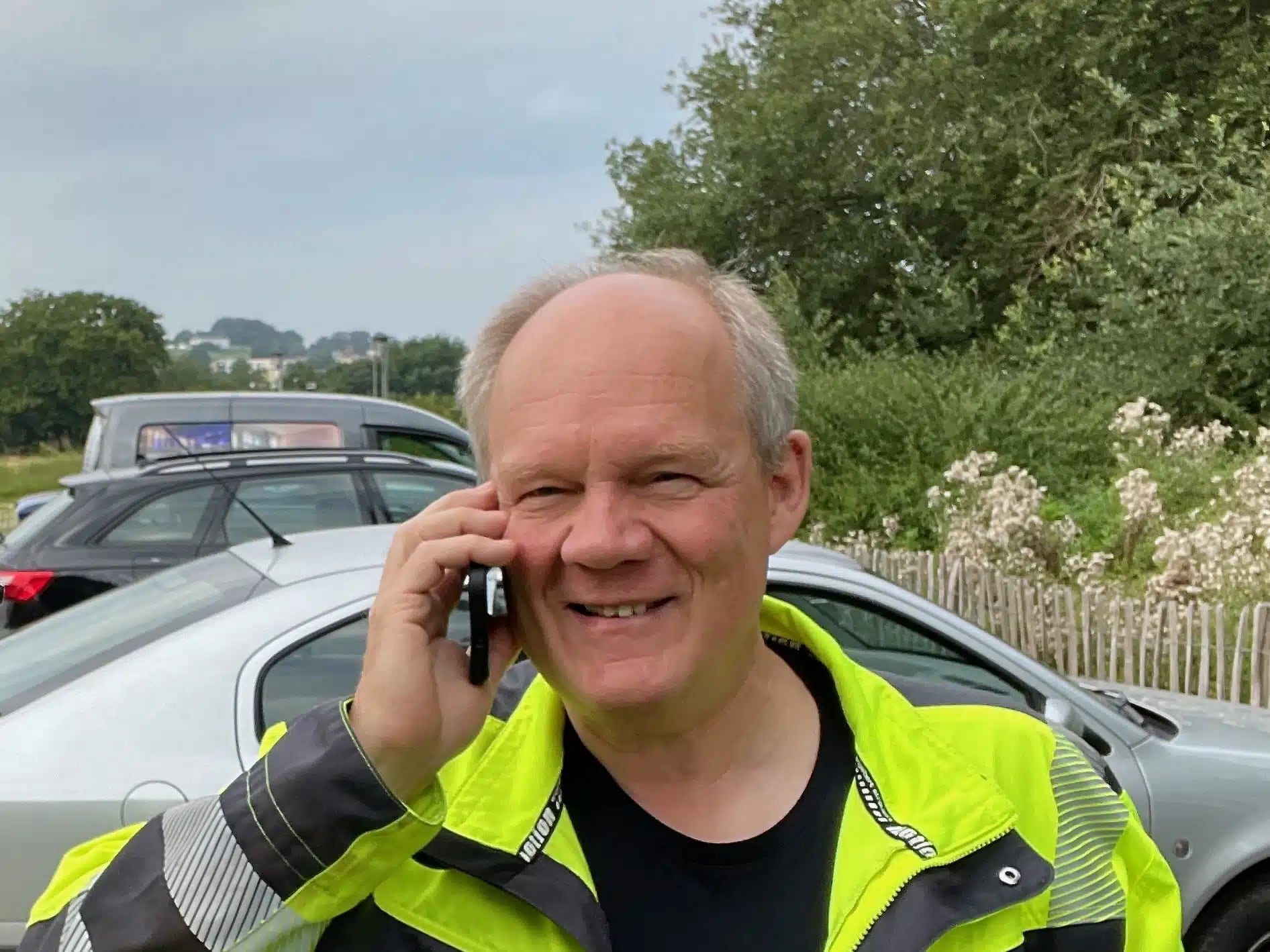 Karsten Lehrke
Project Manager
Karsten Lehrke
Project ManagerDipl.-Ing. Mechanical Engineering
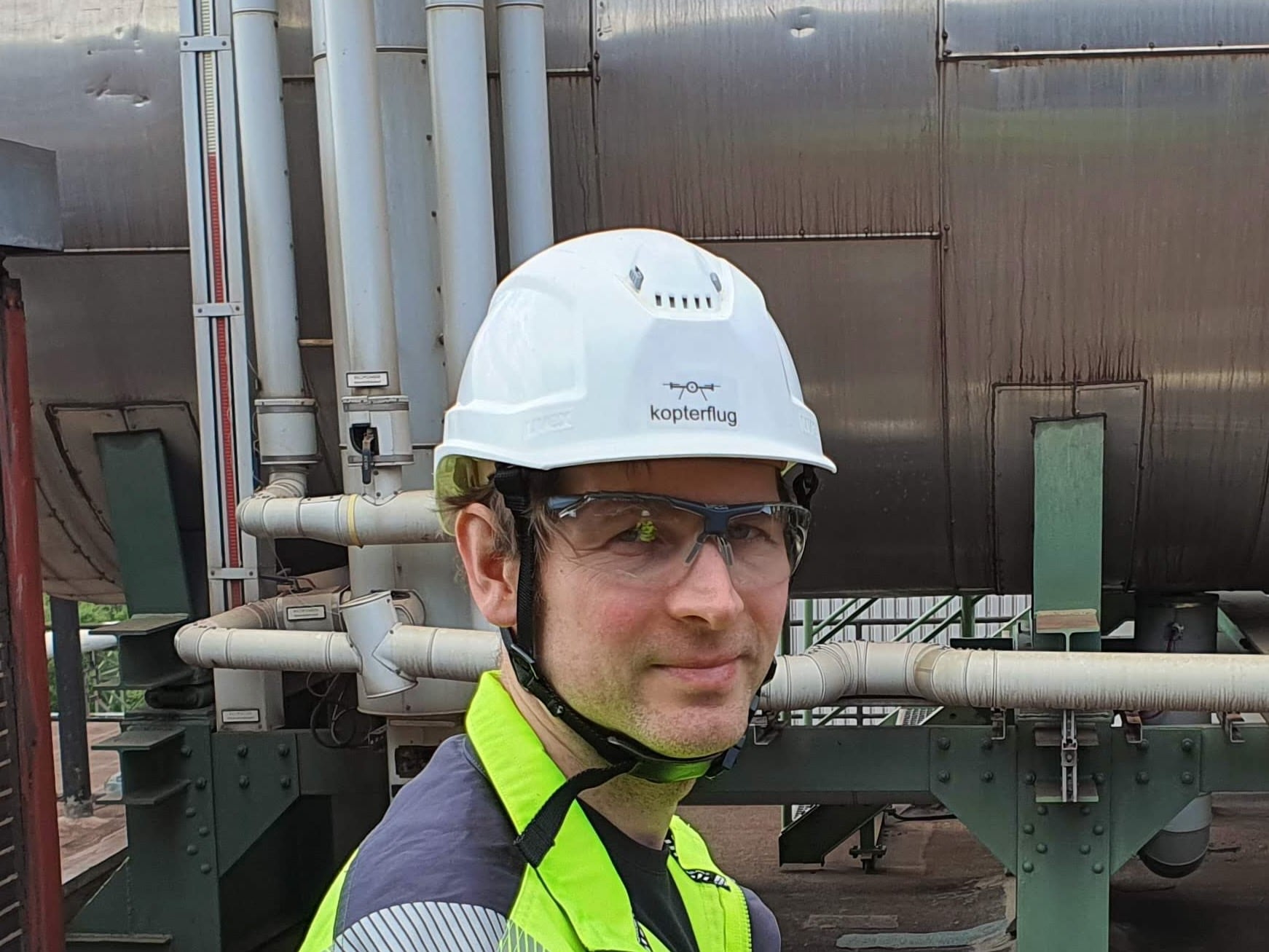 Philipp
Drone Pilot
Philipp
Drone PilotIndustrial Inspection
 Max
Inspection Specialist
Max
Inspection SpecialistData Analysis
 Benjamin
Drone Pilot
Benjamin
Drone PilotField Operations
Related Services
- Industrial Drone Inspection – Comprehensive inspection for all sectors
- Confined Spaces Inspection – Safe inspection without human entry
- Flyability ELIOS 3 – The collision-safe indoor drone with VT, thermography and LiDAR
- Tank Inspection – Internal tank inspection without scaffolding
- Boiler Inspection – Water tube boilers and steam generators by drone
- Chimney Inspection – Internal chimney inspection without scaffolding
- Visual Testing (VT) by Drone – Indirect VT to ISO 17637
- Thermography in Industrial Inspection – CUI, hotspots and leakage detection
- Recurring Inspection under BetrSichV – Drone as inspection tool for ZÜS and qualified persons
Frequently Asked Questions
Is drone-supported VT recognised under DIN EN ISO 17637?
The standard defines requirements for illumination, resolution and observation angle. The ELIOS 3 technically meets these (4K, 16,000 lumen). Whether the specific inspection body accepts remote VT by drone is decided project-specifically. Acceptance is growing steadily.
Can the drone perform ultrasound testing (UT)?
The ELIOS 3 can perform wall thickness measurements with an optional UT payload. For conventional contact UT inspections, we rely on hybrid inspection: the drone localises critical areas by VT and thermography, the inspector measures precisely only there.
What is the difference between NDT by drone and conventional walkdown?
The main difference is access: instead of scaffolding, rope access or human entry, the drone takes over. It captures VT, thermography and LiDAR simultaneously. Data quality is in many cases comparable or better – at significantly less risk and effort.
For what facility sizes is the drone suitable?
The ELIOS 3 fits through openings from DN 600 (approx. 60 cm). Inside, it operates in spaces from a few cubic metres to large halls and tanks. Battery changes between flights take seconds; alternatively tethered operation with up to 1 hour flight time is possible.
How are NDT data documented and delivered?
You receive 4K video, radiometric thermal images and LiDAR point clouds. Data is processed in Flyability Cloud (Inspector 5) and can be exported as .las/.e57 (3D), .mp4 (video) and PDF reports – compatible with standard CAD/BIM systems.
What is hybrid inspection (Hybridinspektion)?
Hybrid inspection is the combination of drone-based non-contact NDT (VT, thermography, LiDAR) with targeted human contact NDT (UT, MT, PT) at drone-identified locations. The drone acts as a systematic pre-screening tool across the entire facility surface; contact methods are only deployed where the drone has identified anomalies. This approach reduces human entry into confined spaces to the absolute minimum and cuts total inspection cost substantially.
Contact Us
We assess free of charge whether drone-based NDT is suitable for your facility. Send us your plant data – we will respond with an honest assessment.
Inspectomatic GmbH
Im Hollergrund 175A, 28357 Bremen, Germany
+49 421 408 937-0 ·
[email protected]
Source page: /en/knowledge-base/zerstoerungsfreie-pruefung-zfp-drohne