
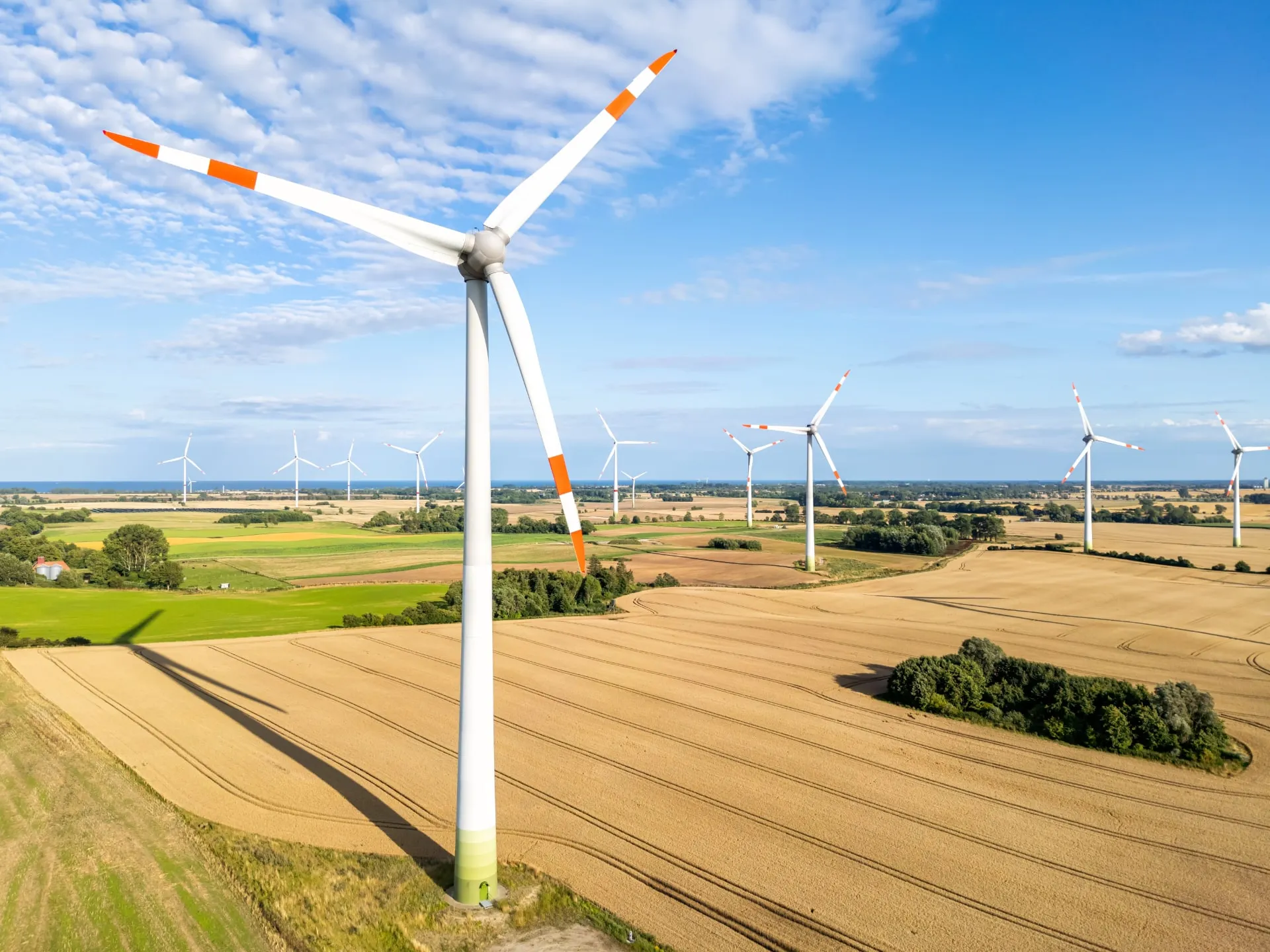
Drone Inspection Wind Turbines – Inside & Outside, Without Climbers
Kopterflug inspects rotor blades from the inside, hubs, towers and nacelles – without rope access teams, without scaffolding, weather-independent. The Flyability ELIOS 3 flies through the blade root opening and documents what is invisible from the outside.
- 90% of blade defects are only visible from inside
- All 3 blades of a turbine in 1.5–3 hours
- 4K + Thermography + LiDAR in a single flight
- Up to 80% lower costs compared to rope access teams
Interior Inspection: What is Invisible from Outside
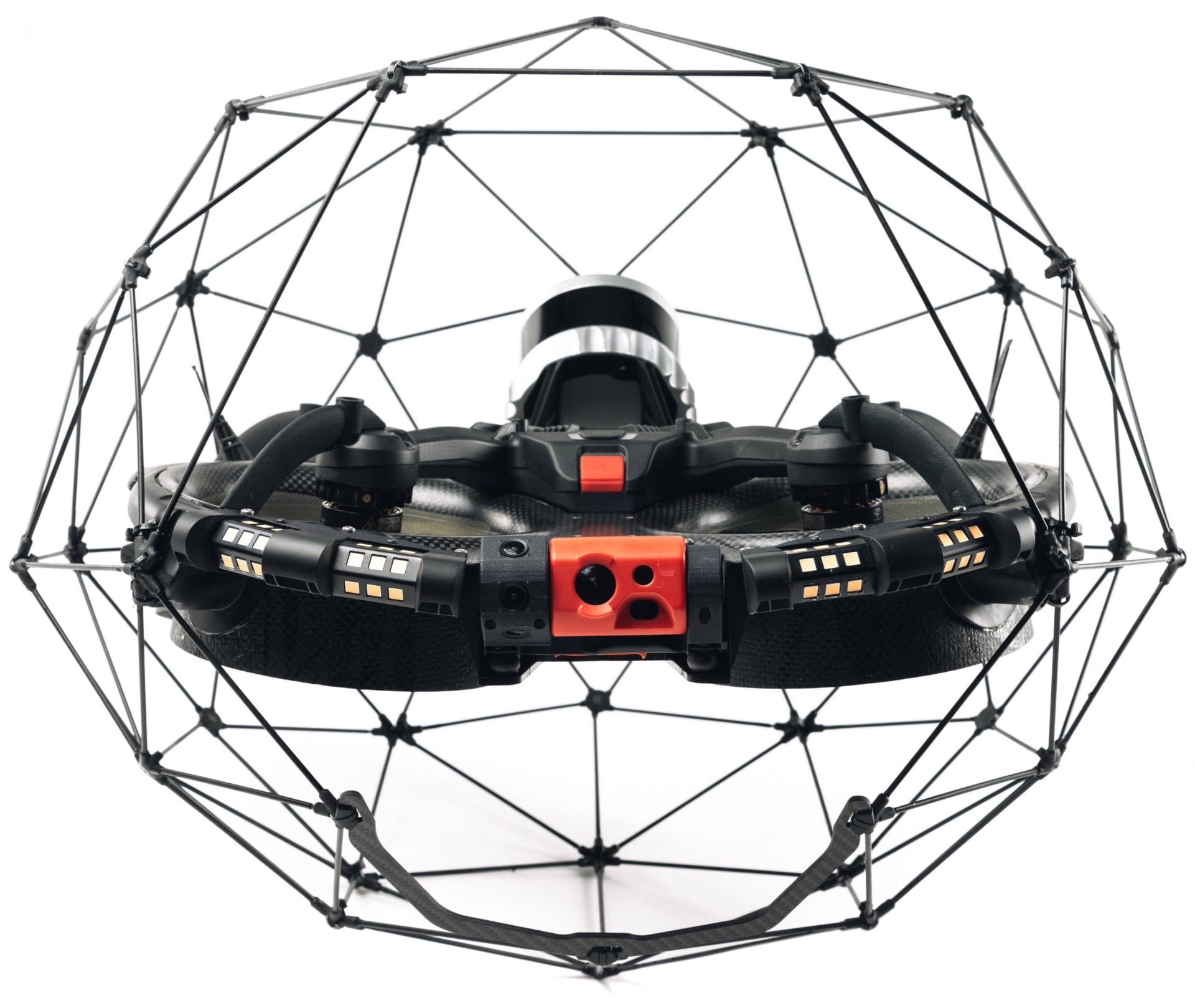
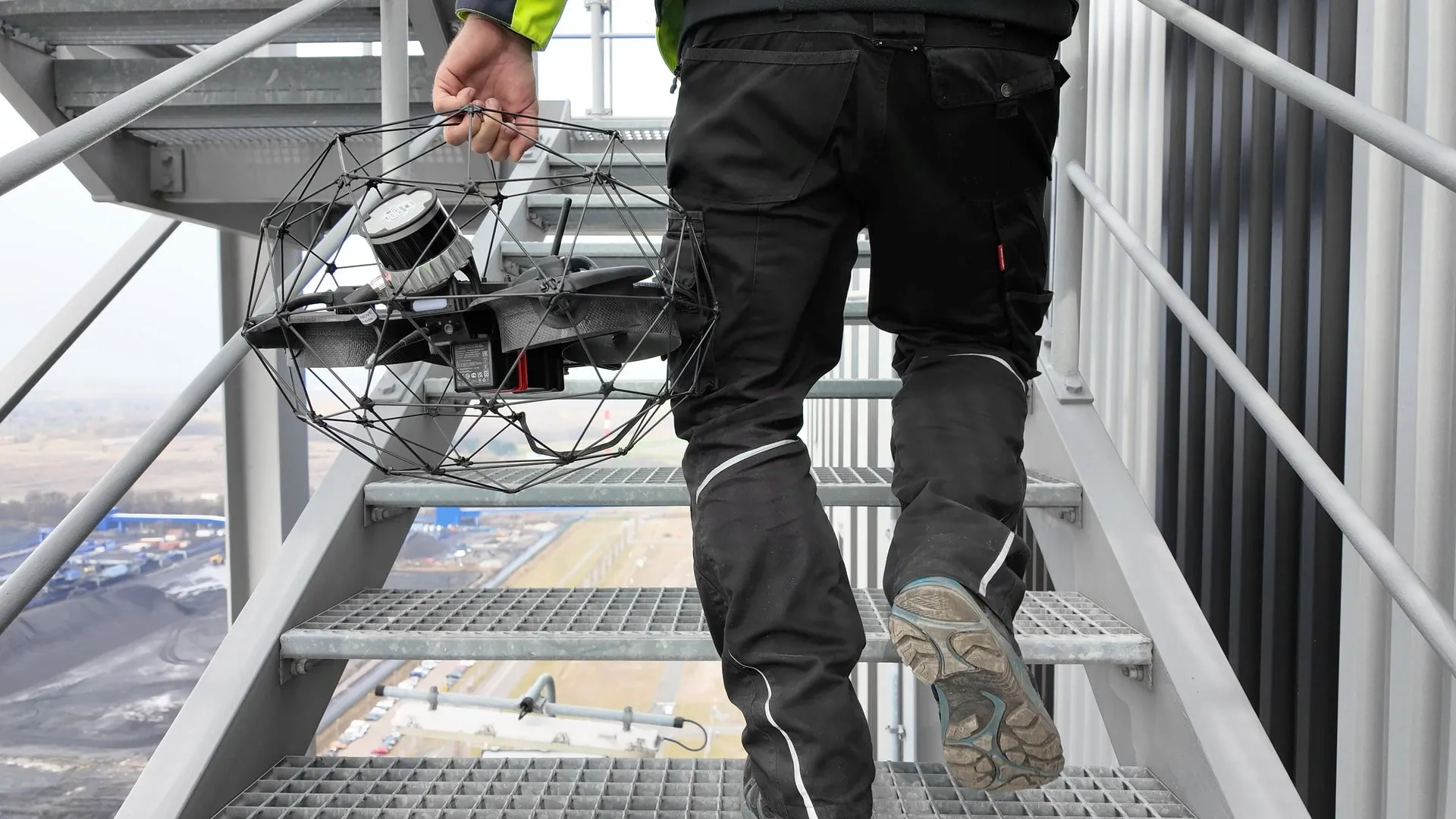
The Flyability ELIOS 3 – GPS-free, collision-safe interior drone for rotor blade and tower inspections.
Most wind turbine inspections focus on the exterior – surface cracks, leading edge erosion, lightning damage. But 90% of structurally relevant blade damage occurs on the inside: delaminations at bond lines, cracks at web adhesives, shell separations. These are invisible from outside – and cannot be captured by walk-arounds or exterior drones.
With the Flyability ELIOS 3, we inspect rotor blades from the inside: the drone flies through the root opening into the blade, systematically along pressure and suction sides, documenting bond lines, web connections and shell interior structures with 4K resolution and optional LiDAR. On removed blades on the ground as well as on the installed turbine.
In addition to rotor blade interior inspection, we capture towers, nacelles and support structures: corrosion in tower segment connections, cracks at flange connections, damage to walkways and fittings. For offshore and onshore turbines alike – coordinated with your condition monitoring team and inspectors.
Finding assessment and all decisions on repairs or continued operation remain with your rotor blade experts and certifiers – we deliver the data foundation: structured 4K video documentation of interior structures and LiDAR point clouds for geometry analysis on request.
Inspection Technology for Wind Turbines
ELIOS 3 for tower interior and nacelle, DJI M30T for rotor blades and external structure – combined for complete WEA inspection.

ELIOS 3 – Tower Interior, Nacelle & Hub
GPS-free SLAM navigation in the tower shaft, collision protection. Inspects weld seams, corrosion, cable runs and structural components without climbing work. Minimum opening DN 600 – suitable for standard service openings.
DJI M30T – Rotor Blades, Hub & Exterior Structure
200x hybrid zoom for leading edge erosion, cracks and lightning damage. Radiometric thermography detects delaminations and voids. IP55 – deployable even in wind and rain.
Handheld LiDAR – Foundation Area & Tower Base
Ground-level 3D capture of foundation structure, tower base and transitions. No tripod, spontaneously deployable. Output E57/LAZ for structural assessment and as-built planning.
Combined Full Turbine Inspection in One Visit
ELIOS 3 inside, M30T outside – one inspection appointment for the entire structure. Report with 4K images, thermograms and 3D model for inspectors, insurers and operators.
The Challenge with Wind Turbines
Rotor blades, hub, tower – 80–150 m high. Industrial climbers = 3,000–5,000€/day, weather-dependent, fall risk. ELIOS 3 inspects from inside – in hours instead of days, without climbers.
- Climbers = fall risk + expensive: 100+ metres height, high safety risk in wind. 3,000–5,000€ per day, weather-dependent, multiple days per turbine. ELIOS 3 flies inside through the rotor blade – no fall risk, all 3 blades in hours.
- Downtime = lost revenue: Stopping WEA = no production. Every hour of downtime on a 5–8 MW turbine costs several hundred euros. The drone inspects all 3 blades in 1.5–3 hours.
- 90% of blade defects only visible from inside: Delamination, fibre breaks, water ingress, bondline failure – not recognisable from outside. ELIOS 3 flies through the blade and documents what is invisible outside.
- Exterior rope access is weather-dependent: Rope access teams must stop work at wind speeds above 8–10 m/s. Interior drone inspection is independent of this.
- Rope access covers only a fraction of the blade: Climbers can barely reach the tip on long blades (>60–80 m). ELIOS 3 flies up to 65–70 m in one battery cycle – significantly more coverage.
- Documentation often not reproducible: Position, angle and quality in climber inspections vary greatly. The drone flies stored paths: crack growth and delamination progress become measurable.
- Insurers and certifiers demand evidence: DNV GL, TÜV and insurers require structured, dated and reproducible inspection data. 4K + LiDAR documentation of the ELIOS 3 meets these requirements.
- Difficult lighting conditions inside the blade: The interior of rotor blades is completely dark. ELIOS 3 brings 16,000 lumens of its own lighting – consistently uniform illumination over the entire blade length.
Typical Interior Inspections at Wind Turbines
With the Flyability ELIOS 3 we inspect wind turbines from the inside – safe, fast and without climbers. 90% of blade defects are only visible from inside. All 3 blades inspected in the shortest time. Early damage detection to avoid costly blade replacements:
1. Rotor Blades (Inside) – Fibreglass
Inspection through the rotor blade from the inside. 90% of defects only visible inside. All 3 blades in the shortest time. Early damage detection to avoid costly blade replacements.
- Sensors: Visual, Thermography, LiDAR
- Typical findings: Delamination, cracks, water ingress, fibre breaks, adhesive failure, blistering, faulty lightning protection components, grease deposits
2. Hub & Transition Elements
Inspection of bearings, hydraulic components, transition pieces without disassembly. Cracks, corrosion, leaks.
- Sensors: Visual, LiDAR, Thermography
- Typical findings: Corrosion, oil leaks, mechanical damage, weld seam cracks, transition piece cracks
3. Tower (Inside) & Nacelle
Inspection of the tower inner wall, nacelle structures for corrosion, cracks and structural damage without climbers or scaffolding.
- Sensors: Visual, LiDAR
- Typical findings: Corrosion, weld seam cracks, structural deformations, moisture, transition piece damage
4. Rotor Blade – Root Area & Bolt Connections
Inspection of the blade root from inside: bolts, inserts, laminate transitions. Critical area for structural integrity – damage here is not recognisable from outside.
- Sensors: Visual, LiDAR
- Typical findings: Cracks in laminate area, loose or corroded bolts, delamination at transition to hub, moisture ingress in root area
5. Rotor Blade – Web Structure & Spar Caps
Inspection of internal shear webs and bond lines over the entire blade length. Many critical damages arise exactly here – and are only visible from inside.
- Sensors: Visual
- Typical findings: Adhesive failure, delamination at webs, cracks along load paths, local structural separations
6. Lightning Protection System in the Rotor Blade
Inspection of conductors, contacts and cables inside the blade. Often underestimated, but extremely relevant – especially after lightning strikes.
- Sensors: Visual
- Typical findings: Broken conductors, loose contacts, corrosion, damage after lightning strike
7. Pitch System (in the Hub)
Inspection of pitch bearings, hydraulic systems and electrical components in the hub. Thermography shows thermal anomalies without disassembly.
- Sensors: Visual, Thermography
- Typical findings: Oil leaks, bearing wear, thermal anomalies, mechanical damage
8. Nacelle – Machine Frame & Supporting Structure
Inspection of the internal steel structure, frames and fixing points. Structural fatigue from continuous operation develops gradually.
- Sensors: Visual
- Typical findings: Corrosion, weld seam cracks, loose connections, structural fatigue
9. Nacelle – Cable Runs & Wiring
Inspection of cable routes in hard-to-access nacelle areas. Thermography detects overheating points without intervention in the electrical installation.
- Sensors: Visual, Thermography
- Typical findings: Damaged cable insulation, loose cables, overheating points, mechanical stress
10. Tower – Flange Connections & Segments
Inspection of tower segments and flange connections over the entire height. Particularly relevant for long-term operation and repowering assessments.
- Sensors: Visual, LiDAR
- Typical findings: Flange corrosion, cracks, leaks, bolt problems
11. Tower – Climbing Systems & Fittings
Inspection of ladders, platforms and service equipment in the tower. Safety-critical components that must be regularly assessed.
- Sensors: Visual
- Typical findings: Corrosion, mechanical damage, loose connections
12. Foundation Connection & Tower Base
Inspection of the tower-to-foundation transition for corrosion, moisture ingress and coating damage. Structural anomalies here are serious and often hard to access.
- Sensors: Visual
- Typical findings: Corrosion, moisture ingress, coating damage, structural anomalies
What We Document at Wind Turbine Interior Inspections
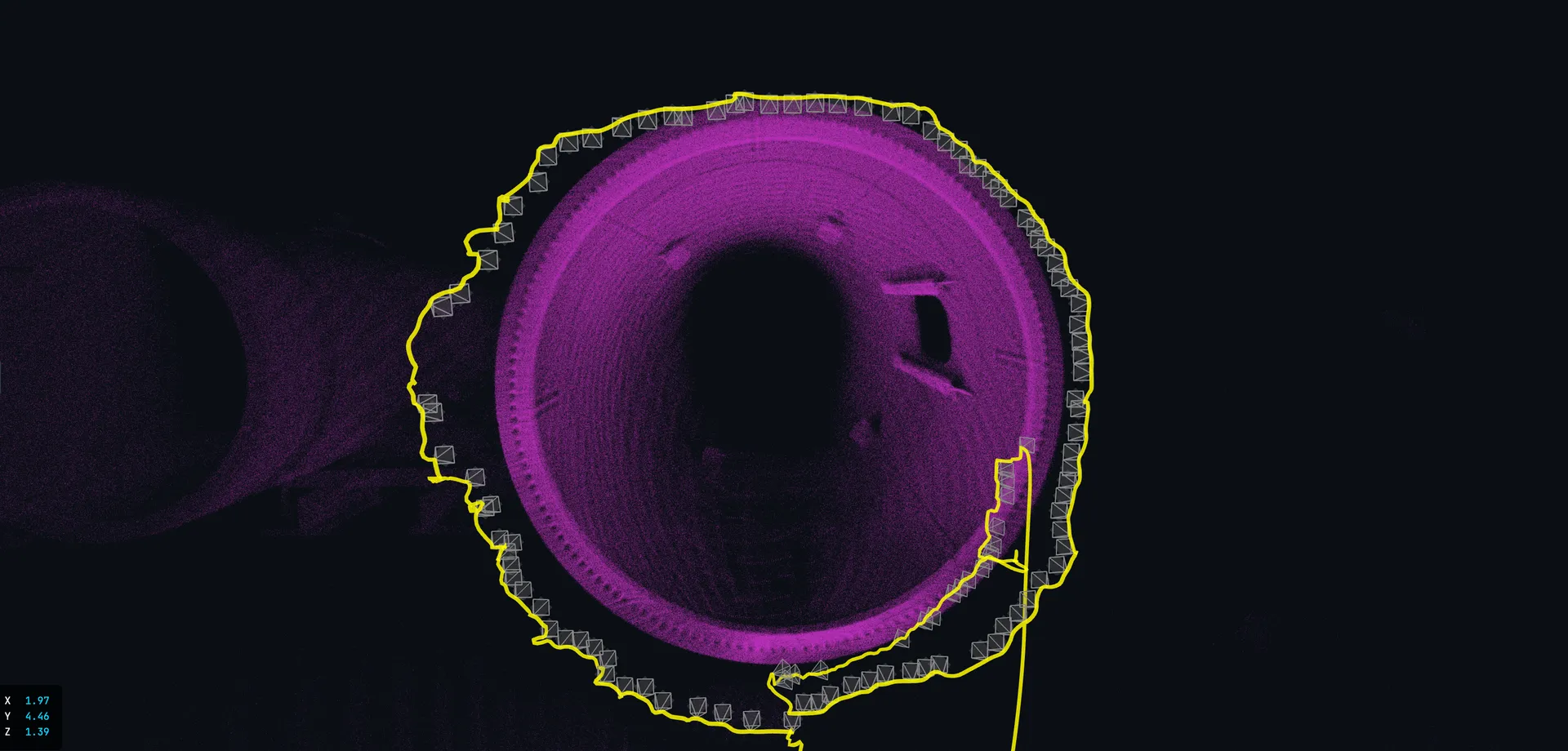
LiDAR 3D scan of a monopile – geometry documentation for structural analysis and condition monitoring.
Rotor blades, towers and nacelles often only reveal their critical damage from inside. We systematically document all safety-relevant areas without climbers – your WEA inspectors and service technicians assess the findings:
Rotor Blades Inside – Shell & Spar Structure
- What we check: Delamination on GRP shell (suction side, pressure side), cracks in foam core, separations at trailing edge adhesive (TE Bond Line), moisture and condensate traces, condition of shear web bond
- Why it matters: Delaminations grow unnoticed – an overlooked crack in the trailing edge adhesive can lead to complete separation and in extreme cases to blade loss. Replacement costs per blade: 80,000–150,000€. Annual interior inspections make crack growth measurable.
- How we do it: ELIOS 3 flies through the blade interior from root to tip – 4K camera with strong LED lighting captures delamination and crack locations, LiDAR measures blade geometry and wall thickness deviations, thermography shows moisture ingress
Rotor Blade Root Area & Bolt Connections
- What we check: Cracks in GRP laminate at root insert, condition of insert bolts and inserts, corrosion at flange surfaces, laminate quality around boreholes
- Why it matters: The root area transfers all loads between blade and hub. Cracks in the laminate around insert bolts are hard to detect from outside and structurally critical. Interior inspection enables direct view of load-bearing areas.
- How we do it: ELIOS 3 flies into the root area and documents bolts, flange and laminate from close range – 4K and LiDAR for crack images and geometry check
Hub & Rotor Blade Connections
- What we check: Cracks and corrosion on hub structure (cast or steel), condition of blade bearings, pitch drives and hydraulic cylinders (visual), seals and cable routing
- Why it matters: The hub as central connecting element between rotor blades and drivetrain is subject to high dynamic loads. Cracks in the casting or corrosion at fastenings are safety-relevant and hard to detect without interior inspection.
- How we do it: ELIOS 3 documents hub and transition elements from inside – 4K camera and LiDAR for crack images and 3D model of hub geometry
Tower Inside – Flange Connections & Weld Seams
- What we check: Corrosion at flanges and weld seams, pitting, coating damage, condition of foundation anchor bolts, cracks at tower wall
- Why it matters: Flange corrosion inside the tower remains invisible for years without inspection. Coating damage allows saltwater corrosion – particularly relevant offshore and at coastal locations. LiDAR measures geometry deviations from thermal deformation.
- How we do it: ELIOS 3 flies along inside the tower and documents all flanges and weld seams – 4K for corrosion and crack locations, LiDAR for geometry measurement of tower cross-section
Nacelle – Machine Frame, Cable Runs & Thermography
- What we check: Corrosion on machine frame and support structure, thermal anomalies at electrical connections and control cabinets, condition of cable runs and insulations
- Why it matters: Thermal anomalies at control cabinets and electrical connections in the nacelle are early warning signals for fire risks. Classic visual inspection without thermography does not detect these risks.
- How we do it: DJI Matrice 30T with radiometric thermography for exterior inspection of nacelle and blade outer surface; ELIOS 3 for interior inspection of the nacelle at hard-to-access components
Result: Structured inspection report with 4K finding images, thermography evaluation and LiDAR 3D model – as data foundation for your WEA inspectors and operations management. Reproducible flight paths enable follow-up inspections with direct damage comparison over years.
Your Advantages as Wind Park Operator
- No climbers: No fall risk, no hazardous work at height. Drastically reduced risk for your personnel.
- Minimal downtime: Significantly shorter inspection time per turbine – instead of days with climber deployments. Faster recommissioning, lower production losses.
- Weather-independent: Inspection from inside – independent of wind and weather. Maintenance windows are maintained, no weeks-long delays.
- Cost savings up to 80%: Compared to climber teams you save up to 80% of inspection costs – without quality loss.
- Precise documentation: 4K video, high-resolution images and LiDAR point clouds – sound decision basis for maintenance and warranty cases.
- Reproducible follow-up inspections: Stored flight paths enable comparative inspections over years. Crack growth and delamination progress become measurable – basis for condition-based maintenance.
- Early detection prevents total damage: An overlooked crack can lead to blade delamination or in extreme cases to blade loss – replacement costs over 500,000€. Early findings enable targeted repairs before damage escalates.
How the Inspection Works
- Initial consultation (free): We analyse your requirements and advise you free of charge on all technical and organisational questions.
- Scheduling & quote: You receive a transparent quote. Together we plan timing, access and safety concept.
- On-site inspection: We carry out the inspection with state-of-the-art drone technology – usually within a few hours.
- Evaluation & inspection report: You receive a detailed report with 4K recordings, 3D models, thermography analyses and systematic findings overview.
Your Contacts for Wind Turbine Inspection
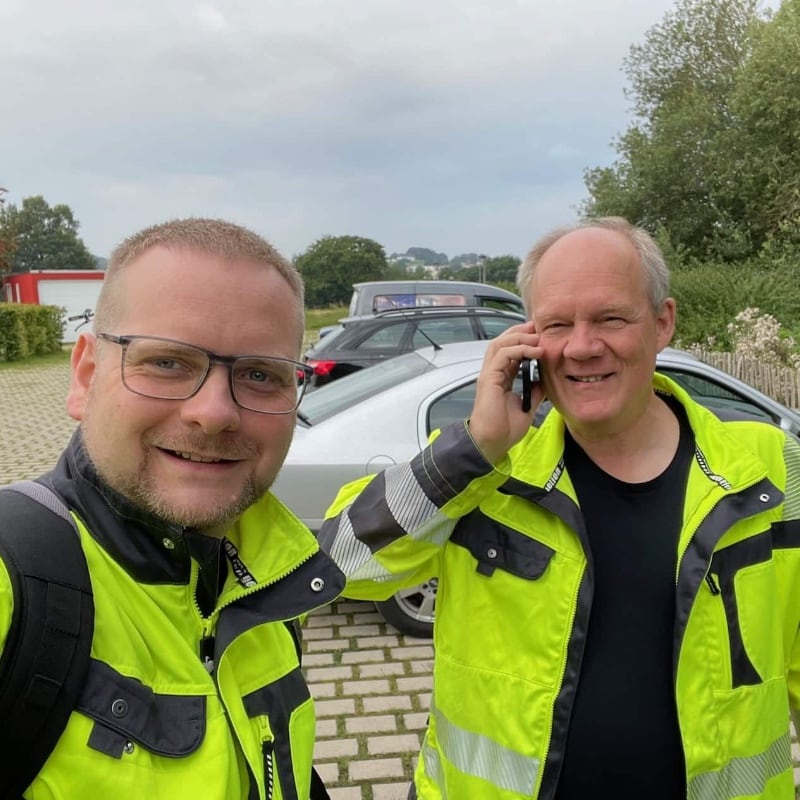
Christian Engelke and Dipl.-Ing. Karsten Lehrke – your direct contacts for wind turbine drone inspection projects.
Christian Engelke and Dipl.-Ing. Karsten Lehrke are your direct contacts for wind turbine drone inspections. Since 2017, Kopterflug has been operating in complex industrial environments. We understand the requirements of the wind energy industry – minimal downtime, precise documentation, highest safety.
We advise without sales pressure – even if the recommendation is: commission the service rather than purchasing equipment.
From wind parks in Bremerhaven and Emden to turbines in Hamburg, Kiel, Rostock and Oldenburg – we inspect wind turbines nationwide across Germany.
Related Services
- Infrastructure Inspection – Towers, foundations and steel structures – condition assessment by drone.
- Energy & Power Plants – Conventional energy generation plants: boilers, cooling towers and chimneys.
- Chimney Inspection – Tall cylindrical structures inspected by drone – without scaffolding and rope access.
- LiDAR Survey – Geometry analysis and deformation capture on wind turbines via 3D point cloud.
- Condition Documentation – 4K video, findings list and PDF report – standards-compliant documentation for insurers and operators.
- Costs & Effort – Rotor blade and tower inspection without climbing teams – why drones are cheaper and safer.
Frequently Asked Questions: Wind Turbine Interior Inspection by Drone
Is drone inspection of rotor blades with the ELIOS 3 established – and do certifiers like DNV GL or TÜV accept the results?
Yes, the deployment is well established in the wind energy industry and is used worldwide by major wind park operators. DNV GL, TÜV and many OEMs accept the results as a basis for maintenance decisions and warranty cases – provided the data is structured, dated and reproducible. Well-prepared 4K and LiDAR data packages are recognised industry-wide as reliable inspection foundations.
How far does the ELIOS 3 reach inside a rotor blade – does it reach the tip on modern 80–120 m blades?
The ELIOS 3 achieves penetration depths of up to around 65–70 m in one battery cycle (9–12 minutes flight time depending on payload). On modern blades of this length, it covers 60–80% of the blade length – significantly more than conventional rope access methods allow for interior inspection. For very long blades (>100 m), a second battery run can complete the coverage.
Which blade defects does the drone reliably detect inside that are invisible from outside?
Exactly the damage responsible for 90% of costly blade failures and not recognisable from outside: delamination (layer separation), water ingress and moisture accumulation, fibre breaks, adhesive failure at webs and spar caps (bondline failures), blistering, cracks in spar caps, faulty or damaged lightning protection components and mechanical damage to fittings. Thermography additionally visualises moisture pockets and temperature anomalies.
How does thermography specifically help detect moisture, delamination or hotspots inside the blade?
Water and moisture change the thermal behaviour of fibre structures: moist zones cool faster or store heat differently than dry structural areas. Delaminations create air pockets that appear as temperature gradients in the thermal image. Thermography also detects hotspots from friction or electrical problems in the lightning protection system. The combination of 4K camera and thermography uncovers damage that would be recognisable neither visually alone nor from outside.
Can LiDAR measure and quantify cracks, deformations or thickness deviations inside the blade?
Yes. The LiDAR integrated in the ELIOS 3 generates centimetre-accurate 3D point clouds of the blade geometry. Crack widths and progressions, geometric deformations and thickness deviations can be measured in post-processing. The point clouds serve as the basis for digital twins – and when the same path is flown in a follow-up inspection, crack growth can be tracked exactly over years.
How long does a drone inspection take – all three rotor blades of a WEA?
Typically 1.5 to 3 hours per turbine, including ascent to the hub, inspection of all three blades and return. The flight itself per blade takes a few minutes; positioning times (rotating blades into inspection position) are additional. At large wind parks, several turbines per day are realistic – significantly more than with conventional rope access. The turbine is back on the grid correspondingly quickly.
How many people are needed for the drone inspection on site?
Standardly two people: a pilot who controls the drone secured in the hub, and an assistant/spotter at the ground or in the tower who secures and coordinates. The two-person team is our standard. No large rope access team of 5–10 people, no aerial work platform crew – personnel effort is significantly lower, and height exposure risk for our team is limited to the ascent to the hub.
How weather-independent is interior inspection really – does it work even in strong wind?
Very high – once the drone is flying inside the blade, external wind has no influence. The turbine must stand still, but unlike rope access methods, there is no wind cut-out for the drone work itself. Classic rope access teams must stop work at wind speeds above 8–10 m/s; interior drone inspections can continue in this window. The only weather-dependent component: the ascent to the hub, which must be assessed according to safety protocols under extreme conditions.
What happens if the drone gets stuck or damaged inside the narrow blade interior – is there a recovery concept?
The ELIOS 3 is designed for this scenario: the collision protection cage allows wall contacts without crash, reverse-spinning motors enable self-rescue if jammed, and the return-to-signal function safely returns the drone to the operator upon communication loss. In real deployments in confined spaces, the drone is extremely robust – collisions with blade structure are part of normal operation. For the very rare case of failure, a safety cord on the device is possible.
How detailed is the 4K documentation – is the resolution sufficient for fibre breaks, blistering and fine cracks?
The resolution is sufficient for most relevant damage: the ELIOS 3 films in 4K Ultra HD (3840×2160, 30 fps) and takes 12-megapixel photos from close range. With 16,000 lumens LED lighting the dark blade interior is evenly illuminated. Fibre breaks, blistering, adhesive delaminations and micro-cracks are visually recognisable. For very fine hairline cracks under 0.5 mm, detectability depends on approach angle and distance – proximity and light are decisive.
Can flight paths be stored and repeated for follow-up inspections – for trend monitoring over years?
Yes, this is one of the decisive advantages over climber inspections. FlyAware SLAM stores trajectories, 3D live maps and point clouds. In the next inspection, the same paths and camera positions can be reproduced. Crack growth, delamination progress or moisture increase over months and years can be cleanly documented. For condition-based maintenance and extended operational life, this is a significant advantage over one-time visual inspections.
Do the inspection data (4K video, LiDAR point clouds, thermography) meet the requirements for warranty or insurance cases?
Generally yes. The data is objective, timestamped, position-referenced (via SLAM positioning) and reproducible – exactly the properties that manufacturers, insurers and certifiers require for reliable damage documentation. Many wind park operators use drone inspection data as evidence for early damage detection, to avoid costly blade replacements or to invoke manufacturer warranty.
Up to what hub height is ELIOS 3 deployment useful – are there limits through access?
There is no fundamental height limit for the drone itself. The limit is hub accessibility – whether and how safely a pilot can reach the hub (interior ladder, lift or exterior ascent). In real deployments, hub heights of over 80–100 m have been inspected without problems. The higher the turbine, the larger generally the rotor blades – and the more relevant the drone, because rope access teams for interior inspections can only go so far anyway.
Can the drone also inspect the hub (bearings, hydraulics, pitch system) and the transition piece for corrosion, leaks or cracks?
Yes, the hub and its components are a classic deployment area for the ELIOS 3. Corrosion, oil leaks, weld seam cracks, damage to pitch components and hydraulic components can be documented visually and by thermography – without disassembly. LiDAR captures the geometry. The transition piece at the tower-to-foundation transition can also be inspected from inside for cracks, corrosion and structural damage.
How well is the ELIOS 3 suited for tower interior inspection (weld seams, corrosion, moisture in the foundation area)?
Very well – the tower is an ideal confined space for the ELIOS 3. The drone flies along interior walls, documents weld seam areas, corrosion spots, moisture damage in the base and foundation area, and transition points between tower segments. LiDAR captures geometry for deformation analyses. Older turbines (>15 years) often show first corrosion signs in the lower tower area – an early finding saves considerable costs compared to full renovation.
How much cheaper is drone inspection compared to industrial climbers (per turbine / per park)?
Rope access teams typically cost 3,000–5,000€ per day, are weather-dependent and need multiple days per turbine. Drone inspection with a small team working through several turbines daily is – in overall consideration of personnel, downtime days and logistics – up to 80% cheaper. Added to this is the revenue gain through shorter downtimes. Specific figures depend on park size, turbine type and scope – ask us for a tailored quote for your wind park.
Are there real references or case studies of wind park operators who saved significant costs through early drone inspection?
Yes. Flyability documents several real cases: in a published case study, blade replacement costs of over 1 million USD per blade were avoided through early defect detection – four turbines were inspected in one day. Another documented deployment shows a complete blade inspection in 27 minutes compared to 1–2 days with conventional methods. On request we are happy to describe our own deployment examples.
How often do you recommend interior inspections for rotor blades, hub and tower – and what determines the interval?
As a guideline: 1–2 interior inspections per year for active turbines, 2 or more for older turbines (over 10–12 years) or at unfavourable site conditions (coast, high lightning density, aggressive moisture). After a lightning strike or unusual vibrations, an event-triggered immediate inspection is recommended. The biggest argument for shorter intervals: with reproducible drone data, inspection becomes condition-based rather than fixed – you inspect more frequently, because each inspection is cheap and fast.
What do we need to prepare as an operator?
The effort on your side is typically minimal: access to the hub (interior ladder or lift), brief safety briefing by your on-site safety officer, and stopping the turbine for the inspection period. No scaffolding, no large rope access teams, no special preparation for confined space entry. We coordinate access with your team and provide our own safety equipment for the ascent.
Get in Touch
Questions about wind turbine drone inspection or need a quote for your project? Fill out the form and we'll get back to you within 24 hours.