
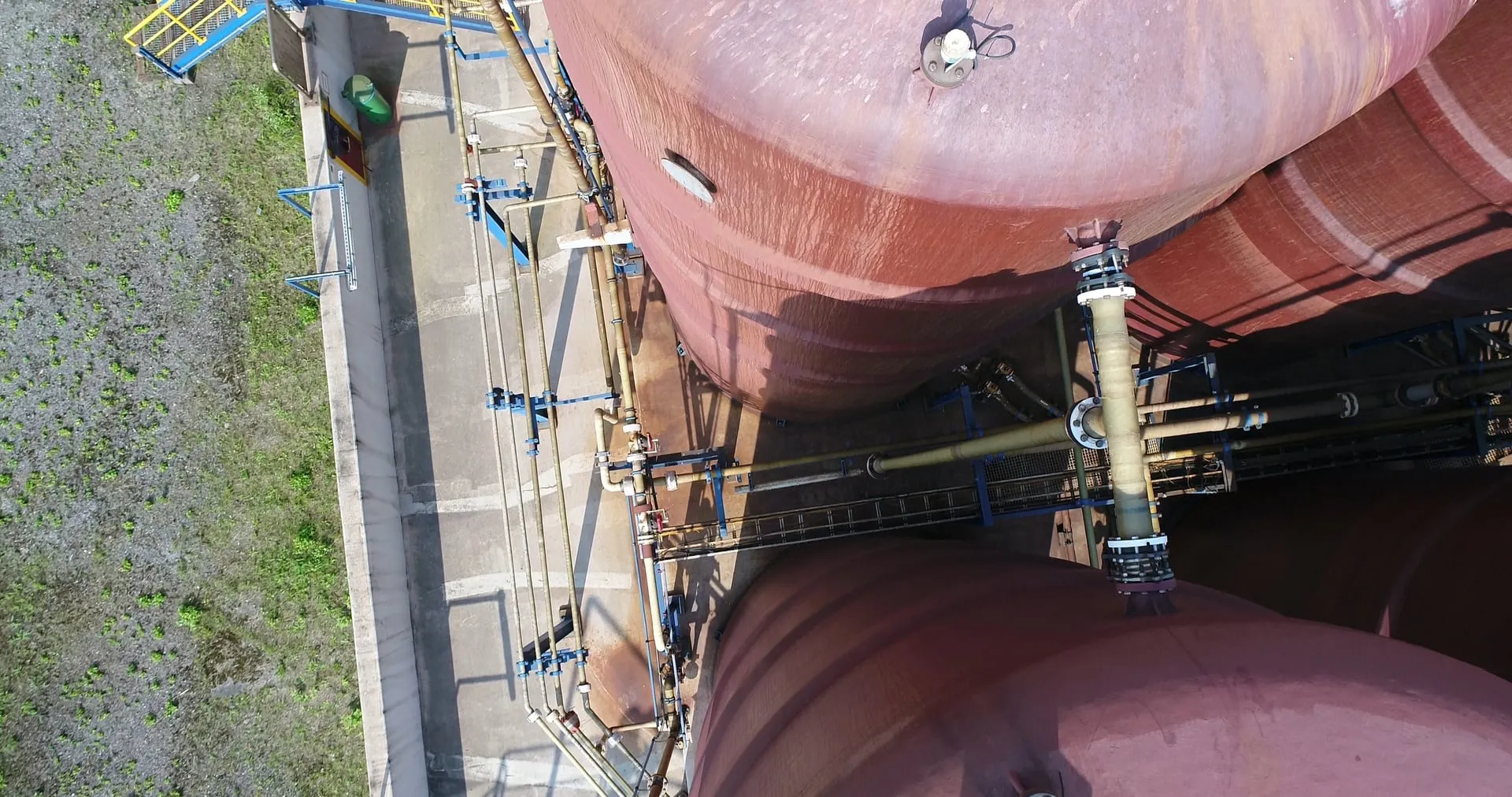
Tank Inspection by Drone – No Entry, No Scaffolding, No Production Stoppage
Kopterflug deploys the Flyability ELIOS 3 for internal tank inspection in oil & gas, chemical and industrial facilities – without scaffolding, without confined space entry (DGUV-compliant), without extended downtime. Water-filled tanks inspected by underwater camera without draining. TÜV inspectors assess our data.
- No confined space entry – drone or underwater camera does the job
- DN 600 minimum opening for the ELIOS 3
- 4K + Thermography + LiDAR in a single deployment
- Documentation aligned with BetrSichV (German Industrial Safety Regulation) & API 653
Tank Inspection by Drone: Proven in the Field
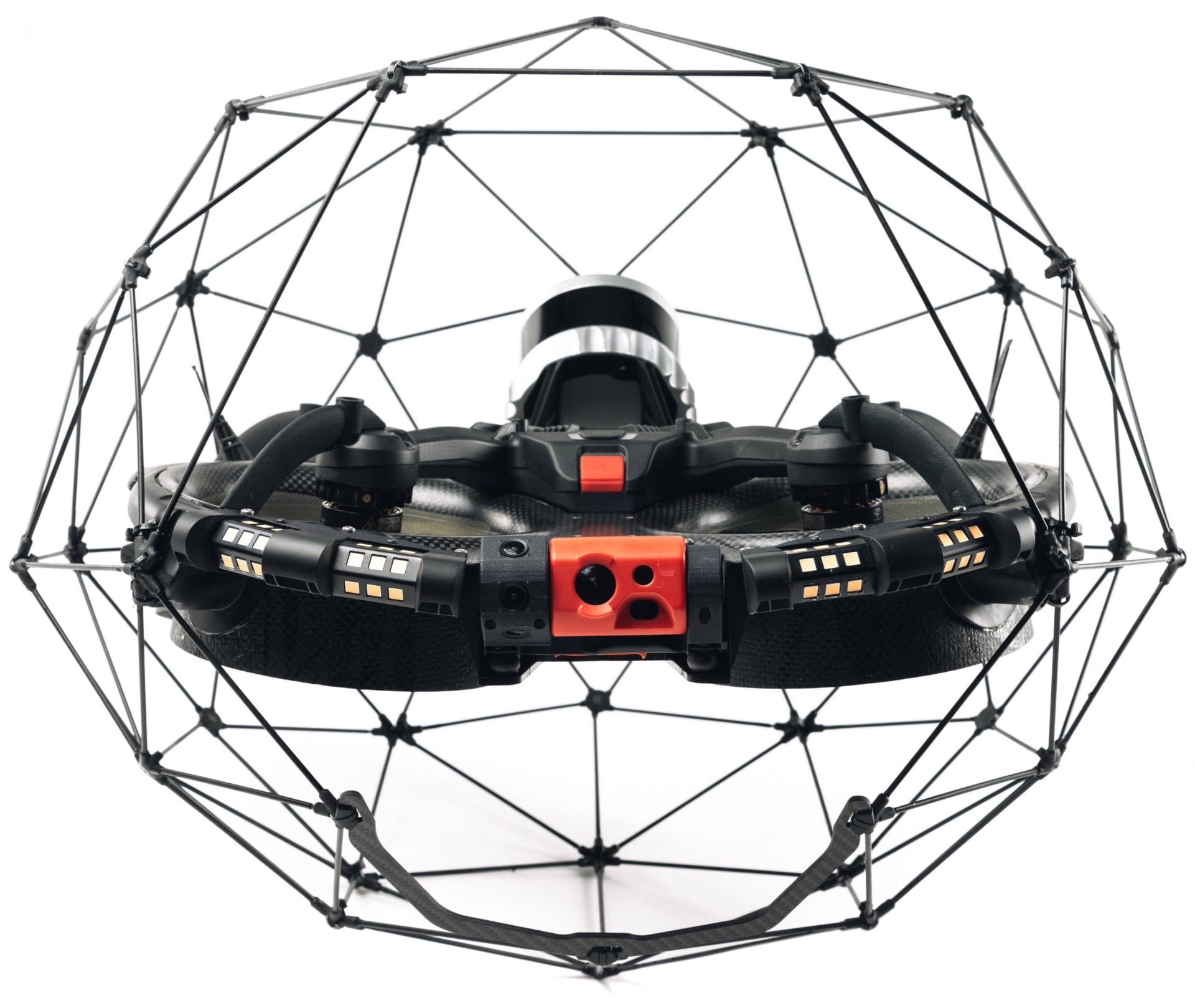
The Flyability ELIOS 3 with its collision-safe carbon cage – built for confined industrial tank interiors.
"Every industry has tanks" – and depending on the medium, operating conditions or certification requirements, these vessels must be regularly inspected or subjected to a formal tank inspection. The key priority: take the tank out of production for as short a time as possible, avoid human entry where possible, and deliver meaningful findings.
We choose the right system for each situation: the ELIOS 3 for internal inspection of drained tanks (no scaffolding, no human entry), an underwater camera for water-filled tanks – depending on medium and operating conditions – and the DJI M30T for external inspection of complete tank farms. Always without human entry. Always with usable data for your TÜV-certified inspectors.
The goal of every condition assessment is planning certainty: Where does the tank stand today, which areas are critical, what can wait until the next inspection? Our documentation provides the data foundation – your maintenance team and TÜV inspectors make the decisions.
Steel tanks typically show pitting at the floor plate, underside corrosion from condensate, weld seam failures and CUI (Corrosion Under Insulation) beneath insulation layers – all findings we capture systematically with 4K imaging and thermography. GRP tanks (glass-fibre reinforced plastic, German: GfK) reveal delamination, osmotic blistering, hairline cracks in the gel coat and ageing of the fibre reinforcement – damage often missed in visual inspections from scaffolding. Coatings in steel tanks (epoxy, polyurethane, rubber linings) are assessed for blistering, disbonding at weld seams and chemical attack – before localised defects develop into large-scale corrosion.
The Challenge of Tank Inspection
Tanks are difficult to access, often contaminated, and technically complex. Conventional inspections require human entry under hazardous conditions – with significant effort, risk and limited data quality.

Small manholes, narrow ladders and internal fittings make access extremely difficult. Equipment can only be brought in with great effort – costly in time and increasing injury risk.
Oxygen deficiency, toxic gases, explosive atmospheres – entering tanks is one of the most hazardous tasks in industry. In an emergency, the confined entry point severely complicates rescue.

Working in forced postures, heat, cold and with respiratory protection leads quickly to fatigue. Darkness and reflections on oily or wet surfaces cause defects to be overlooked – inspection quality drops.

Tanks often require extensive cleaning and gas-freeing. Scaffolding erection, confined space preparation and rescue chain coordination add days or weeks of production loss.

Wall thinning, pitting and weld seam corrosion are often detected too late. Poor visibility due to darkness and reflections amplifies the problem – critical zones are only partially checked.

Notes, photos and markings are often imprecise. Defects can hardly be relocated later – comparative condition assessment across multiple inspection cycles is barely possible.

Beyond the inspection itself: scaffolding logistics, equipment, certified personnel and disposal of contaminated waste – often higher than expected. Experienced inspectors are scarce; short-notice deployment is difficult to plan.
What We Document in Tank Inspections
We systematically document all safety-relevant areas. Technical assessment is carried out by your maintenance teams and TÜV-certified inspectors – we deliver the data:
| Area | What We Capture | Why It Matters | How |
|---|---|---|---|
| Tank walls & weld seams | 4K footage of corrosion, wall thinning, pitting, weld damage, cracks | Corrosion causes leaks; in chemical or oil tanks this means environmental damage. Weld failures are typical weak points. | 4K camera at close range (ELIOS 3), thermography for hotspots; underwater camera for water-filled tanks |
| Tank floor & sediments | Floor corrosion, sediment deposits, sludge, MIC (microbiologically induced corrosion) | The floor is often the most affected area. Standing water, sediments and MIC accelerate corrosion significantly. | Underwater camera (filled tanks); ELIOS 3 with 4K and LiDAR (drained tanks) |
| Coatings & linings | Coating damage, blistering, disbonding, cracks in linings (GRP tanks) | Damaged coatings accelerate corrosion. In GRP tanks, lining cracks are critical. | 4K documentation shows coating damage precisely; thermography detects disbonding via temperature differentials |
| Tank roof, floating roof & internals | Roof condition, floating deck damage, agitators, pipework, connections | Floating roofs in oil tanks must be intact. Agitators and internals can have concealed damage. | Internal inspection with ELIOS 3; external inspection by outdoor drone with thermography if needed |
| Water-phase zone & underside | Corrosion in the water-phase zone, floor pitting, MIC, floor weld seams | The water-phase zone is the most stressed area – constant phase changes between liquid and gas accelerate corrosion dramatically. | ELIOS 3 flies the water-phase zone at close range – 4K and thermography capture concealed corrosion fields |
| Internals, pipe connections & risers | Anti-vortex plates, pipe clamps, risers, nozzles, heating coils, agitators – corrosion, attachment damage, deposits | Internals are hard to reach in conventional inspections and often only partially checked. Damaged anti-vortex plates or loose clamps can cause production shutdowns. | The omni-directional ELIOS 3 flies deliberately around internals – even tight areas behind risers and between fittings are systematically documented |
| Roof interior & roof connections | Condensate damage on inner ceiling, corrosion at roof connections, nozzle seals, ventilation openings, fixed-roof internal structure | Condensate collects under the tank roof and causes unnoticed corrosion. Leaking roof connections allow product escape or water ingress. | ELIOS 3 inspects the inner ceiling at close range – thermography detects condensate zones even with visually intact coating |
At the end, you receive a detailed inspection report with 4K images, thermography evaluation and optional LiDAR point clouds – documented to BetrSichV (German Industrial Safety Regulation) requirements for your TÜV inspectors.
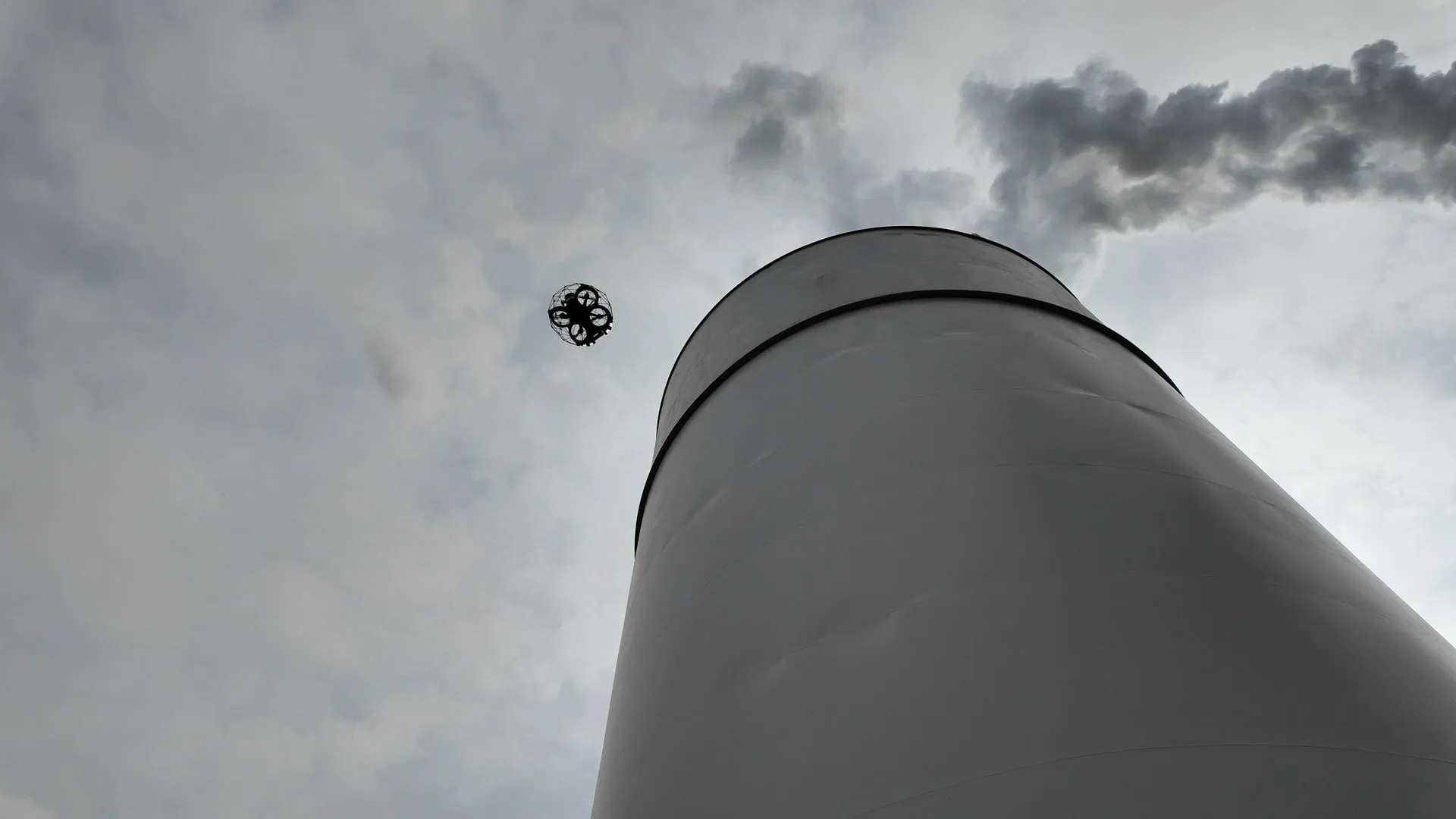
Tank Types We Inspect
We inspect primarily from the inside with the ELIOS 3 – supplemented where needed by the underwater camera for filled vessels or the DJI M30T for external inspection of entire tank farms:






Oil & Gas Tanks
Crude oil tanks, product tanks and storage tanks in refineries and bulk liquid terminals. Typical findings: floor corrosion, floating roof damage, sediment deposits, wall thinning, weld seam corrosion.
- Sensors: Visual (4K), LiDAR, Thermography
- Standards: API 653 (above-ground storage tank inspection), BetrSichV
Chemical Process Vessels
Reactors, storage tanks and buffer vessels with toxic or corrosive media. Coatings, linings and weld seams require close scrutiny. GRP (glass-fibre reinforced plastic, German: GfK) lining cracks are typical critical findings.
- Sensors: Visual (4K), Thermography
- Typical findings: Coating damage, chemical corrosion, GRP lining cracks, leaks
Water & Fire Suppression Tanks (Without Draining)
Potable water tanks, sprinkler tanks, elevated tanks – inspected by underwater camera without draining. MIC (microbiologically induced corrosion) and sediments detected without emptying the vessel.
- Sensors: Visual (4K), Underwater camera (Chasing M2 Pro Max ROV)
- Typical findings: MIC corrosion, sediment, deposits, coating damage
Pressure Vessels & Pressure Tanks
Compressed air receivers, gas vessels, autoclaves and low-pressure tanks in process industry. Interior surfaces, weld seams and coatings inspected. For pressure vessels, a TÜV inspection (per BetrSichV, German Industrial Safety Regulation) is mandatory – we deliver the visual and geometric documentation your certified inspectors need for their assessment.
- Sensors: Visual (4K), LiDAR, Thermography
- Standards: BetrSichV (Betriebssicherheitsverordnung – German Operational Safety Ordinance), DGUV Regel 113-004
Ballast & Cargo Tanks (Marine / Offshore)
Ballast water and cargo tanks on ships, offshore platforms and FPSO installations. Classic confined spaces with high corrosion exposure. ELIOS 3 is well-suited to the complex internal geometries of ship tank frames.
- Sensors: Visual (4K), LiDAR, Thermography
- Typical findings: Floor and wall corrosion, coating damage, anode depletion, deposits, structural deformation
LPG / LNG Tanks (External Inspection)
Spherical and cylindrical storage tanks for liquefied gases. Focus on external inspection and critical zones by DJI M30T. CUI (Corrosion Under Insulation) is a primary risk factor.
- Sensors: Visual (4K), Thermography, LiDAR
- Typical findings: CUI (Corrosion Under Insulation), coating damage, thermal anomalies, valve and fitting leaks
Drone vs. Conventional Tank Inspection
| Aspect | Conventional (scaffolding / climbers / entry) | Drone (ELIOS 3 / ROV) |
|---|---|---|
| Access | Internal scaffolding + climbers | Via manhole, no scaffolding |
| Downtime | 2–3 weeks | 2–3 days |
| Human entry | Yes – DGUV Regel 113-004 (confined space entry regulation), respiratory protection, rescue chain | No entry – drone or ROV does the job |
| Documentation | Photos + handwritten notes | 4K + LiDAR + Thermography |
| Coverage | Accessible areas only | Complete interior surface |
| Total effort | Scaffolding + safety personnel + cleaning + waste disposal | Inspection time only |
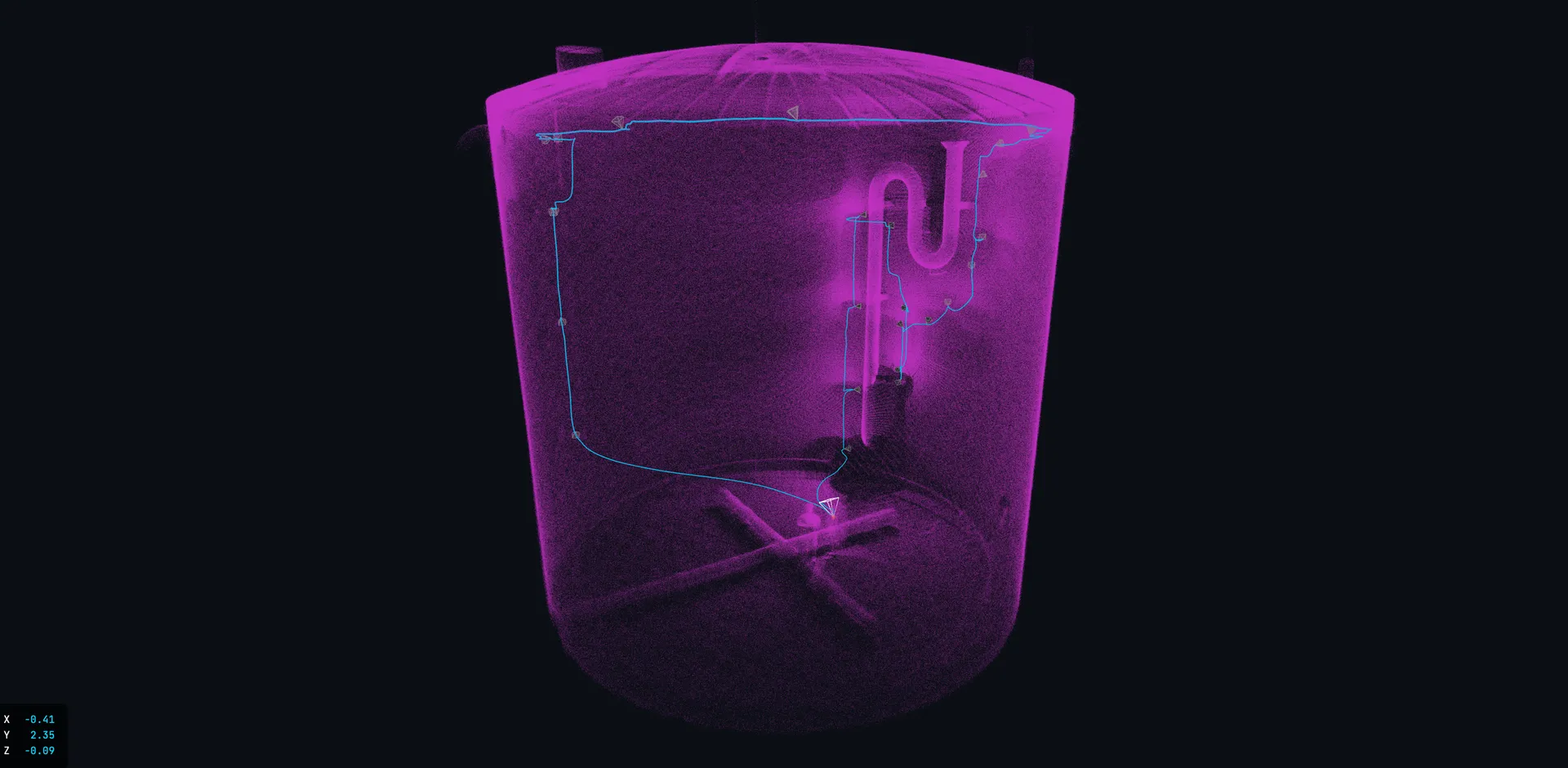
LiDAR 3D point cloud of a steel tank interior – centimetre-accurate geometry for API 653 documentation and deformation analysis.
Benefits of Drone Tank Inspection


Inspection Technologies
ELIOS 3 – Tank Interior (Drained)
GPS-free SLAM navigation in the tank interior. No human entry. Minimum opening: DN 600 (600 mm nominal diameter). Inspects inner roof structure, wall corrosion, wall connections and floor area after draining – documented to API 653, API 510 and BetrSichV (German Industrial Safety Regulation).
- Sensors: 4K video, thermography, LiDAR 3D point cloud
- Access requirement: Tank drained, gas-free measured, manhole ≥ DN 600
DJI M30T – Floating Roof, External Shell & Fittings
External inspection of floating roofs, external corrosion, seals and nozzles. 200× zoom and thermography – no climbing required, inspection possible with tank in service.
- Sensors: 4K zoom camera, thermal imaging
- Best for: Tank farms, external CUI screening, floating roof condition
Chasing M2 Pro Max ROV – Water-Filled Tanks Without Draining
Diving depth to 200 m, 4K, 8,000 lumens, 8 thrusters. Inspects tank floor and submerged walls without draining and without divers – for water-filled fire suppression, sprinkler and process liquid tanks. API 653 compatible.
- Sensors: 4K underwater camera, LED lighting
- Best for: Potable water tanks, fire water tanks, sprinkler tanks
LiDAR – Volume, Wall Deformation & API 653 Documentation
3D point cloud (centimetre-accurate) for tank volume determination, wall deformation analysis and floor plate geometry. Findings report to API 653 – with coordinate references for maintenance planning and insurance documentation.
- Accuracy: Typically ±2–5 cm depending on range and surface
- Outputs: 3D point cloud, colorised model, deformation map, volume calculation
How the Tank Inspection Works
-
Step 1: Initial Consultation & Method Selection (Free)
Which medium? Internal or external inspection? We select the optimum method: ELIOS 3 for drained tanks, underwater drone for water-filled tanks, DJI M30T for external tank farm inspection. Free initial consultation. -
Step 2: Scheduling & Quotation
Transparent fixed-price quotation. We plan the timing, access and safety concept together – coordinated with your TÜV inspectors. -
Step 3: On-Site Inspection
Always with at least two people on site. Gas-free measurement, inspection, data backup – in hours, not days. If required, TÜV inspector present on site. -
Step 4: Inspection Report
Detailed report with 4K footage, thermography evaluation and optional LiDAR point clouds – documented to BetrSichV (German Industrial Safety Regulation) for your TÜV inspectors.
Your Contacts for Tank Inspections
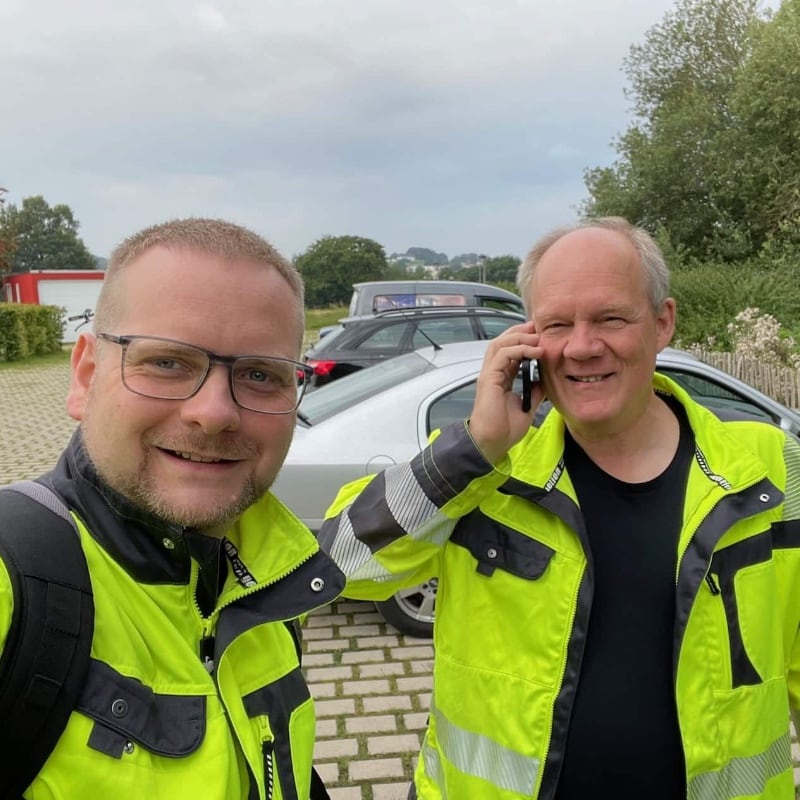
Christian Engelke and Dipl.-Ing. Karsten Lehrke – your direct contacts for tank inspection projects.
Since 2017, we have been inspecting tanks across Germany – from small storage tanks to large crude oil tanks in refineries. We work alongside TÜV-certified inspectors and understand the failure patterns of GRP and steel tanks. Depending on the situation, we deploy the ELIOS 3 or the underwater camera – always without human entry.
Major Industrial Tank Manufacturers
The European market has no single dominant manufacturer – different companies have established themselves depending on material, construction type and application. For the operator, however, it is not the manufacturer that matters, but the condition of the vessel. Regardless of make and year of construction, we document the current condition of your tank – without draining, without scaffolding, without human entry.

Related Services
- Confined Spaces Inspection – All confined interior spaces without human entry – ELIOS 3 for tanks, boilers, silos and shafts.
- Silo Inspection – Structural assessment, deposits and lining damage in silos and bunkers.
- Boiler Inspection – Steam boilers and pressure vessels – findings for certified inspectors without DGUV confined space entry (DGUV Regel 113-004).
- Underwater Inspection – Water-filled tanks, harbour structures and submerged components without divers.
- Industrial LiDAR Survey – 3D point clouds for deformation analysis, volume calculation and API 653 documentation.
- Industrial Drone Inspection – Overview of all inspection services with ELIOS 3 and complementary systems.
- Flyability ELIOS 3 – Full technical profile of the drone we use for all confined space inspections.
Frequently Asked Questions
Which tank types can be inspected with the ELIOS 3?
We inspect storage tanks, pressure vessels and process tanks of all types – steel tanks, GRP tanks (glass-fibre reinforced plastic), stainless steel tanks and concrete tanks. Typical applications include crude oil tanks, chemical tanks, buffer vessels, acid tanks and industrial storage tanks. Key requirement: the tank must be drained, cleaned and gas-free measured, with an access opening of at least DN 600 (600 mm nominal diameter).
Does the tank need to be drained for drone inspection?
For the drone inspection with the ELIOS 3, the tank must be drained, cleaned and gas-free measured. For water-filled tanks (potable water, fire water, sprinkler tanks), we alternatively offer underwater inspection by ROV camera – without any draining required.
How is gas safety ensured during tank inspection?
Before every deployment, we carry out a gas-free measurement with a multi-gas sensor (O², LEL, H²S, CO). The ELIOS 3 is not ATEX-certified – a gas-free atmosphere must be confirmed before the drone enters. We always work in a two-person team as a minimum and agree the safety concept in advance. The ATEX classification concerns explosive atmospheres as defined in the ATEX directive (94/9/EC / 2014/34/EU); "gas-free measured" means confirmed absence of flammable gases above LEL threshold.
Which standards apply to tank inspection?
Our documentation aligns with the requirements of API 653 (Standard for above-ground storage tank inspection, repair, alteration and reconstruction), BetrSichV (Betriebssicherheitsverordnung – German Operational Safety Ordinance governing pressurised vessels and technical equipment) and DGUV Regel 113-004 (German statutory accident insurance regulation for work in vessels and confined spaces). TÜV inspectors and certified assessors use our data as the evaluation basis to determine whether measures are required.
What damage is typically found?
Typical findings include wall and floor corrosion, pitting, coating damage (blistering, disbonding), weld seam defects and sediment deposits. In GRP tanks, cracks in the lining are frequently detected. Thermography also reveals coating undercreep and moisture areas invisible to the 4K camera alone.
How long does a tank inspection take?
Flight time per battery is approximately 12 minutes. Depending on tank size, one to several flights are needed. Typical inspections are completed in a few hours including preparation and data backup – compared to 2–3 weeks for conventional scaffolded inspections.
Do DGUV confined space entry rules still apply with drone inspection?
Since drone inspection involves no human entry, the requirements of DGUV Regel 113-004 (German statutory accident insurance regulation for confined space entry) do not apply to the inspection itself – no gas-freeing for personnel, no respiratory protection, no rescue chain. Whether an additional human entry is required for repairs is decided by your inspectors based on our findings data.
Is the data accepted by TÜV inspectors and certified assessors?
Yes. Our documentation is regularly used by inspection bodies (TÜV, DEKRA, authorised experts) as an assessment basis. What matters is structured data preparation – with position-referenced image evidence, a findings list and clear action recommendations, aligned with BetrSichV and API 653. On request, we agree scope and format with your inspector in advance.
What role does thermography play in tank inspection?
The ELIOS 3 carries an integrated thermography system. It enables detection of coating undercreep, moisture zones, thermal anomalies and hotspots – even behind visually intact surfaces. Thermography delivers findings that a visual camera alone cannot reveal. Images are mapped to the corresponding locations in the report.
What is LiDAR used for in tank inspection?
LiDAR generates a precise 3D point cloud of the tank interior during flight – with centimetre-level accuracy. This delivers two practical advantages: First, the map provides spatial orientation for the findings list – every anomaly gets a position in 3D space. Second, follow-up inspections can be carried out at exactly the same locations, and changes measured over time – e.g. deformation or corrosion progression. Essential for API 653-compliant trending.
How much does a drone tank inspection cost?
Costs depend on tank size, accessibility, selected sensors (4K, thermography, LiDAR) and the required report format. Typically they are significantly lower than conventional inspections with scaffolding, human entry and multi-day downtime. We provide a transparent fixed-price quotation based on your details – no surprises. Contact us for a free initial assessment.
What does the inspection report look like after a tank inspection?
You receive a structured findings report containing: 4K image and video evidence of all captured areas, a position-referenced findings list with description and assessment of each anomaly, thermography evaluation (where deployed) and optionally a LiDAR 3D point cloud as a georeferenced baseline. The data package is prepared in an audit-proof format for direct use by TÜV inspectors and certified assessors.
Can floating roofs, internals and pipe connections be inspected?
Yes – this is a key advantage over rigid camera systems. The ELIOS 3 can deliberately target complex internal geometries: floating roofs, pipe connections, support beams, risers, internals and corners. Areas difficult to reach for a diver or a fixed camera system can be systematically captured and documented thanks to the omnidirectional manoeuvrability of the drone.
What happens if the drone collides with the tank wall?
The ELIOS 3 is specifically designed for confined space operation – with a robust cage frame that absorbs light collisions without any risk of failure. The system is built for contact with walls, ceilings and internals. Following a collision, the drone typically remains fully operational. Loss of the drone is effectively excluded as the system always remains within the pilot's range of sight.
Are repeat inspections and trend tracking possible?
Yes – this is one of the strongest practical benefits of drone inspection for condition-based maintenance (CBM / RBI). Reproducible flight paths and LiDAR georeferencing allow follow-up inspections to be carried out at exactly the same locations. Corrosion progression, growing coating damage or structural deformation become measurable and documentable across inspection cycles – as a basis for risk-based inspection (RBI) decisions.
What preparation is required for a deployment?
Requirements are manageable: access to the tank (manhole from DN 600 or equivalent opening), defined operating state (drained and gas-free measured for ELIOS 3, or filled for ROV deployment), and information about the medium and tank geometry for mission planning. The operational side – gas-free measurement, safety concept, data backup – is handled entirely by us.
How quickly can a tank inspection be scheduled?
For urgent requirements, we are often on site within a few working days – significantly faster than conventional inspections requiring scaffolding logistics, dive teams or multi-day preparations. For planned inspections, we recommend some lead time for coordination with your inspector and safety concept preparation. Contact us directly – including for short-notice requests.
Why is the water-phase zone especially critical in tank inspection?
The water-phase zone – the area where the medium periodically alternates between liquid and gas – is the most stressed zone inside a tank. The constant phase change creates aggressive corrosion conditions: condensate, fluctuating pH levels and elevated oxygen concentration dramatically accelerate pitting and wall thinning. In conventional scaffolded tank inspection, this zone is often difficult to access – the ELIOS 3 flies it at close range in a targeted pass.
What corrosion damage on the inner tank wall can be detected by drone?
By drone we capture pitting, broad wall thinning, weld seam corrosion, CUI (Corrosion Under Insulation) and MIC (microbiologically induced corrosion). In addition, coating damage such as blistering, disbonding and cracks in epoxy or rubber linings. Thermography detects coating undercreep even behind visually intact surfaces – findings that visual inspection from scaffolding frequently misses. All findings are documented with positional reference for your TÜV inspectors and certified assessors.
Can cracks in the vessel be reliably detected by drone?
Visible cracks in the vessel wall, at weld seams and in linings (GRP, rubber, epoxy) are captured by 4K camera at close range. The ELIOS 3 covers the surface systematically and fully – no area left unchecked. For assessment of hairline cracks and micro-defects, non-destructive testing (NDT) by certified assessors is required – we provide the visual pre-inspection that directs the inspector precisely to critical areas.
Get in Touch
Have questions about drone tank inspection or need a quote for your project? Fill out the form below and we'll get back to you within 24 hours.