
Corrosion Protection Inspection by Drone – Wall Thickness, CUI & Coating
CUI detection with thermography, documenting coating defects, and wall thickness estimation from drone data – a practical guide. Kopterflug with the ELIOS 3 and DJI Matrice 30T since 2017.
Corrosion in Industrial Plants: Damage Patterns and Economic Relevance
Corrosion is the costliest damage mechanism in the petrochemical, chemical and energy supply industry. Estimates by NACE International (now AMPP) put the annual corrosion damage in Germany at a double-digit billion figure – and the overwhelming part of these costs arises from corrosion damage not detected and treated in time.
Drones can contribute to corrosion monitoring on several fronts – for both external and internal corrosion inspection:
External Corrosion Inspection (ELIOS 3 / DJI Matrice 30T)
- Surface corrosion on pipe bridges, steelwork, vessel walls: The DJI Matrice 30T with 200x hybrid zoom detects corrosion spots, blistering under coatings and active rust streaks without scaffolding or elevated work platforms.
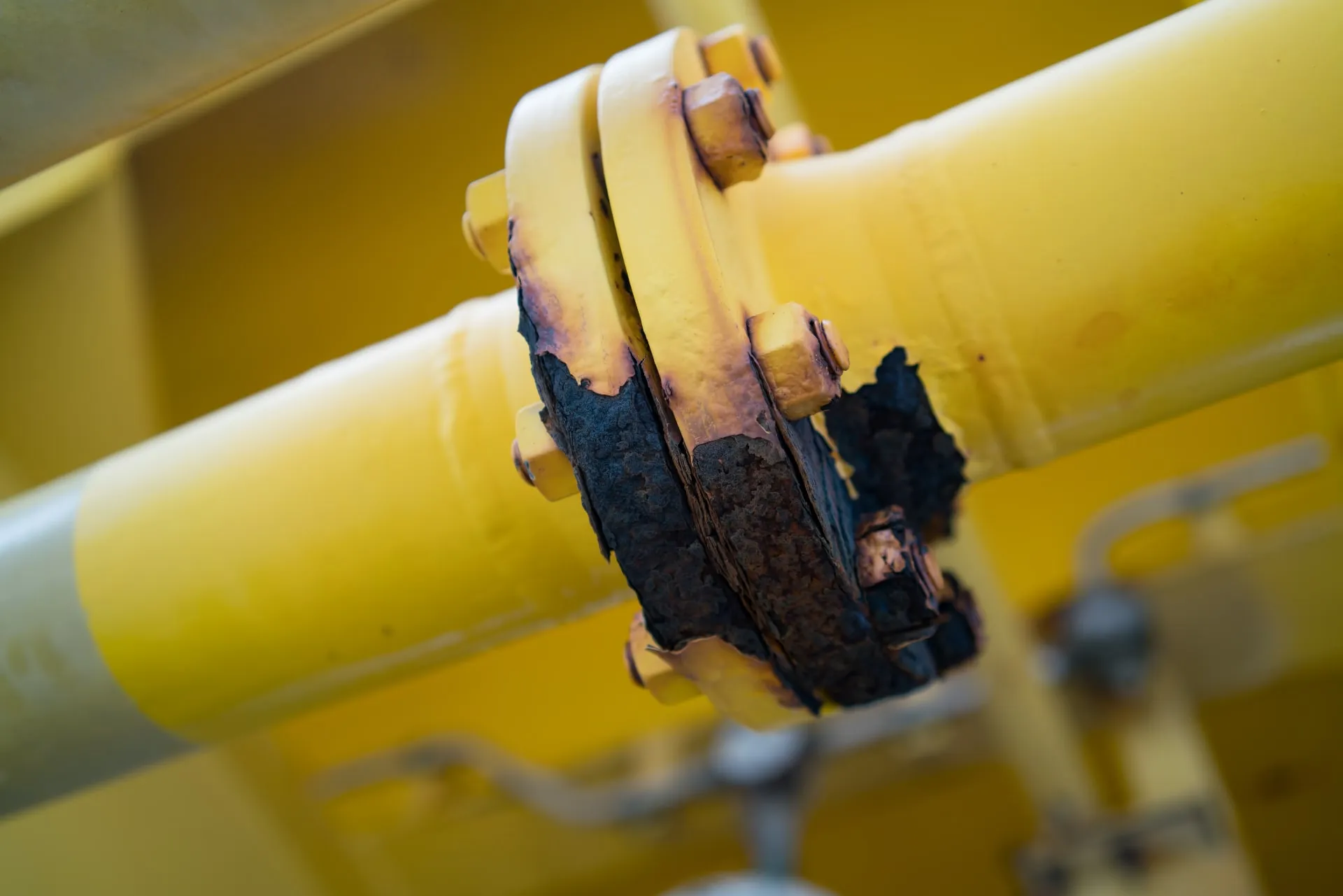
- Damage to corrosion protection coatings: Flaking, cracking, undercut corrosion – all visible in 4K from a safe distance. The Matrice 30T gets close enough to characterise the damage.
- Corrosion at weld seams: Preferred attack points for galvanic corrosion and stress corrosion cracking. 4K close-ups allow differentiation between surface corrosion and crack-relevant findings.
Internal Corrosion Inspection (ELIOS 3)
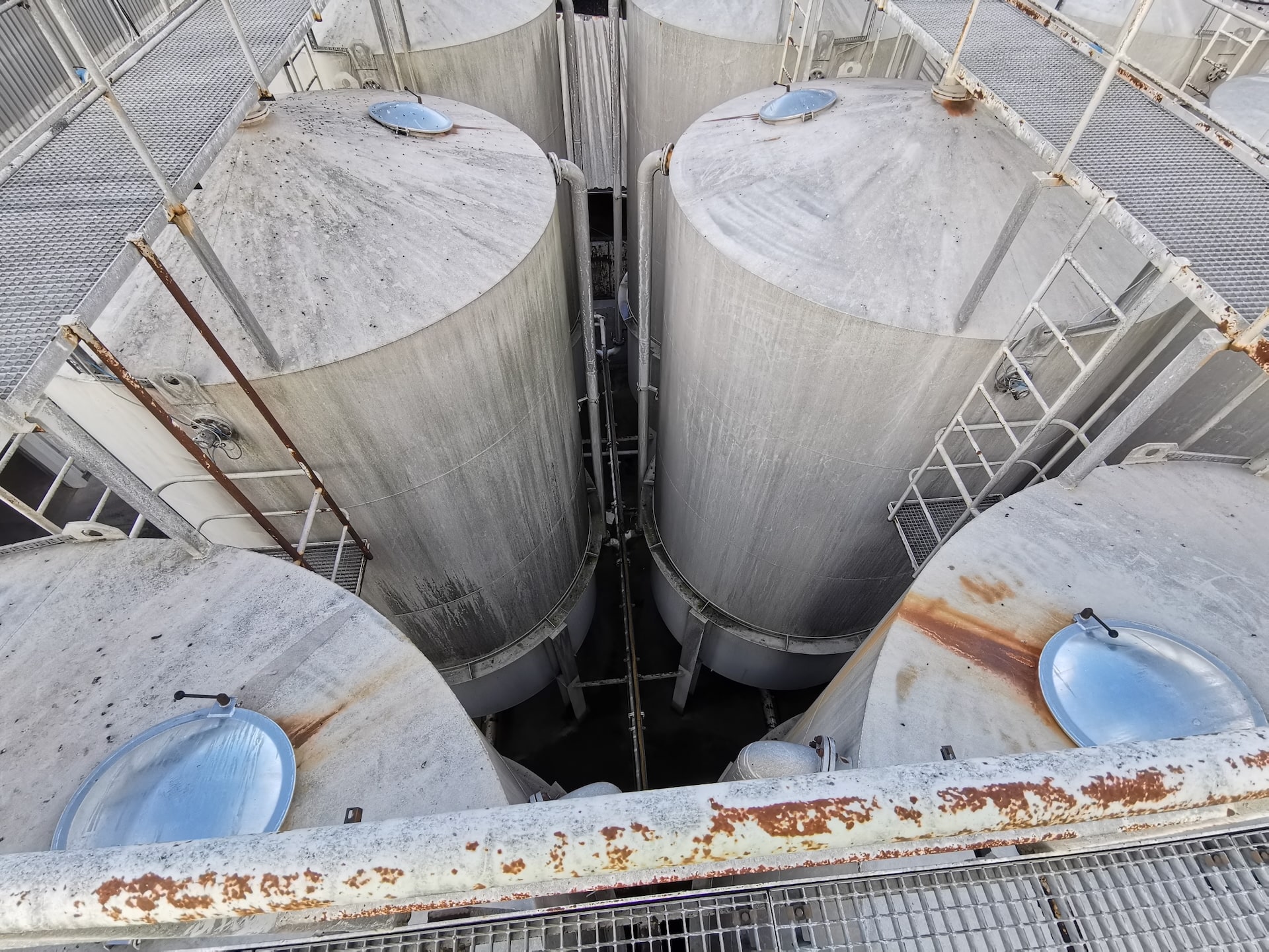
- Inner wall corrosion in tanks, boilers, columns: The ELIOS 3 documents the entire internal surface completely. Corrosion pits, uniform surface corrosion and pitting are recognisable in 4K.
- Floor corrosion in storage tanks: Particularly critical in flat-bottom tanks – the floor is the most vulnerable zone. The ELIOS 3 flies close above the floor and documents pitting and corrosion zones.
- Condensate corrosion in chimneys and flue ducts: Below the acid dew point temperature, aggressive sulphuric acid forms – the drone recognises the characteristic damage patterns.
CUI – Corrosion Under Insulation: The Hidden Problem
Corrosion Under Insulation (CUI) is one of the most dangerous and costly corrosion mechanisms in process plants. Under the thermal insulation (mineral wool, foam, mineral wool), moisture accumulates – either from rainwater, condensation or process steam. The moist, oxygen-rich environment between the steel pipe and insulation creates ideal corrosion conditions invisible from outside.
Why CUI is So Dangerous
CUI develops under the insulation over years before becoming externally visible. When corrosion first becomes visible through rust-coloured efflorescence on the insulation surface or through wall breakthrough, the damage is often already well advanced. Wall thickness losses of 50–80% without any external warning signal are not uncommon.
Normatively, CUI is regulated in API 571 (Damage Mechanisms Affecting Fixed Equipment in the Refining Industry) and API 583 (Corrosion Under Insulation and Fireproofing). The latter describes risk factors and inspection strategies in detail.
CUI Detection with Thermography Drone
The most effective non-destructive detection of CUI is active or passive thermography. The basic principle: moist insulation has different thermal conductivity from dry insulation. This difference creates measurable temperature differences on the insulation surface that can be captured with a thermal camera.
- Passive thermography during operation: Most effective for pipelines and vessels in normal operation with a temperature differential to the environment (>10 K). Hot processes create strong thermal gradients that are disturbed by moisture locations. The DJI Matrice 30T with FLIR radiometry camera scans long pipelines in a single overflight.
- Identifying suspect zones: Thermography shows where moisture is present in the insulation – not how much wall thickness remains. For wall thickness measurement, subsequent ultrasonic testing (UT) with local removal of insulation is required.
The combination of thermography drone (identifying suspect zones) and spot UT measurement by climbers or after insulation removal is the most efficient strategy for large-scale pipeline systems.
Coating Inspection: Documenting Protective Coatings
The first corrosion protection of a steel structure is its coating. The service life of corrosion protection coatings in industry typically ranges from 10–25 years – depending on coating system, substrate preparation and environmental stress. Regular inspection of coating condition enables timely remediation before the steel beneath is attacked.
Typical Coating Defects and Their Detectability by Drone
- Blistering: Pressure blisters under the coating through osmotic moisture ingress. Well recognisable in 4K recordings from approx. 5 mm diameter.
- Delamination/Peeling: Adhesion failure, often at edges, weld seams and rivets. Area and depth of detachment well documentable.
- Cracking: Ageing cracks in the topcoat through to cohesive cracks from thermal stresses. Detectable from approx. 0.3 mm width in close-up shots.
- Undercutting: Corrosion spreading under intact coating – recognisable by rust-orange discolouration and lifting.
- Chalking: Photochemical degradation of binder molecules at the surface – visually recognisable as a matte, chalky surface.
Coating Degree and Defect Classes per ISO 4628
Assessment of corrosion protection coatings is carried out according to DIN EN ISO 4628 (Coating defects, assessment of quantity and size of defects). Defect grades 0 (no damage) to 5 (very severe damage) are assessed using photographic atlases. Drone 4K recordings deliver sufficient image quality for this assessment – provided the distance to the surface is less than 1 metre.
Wall Thickness Estimation from Drone Data: Possibilities and Limits
A frequently asked question from operators: “Can the drone measure wall thickness?” The answer: No – not directly. But a substantiated estimate is possible.
What LiDAR Data Can Say About Wall Thickness
The LiDAR scanner of the ELIOS 3 generates a 3D point cloud of the internal geometry. If the external geometry of the vessel is known (from technical drawings or an external LiDAR scan with the DJI Matrice 30T), the difference between internal and external geometry can be used as an approximation of the current wall thickness.
Limitations of this method:
- LiDAR accuracy of the ELIOS 3: ±3 cm – completely inadequate for wall thickness measurements on thin-walled pipelines (5–20 mm)
- Useful for thick-walled vessels with expected corrosion loss >5 cm (e.g. refractory linings in blast furnaces, concrete vessels)
- No replacement for ultrasonic wall thickness measurement (UT) per DIN EN ISO 16811
The Right Strategy: Drone for Orientation, UT for Measurement
The drone shows where corrosion is present – and thus provides a priority list for targeted UT measurements. Instead of blindly placing a UT measurement point every 2 metres, only the conspicuous areas from the drone visual inspection are measured specifically. This saves time and gives the UT inspector context for their assessment.
This combined strategy – drone for VT/thermography, climber/UT for quantitative wall thickness measurement at prioritised locations – is the current best-practice standard for corrosion monitoring in the process industry. Kopterflug coordinates the entire process including UT subcontractors on request.
Related Services



Frequently Asked Questions
What is CUI and why is it so difficult to detect?
CUI (Corrosion Under Insulation) is corrosion that develops between the steel surface of a pipe or vessel and its outer insulation – driven by moisture trapped in the insulation. It is particularly dangerous because it is invisible from outside for years. The first visible signs (rust staining on the insulation surface) typically appear only when wall thickness loss is already advanced. Thermography is the most effective non-destructive method for CUI screening.
How does thermography detect CUI?
Moist insulation conducts heat differently from dry insulation. When a pipe or vessel has a temperature differential to the environment (e.g. process temperature vs. ambient), moist insulation zones create measurable temperature anomalies on the insulation surface. The radiometric thermal camera records these anomalies and marks them as suspect zones for further investigation by UT.
Can coating damage be assessed per ISO 4628 from drone images?
Yes – provided the drone is flown at less than 1 metre from the surface. DIN EN ISO 4628 grades defects on a scale of 0–5 based on visual appearance. Our 4K footage at close range delivers the image quality needed for this classification. We provide graded coating condition assessments in our inspection reports on request.
Is drone-based CUI inspection accepted by insurance companies and testing organisations?
Increasingly yes. Thermography data from drone inspections is becoming accepted as a basis for risk assessments and inspection planning by testing organisations (TÜV, DEKRA, Bureau Veritas) and industrial insurers. We provide radiometric thermography data with temperature mapping in our reports. The quantitative UT follow-up measurement by a qualified UT inspector remains the mandatory confirmation step.
What is the combined drone + UT strategy for pipe bridges?
Step 1: The DJI Matrice 30T overflies the complete pipe bridge with thermal camera – identifying all suspect CUI zones in a single pass. Step 2: The suspect zone list is prioritised by location and temperature anomaly severity. Step 3: A UT inspector removes insulation only at the prioritised locations and measures residual wall thickness. This reduces the number of insulation removal points from hundreds (blind UT grid) to tens (targeted), saving significant time and cost.
Request a Corrosion Protection Inspection by Drone
We assess free of charge whether CUI suspect zones, external coating defects or internal corrosion in your plants can be recorded by drone – without scaffolding and without shutdown.