
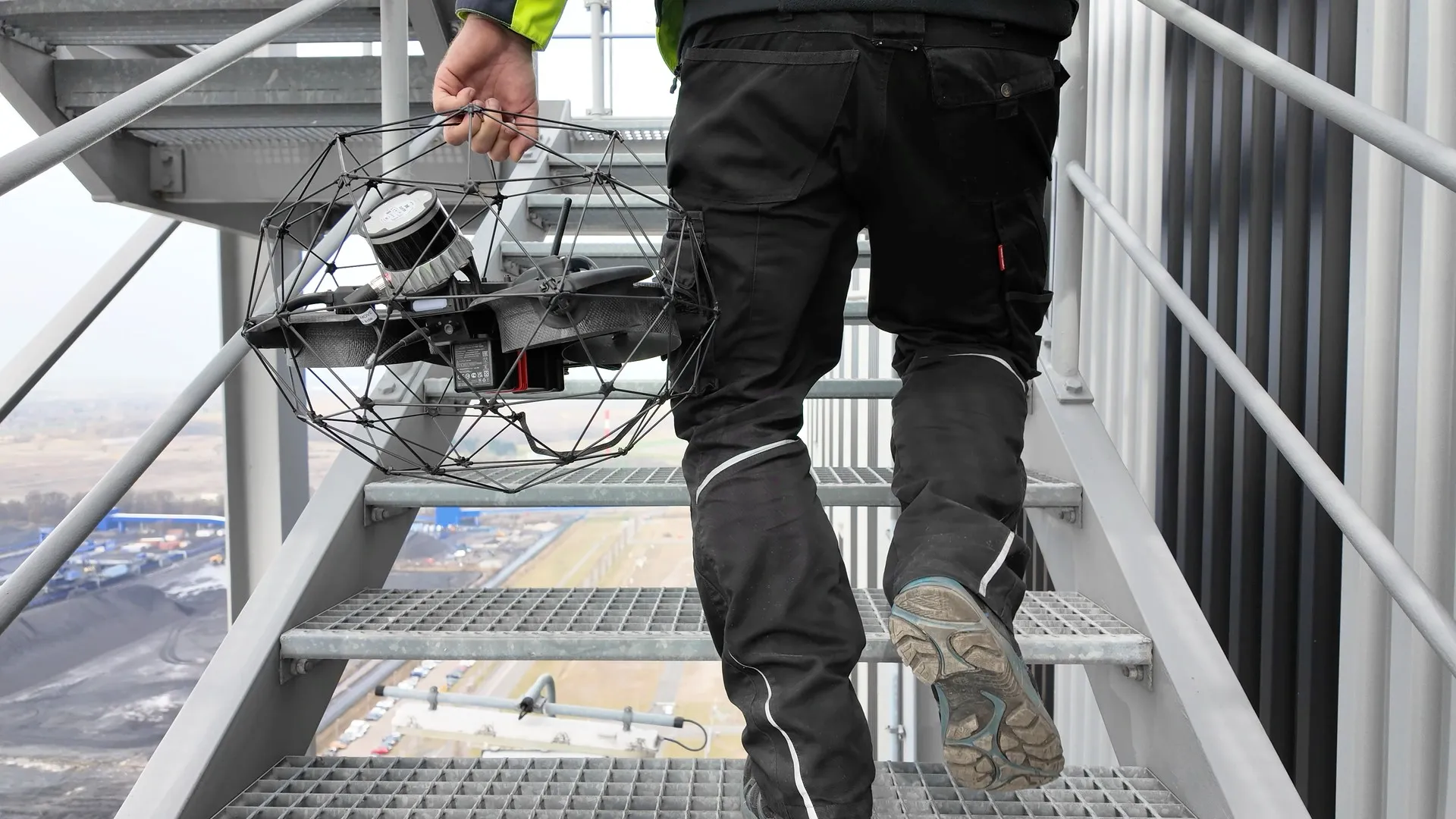
Industrial Drone Inspection – No Entry, No Scaffolding
Kopterflug deploys the Flyability ELIOS 3 for interior inspections and the DJI Matrice 30T for exterior structures – covering tanks, boilers, silos, chimneys, pipe bridges and more. No human entry into hazardous areas, no scaffolding, minimal downtime. Operating since 2017.
- No personnel entry into confined spaces
- 4K + Thermography + LiDAR in a single flight
- Cost savings up to 80% vs. conventional methods
- DGUV-compliant – no confined space entry procedures required
Flyability ELIOS 3 – The Confined Space Inspection Drone
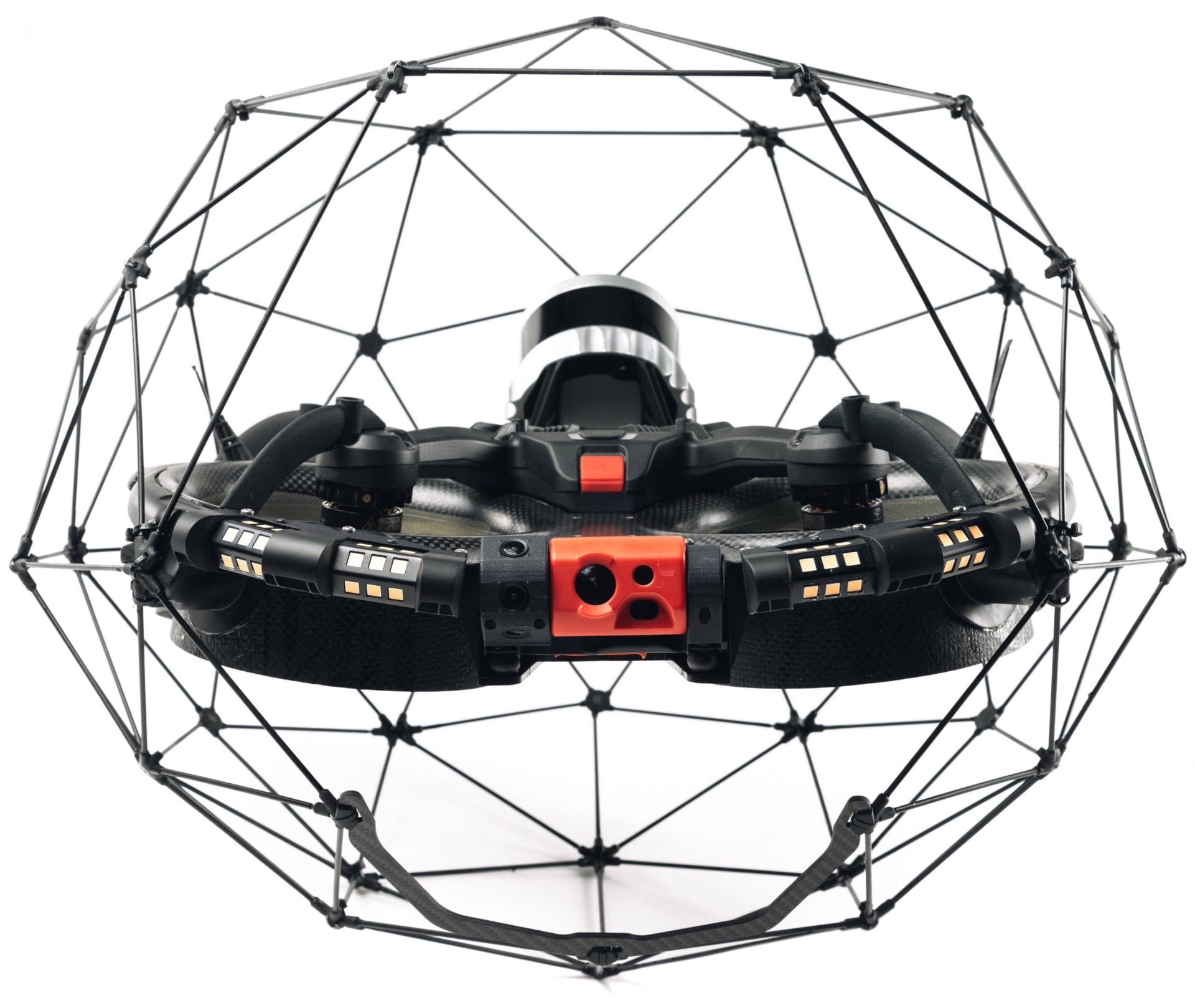
The ELIOS 3 with its collision-safe carbon cage – purpose-built for confined industrial spaces.
The ELIOS 3 is not a standard drone. It was developed specifically for hazardous, tight interior spaces – exactly where classical inspection methods fail. GPS-independent, collision-safe, LiDAR-supported: it delivers 4K video, thermography and 3D point clouds in a single flight.
- GPS-free SLAM navigation: Stable flights in tanks, boilers, silos and shafts – without any satellite signal.
- Collision-safe carbon cage: Wall contact is tolerable – the drone remains stable and continues flying. Entry from approx. DN 600.
- LiDAR 3D mapping: Precise point clouds for geometry, documentation and repeatable inspections over years.
- Thermography in confined spaces: Detection of hotspots, leaks and thermal anomalies – even in complete darkness.
- 4K documentation with 16,000 lm lighting: Clear footage even in dusty, dark and contaminated environments.
- Zero human entry: No confined space entry, no rescue chain, no risk to your personnel.
- Reproducible inspections: Saved flight paths and 3D maps allow comparison inspections over years – damage progression becomes measurable.
What Drone Inspection Really Means
The term drone inspection describes the use of remotely operated unmanned aerial systems for visual, thermographic or measurement-based condition assessment of industrial plants, infrastructure structures and technical installations. In the industrial context, this has evolved over recent years into a standalone inspection discipline – with clear application fields, defined boundaries and growing regulatory acceptance.
At its core, drone inspection solves a fundamental problem: many inspection objects are dangerous, expensive or simply impossible for humans to access. Tanks, boilers, chimneys, silos, columns, reactors, shafts – all of these require either direct personnel entry or costly scaffolding under classical approaches. Both cost time and money, and pose risks to your employees.
Confined Spaces – The Most Critical Application
Particularly critical are confined spaces: areas not designed for permanent human occupation but which must nonetheless be entered – for example for inspections. The German Industrial Safety Regulation (BetrSichV) and DGUV Rule 113-004 govern the conditions under which such entry is permissible at all, requiring extensive protective measures: gas-free measurement, rescue chain, respiratory protection, and accompanying safety personnel.
The drone eliminates this problem fundamentally: since no personnel enters the confined space, the DGUV confined space entry procedures are not required. Rescue chains, respiratory protection and escort personnel become unnecessary. Our pilots operate exclusively outside the hazardous zones.
GPS-Free Navigation as the Key Technology
What had long constrained drone inspection in industrial environments was the absence of reliable navigation without GPS. In enclosed spaces, behind thick steel walls, or deep inside vessels, no drone receives a usable satellite signal. Only with the introduction of SLAM technology (Simultaneous Localization and Mapping) combined with LiDAR sensors did a robust alternative become possible.
The Flyability ELIOS 3 uses SLAM navigation: it maps its surroundings in real time, builds a 3D map of the space and navigates on that basis – entirely GPS-independent. Simultaneously, a precise 3D point cloud is created that can be used as a digital twin of the inspected installation. These point clouds are reproducible – damage progression can be derived directly from comparing two scans taken months or years apart.
Thermography and Its Boundaries
Alongside visual inspection, the thermal camera (thermography) plays an increasingly important role. It makes temperature differences visible that indicate leaks, hotspots, corrosion under insulation (CUI) or insulation-critical defects. Important to understand: thermography is an indirect indication method. It provides leads that must be verified by further non-destructive testing (NDT) methods. No thermography finding replaces a material test.
For exterior inspections, Kopterflug deploys the DJI Matrice 30T – an industrial drone with 200x hybrid zoom and an integrated radiometric thermal camera. It inspects pipe bridges, flares, chimney facades and open structures from a safe distance, during live operations and without scaffolding. The combination of ELIOS 3 (interior) and Matrice 30T (exterior) enables a complete plant inspection in a single deployment.
When Drone Inspection Excels
Drone inspection is not a universal remedy. It solves certain problems very effectively – others not at all. Knowing the strengths and limits allows you to deploy the technology effectively.
No Entry Is the Problem
When personnel entry is the actual problem, the drone is often the most economical solution. Confined space inspections with full entry organization are personnel-intensive and risk-prone. Drone inspections reduce this overhead to a minimum – and eliminate personnel risk in the hazardous zone entirely.
No Scaffolding or Rope Access
When scaffolding or rope access techniques need to be avoided, the drone wins clearly. For exterior structures like chimneys, pipe bridges, elevated tanks and flares, classical inspection often means weeks of setup time and considerable cost. The drone needs no support structure.
Minimal Downtime
When downtime must be minimized, the drone is virtually unbeatable. Plants that would need to stand idle for weeks or months under a classical inspection regime can be captured in hours with a drone. For production facilities with tight maintenance windows, this is a decisive factor.
Condition-Based Maintenance
When a condition-based maintenance strategy is being built, the drone delivers the data foundation through 3D point clouds and reproducible flight paths. Damage progression becomes measurable and comparable across inspection cycles – a basis for predictive maintenance strategies.
When Drone Inspection Is NOT the Right Choice
Contact-Based NDT Methods
Contact-bound non-destructive testing (e.g., ultrasonic wall thickness measurement with direct material contact, magnetic particle testing, dye penetrant testing) cannot be replaced by the drone alone. Exception: the optional Cygnus UT payload for the ELIOS 3 enables geo-referenced ultrasonic wall thickness measurements in flight – a special case.
Very Narrow Openings Below ~50–60 cm
Very narrow openings below approximately 50–60 cm diameter generally exclude ELIOS 3 deployment. Very long, tight runs without intermediate access points can also be problematic.
Mandatory Expert Inspections
Legally mandated inspections by certified inspectors (e.g., ZÜS inspections under BetrSichV) can be supplemented by drones but cannot be replaced. The inspector must conduct the examination personally – but can use our documentation as a basis and follow the drone flight live. Many clients use this approach: the drone provides the overall picture, the inspector focuses on critical areas.
Working with Certified Inspectors
Kopterflug works regularly with TÜV, DEKRA and licensed inspection engineers. Our inspection documentation – 4K footage, thermography images, 3D point clouds – is structured so that inspectors can assess and decide confidently on this basis. In many cases the inspector is on site during the drone flight, following the inspection in real time via live feed.
This model combines the reach and safety of the drone with the normative expertise of the inspector. The result: inspections that are both technically and regulatorily sound – without compromises on completeness or documentation quality.
Complementary Systems: Exterior & Underwater
The ELIOS 3 is our primary system for interior spaces and confined spaces. For exterior areas and underwater, we deploy additional systems depending on the task.
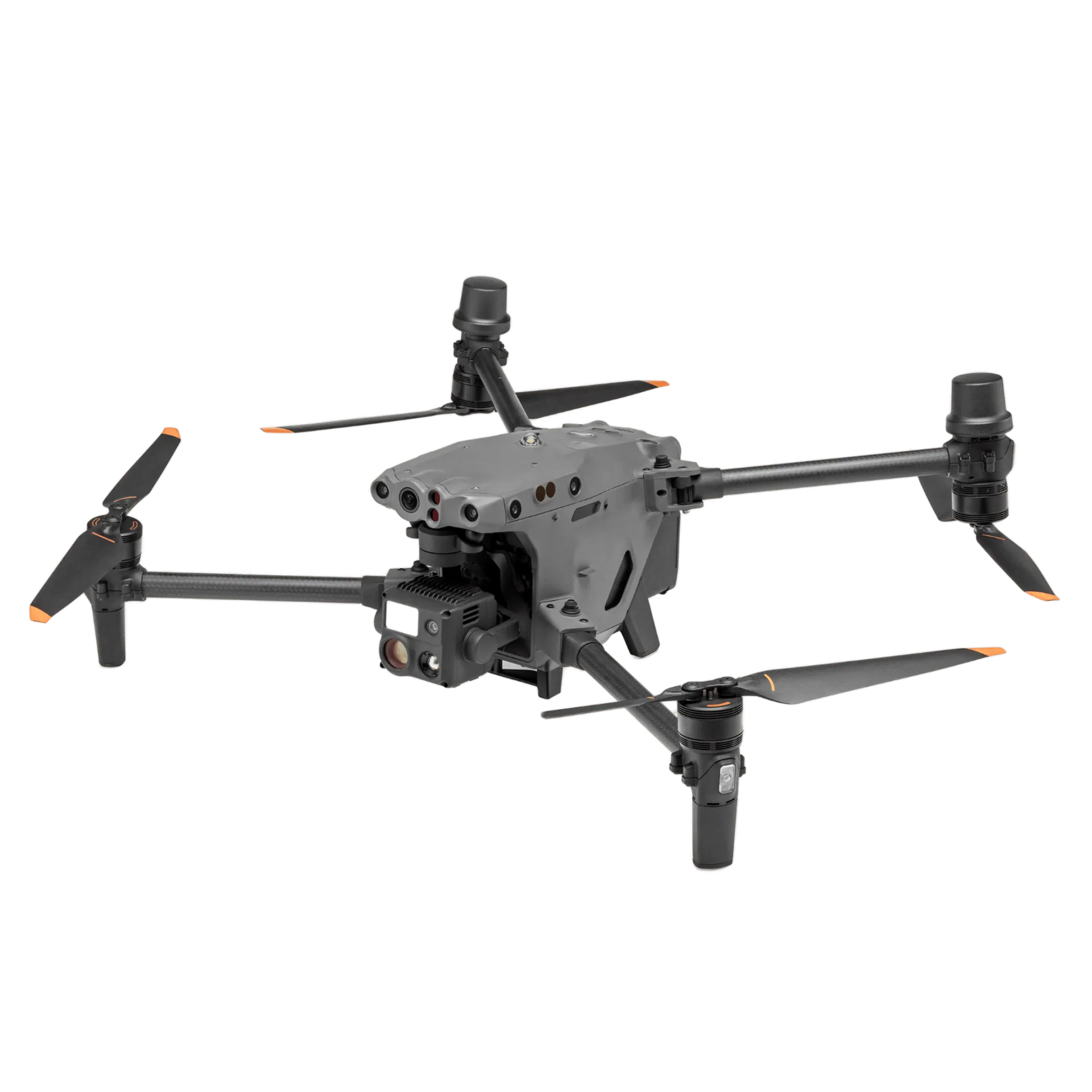
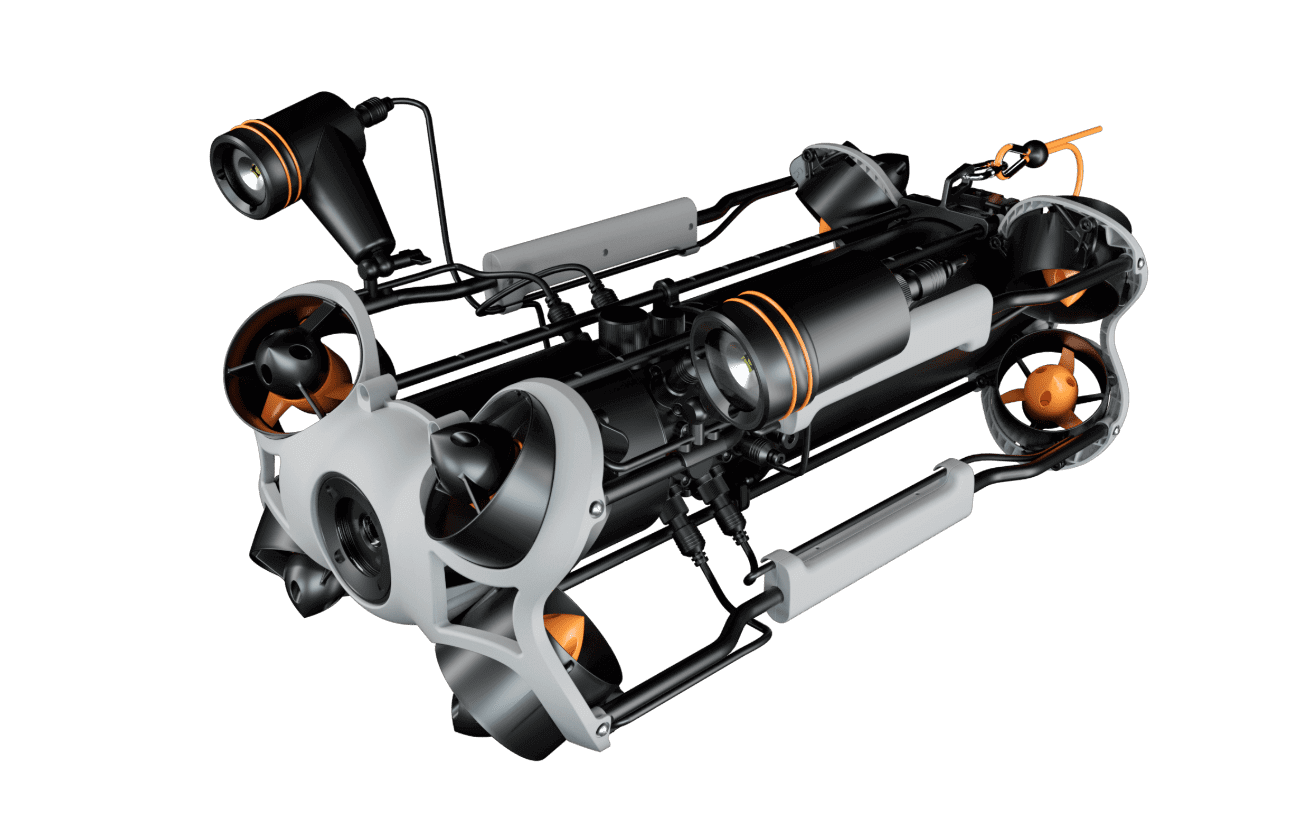
In combination: the ELIOS 3 handles confined spaces, the Matrice 30T covers exterior areas from a safe distance, and the ROV inspects underwater zones. Together they form a complete inspection system that covers virtually every industrial plant – inside and outside, in one deployment.
Drone Inspection by Industry Sector
Kopterflug has been active across many industries since 2017. Every sector has its own requirements – here is an overview of the 17 sectors we serve:




Team, Safety & DGUV Compliance
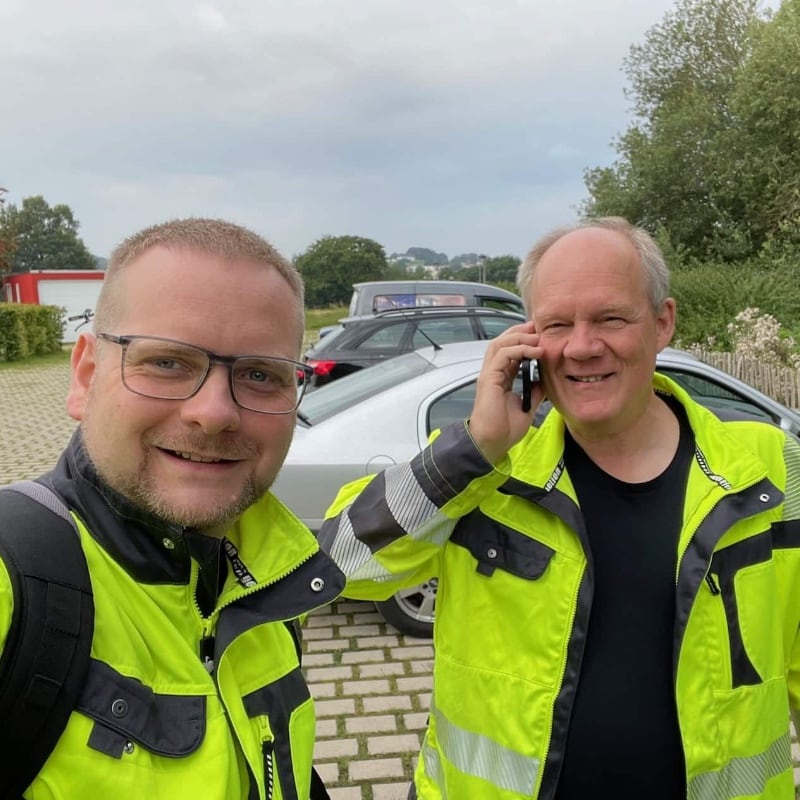
Christian Engelke and Dipl.-Ing. Karsten Lehrke – Kopterflug inspection team in the field since 2017.
Kopterflug operates in a standard team of two (pilot and assistant) with its own safety concept – for select assignments also in teams of three. Before every deployment we perform a gas-free measurement with our multi-gas sensor (O⊂2;, LEL, H⊂2;S, CO).
- DGUV-compliant: Since no personnel enters the confined space, DGUV confined space entry procedures (rescue chain, respiratory protection, gas measurement escort) do not apply. Operational safety clearances from your plant remain required as standard.
- ATEX (explosion protection): The ELIOS 3 is not ATEX-certified. Deployment in potentially explosive atmospheres is only permissible after confirmed gas-free measurement and a corresponding operational permit. With the optional flammable gas sensor, the drone can monitor gas levels during flight and withdraw if thresholds are exceeded.
- Certified pilots: All pilots hold EU drone licences (A2). A safety concept is created before every deployment.
- Collaboration with certified inspectors: We coordinate regularly with TÜV, DEKRA and licensed inspection engineers. Our documentation is structured so that inspectors can assess and decide on this basis – in many cases the inspector is on site and follows the inspection via live feed in real time.
4-Step Workflow
Step 1: Initial Consultation (free)
We analyze your requirements and advise you free of charge on all technical and organizational questions – which assets, what frequency, which sensors, what data do you need?
Step 2: Scheduling & Quotation
You receive a transparent quotation. Together we plan the timing, access and safety concept – coordinated with your maintenance windows and shutdown plan.
Step 3: On-Site Inspection
We carry out the inspection with state-of-the-art drone technology – typically within a few hours. Standard team of pilot and assistant with their own safety concept. No scaffolding, no confined space entry preparation required on your side.
Step 4: Evaluation & Inspection Report
You receive a detailed report with 4K footage and position-referenced findings, thermography evaluation with anomaly descriptions, 3D LiDAR point clouds (where deployed), and a systematic findings list by severity with action recommendations. No uncontextualized video – every finding is traceably located. Delivered within a few working days.
Drone Inspection vs. Classical Methods
| Aspect | Classical (scaffolding / climbers / entry) | Drone Inspection |
|---|---|---|
| Personnel entry | Required – DGUV (German statutory accident insurance) confined space entry, rescue chain, respiratory protection | No entry – no rescue team, no confined space procedures |
| Access | Scaffolding, elevated platform or industrial climbers | Direct flight – no scaffolding, no climbers |
| Downtime | 2–4 weeks | Often less than 1 day |
| Preparation | Weeks of lead time: scaffolding construction, permits, cleaning | Coordination in a few days |
| Documentation | Photos by technician, patchy coverage | 4K full coverage, thermography, LiDAR – reproducible |
| Result | Subjective technician report, not repeatable | Structured findings report with position reference, repeatable |
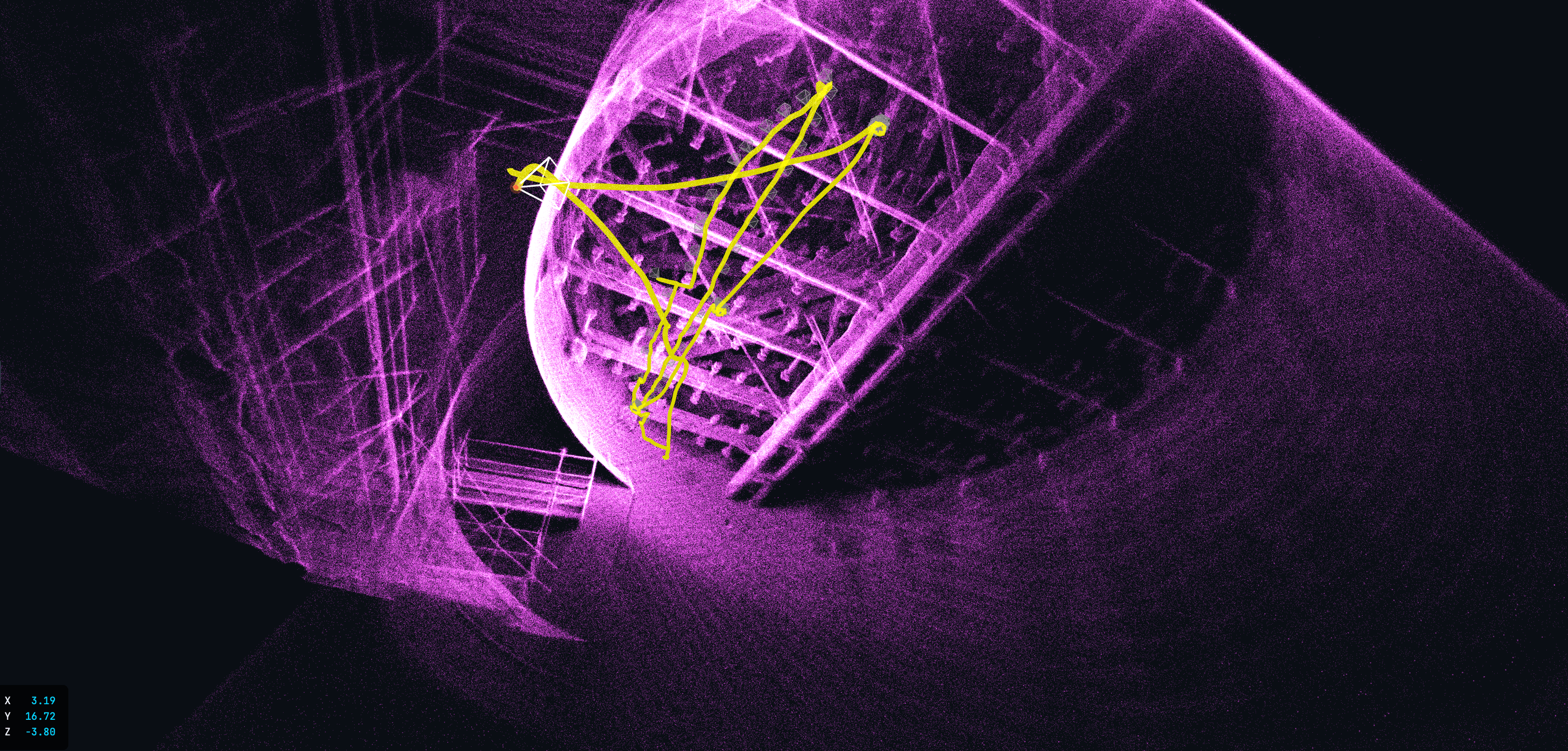
LiDAR 3D point cloud generated by the ELIOS 3 – centimeter-accurate geometry data for documentation and digital twins.
Key Advantages
- No personnel entry: Dramatically reduced risk for your employees. No DGUV (German statutory accident insurance) confined space procedures, no rescue chains. The drone flies in – your team stays outside.
- Minimal downtime: Inspections in hours instead of weeks. Maintenance windows are used optimally. Plants that would stand idle for weeks under classical approaches are captured in hours.
- Precise documentation: 3D models, thermal maps, 4K video – a solid decision basis for maintenance. Structured findings reports with position reference instead of uncontextualized video.
- Cost savings up to 80%: Compared to classical methods (scaffolding, industrial climbers, confined space entry) you save significantly on time and money – primarily through shorter downtime, fewer personnel in hazardous zones and eliminated scaffolding.
- No confined space entry procedures: Since no personnel enters the confined space, DGUV confined space entry requirements (rescue chain, respiratory protection, gas measurement escort) do not apply. Operational safety clearances remain required.
- Reproducible results: Saved flight paths allow comparison inspections over years. Damage progression – corrosion advance, deformation – becomes measurable across inspection cycles as a basis for condition-based maintenance.
Your Contacts
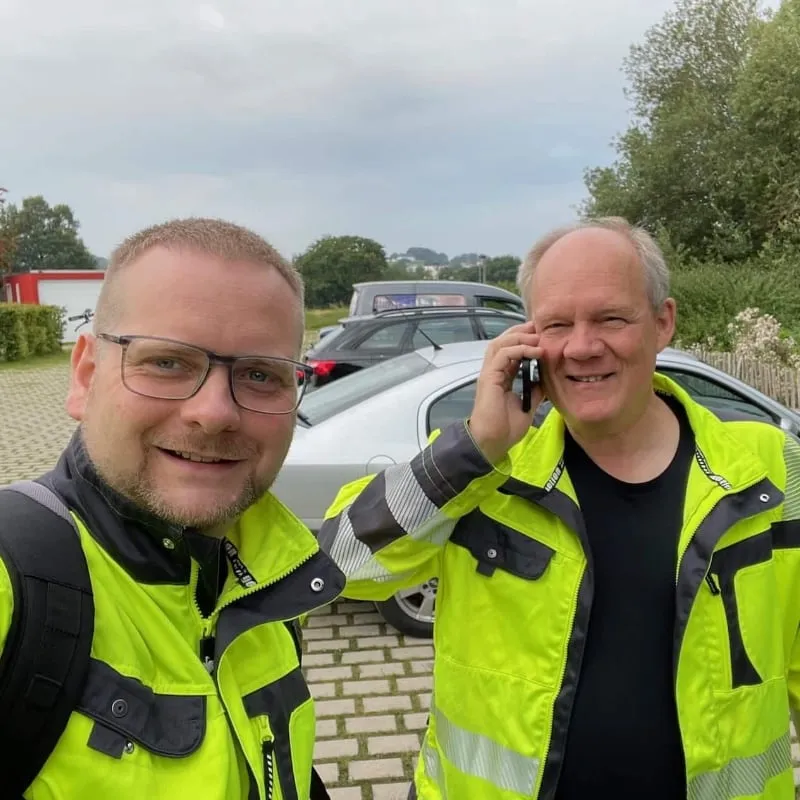
Christian Engelke and Dipl.-Ing. Karsten Lehrke – your direct contacts for drone inspection projects.
Christian Engelke and Dipl.-Ing. Karsten Lehrke are your direct contacts for technical questions – deployment planning, sensor selection, safety concepts. Since 2017, the Kopterflug team has inspected hundreds of installations: blast furnaces, tanks, silos, chimneys, pipe bridges, sprinkler tanks.
Our full team:
- Christian Engelke – Founder, drone pilot. EU-certified, 10+ years, hundreds of confined space deployments, also internationally.
- Dipl.-Ing. Karsten Lehrke – Project Manager. Mechanical engineer, project planning, industry standards.
- Juliana Engelke – ROV specialist & drone pilot. Nautical engineering background, maritime confined space experience, ELIOS 3 & underwater ROV operations.
- Philipp von der Born – Founder, operations planning & logistics. Nationwide inspection tour coordination.
- Stephan Grosser – Operations planning & logistics.
We advise without sales pressure – even if the recommendation is: commission the service rather than purchasing equipment.
Related Services
- Confined Spaces Inspection – The primary ELIOS 3 use case: tanks, boilers, silos and shafts without human entry.
- Tank Inspection – Corrosion, coating damage and wall thickness in storage and process tanks.
- Boiler Inspection – Steam boilers and pressure vessels – findings for certified inspectors without DGUV confined space entry.
- Silo Inspection – Liner damage, buildup and LiDAR volume measurement in silos.
- Flyability ELIOS 3 – The collision-safe indoor drone with 4K, LiDAR and thermography in detail.
- Industrial LiDAR Survey – 3D point clouds for plant planning, digital twins and as-built documentation.
- Underwater Inspection – Water-filled tanks, sprinkler tanks and harbour structures without divers.
- Condition Documentation – 4K video, findings list and PDF report – audit-proof documentation after every inspection.
Frequently Asked Questions
What is the Flyability ELIOS 3?
The Flyability ELIOS 3 is a drone developed specifically for interior inspections, with a fully enclosed protective cage. It navigates GPS-independently via SLAM technology and LiDAR, is collision-safe, and carries a 4K camera, thermal camera and LiDAR scanner. With 16,000 lumens of lighting, it documents every corner even in the darkest confined spaces – tanks, boilers, chimneys, silos and more.
When is the DJI Matrice 30T deployed?
The DJI Matrice 30T is our exterior drone for all areas the ELIOS 3 cannot reach: pipe bridges, flares, chimney exteriors, facades and open industrial plants. With 200x hybrid zoom it documents details from a safe distance – without elevated platforms, without climbers. The integrated radiometric thermal camera detects hotspots, leaks and corrosion under insulation (CUI). Its IP55 weather protection keeps it operational in wind and light rain – often during live operations without production stoppage. In combined deployment with the ELIOS 3, we cover the complete spectrum of an industrial plant: inside and outside, in one deployment.
Which industries does Kopterflug serve?
We inspect in all sectors with difficult-to-access or hazardous interiors: Energy and power plants, chemical industry, oil and gas, maritime, heavy industry (steel, foundries), cement plants, mining, wind energy (interior), food industry and many more. Wherever personnel entry is dangerous, expensive or impossible.
What are the advantages over classical inspection methods?
Drone inspection replaces in many cases scaffolding, rope access (industrial climbers) and personnel entry into hazardous areas. This eliminates DGUV (German statutory accident insurance) confined space entry procedures, respiratory protection and rescue chains. Your employees stay safe, downtime is dramatically reduced, and costs fall by up to 80%.
What data does an industrial inspection with the ELIOS 3 deliver?
You receive a detailed inspection report with 4K footage for visual damage documentation, LiDAR 3D point clouds for geometry measurement and digital twins, and thermography images for hotspots, leaks and insulation defects. All findings are systematically documented and geo-referenced.
How is safety ensured during drone inspection?
We operate as standard in a team of two (pilot and assistant) with our own safety concept – for select assignments also as a team of three. Before every deployment we perform a gas-free measurement with our multi-gas sensor (O⊂2;, LEL, H⊂2;S, CO). The ELIOS 3 is not ATEX-certified – a gas-free atmosphere must be confirmed. Our inspections are DGUV-compliant since no personnel enters the confined space.
What does an industrial inspection with the ELIOS 3 cost?
Costs depend on plant type, size, number of assets and required sensors. Compared to classical methods (scaffolding, industrial climbers, DGUV confined space entry), our clients typically save up to 80% of total costs. We provide a transparent, non-binding quotation after a free initial consultation.
How quickly can Kopterflug be on site?
We are available across Germany and coordinate flexibly around your maintenance windows and shutdown schedules. For acute failures or specific damage suspicions – contact us immediately. We will do everything possible to support you as quickly as possible. The earlier we can plan, the better we can accommodate your requirements.
Does Kopterflug work with TÜV, DEKRA and certified inspectors?
Yes – we coordinate regularly with TÜV, DEKRA and licensed inspectors. Our documentation is structured so that inspectors can assess and decide on the basis of our data. In many cases the inspector is present during the drone flight and follows the inspection via live feed in real time.
Can drones be used for complete plant inspections – inside and outside?
Yes – through the combination of indoor and outdoor systems, interior spaces, exterior structures and hard-to-access zones can be captured in one continuous approach. The ELIOS 3 covers confined spaces, the Matrice 30T covers exterior areas from a safe distance. Our services with both systems: Confined Spaces, Flyability ELIOS 3.
Does the drone completely replace classical inspection methods?
No – and this is an important clarification. The drone is in many cases a more efficient alternative, a useful preparation, or a valuable supplement. It does not replace all testing methods and not the assessment by certified inspectors. What it does replace: the dangerous personnel entry, the scaffolding and long downtime. More on the distinction: Confined Spaces inspection.
How much does drone inspection actually save?
The advantage arises primarily through less downtime, fewer personnel in hazardous zones and the elimination of scaffolding and access equipment. How much is saved concretely is project-specific. Flyability documents significant savings in their own case studies: Boiler Inspections and FPSO Inspection. For your plant, we are happy to advise you.
What are the specific advantages of the Matrice 30T for exterior inspections?
The DJI Matrice 30T is ideal for distance-based inspections, hard-to-reach exterior areas and live operations: 200x hybrid zoom for detail shots without close approach, radiometric thermography for CUI detection and leak finding, IP55 protection for industrial environments. Typical deployments: pipe bridges, flares, facades, chimney exteriors.
Can the Matrice 30T operate in adverse weather?
Yes, within its technical limits. The M30T is designed for industrial conditions and tolerates wind and light rain (IP55). In strong wind, thunderstorms or very poor visibility, the deployment is suspended – safety takes priority. We adapt deployment planning flexibly to your maintenance windows.
Can the ELIOS 3 perform ultrasonic wall thickness measurements (UT)?
Yes – with the optional Cygnus UT payload, the ELIOS 3 enables geo-referenced wall thickness measurements directly in flight, without personnel entry. This allows corrosion mapping in tanks, boilers and vessels. Our services: Tank Inspection, Boiler Inspection. Reference example from Flyability: Tank UT Measurement.
How long does a typical inspection take?
This depends strongly on the asset – size, access situation and the sensor package commissioned are decisive. In many cases drone inspection is significantly faster than classical methods because scaffolding construction and confined space entry preparation are eliminated. Typical: a few hours per asset. Total time on site: usually 1–4 hours.
What happens if the drone hits a wall in a tight space?
The ELIOS 3 is purpose-built for exactly these situations: the carbon protective cage absorbs light collisions, and the drone stabilizes autonomously. In the event of a flip, it returns to normal attitude independently. Reverse motors additionally enable active maneuvering free. All deployments are planned with a safety concept.
Can the drone be deployed in gas-hazardous areas?
With clear restrictions. The ELIOS 3 is not ATEX-certified – deployment requires gas-free measurement and operational clearance. Optionally, a flammable gas sensor is available that warns during flight. However, this does not replace an Ex assessment or safety clearance.
Can the Matrice 30T detect leaks or thermal anomalies?
Yes. The radiometric thermal camera of the M30T makes temperature differences visible – as an indication of leaks, CUI (corrosion under insulation) or hotspots. This is particularly valuable during live operations when access is not possible. Thermography is an indication method – it provides leads for further testing. Deployments with thermography: Pipe Bridges, Oil & Gas, Flares.
Can damage be documented and compared over several years?
Yes. Through structured, repeatable data collection, inspections can be directly compared – corrosion progression, geometry changes and new damage become measurable across multiple cycles. This forms the foundation for condition-based maintenance instead of fixed intervals. More: LiDAR Survey, Condition Documentation.
Are there limits to drone deployment in industrial plants?
Yes. Typical limits: very high temperatures (ELIOS 3 max. 50°C – the plant must have cooled down), extreme dust loading, very tight geometries below approximately 50 cm opening, and active Ex zones without gas-free measurement. For very long runs, multiple access points are used. What is still feasible, we clarify with you in advance.
How often should drone inspections be carried out?
This depends on the plant, usage intensity and regulatory requirements. Drones enable condition-based inspections: instead of fixed intervals, decisions are made on the basis of reproducible data about when a follow-up inspection makes sense. Typical: inspections during shutdowns, after events or as regular condition checks.
Why exactly this combination of ELIOS 3 and Matrice 30T?
Because they cover different requirements perfectly: the ELIOS 3 goes wherever humans cannot safely enter – tight interiors, tanks, boilers, silos. The M30T inspects everything outside from a safe distance – large structures, flares, pipe bridges, during live operations. Together they form a complete inspection system covering virtually every industrial plant.
Do you have references from different industry sectors?
Yes – we have been active across many sectors since 2017. Our industry-specific pages give an overview: Energy & Power Plants, Chemical Industry, Oil & Gas, Maritime, Tank Inspections, Cement Industry. Case studies from Flyability: Power Generation, FPSO.
When does drone inspection make sense – and when is it not the right solution?
Drone inspection makes sense when personnel entry is dangerous or complex, when downtime must be minimized, or when verifiable documentation is required. It is generally not suitable for: openings below approximately 60 cm (DN 600); active ATEX zones without gas-free measurement; when contact-bound NDT (e.g., direct-contact ultrasonic wall thickness measurement) is required; or when a legally mandated inspection by a certified inspector must take place – the drone can supplement but not replace this. When in doubt, we clarify this in a free initial consultation.
Which standards and regulations are relevant for drone inspection?
Drone inspection itself is not subject to a unified inspection standard – it is a data collection tool. The standards of the respective asset apply: e.g., BetrSichV (German Industrial Safety Regulation) and DGUV Rule 113-004 for confined spaces, API 653 or DIN EN 14015 for storage tanks, EN 12952/12953 for boilers. Since no personnel entry takes place, DGUV confined space procedures do not apply. Our documentation is structured so that it can serve TÜV, DEKRA and licensed inspectors as a basis for assessment.
What do we need to prepare for a smooth inspection?
Typically little: access to the plant (manhole, inspection opening – at least DN 600 as a guideline), information about atmospheric conditions (gas-free measurement for confined spaces), a brief safety briefing from your on-site safety officer, and – for interior inspections – a shut-down plant with sufficient cooling time. We create the safety concept ourselves and coordinate preparation with your operations team in advance.
What documentation do we receive after the inspection?
After every inspection we create a structured inspection report with: a systematic findings list by severity, 4K image sequences with position references, thermography evaluation with anomaly descriptions, and – where LiDAR was deployed – a 3D point cloud of the inspected plant. All findings are geo-referenced to the extent the geometry allows. The format is structured so that maintenance planners, engineers and certified inspectors can work with it directly.
Can the ELIOS 3 operate in environments with extreme dust loading?
Yes, within certain limits. The ELIOS 3 is designed for dusty environments (cement, lime, coal, silos) and has been deployed many times in such conditions. At very high dust concentrations that restrict visibility, image quality is reduced accordingly. In such cases we recommend inspecting as far as possible in a cleaned state or with brief pauses for dust settling. The ELIOS 3 camera lens can be cleaned on site.
What is the difference between the ELIOS 3 and a simple FPV drone in an interior space?
The difference is fundamental. FPV drones without collision protection are barely controllable in tight industrial spaces and crash on light contact. The ELIOS 3 by contrast is: fully collision-protected by a carbon cage, GPS-independent through SLAM navigation, equipped with industrial sensors (LiDAR, thermography, optional UT), and produces reproducible documentation with geo-referencing. It is a precision tool – not a consumer product.
What languages do your pilots speak – can you serve international sites?
Our team communicates in German and English. International sites within Europe are possible in principle – please contact us early so we can clarify logistics, regulations and equipment import conditions. For occasional international projects we have worked out solutions together with the client in the past.
How does drone inspection differ from ROV underwater inspection?
ROVs (Remotely Operated Vehicles) are designed for water-filled environments. We deploy the Chasing M2 Pro Max for underwater inspections – e.g., in water-filled sprinkler tanks, cooling water basins or harbour structures. The ELIOS 3 by contrast operates in air-filled confined spaces. For tanks that are still partially filled: in special cases we have combined both systems – drone in the air space, ROV in the water area. More: Underwater Inspection.
Can you create a calculation for the time saved?
Yes – and this is often the most convincing step before a first commission. If you share the key data of your plant with us (plant type, size, previous inspection method, downtime duration, trades involved), we calculate together what a drone inspection means concretely in comparison. Since we prefer not to quote blanket figures that may not apply to your situation, we carry out this step individually. Inquiries welcome by phone or contact form.
Who is liable in the event of damage?
All pilots hold the required EU drone licences (A2). A safety concept is created before every deployment, accounting for possible risks to the plant and surroundings. Damage to the drone itself falls on our risk – we plan our deployments so that recovery and securing are possible without intervention into your plant.
Get in Touch
Questions about drone inspection for your plant? Need a quotation or want to discuss technical feasibility? Fill out the form below and we will get back to you within 24 hours.